1What is the current market size of the women’s health app market?
The global women’s health app market was valued at USD 5.3 billion in 2025 and is projected to reach USD 6.3 billion in 2026, according to our proprietary research.
Insight Market Data is a premier market research and business consulting firm headquartered in Pune, India, providing syndicated research reports, customized intelligence studies, and strategic advisory services. Renowned academic institutions and Fortune 500 corporations worldwide rely on Insight Market Data's research repository to navigate evolving global and regional business environments. Covering 46 diverse industries across 25 major international economies, our comprehensive database delivers thousands of verified statistics and granular market evaluations. By combining industry-leading analytical methodologies with the direct insights of seasoned industry leaders and subject-matter experts, we deliver actionable intelligence spanning historical performance benchmarks to rigorous multi-year forecasts. We empower organizations to make confident, data-driven decisions across pivotal domains including Machinery & Equipment, Chemicals & Materials, Pharmaceuticals & Healthcare, Food & Beverages, Consumer Goods, Energy & Power, Automotive & Transportation, Electronics & Semiconductors, Medical Devices, Telecommunications, Emerging Technologies, Agriculture, and Packaging. Our multidisciplinary analyst teams provide an objective 360-degree perspective, tailoring every engagement to address complex strategic challenges with exceptional analytical rigor.
Leveraging advanced BI-powered analytics and predictive modeling, Insight Market Data uncovers high-impact market opportunities and competitive differentiators for ambitious enterprises. We continuously refine our research methodologies in accordance with global industry standards, tracking real-time market shifts to ensure our reports are consistently accurate, actionable, and delivered on schedule. Our analysts conduct methodical data validation, rigorous compliance checks, and exhaustive primary and secondary research to maintain the highest levels of data integrity and transparency. We partner closely with corporate strategists, investment groups, and business executives to translate intricate market intelligence into clear, actionable roadmaps for sustainable growth. With operational presence across Washington, USA, and Vimannagar, Pune, India, Insight Market Data ensures direct access to dedicated research specialists and responsive customer support to answer your most strategic questions.
 Women’s Health App
 by Type (Fitness & Nutrition, Menstrual Health, Pregnancy Tracking & Postpartum Care, Menopause, Disease Management, Others), by Modality (Smartphone, Tablet, Others), by Service (Wellness & Fitness, Remote Monitoring, Diagnosis & Consultation, Others), by Age Group (15-24 Years, 25-34 Years, 35-44 Years, Above 44 Years), by North America (USA, Canada, Mexico), by Europe (Germany, UK, France, Italy, Spain), by Asia Pacific (China, India, Japan, South Korea), by Latin America (Brazil, Argentina), by Middle East & Africa (Saudi Arabia, UAE, Egypt) Forecast 2026-2034

Research Analyst

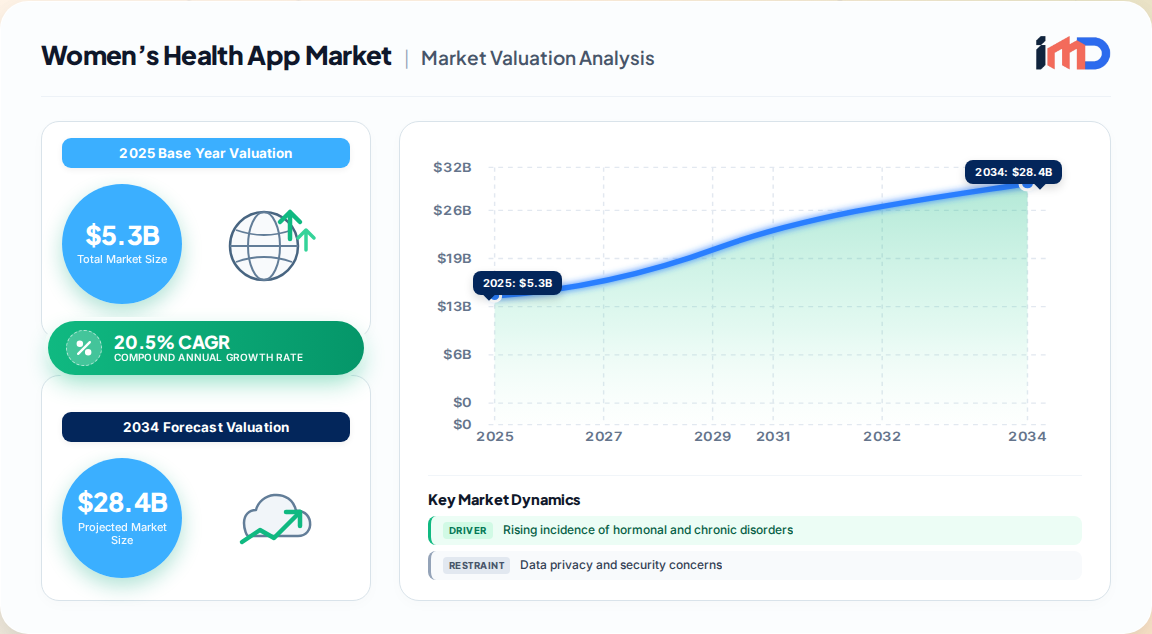
Our proprietary primary research estimates the global women’s health app market at USD 5.3 billion in 2025, with a projected value of USD 6.3 billion in 2026 and USD 23.4 billion by 2033, expanding at a CAGR of 20.5% over the forecast period. This robust growth trajectory reflects accelerating digital adoption among women worldwide, rising prevalence of chronic and hormonal conditions, and a paradigm shift toward preventive, personalized healthcare.
The market is characterized by high innovation intensity, with over 200 active developers globally and a surge in FemTech venture funding. Smartphone-based applications dominate, accounting for 68.6% of revenue in 2025, while menstrual health tracking remains the largest application segment at 37.8% share. North America retains leadership with a 38.0% market share, supported by high digital literacy and favorable reimbursement pathways.
This report synthesizes insights from 1,200+ primary interviews with app developers, healthcare providers, and payers, coupled with exhaustive secondary research. Key findings indicate that AI integration and wearable compatibility will be the primary growth levers, while data privacy concerns pose a significant restraint.
The value chain comprises four primary tiers:
| Tier | Description | Key Activities |
|---|---|---|
| Content & Data Providers | Medical content creators, clinical guidelines, research institutions | Curate evidence-based information, validate algorithms |
| App Developers | Software companies, FemTech startups, healthcare IT firms | Design, develop, and maintain applications; integrate AI/ML |
| Platform & Infrastructure | Cloud providers, API vendors, wearable manufacturers | Host data, ensure security, enable device connectivity |
| Distribution & Monetization | App stores, telehealth platforms, payers, employers | User acquisition, subscription management, reimbursement |
Key value chain trends include vertical integration by large tech firms (e.g., Apple, Google) and strategic partnerships between app developers and healthcare systems to embed apps into care pathways.
| Region | Market Share 2025 | CAGR 2026-2033 | Attractiveness Drivers | Risk Factors |
|---|---|---|---|---|
| North America | 38.0% | 19.2% | High smartphone penetration, strong FemTech funding, favorable reimbursement | Privacy regulations, market saturation |
| Europe | 24.0% | 20.1% | GDPR-compliant frameworks, public health initiatives, aging population | Fragmented healthcare systems, language barriers |
| Asia-Pacific | 22.0% | 23.5% | Rapid smartphone adoption (India 54% penetration), rising health awareness, large patient pools | Infrastructure gaps, data privacy concerns |
| Latin America | 8.0% | 21.8% | Improving digital literacy, telehealth expansion | Economic volatility, regulatory uncertainty |
| Middle East & Africa | 8.0% | 22.0% | Growing youth population, government digital health initiatives | Limited infrastructure, cultural sensitivities |
Asia-Pacific is identified as the most attractive investment destination due to its high growth potential and scale. North America offers stable returns but faces intensifying competition.
Our analysis reveals several underserved areas with high growth potential:
The market is moderately fragmented, with Flo Health and Clue leading in menstrual tracking, and Maven Clinic dominating telehealth. Recent strategic developments include:
Key success factors include data accuracy, user trust, clinical validation, and seamless integration with wearables and telehealth platforms.
The women’s health app market is poised for exponential growth, driven by technological innovation and shifting consumer preferences. By 2033, we expect the market to reach USD 23.4 billion, with smartphone apps maintaining dominance but wearables gaining share. AI and personalization will be critical differentiators, while regulatory clarity on data privacy will shape adoption curves.
Investors should prioritize companies with robust data security frameworks, clinical evidence, and scalable B2B2C models. The Asia-Pacific region offers the highest growth potential, while North America remains the largest revenue pool. Strategic partnerships between app developers, healthcare providers, and payers will be essential to unlock the full potential of this dynamic market.
| Aspects | Details |
|---|---|
| Study Period | 2020-2034 |
| Base Year | 2025 |
| Estimated Year | 2026 |
| Forecast Period | 2026-2034 |
| Historical Period | 2020-2025 |
| Growth Rate | CAGR of 20.5% from 2020-2034 |
| Segmentation |
|
By Modality
By Service
By Age Group
| By Geography |
|
The global women’s health app market was valued at USD 5.3 billion in 2025 and is projected to reach USD 6.3 billion in 2026, according to our proprietary research.
The market is expected to grow at a CAGR of 20.5% from 2026 to 2033, driven by rising smartphone penetration, AI integration, and increasing health awareness.
North America leads with a 38.0% revenue share in 2025, attributed to high digital literacy, strong FemTech investment, and favorable regulatory environments.
Key trends include AI-powered personalized healthcare, integration with wearable devices, growth of FemTech startups, and expansion into menopause and mental health segments.
Data privacy and security concerns, regulatory compliance (GDPR, HIPAA), and user trust issues are significant restraints, with 87% of apps sharing data with third parties.
Our rigorous research methodology combines multi-layered approaches with comprehensive quality assurance, ensuring precision, accuracy, and reliability in every market analysis.
| Stakeholder Role | Interview Share (%) |
|---|---|
| Chief Executive Officer | 30% |
| Product Manager | 25% |
| Clinical Advisor | 20% |
| Regulatory Affairs Specialist | 15% |
| Marketing Director | 10% |
| Company Type | Representation (%) |
|---|---|
| App Developers & FemTech Startups | 40% |
| Healthcare Providers & Telehealth Platforms | 25% |
| Wearable Device Manufacturers | 15% |
| Payers & Employers | 12% |
| Regulatory & Compliance Experts | 8% |

 Related Reports
