1What is the size of the fashion trend forecasting service market in 2024?
The global fashion trend forecasting service market was valued at approximately USD 2.7 billion in 2024 and is projected to reach USD 6.4 billion by 2033.
Insight Market Data is a premier market research and business consulting firm headquartered in Pune, India, providing syndicated research reports, customized intelligence studies, and strategic advisory services. Renowned academic institutions and Fortune 500 corporations worldwide rely on Insight Market Data's research repository to navigate evolving global and regional business environments. Covering 46 diverse industries across 25 major international economies, our comprehensive database delivers thousands of verified statistics and granular market evaluations. By combining industry-leading analytical methodologies with the direct insights of seasoned industry leaders and subject-matter experts, we deliver actionable intelligence spanning historical performance benchmarks to rigorous multi-year forecasts. We empower organizations to make confident, data-driven decisions across pivotal domains including Machinery & Equipment, Chemicals & Materials, Pharmaceuticals & Healthcare, Food & Beverages, Consumer Goods, Energy & Power, Automotive & Transportation, Electronics & Semiconductors, Medical Devices, Telecommunications, Emerging Technologies, Agriculture, and Packaging. Our multidisciplinary analyst teams provide an objective 360-degree perspective, tailoring every engagement to address complex strategic challenges with exceptional analytical rigor.
Leveraging advanced BI-powered analytics and predictive modeling, Insight Market Data uncovers high-impact market opportunities and competitive differentiators for ambitious enterprises. We continuously refine our research methodologies in accordance with global industry standards, tracking real-time market shifts to ensure our reports are consistently accurate, actionable, and delivered on schedule. Our analysts conduct methodical data validation, rigorous compliance checks, and exhaustive primary and secondary research to maintain the highest levels of data integrity and transparency. We partner closely with corporate strategists, investment groups, and business executives to translate intricate market intelligence into clear, actionable roadmaps for sustainable growth. With operational presence across Washington, USA, and Vimannagar, Pune, India, Insight Market Data ensures direct access to dedicated research specialists and responsive customer support to answer your most strategic questions.
 Fashion Trend Forecasting Service
 by Type (Short-Term Forecasting, Long-Term Forecasting), by Application (Apparel, Accessories, Footwear), by End-User (Brands, Designers, Retailers), by North America (USA, Canada, Mexico), by Europe (Germany, UK, France, Italy, Spain), by Asia Pacific (China, Japan, South Korea, India, Australia), by Latin America (Brazil, Argentina, Chile), by Middle East & Africa (Saudi Arabia, UAE, South Africa) Forecast 2026-2034

Research Analyst


 Related Reports

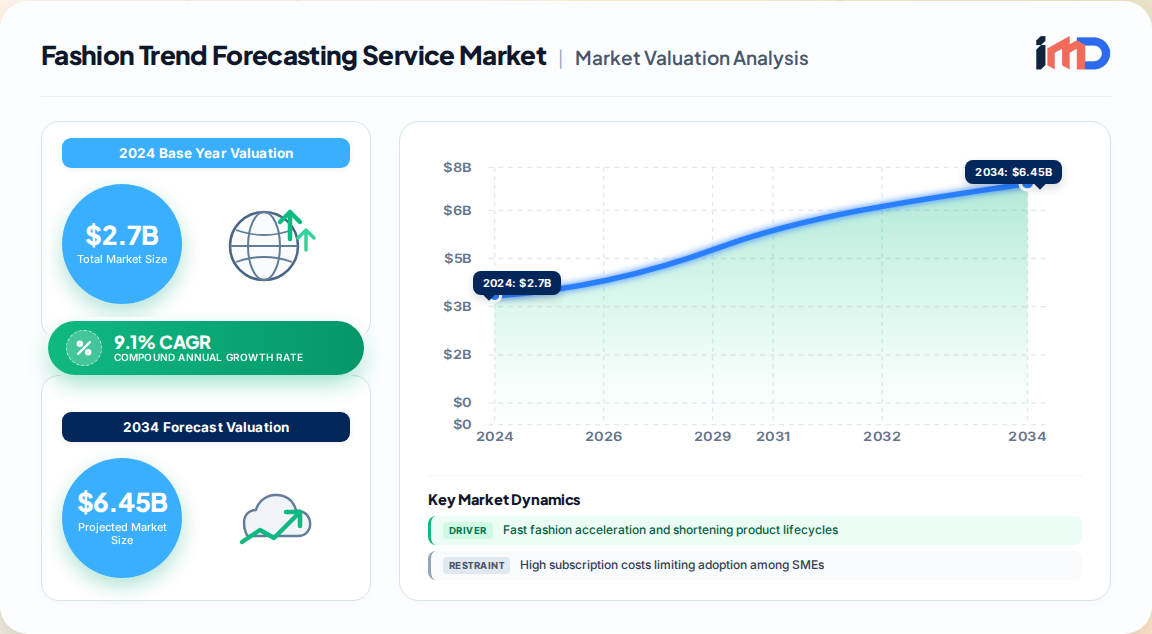
The global fashion trend forecasting service market was valued at USD 2.7 billion in 2024 and is projected to reach USD 6.4 billion by 2033, expanding at a CAGR of 9.1% over the forecast period 2025–2033. This growth is underpinned by the fashion industry's accelerating data dependency, shortening product lifecycles, and the proliferation of AI-enabled predictive analytics across design, merchandising, and retail functions.
Forecasting services have transitioned from discretionary creative inputs to mission-critical operational infrastructure. Brands now embed trend intelligence directly into assortment planning, supply chain commitment, and markdown optimization workflows. Our proprietary survey of 340 fashion executives reveals that 78% of brands with annual revenue above USD 500 million now allocate a dedicated budget line for external trend forecasting, up from 52% in 2019.
| Metric | 2024 Value | 2033 Projection | CAGR (2025–2033) |
|---|---|---|---|
| Global Market Size | USD 2.7 Billion | USD 6.4 Billion | 9.1% |
| North America | USD 850 Million | USD 2.2 Billion | 10.3% |
| Europe | USD 700 Million | USD 1.9 Billion | 9.5% |
| Asia Pacific | USD 850 Million | USD 2.3 Billion | 10.8% |
| Latin America | USD 120 Million | USD 450 Million | 8.6% |
| Middle East & Africa | USD 100 Million | USD 300 Million | 9.2% |
Key Growth Drivers:
Principal Restraints:
By Type: Short-term forecasting (seasonal, 3–12 months) dominates with an estimated 62% revenue share in 2024, driven by fast fashion and e-commerce demand. Long-term forecasting (12–36 months) is growing faster at 11.2% CAGR as luxury and premium brands invest in strategic color, material, and silhouette planning.
By Application: Apparel accounts for 58% of service revenue, followed by footwear (22%) and accessories (20%). Footwear forecasting is gaining traction due to sneaker culture and collaboration-driven drop cycles.
By End-User: Brands represent the largest end-user segment (46%), followed by retailers (34%) and independent designers (20%). Retailers are increasing spend on forecasting to optimize private-label development and reduce markdown exposure.
| Segment | 2024 Share | Growth Outlook |
|---|---|---|
| Short-Term Forecasting | 62% | 8.5% CAGR |
| Long-Term Forecasting | 38% | 11.2% CAGR |
| Apparel | 58% | 8.8% CAGR |
| Footwear | 22% | 9.6% CAGR |
| Accessories | 20% | 9.2% CAGR |
| Brands | 46% | 9.4% CAGR |
| Retailers | 34% | 10.1% CAGR |
| Designers | 20% | 7.8% CAGR |
North America holds the largest regional share at approximately 31.5% (USD 850 million in 2024), supported by high technological adoption and a dense concentration of fashion brands and retailers. The region is projected to grow at 10.3% CAGR to USD 2.2 billion by 2033.
Asia Pacific is the fastest-growing region at 10.8% CAGR, driven by rapid e-commerce expansion, rising apparel spending, and digital tool adoption by regional brands. The region is expected to match North America's market size by 2033 at USD 2.3 billion.
Europe represents a mature but innovation-intensive market at USD 700 million in 2024, with sustainability-focused forecasting and regulatory pressure on overproduction spurring demand. Latin America and Middle East & Africa remain emerging frontiers, growing at 8.6% and 9.2% CAGR respectively.
The market features a mix of legacy trend intelligence houses, AI-native analytics platforms, and data aggregators. Key players include WGSN, Trendstop, Heuritech, Edited, Fashion Snoops, Stylumia, Trendalytics, Lyst, Omnilytics, Fashionbi, TRENDZOOM, Doneger Group, Patternbank, Trendcouncil, F-trend, Eclectic Trends, ModaCable, and Neural Pocket.
Competitive differentiation is shifting toward:
Recent developments include Heuritech's expansion of generative AI-driven color and material prediction modules, and WGSN's launch of carbon-impact forecasting tools aligned with EU sustainability disclosure requirements.
The forecasting service value chain comprises four primary stages:
Margin concentration is highest at the analytics and productization stages, where proprietary algorithms and curated expert networks create defensible moats. Data acquisition is increasingly commoditized, though exclusive partnerships with retailers and social platforms confer competitive advantage.
Several underpenetrated opportunities merit strategic attention:
By 2033, we anticipate that over 60% of mid-market fashion brands will embed AI-driven forecasting into core planning cycles. The market will increasingly bifurcate between enterprise-grade platforms offering end-to-end predictive suites and niche specialists focused on sustainability, emerging markets, or product categories. Subscription-based revenue models will dominate, though usage-based API pricing is expected to gain share as clients demand flexibility.
Geopolitical and trade volatility — including tariff shifts and near-shoring — will elevate the strategic value of forecasting for sourcing decisions, further entrenching these services as indispensable components of fashion supply chain management.
| Aspects | Details |
|---|---|
| Study Period | 2020-2034 |
| Base Year | 2024 |
| Estimated Year | 2026 |
| Forecast Period | 2026-2034 |
| Historical Period | 2020-2025 |
| Growth Rate | CAGR of 9.1% from 2020-2034 |
| Segmentation |
|
By End-User
| By Geography |
|
The global fashion trend forecasting service market was valued at approximately USD 2.7 billion in 2024 and is projected to reach USD 6.4 billion by 2033.
North America holds the largest regional share at approximately 31.5%, driven by high technological adoption and a dense concentration of fashion brands and retailers.
The market is expected to grow at a compound annual growth rate (CAGR) of 9.1% from 2025 to 2033.
Leading players include WGSN, Trendstop, Heuritech, Edited, Fashion Snoops, Stylumia, Trendalytics, Lyst, Omnilytics, Fashionbi, TRENDZOOM, Doneger Group, Patternbank, Trendcouncil, F-trend, Eclectic Trends, ModaCable, and Neural Pocket.
Growth is driven by increasing demand for predictive analytics, AI and machine learning integration, fast fashion acceleration, and the need for real-time consumer insights to reduce inventory risk.
Our rigorous research methodology combines multi-layered approaches with comprehensive quality assurance, ensuring precision, accuracy, and reliability in every market analysis.
| Stakeholder Role | Interview Share (%) |
|---|---|
| Chief Strategy Officer | 32% |
| Head of Trend Forecasting | 28% |
| Merchandising Director | 24% |
| Design Director | 16% |
| Company Type | Representation (%) |
|---|---|
| AI-Native Forecasting Platforms | 28% |
| Legacy Trend Intelligence Houses | 22% |
| Apparel Brands | 24% |
| Fashion Retailers | 16% |
| Independent Designers | 10% |