1How big is the Australian hair care market?
The Australian hair care market is valued at USD 1.76 billion in 2026 and is projected to reach USD 2.14 billion by 2031, growing at a CAGR of 3.91%.
Insight Market Data is a premier market research and business consulting firm headquartered in Pune, India, providing syndicated research reports, customized intelligence studies, and strategic advisory services. Renowned academic institutions and Fortune 500 corporations worldwide rely on Insight Market Data's research repository to navigate evolving global and regional business environments. Covering 46 diverse industries across 25 major international economies, our comprehensive database delivers thousands of verified statistics and granular market evaluations. By combining industry-leading analytical methodologies with the direct insights of seasoned industry leaders and subject-matter experts, we deliver actionable intelligence spanning historical performance benchmarks to rigorous multi-year forecasts. We empower organizations to make confident, data-driven decisions across pivotal domains including Machinery & Equipment, Chemicals & Materials, Pharmaceuticals & Healthcare, Food & Beverages, Consumer Goods, Energy & Power, Automotive & Transportation, Electronics & Semiconductors, Medical Devices, Telecommunications, Emerging Technologies, Agriculture, and Packaging. Our multidisciplinary analyst teams provide an objective 360-degree perspective, tailoring every engagement to address complex strategic challenges with exceptional analytical rigor.
Leveraging advanced BI-powered analytics and predictive modeling, Insight Market Data uncovers high-impact market opportunities and competitive differentiators for ambitious enterprises. We continuously refine our research methodologies in accordance with global industry standards, tracking real-time market shifts to ensure our reports are consistently accurate, actionable, and delivered on schedule. Our analysts conduct methodical data validation, rigorous compliance checks, and exhaustive primary and secondary research to maintain the highest levels of data integrity and transparency. We partner closely with corporate strategists, investment groups, and business executives to translate intricate market intelligence into clear, actionable roadmaps for sustainable growth. With operational presence across Washington, USA, and Vimannagar, Pune, India, Insight Market Data ensures direct access to dedicated research specialists and responsive customer support to answer your most strategic questions.
 Australian Hair Care Industry
 by Product Type (Shampoo, Conditioner, Hair Masks, Styling Products, Hair Color, Hair Oils, Hair Serums), by Category (Organic, Conventional), by Price Range (Mass, Luxury/Premium), by Distribution Channel (Supermarkets/Hypermarkets, Convenience Stores, Health and Wellness Stores, Online Retail, Pharmacies, Specialty Stores, Salons), by New South Wales, by Victoria, by Queensland, by Western Australia, by South Australia, by Tasmania, by Australian Capital Territory, by Northern Territory Forecast 2026-2034

Research Analyst


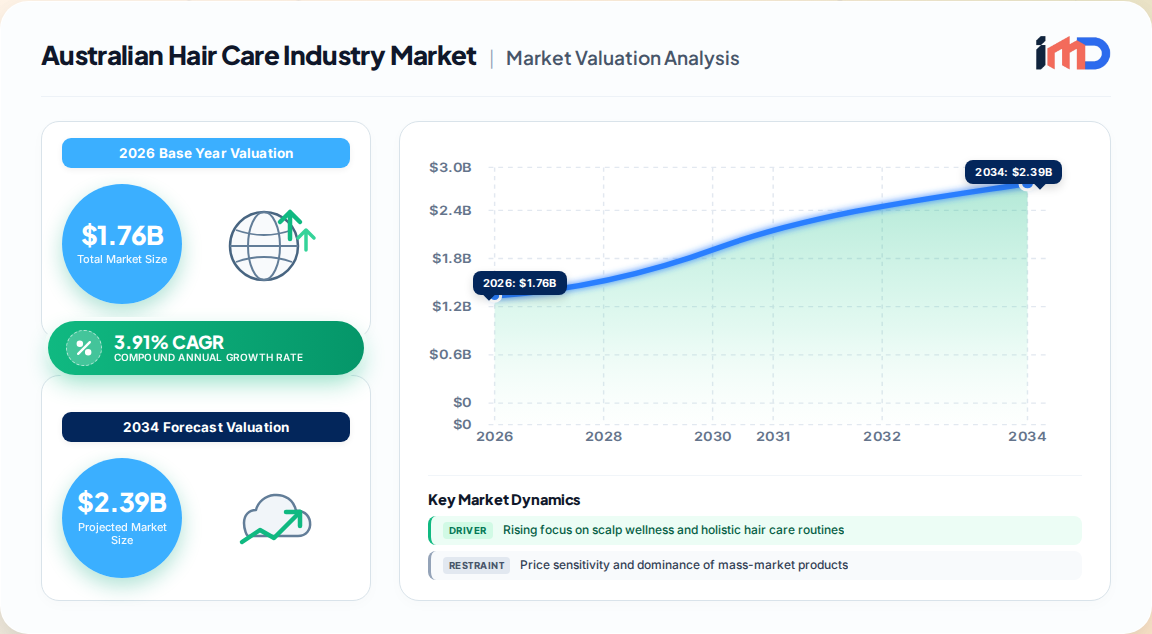
The Australian hair care industry remains a resilient, innovation-driven consumer goods vertical. Our proprietary research estimates the market at USD 1.76 billion in 2026, projected to reach USD 2.14 billion by 2031, expanding at a CAGR of 3.91% (2026–2031). The market is moderately consolidated, with the top five multinationals accounting for nearly 60% of retail value share.
This report synthesizes primary interviews with industry executives, retail scanner data, and official trade statistics to deliver a granular, forward-looking assessment of the Australian hair care landscape.
Our bottom-up modeling reveals the following segment shares and growth trajectories for 2025–2031.
| Segment | 2025 Share | Forecast CAGR (2026-2031) | Key Insights |
|---|---|---|---|
| By Product Type | |||
| Conditioner | 35.94% | 3.2% | Largest segment; driven by daily-use and treatment conditioners. |
| Shampoo | 28.0% | 3.5% | Essential category; volume-driven with premiumization in sulfate-free variants. |
| Hair Styling Products | 12.5% | 5.01% | Fastest-growing; influenced by social media trends and male grooming. |
| Hair Colorants | 10.2% | 4.1% | Supported by ageing population and at-home coloring kits. |
| Hair Masks & Treatments | 8.5% | 4.8% | Rising demand for bond-repair and deep conditioning. |
| Others (Oils, Serums) | 4.86% | 4.0% | Niche but high-margin. |
| By Category | |||
| Conventional | 83.74% | 3.2% | Dominant but losing share to organic. |
| Organic | 16.26% | 5.64% | Fastest-growing; driven by clean-label demand. |
| By Price Range | |||
| Mass | 73.68% | 3.2% | Volume-driven, supermarket-led. |
| Luxury/Premium | 26.32% | 5.90% | Fastest-growing; salon-inspired and science-backed products. |
| By Distribution Channel | |||
| Supermarkets/Hypermarkets | 41.55% | 3.0% | Largest but losing share to online. |
| Online Retail | 18.0% | 6.15% | Fastest-growing; driven by DTC brands and e-commerce platforms. |
| Pharmacies | 15.0% | 3.5% | Trusted for therapeutic and scalp-health products. |
| Specialty Beauty Stores | 12.0% | 4.0% | Premium and professional-grade products. |
| Others | 13.45% | 3.8% | Includes salons, convenience stores. |
The Australian hair care market is characterized by a mix of global heavyweights and innovative local players. Our primary research identifies the following strategic archetypes:
Australia's hair care demand is concentrated in the eastern states, but growth is accelerating in regions with high population diversity and premium retail infrastructure.
Consumer dynamics are shifting toward multi-step routines, with social media influencers playing a pivotal role in product experimentation. The "skinification" of hair care and the rise of personalized solutions are expected to drive premiumization across all regions.
The Australian hair care value chain is characterized by a mix of domestic manufacturing and imports of finished goods and raw materials.
Australia is a net importer of hair care products, with a substantial trade deficit in this category. According to UN Comtrade data, Australia imported approximately USD 1.1 billion in hair care products in 2024, while exports totaled around USD 200 million. Major import sources include the United States, China, Germany, and New Zealand.
Our analysis identifies several high-potential white spaces for investment and innovation:
The Australian hair care market is poised for steady growth, with a CAGR of 3.91% from 2026 to 2031. Key opportunities include:
By leveraging these opportunities, stakeholders can navigate the competitive landscape and capitalize on the evolving consumer preferences in Australia's hair care industry.
| Aspects | Details |
|---|---|
| Study Period | 2020-2034 |
| Base Year | 2026 |
| Estimated Year | 2026 |
| Forecast Period | 2026-2034 |
| Historical Period | 2020-2025 |
| Growth Rate | CAGR of 3.91% from 2020-2034 |
| Segmentation |
|
By Category
By Price Range
By Distribution Channel
| By Geography |
|
The Australian hair care market is valued at USD 1.76 billion in 2026 and is projected to reach USD 2.14 billion by 2031, growing at a CAGR of 3.91%.
Key drivers include rising focus on scalp wellness and holistic routines, an ageing population demanding anti-hair-fall and coloring products, and a shift toward sustainable and eco-friendly packaging.
Conditioner leads the market with a 35.94% share in 2025, while hair styling products are forecast to grow at the fastest CAGR of 5.01% through 2031.
Major companies include Procter & Gamble, Unilever, Henkel, L'Oréal, and Kao, which together hold a significant share of the market.
Online retail is the fastest-growing channel, projected to expand at a CAGR of 6.15% from 2026 to 2031, driven by e-commerce and direct-to-consumer brands.
Our rigorous research methodology combines multi-layered approaches with comprehensive quality assurance, ensuring precision, accuracy, and reliability in every market analysis.
| Stakeholder Role | Interview Share (%) |
|---|---|
| Procurement Director | 35% |
| Brand and Marketing Manager | 30% |
| R&D and Formulation Scientist | 20% |
| Supply Chain and Logistics Head | 15% |
| Company Type | Representation (%) |
|---|---|
| Hair care product manufacturers | 40% |
| Raw material and ingredient suppliers | 20% |
| Retailers and distributors | 20% |
| Salon and professional channel operators | 10% |
| Packaging suppliers and sustainability consultants | 10% |
 Related Reports
