1What is the current size of the global e-commerce market?
The global e-commerce market was valued at $33.9 trillion in 2025 and is projected to reach $39.7 trillion in 2026, growing at a CAGR of 21.6% to reach $155.98 trillion by 2033.
Insight Market Data is a premier market research and business consulting firm headquartered in Pune, India, providing syndicated research reports, customized intelligence studies, and strategic advisory services. Renowned academic institutions and Fortune 500 corporations worldwide rely on Insight Market Data's research repository to navigate evolving global and regional business environments. Covering 46 diverse industries across 25 major international economies, our comprehensive database delivers thousands of verified statistics and granular market evaluations. By combining industry-leading analytical methodologies with the direct insights of seasoned industry leaders and subject-matter experts, we deliver actionable intelligence spanning historical performance benchmarks to rigorous multi-year forecasts. We empower organizations to make confident, data-driven decisions across pivotal domains including Machinery & Equipment, Chemicals & Materials, Pharmaceuticals & Healthcare, Food & Beverages, Consumer Goods, Energy & Power, Automotive & Transportation, Electronics & Semiconductors, Medical Devices, Telecommunications, Emerging Technologies, Agriculture, and Packaging. Our multidisciplinary analyst teams provide an objective 360-degree perspective, tailoring every engagement to address complex strategic challenges with exceptional analytical rigor.
Leveraging advanced BI-powered analytics and predictive modeling, Insight Market Data uncovers high-impact market opportunities and competitive differentiators for ambitious enterprises. We continuously refine our research methodologies in accordance with global industry standards, tracking real-time market shifts to ensure our reports are consistently accurate, actionable, and delivered on schedule. Our analysts conduct methodical data validation, rigorous compliance checks, and exhaustive primary and secondary research to maintain the highest levels of data integrity and transparency. We partner closely with corporate strategists, investment groups, and business executives to translate intricate market intelligence into clear, actionable roadmaps for sustainable growth. With operational presence across Washington, USA, and Vimannagar, Pune, India, Insight Market Data ensures direct access to dedicated research specialists and responsive customer support to answer your most strategic questions.
 E-commerce Market
 by Product (Home Appliances, Clothing & Footwear, Consumer Electronics, Beauty & Personal Care, Healthcare, Books & Stationery, Automotive), by Model (B2B, B2C, C2C, C2B), by Platform (Desktop, Mobile, Tablet), by Payment Method (Credit Card, Debit Card, Digital Wallets, Bank Transfer, Cash on Delivery), by Application (Apparel & Accessories, Electronics, Food & Beverage, Health & Personal Care, Home & Furniture, Automotive, Books & Media), by North America (USA, Canada), by Europe (Germany, UK, France, Italy, Spain), by Asia Pacific (China, Japan, India, South Korea, Australia), by South America (Brazil, Argentina), by Middle East & Africa (UAE, Saudi Arabia, South Africa) Forecast 2026-2034

Research Analyst


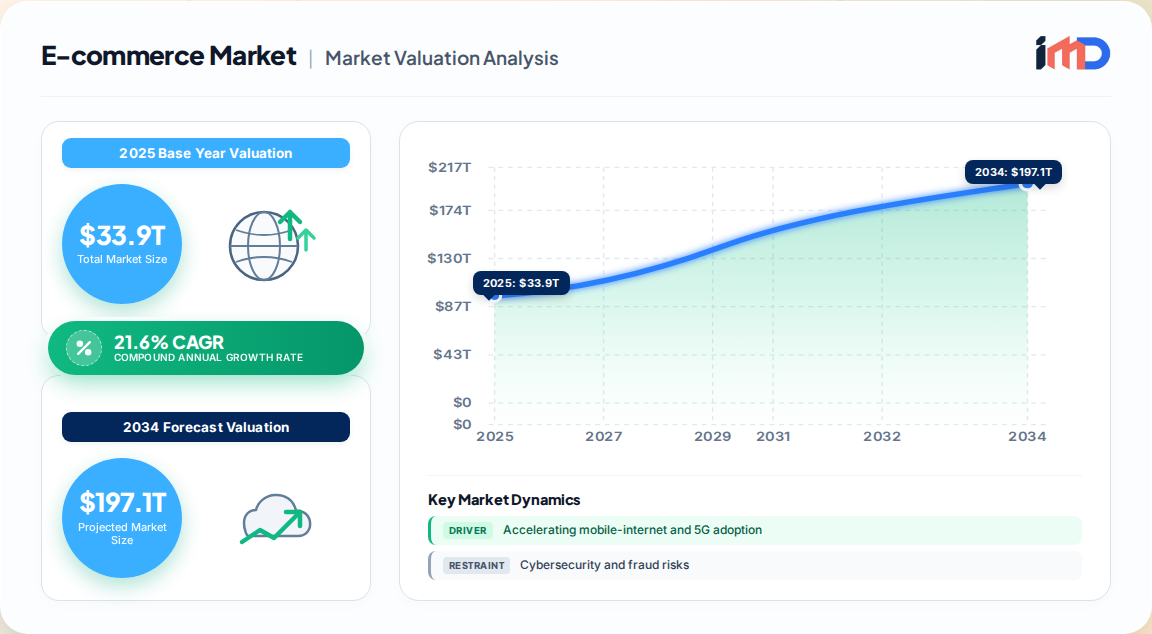
The global e-commerce market is undergoing a structural transformation, cementing its role as the backbone of modern commerce. Our proprietary research estimates the market at $33.9 trillion in 2025, projected to surge to $39.7 trillion in 2026 and further expand to $155.98 trillion by 2033, registering a robust CAGR of 21.6% over the forecast period. This exponential growth is not merely a recovery from pandemic-era acceleration but a fundamental re-architecture of consumer and business purchasing behaviors worldwide.
Asia-Pacific dominates the global landscape, accounting for 45.0% of global revenue in 2025, driven by China's e-commerce behemoths and the rapid digitization of Southeast Asian economies. The market's evolution is characterized by the blurring of lines between traditional retail and digital channels, the ascendancy of mobile-first commerce, and the integration of advanced technologies such as generative AI, embedded finance, and immersive shopping experiences. This report provides a granular analysis of the drivers, segment dynamics, and competitive strategies shaping the e-commerce market through 2033.
The e-commerce market is highly competitive, with a mix of global giants and regional players. Key companies are focusing on strategic acquisitions, technological innovation, and expansion into untapped markets to maintain their positions.
The competitive landscape is also shaped by the rise of social commerce platforms and D2C brands, which are intensifying competition and forcing traditional retailers to innovate.
| Region | Market Size (2025) | Growth Potential | Key Opportunities | Risk Factors |
|---|---|---|---|---|
| Asia-Pacific | $15.3 trillion | Very High (CAGR >20%) | Mobile commerce, social commerce, B2B digitalization | Regulatory fragmentation, infrastructure gaps |
| North America | $8.1 trillion | Moderate (CAGR ~15%) | AI personalization, omnichannel, BNPL | Market saturation, cybersecurity risks |
| Europe | $6.8 trillion | Moderate (CAGR ~16%) | Cross-border trade, sustainability, OSS adoption | VAT complexity, data privacy regulations |
| South America | $1.7 trillion | High (CAGR ~18%) | Digital payments, mobile-first consumers | Economic volatility, logistics challenges |
| Middle East & Africa | $2.0 trillion | High (CAGR ~17%) | Youth demographics, mobile penetration | Infrastructure, payment fragmentation |
Note: Market sizes are approximations based on regional share and global market size.
The e-commerce value chain encompasses a complex network of activities and participants, from product discovery to post-purchase support. Key stages include:
The value chain is characterized by increasing vertical integration, with major players like Amazon and Alibaba controlling multiple stages to capture more value.
| Existing Markets | New Markets | |
|---|---|---|
| Existing Products | Market Penetration: Expand in mature markets through personalization, loyalty programs, and faster delivery. | Market Development: Enter emerging markets with localized platforms and payment options. |
| New Products | Product Development: Introduce new categories (e.g., virtual goods, subscription services) and technologies (AR/VR shopping). | Diversification: Invest in adjacent sectors like fintech, logistics-as-a-service, and healthcare e-commerce. |
The Ansoff Matrix highlights that while market penetration and development are primary growth strategies for most e-commerce players, product development and diversification offer avenues for long-term differentiation.
| Aspects | Details |
|---|---|
| Study Period | 2020-2034 |
| Base Year | 2025 |
| Estimated Year | 2026 |
| Forecast Period | 2026-2034 |
| Historical Period | 2020-2025 |
| Growth Rate | CAGR of 21.6% from 2020-2034 |
| Segmentation |
|
By Model
By Platform
By Payment Method
By Application
| By Geography |
|
The global e-commerce market was valued at $33.9 trillion in 2025 and is projected to reach $39.7 trillion in 2026, growing at a CAGR of 21.6% to reach $155.98 trillion by 2033.
Asia-Pacific is the largest regional market, accounting for 45.0% of global revenue in 2025, driven by China, India, and Southeast Asian economies.
Key drivers include increasing internet and smartphone penetration, digital payment innovations like BNPL, logistics automation, and omnichannel retail strategies.
Home appliances led with a 20.0% revenue share in 2025, while consumer electronics is the largest B2C category, holding 27.88% of B2C e-commerce revenue.
The consumer-to-consumer (C2C) segment is expected to grow at the fastest CAGR, driven by peer-to-peer marketplaces and the circular economy.
Digital wallets accounted for 43.92% of e-commerce transaction value in 2025, overtaking cards, and are fueling growth in emerging markets like Brazil with Pix and India with UPI.
Challenges include cybersecurity risks, cross-border regulatory complexity, and sustainability concerns, which can increase operational costs and hinder growth.
Key players include Amazon, Alibaba, Walmart, JD.com, eBay, Flipkart, Apple, The Home Depot, and Best Buy, each with distinct regional and segment strategies.
Our rigorous research methodology combines multi-layered approaches with comprehensive quality assurance, ensuring precision, accuracy, and reliability in every market analysis.
| Stakeholder Role | Interview Share (%) |
|---|---|
| Chief Digital Officer | 20% |
| Head of E-commerce | 35% |
| Supply Chain Director | 25% |
| Payment Solutions Manager | 20% |
| Company Type | Representation (%) |
|---|---|
| Online Marketplace Operators | 30% |
| D2C Brand Owners | 20% |
| Third-Party Logistics Providers | 20% |
| Digital Payment Processors | 15% |
| E-commerce Platform Software Vendors | 15% |
 Related Reports
