1What is the current market size of water-based epoxy resin curing agents?
The global market is valued at USD 3.60 billion in 2026 and is projected to reach USD 5.05 billion by 2032, growing at a CAGR of 5.76%.
Insight Market Data is a premier market research and business consulting firm headquartered in Pune, India, providing syndicated research reports, customized intelligence studies, and strategic advisory services. Renowned academic institutions and Fortune 500 corporations worldwide rely on Insight Market Data's research repository to navigate evolving global and regional business environments. Covering 46 diverse industries across 25 major international economies, our comprehensive database delivers thousands of verified statistics and granular market evaluations. By combining industry-leading analytical methodologies with the direct insights of seasoned industry leaders and subject-matter experts, we deliver actionable intelligence spanning historical performance benchmarks to rigorous multi-year forecasts. We empower organizations to make confident, data-driven decisions across pivotal domains including Machinery & Equipment, Chemicals & Materials, Pharmaceuticals & Healthcare, Food & Beverages, Consumer Goods, Energy & Power, Automotive & Transportation, Electronics & Semiconductors, Medical Devices, Telecommunications, Emerging Technologies, Agriculture, and Packaging. Our multidisciplinary analyst teams provide an objective 360-degree perspective, tailoring every engagement to address complex strategic challenges with exceptional analytical rigor.
Leveraging advanced BI-powered analytics and predictive modeling, Insight Market Data uncovers high-impact market opportunities and competitive differentiators for ambitious enterprises. We continuously refine our research methodologies in accordance with global industry standards, tracking real-time market shifts to ensure our reports are consistently accurate, actionable, and delivered on schedule. Our analysts conduct methodical data validation, rigorous compliance checks, and exhaustive primary and secondary research to maintain the highest levels of data integrity and transparency. We partner closely with corporate strategists, investment groups, and business executives to translate intricate market intelligence into clear, actionable roadmaps for sustainable growth. With operational presence across Washington, USA, and Vimannagar, Pune, India, Insight Market Data ensures direct access to dedicated research specialists and responsive customer support to answer your most strategic questions.
 Water-Based Epoxy Resin Curing Agent Market
 by Type (Less than 40%, 40%-60%, Above 60%), by Application (Coating, Adhesive, Flooring, Marine, Others), by Asia-Pacific (China, India, Japan, South Korea, Southeast Asia), by North America (USA, Canada, Mexico), by Europe (Germany, UK, France, Italy, Spain), by South America (Brazil, Argentina), by Middle East & Africa (GCC, South Africa) Forecast 2026-2034

Senior Analyst


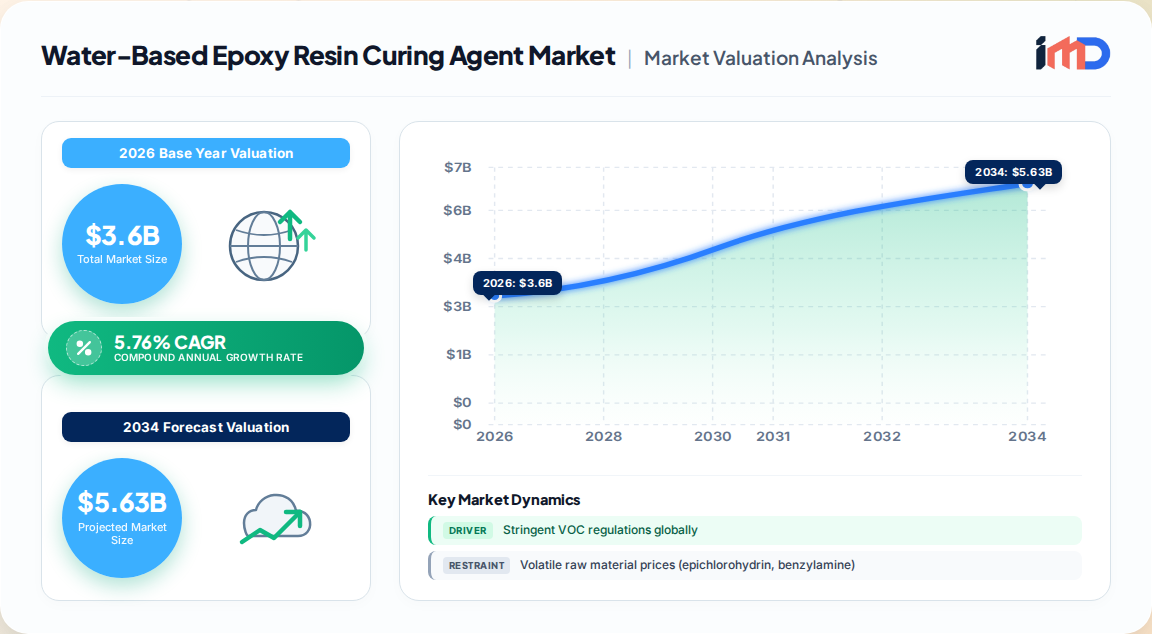
The global water-based epoxy resin curing agent market is projected to reach USD 3.60 billion in 2026, expanding at a CAGR of 5.76% to USD 5.05 billion by 2032. This growth is underpinned by a structural shift away from solvent-borne systems, driven by tightening volatile organic compound (VOC) regulations and rising demand for low-emission industrial materials. Water-based curing agents are chemically engineered to cross-link epoxy resins in aqueous media, delivering adhesion, chemical resistance, and durability comparable to traditional systems while significantly reducing environmental and health hazards.
Our proprietary analysis indicates that the market’s evolution is no longer solely about regulatory compliance; it is increasingly shaped by performance parity and formulation innovation. Advances in amine chemistry, emulsification technology, and latent curing mechanisms have enabled water-based systems to meet the demanding requirements of coatings, adhesives, flooring, and marine applications. As a result, adoption is accelerating across construction, automotive, electronics, and renewable energy sectors.
Demand for water-based epoxy curing agents is propelled by several interrelated factors. Environmental regulations, such as the EU REACH framework and US EPA standards, have imposed strict limits on VOC emissions, compelling formulators to replace solvent-based hardeners with waterborne alternatives. In parallel, the construction industry’s robust expansion—particularly in Asia-Pacific—is fueling consumption in protective coatings, floorings, and structural adhesives. The global push toward electric vehicles and wind energy further creates new application frontiers for water-based epoxy systems, where low-emission manufacturing and lightweight composites are paramount.
However, the market faces headwinds. The volatility of key feedstock prices, notably epichlorohydrin and benzylamine, exerts pressure on margins, especially for smaller formulators. Technical challenges persist in achieving consistent cure performance under high humidity and low-temperature conditions, which can limit adoption in certain geographies. Additionally, the higher cost of water-based systems relative to conventional solvent-borne products remains a barrier in price-sensitive markets.
The market is segmented by curing agent solid content: less than 40%, 40%-60%, and above 60%. The 40%-60% segment accounts for the largest share, estimated at 37% of total revenue in 2026, as it balances performance characteristics with ease of formulation. The above-60% segment is forecast to grow at the fastest rate, driven by demand for high-solids, low-VOC coatings in industrial maintenance and marine applications.
| Type | 2026 Share (%) | CAGR 2026-2032 (%) |
|---|---|---|
| Less than 40% | 37 | 5.2 |
| 40%-60% | 37 | 5.8 |
| Above 60% | 26 | 6.5 |
Coatings represent the dominant application, contributing 24% of market value in 2026, followed by adhesives at 22%, flooring at 18%, marine at 20%, and other applications at 16%. The adhesives segment is gaining traction due to the growing use of water-based epoxy in packaging, automotive assembly, and electronics. Marine applications are also expanding, as shipbuilders and port authorities seek environmentally compliant protective coatings that withstand harsh saline environments.
| Application | 2026 Share (%) | Key Growth Drivers |
|---|---|---|
| Coating | 20 | Infrastructure renewal, VOC caps |
| Adhesive | 24 | Lightweighting, electronics miniaturization |
| Flooring | 18 | Cleanroom standards, pharmaceutical construction |
| Marine | 22 | Environmental regulations, corrosion protection |
| Others | 16 | Composites, 3D printing |
Asia-Pacific commands the largest and fastest-growing share of the water-based epoxy resin curing agent market, accounting for 41% of global revenue in 2026 and projected to grow at a CAGR of 7.2% through 2032. The region’s dominance is fueled by rapid industrialization, extensive construction activity, and government initiatives promoting green building materials. China, India, and Southeast Asian nations are key contributors, with China’s stringent VOC limits (<80 g/L) accelerating the shift to waterborne systems.
North America and Europe follow, with shares of 24% and 22%, respectively. These mature markets are characterized by strict environmental enforcement and a strong emphasis on high-performance, durable coatings. The United States and Germany are at the forefront of adopting advanced water-based curing agents for infrastructure and automotive applications. Latin America and the Middle East & Africa represent smaller but promising markets, with growth driven by infrastructure investments and increasing environmental awareness.
The market is moderately concentrated, with leading chemical companies investing in R&D to expand their water-based curing agent portfolios. Key players include Evonik, Huntsman, Olin Corporation, Westlake, Kukdo Chemical, Aditya Birla Group, Hengsite, Incorez, Rich Chemical, Mitsubishi Chemical, Cardolite, Reaksiyon Kimya, and QR-Polymers. These companies compete on product performance, technical support, and supply chain reliability. Strategic initiatives focus on developing bio-based curing agents, enhancing low-temperature cure capabilities, and forming partnerships with downstream formulators to co-create tailored solutions.
Recent developments include Evonik’s launch of a new line of water-based amine curing agents for marine coatings, and Huntsman’s acquisition of a specialty chemicals firm to bolster its waterborne epoxy portfolio. Kukdo Chemical has expanded its production capacity in South Korea to meet rising demand from the electronics sector.
The value chain for water-based epoxy resin curing agents spans raw material suppliers, curing agent manufacturers, formulators, and end-users. Key raw materials include epichlorohydrin, amines (e.g., polyamines, cycloaliphatic amines), and emulsifiers. Manufacturers synthesize curing agents through reactions such as amination or adduction, then blend them with water and additives to create stable dispersions. Formulators combine these curing agents with water-based epoxy resins, pigments, and fillers to produce final coatings, adhesives, and flooring systems. End-users span construction, automotive, marine, electronics, and renewable energy sectors.
Supply chain resilience is critical, as disruptions in amine feedstock or epichlorohydrin supply can ripple through the value chain. Integrated producers benefit from backward integration, while smaller players rely on spot purchases, exposing them to price volatility.
Significant untapped opportunities exist in bio-based curing agents derived from renewable feedstocks such as cashew nut shell liquid (phenalkamines) and plant-based amines. These products appeal to sustainability-focused customers and can command premium pricing. Another white space is the development of one-component (1K) water-based epoxy systems that offer extended pot life and simplified application, particularly for DIY and consumer markets. Additionally, the integration of digital tools for predictive formulation and quality control presents a avenue for differentiation, enabling faster time-to-market and reduced waste.
Geographically, emerging markets in Southeast Asia, India, and the Middle East offer growth potential for cost-effective water-based curing agents tailored to local climatic conditions and regulatory environments. Companies that invest in regional technical support and application development can capture share in these high-growth areas.
| Aspects | Details |
|---|---|
| Study Period | 2020-2034 |
| Base Year | 2026 |
| Estimated Year | 2026 |
| Forecast Period | 2026-2034 |
| Historical Period | 2020-2025 |
| Growth Rate | CAGR of 5.76% from 2020-2034 |
| Segmentation |
|
| By Geography |
|
The global market is valued at USD 3.60 billion in 2026 and is projected to reach USD 5.05 billion by 2032, growing at a CAGR of 5.76%.
Asia-Pacific holds the largest share, accounting for 41% of global revenue in 2026, driven by rapid industrialization and construction activities in China and India.
Stringent VOC regulations, growing demand for eco-friendly coatings and adhesives, and advancements in formulation technology that match solvent-based performance are primary drivers.
Key players include Evonik, Huntsman, Olin Corporation, Westlake, Kukdo Chemical, Aditya Birla Group, and Mitsubishi Chemical, among others.
Challenges include volatile raw material prices, technical hurdles in achieving consistent cure under high humidity, and higher costs compared to conventional solvent-based systems.
Our rigorous research methodology combines multi-layered approaches with comprehensive quality assurance, ensuring precision, accuracy, and reliability in every market analysis.
| Stakeholder Role | Interview Share (%) |
|---|---|
| Procurement Director | 30% |
| R&D Manager | 25% |
| Chief Technology Officer | 20% |
| Operations Manager | 25% |
| Company Type | Representation (%) |
|---|---|
| Curing Agent Manufacturers | 40% |
| Epoxy Resin Formulators | 25% |
| Distributors | 15% |
| End-Users (Construction, Automotive, Marine) | 20% |
 Related Reports
