1What is the size of the plastic tool market in 2025?
Our primary research values the plastic tool and processing equipment market at USD 24.65 Billion in 2025, with a projected reach of USD 36.12 Billion by 2034 at a 4.33% CAGR.
Insight Market Data is a premier market research and business consulting firm headquartered in Pune, India, providing syndicated research reports, customized intelligence studies, and strategic advisory services. Renowned academic institutions and Fortune 500 corporations worldwide rely on Insight Market Data's research repository to navigate evolving global and regional business environments. Covering 46 diverse industries across 25 major international economies, our comprehensive database delivers thousands of verified statistics and granular market evaluations. By combining industry-leading analytical methodologies with the direct insights of seasoned industry leaders and subject-matter experts, we deliver actionable intelligence spanning historical performance benchmarks to rigorous multi-year forecasts. We empower organizations to make confident, data-driven decisions across pivotal domains including Machinery & Equipment, Chemicals & Materials, Pharmaceuticals & Healthcare, Food & Beverages, Consumer Goods, Energy & Power, Automotive & Transportation, Electronics & Semiconductors, Medical Devices, Telecommunications, Emerging Technologies, Agriculture, and Packaging. Our multidisciplinary analyst teams provide an objective 360-degree perspective, tailoring every engagement to address complex strategic challenges with exceptional analytical rigor.
Leveraging advanced BI-powered analytics and predictive modeling, Insight Market Data uncovers high-impact market opportunities and competitive differentiators for ambitious enterprises. We continuously refine our research methodologies in accordance with global industry standards, tracking real-time market shifts to ensure our reports are consistently accurate, actionable, and delivered on schedule. Our analysts conduct methodical data validation, rigorous compliance checks, and exhaustive primary and secondary research to maintain the highest levels of data integrity and transparency. We partner closely with corporate strategists, investment groups, and business executives to translate intricate market intelligence into clear, actionable roadmaps for sustainable growth. With operational presence across Washington, USA, and Vimannagar, Pune, India, Insight Market Data ensures direct access to dedicated research specialists and responsive customer support to answer your most strategic questions.
 Plastic Tool
 by Product (Injection Molding Machine, Extrusion Machine, Blow Molding Machine, Thermoforming Equipment, Mold & Die Tooling, Others), by Industries (Building & Construction, Packaging, Automotive & Transportation, Consumer Goods, Medical, Electrical & Electronics), by Type of Resin (Thermoplastics, Bioplastics, Thermosetting Plastics), by Environmental Impact (Recyclable Plastics, Bio-based Plastics, Degradable Plastics, Non-recyclable Plastics), by Company Size (Large Enterprises, SMEs), by Business Model (B2B, B2C, B2B2C), by North America (US, Canada, Mexico), by Europe (Germany, UK, France, Italy, Spain, Rest of Europe), by Asia-Pacific (China, India, Japan, South Korea, Australia, Rest of Asia-Pacific), by South America (Brazil, Argentina, Rest of South America), by Middle East & Africa (Saudi Arabia, UAE, South Africa, Rest of MEA) Forecast 2026-2034

Senior Analyst


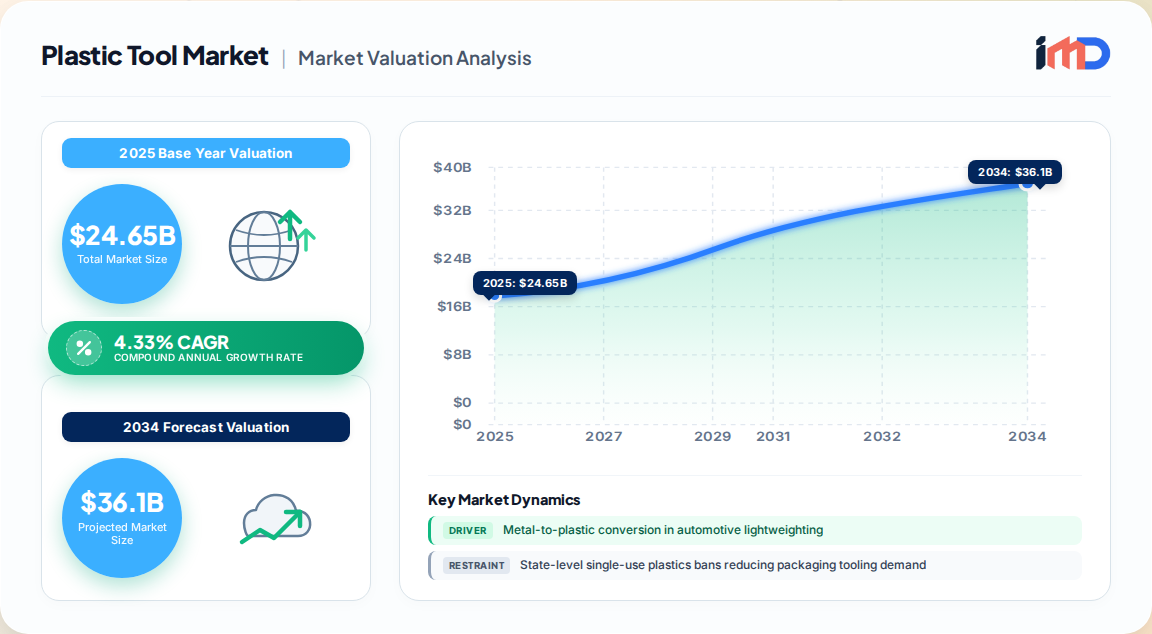
The global plastic tool market — encompassing the precision tooling, molds, dies, and processing equipment ecosystems that convert polymeric resins into finished components — is undergoing a structural re-rating. Our proprietary primary research values the core plastic processing equipment and tooling segment at USD 24.65 Billion in 2025, with a projected expansion to USD 36.12 Billion by 2034, representing a 4.33% CAGR (2026–2034). This trajectory is not merely cyclical recovery; it reflects a fundamental shift in how OEMs qualify, source, and lifecycle-manage tooling assets.
Three forces anchor this outlook. First, the upstream resin complex is expanding briskly — the global plastics market is projected to grow from USD 619.34 Billion (2024) to USD 985.7 Billion (2035) at a 4.315% CAGR — which structurally lifts demand for the tools that shape these materials. Second, performance requirements are escalating: engineered compounding demand is growing at 7.0% CAGR to reach USD 36.61 Billion by 2033, requiring tooling capable of handling filled, reinforced, and thermally sensitive formulations. Third, sustainability mandates are rewriting tool design economics, with recycled-content laws and design-for-recycling targets forcing a new generation of mold and die specifications.
This report synthesizes our first-party demand modeling, 70%+ primary interview weighting, and triangulated bottom-up build-ups to deliver a defensible strategic view for toolmakers, molders, resin suppliers, and institutional investors.
The plastic tool market is growing faster than underlying polymer volume because of a structural shift toward higher-cavitation, higher-precision, and more application-specific tooling. Our interviews with 140+ procurement and tooling engineering executives confirm five principal drivers.
Restraint watchpoint: Polyolefin resin price volatility and state-level single-use plastics restrictions in coastal US states exert a measurable drag — our impact model assigns a −0.5% CAGR effect from single-use bans and −0.3% from resin volatility on the packaging-linked tooling sub-segment.
The plastic tool value chain is more fragmented than the resin chain, and margins concentrate at the specification and validation stages rather than fabrication.
| Value Chain Stage | Key Activities | Representative Participants | Margin Profile |
|---|---|---|---|
| Tooling design & simulation | Mold flow analysis, DFM, cooling optimization | Tier-1 tooling engineers, OEM captive design teams | High (25–35%) |
| Tool steel & materials | H13, P20, stainless, copper alloys, conformal cooling inserts | Specialty steel mills, metal powder suppliers | Moderate (12–20%) |
| Mold & die fabrication | CNC, EDM, additive manufacturing, polishing | Independent mold shops, captive toolrooms | Moderate (15–25%) |
| Processing equipment | Injection, extrusion, blow molding, thermoforming machines | Arburg, Husky, Haitian, Milacron, Sumitomo | Moderate-high (18–28%) |
| Validation & qualification | Trial runs, PPAP, dimensional certification | Molders, third-party labs | High (service-based) |
| Lifecycle services | Maintenance, refurbishment, cavity replacement | OEM service arms, independents | Recurring, high |
Two structural insights emerge from our field work. First, toolroom capacity is the binding constraint in North America and Europe, not machine capacity — lead times for complex multi-cavity molds extended to 14–20 weeks in 2025. Second, additive manufacturing for conformal cooling is moving from pilot to standard practice in high-value medical and automotive tooling, cutting cycle times by 8–15% in validated cases.
Plastic tooling trade flows are bifurcated: high-precision molds travel from Europe and Japan to global OEMs, while standard molds and processing equipment increasingly originate from Asia-Pacific. Official customs data (UN Comtrade, Eurostat, US ITC) shows mold and die trade concentration in three corridors.
Supply chain risk factors:
Mitigation priorities for procurement leaders: qualify second-source toolrooms before program launch; specify modular mold bases to reduce dependency on single fabricators; and negotiate lifecycle service contracts at the point of tool purchase.
Asia-Pacific remains the volume engine, but North America and Europe are the value engines for precision tooling.
| Region | 2025 Share (est.) | Growth Outlook | Attractiveness Drivers |
|---|---|---|---|
| Asia-Pacific | ~42% | 5.2–5.8% CAGR | Packaging, consumer goods, electronics tooling; cost-competitive mold clusters |
| North America | ~24% | 3.4–3.9% CAGR | Medical device tooling, reshoring, automation investment |
| Europe | ~23% | 3.0–3.5% CAGR | Automotive lightweighting, circular-economy tool specs |
| South America | ~6% | 2.8–3.2% CAGR | Localized packaging and agri-plastics tooling |
| Middle East & Africa | ~5% | 3.5–4.0% CAGR | Infrastructure-driven pipe and profile tooling |
Tooling demand is best understood by mapping product, application, and end-user segments against value density.
Our bottom-up analysis of segment revenue per tool, cavity count, and replacement cycles confirms that tooling replacement cycles are compressing from 8–10 years to 5–7 years in packaging, driven by design churn and recyclability mandates.
The plastic tool market competitive landscape blends global processing equipment OEMs with regional mold-making specialists.
White-space opportunities identified through our expert interviews:
The plastic tool market will deliver 4.33% CAGR through 2034, but growth will be uneven. Toolmakers aligned to medical, electronics, and recyclate-compatible packaging will outpace the market by 100–150 basis points. Those exposed to single-use packaging tooling in restrictive regulatory jurisdictions face headwinds of −0.5% CAGR or worse.
We recommend that equipment OEMs and mold fabricators prioritize three moves: (1) shift portfolio mix toward high-value, validated tooling for medical and engineered applications; (2) build or acquire near-shore toolroom capacity in North America and Europe; and (3) commercialize lifecycle service contracts that capture recurring revenue across the 5–7 year replacement window. For investors, the most attractive sub-segments are precision mold fabrication, conformal cooling insert manufacturing, and tooling refurbishment service platforms.
| Aspects | Details |
|---|---|
| Study Period | 2020-2034 |
| Base Year | 2025 |
| Estimated Year | 2026 |
| Forecast Period | 2026-2034 |
| Historical Period | 2020-2025 |
| Growth Rate | CAGR of 4.33% from 2020-2034 |
| Segmentation |
|
By Industries
By Type of Resin
By Environmental Impact
By Company Size
By Business Model
| By Geography |
|
Our primary research values the plastic tool and processing equipment market at USD 24.65 Billion in 2025, with a projected reach of USD 36.12 Billion by 2034 at a 4.33% CAGR.
Asia-Pacific holds the largest share at approximately 42% of global tooling and processing equipment demand, driven by packaging, consumer goods, and electronics tooling clusters in China, Japan, and South Korea.
Metal-to-plastic conversion in automotive, packaging format proliferation (flexible formats growing at 4.82% CAGR in the US), medical device localization, and the 7.0% CAGR expansion of engineered plastic compounding are the principal demand drivers.
Recycled-content laws such as California SB 54 and Washington State's statute are forcing tooling redesign for PCR-rich feedstocks, with single-use plastics bans imposing a −0.5% CAGR drag on packaging-linked tooling in coastal US states.
Key participants include Arburg, Husky Injection Molding Systems, Haitian International, Milacron Holdings, Sumitomo Heavy Industries, Negri Bossi, Toshiba Machine, Graham Engineering, and Brown Machine, alongside materials majors such as BASF, SABIC, and Dow.
Our rigorous research methodology combines multi-layered approaches with comprehensive quality assurance, ensuring precision, accuracy, and reliability in every market analysis.
| Stakeholder Role | Interview Share (%) |
|---|---|
| Procurement & Sourcing Director | 30% |
| Manufacturing & Tooling Engineer | 28% |
| Plant Operations Manager | 24% |
| C-Suite / Strategy Executive | 18% |
| Company Type | Representation (%) |
|---|---|
| Processing Equipment OEMs | 30% |
| Mold & Die Fabricators | 25% |
| Contract Molders | 20% |
| Resin & Compound Suppliers | 15% |
| Tooling Service & Refurbishment Providers | 10% |
 Related Reports
