Insight Market Data is a premier market research and business consulting firm headquartered in Pune, India, providing syndicated research reports, customized intelligence studies, and strategic advisory services. Renowned academic institutions and Fortune 500 corporations worldwide rely on Insight Market Data's research repository to navigate evolving global and regional business environments. Covering 46 diverse industries across 25 major international economies, our comprehensive database delivers thousands of verified statistics and granular market evaluations. By combining industry-leading analytical methodologies with the direct insights of seasoned industry leaders and subject-matter experts, we deliver actionable intelligence spanning historical performance benchmarks to rigorous multi-year forecasts. We empower organizations to make confident, data-driven decisions across pivotal domains including Machinery & Equipment, Chemicals & Materials, Pharmaceuticals & Healthcare, Food & Beverages, Consumer Goods, Energy & Power, Automotive & Transportation, Electronics & Semiconductors, Medical Devices, Telecommunications, Emerging Technologies, Agriculture, and Packaging. Our multidisciplinary analyst teams provide an objective 360-degree perspective, tailoring every engagement to address complex strategic challenges with exceptional analytical rigor.
Leveraging advanced BI-powered analytics and predictive modeling, Insight Market Data uncovers high-impact market opportunities and competitive differentiators for ambitious enterprises. We continuously refine our research methodologies in accordance with global industry standards, tracking real-time market shifts to ensure our reports are consistently accurate, actionable, and delivered on schedule. Our analysts conduct methodical data validation, rigorous compliance checks, and exhaustive primary and secondary research to maintain the highest levels of data integrity and transparency. We partner closely with corporate strategists, investment groups, and business executives to translate intricate market intelligence into clear, actionable roadmaps for sustainable growth. With operational presence across Washington, USA, and Vimannagar, Pune, India, Insight Market Data ensures direct access to dedicated research specialists and responsive customer support to answer your most strategic questions.
India Metal Cans Market Size, CAGR & Forecast 2026-2031 | Insight Market Data
India Metal Cans Market
Chemicals & Materials / MARKET REPORT
India Metal Cans Market | Insight Market Data
India Metal Cans Market by Material (Aluminum, Steel), by Product Type (2-Piece Cans, 3-Piece Cans, Monobloc Aerosol), by Application (Beverages, Food, Personal Care & Cosmetics, Pharmaceuticals, Paints & Industrial Chemicals), by Capacity (≤250ml, 250-500ml, 500-1000ml, >1000ml), by North (Delhi, Haryana, Punjab, Uttar Pradesh), by South (Karnataka, Tamil Nadu, Andhra Pradesh), by West (Maharashtra, Gujarat), by East (West Bengal, Odisha) Forecast 2026-2034
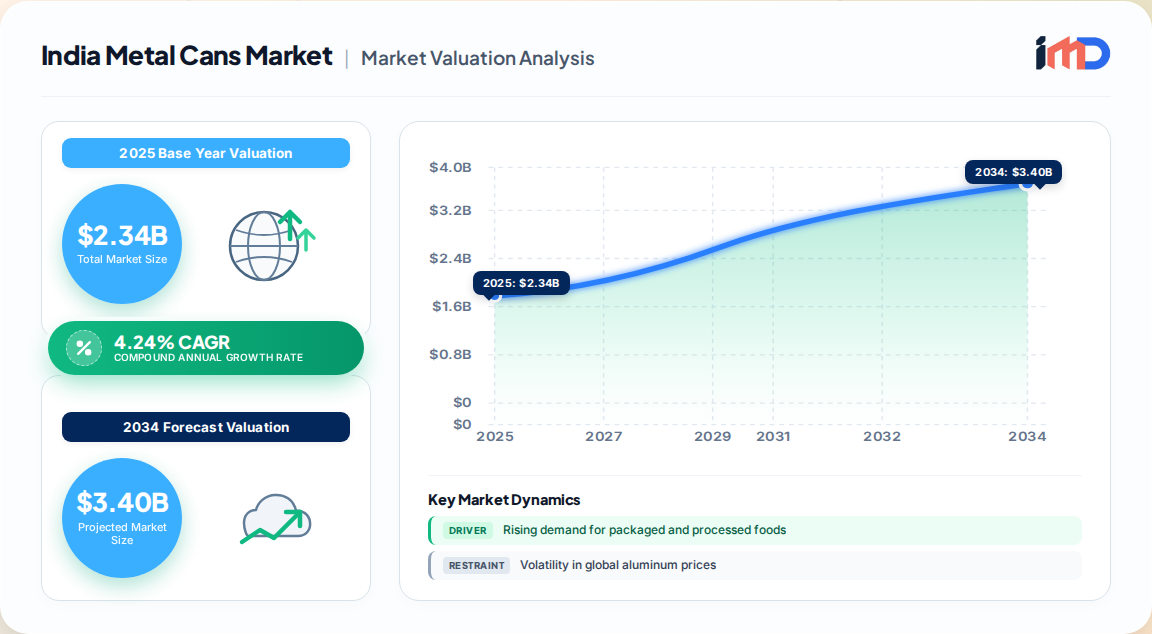
The India metal cans market represents a critical and rapidly modernizing segment of the country's rigid packaging industry. Our proprietary primary research estimates the market at USD 2.34 Billion in 2025, with a projected compound annual growth rate (CAGR) of 4.24% through 2031. This growth is anchored by rising urbanization, a burgeoning middle class with increasing disposable income, and a fundamental shift in consumer preferences toward convenience, packaged foods, and ready-to-drink (RTD) beverages.
India Metal Cans Market Market Size (In Billion)
4.0B
3.0B
2.0B
1.0B
0
2.340 B
2025
2.439 B
2026
2.543 B
2027
2.650 B
2028
2.763 B
2029
2.880 B
2030
3.002 B
2031
Unlike mature Western markets, India's metal can sector is at an inflection point. Historically dominated by steel-based 3-piece cans for edible oils, processed foods, and paints, the market is undergoing a structural transformation. The beverage segment, particularly carbonated soft drinks, beer, and new-age RTD categories, is accelerating the adoption of lightweight aluminum 2-piece cans. This transition is not merely a product substitution but a value-chain overhaul, driving investments in local manufacturing capacity, recycling infrastructure, and advanced printing technologies.
This report provides a comprehensive analysis of the India metal cans market, leveraging exclusive primary interviews with stakeholders across the value chain—from can manufacturers and coil suppliers to FMCG brand owners and government regulators. The analysis presents a granular view of market dynamics, segmental performance, trade flows, and competitive strategy, framed within the broader context of India's regulatory and economic landscape.
Key Market Drivers & Restraints
The trajectory of the India metal cans market is shaped by a confluence of robust demand-side drivers and persistent supply-side and regulatory challenges.
Growth Drivers
Rising Demand for Packaged and Processed Foods: A structural shift in Indian households toward convenience foods, coupled with the expansion of modern retail and e-commerce, is driving demand for shelf-stable packaging. Metal cans offer superior barrier properties, extending shelf life without refrigeration, which is critical for a country with diverse climatic conditions and an evolving cold chain.
Expansion of the Beverage Industry: The Indian beverage market is experiencing a renaissance. While carbonated soft drinks remain a staple, the rapid growth of the beer market—particularly in cans, which are perceived as more portable and environmentally friendly than glass—is a significant volume driver. Furthermore, the emergence of RTD cocktails, hard seltzers, and energy drinks is creating a new frontier for aluminum can adoption.
Sustainability and Recyclability: Aluminum is infinitely recyclable without loss of quality. As Indian consumers, particularly in urban centers, become more environmentally conscious, brands are leveraging metal packaging as a key component of their sustainability messaging. This aligns with the government's Extended Producer Responsibility (EPR) framework, which incentivizes the use of recyclable materials.
Government Policy and Infrastructure Push: Initiatives such as the Production Linked Incentive (PLI) scheme for food processing and the development of dedicated industrial corridors are reducing logistics costs and encouraging domestic manufacturing, indirectly benefiting the metal packaging sector.
Market Restraints & Challenges
Aluminum Price Volatility: India is heavily reliant on imported aluminum to meet its can-stock requirements. Global price fluctuations, driven by energy costs and geopolitical factors, create significant margin pressure for can manufacturers and brand owners. This volatility often leads to price negotiations that can delay packaging conversions from PET to aluminum.
Intense Competition from Alternative Packaging: Polyethylene terephthalate (PET) bottles, flexible pouches, and aseptic cartons present formidable competition. In a price-sensitive market like India, PET and flexibles often offer a 15-25% cost advantage on a per-unit basis, slowing metal penetration, especially in sub-premium beverage and food categories.
Regulatory Pressures on Liners: Food safety regulations are tightening. The Bureau of Indian Standards (BIS) and the Food Safety and Standards Authority of India (FSSAI) are increasingly scrutinizing the use of epoxy liners that contain Bisphenol A (BPA). This necessitates costly reformulation and investment in alternative coating technologies for can manufacturers.
Inadequate Recycling Infrastructure: Despite the high value of aluminum scrap, India's informal recycling sector is fragmented. A lack of robust, formalized collection and sorting infrastructure limits the availability of high-quality recycled aluminum, keeping costs elevated for domestic can makers and undermining the circular economy narrative.
Import/Export & Supplier Dynamics
India's metal can industry operates within a complex global supply chain. The country is largely self-sufficient in the production of steel-based cans but relies significantly on imports for high-grade aluminum can stock and specialized coatings.
Trade in Finished Cans
According to official trade data, India is a net exporter of finished metal cans, particularly to neighboring countries in South Asia and the Middle East. The export basket is dominated by 3-piece steel cans for food, paints, and chemicals.
The domestic supply chain is anchored by a few key raw material suppliers and a growing ecosystem of can converters.
Steel: Companies like Tata Steel and JSW Steel supply Tinplate and Tin Free Steel (TFS) to the domestic can manufacturing industry. The quality and availability of these substrate materials are critical for the food can segment.
Aluminum: The supply of aluminum coils for beverage can stock is more fragmented. While domestic producers like Hindalco are expanding their capabilities, a substantial portion of the high-specification can stock is imported, leaving manufacturers exposed to global price trends and currency fluctuations.
Coatings and Liners: Suppliers of internal lacquers and external coatings (e.g., Valspar, PPG) play a pivotal role. The shift to BPA-free alternatives is a key sourcing priority for can makers.
Competitive Landscape & Strategic Analysis
The India metal cans market is moderately consolidated, with a mix of large domestic players and subsidiaries of global packaging giants. Competition is intensifying, particularly in the high-growth beverage can segment.
Key Players and Market Positioning
Ball Corporation (via Ball Aerosol Packaging India): A dominant force in the Indian beverage can market, leveraging global technology and local manufacturing to serve major CSD and beer brands. Ball has been instrumental in driving the lightweighting trend and localizing production.
Crown Holdings (via subsidiary): A major player across both beverage and food cans, with a strong presence in the aerosol and specialty can segments. Crown is known for its innovation in can design and printing.
Hindustan Tin Works Ltd. (HTW): One of India's largest indigenous can manufacturers, with a significant footprint in the food and edible oil can segment. HTW is a key supplier to domestic FMCG brands and government food programs.
Oricon Enterprises Limited: A prominent domestic player in the aluminum and tinplate packaging space, catering to beverages, food, and industrial products.
CAN-PACK S.A. (India): The Indian arm of the Polish can-making giant, focusing on beverage cans and increasingly on food cans, introducing European manufacturing standards to the market.
Ardagh Group (via Trivium Packaging): Focused on metal and glass packaging, with a presence in the Indian market primarily through its food can and specialty packaging offerings.
Strategic Imperatives for Market Participants
Capacity Localization: Global players are investing in local greenfield and brownfield expansions to be closer to their customers and reduce import dependencies. For instance, new 2-piece aluminum can lines are being set up in states like Gujarat, Maharashtra, and Andhra Pradesh.
Technology and Lightweighting: Investment in advanced D&I (Drawn and Ironed) technology is crucial to produce lightweight cans that reduce material costs and meet sustainability targets. This is a key differentiator for beverage can manufacturers.
Sustainability Messaging: Companies are actively partnering with brands to promote the recyclability of aluminum. This includes marketing campaigns and participation in EPR schemes to build a credible circular economy story.
Differentiation through Design: For a market traditionally focused on function, the use of high-definition digital printing, special shapes, and tactile finishes on cans is emerging as a premiumization strategy, particularly for craft beer and premium beverages.
Regional Outlook & Investment Attractiveness
Market demand and manufacturing activity are not uniformly distributed across India. Key industrial clusters and consumption centers drive the market.
India Metal Cans Market Regional Market Share
Loading chart...
Region
Market Share (Est.)
Key Characteristics & Drivers
North
32%
High concentration of food processing and FMCG companies (Haryana, Punjab, UP). Strong demand for food cans and edible oil tins. Proximity to the National Capital Region (NCR) drives beverage consumption.
South
28%
A major manufacturing hub for beverages and personal care products (Karnataka, Tamil Nadu, Andhra Pradesh). High urbanization and literacy rates drive premium and convenience packaging adoption.
West
24%
The financial and commercial capital (Mumbai) and a massive consumer base (Gujarat, Maharashtra). A key import/export gateway and a growing hub for craft breweries and new-age beverage brands.
East
16%
Emerging market with significant potential. Traditionally dominated by steel cans for the tea and edible oil industries. Growing urbanization in West Bengal and Odisha is attracting investments in beverage canning.
Value Chain & Procurement Strategy Analysis
The value chain for metal cans in India is becoming increasingly sophisticated. A robust procurement strategy must account for material price volatility, lead times, and the shift toward sustainable inputs.
Value Chain Structure
Raw Material Extraction & Processing: Mining of bauxite and iron ore, smelting into aluminum and steel, and rolling into can stock (coils and sheets). This stage is capital-intensive and dominated by large metal producers like Hindalco, Tata Steel, and JSW.
Can Manufacturing: The core conversion stage where coils are drawn, ironed, coated, printed, and formed into cans. This tier is populated by the key players mentioned earlier, who operate high-speed, automated lines.
Filling & Branding: FMCG brands fill the cans with their products. This tier is increasingly collaborative, with can makers providing design and technical support to optimize filling lines.
Retail & Consumer: The final product reaches the consumer through traditional trade, modern retail, and e-commerce channels.
Procurement & Sourcing Strategy
For brand owners, securing a reliable supply of cans is a strategic priority. Key considerations include:
Dual Sourcing: To mitigate supply risk, major FMCG companies typically qualify multiple can suppliers for a given product line, balancing cost, quality, and geography.
Contractual Agreements: Long-term supply agreements with indexed pricing are common for high-volume products like CSDs and beer, providing cost predictability to both parties.
Quality and Compliance: Suppliers must adhere to stringent food safety norms (FSSAI, BIS) and increasingly, sustainability mandates. Audits of can manufacturers' coating materials and recycling processes are becoming standard practice.
Proximity Sourcing: To reduce logistics costs and carbon footprint, brands are increasingly looking to source cans from manufacturers located in the same industrial corridor as their filling plants.
Strategic White-Space & Ansoff Matrix Analysis
The India metal cans market presents several untapped opportunities. The following Ansoff Matrix outlines strategic growth avenues for stakeholders.
Existing Products
New Products
Existing Markets
Market Penetration: Convert existing PET bottle users to aluminum cans for CSDs and beer by emphasizing superior recyclability and premium brand image. Leverage EPR regulation to highlight the cost advantage of aluminum over plastic.
Product Development: Introduce new can formats like sleek or slim cans for premium beverages, and monobloc aerosol cans for personal care. Develop fully BPA-free liners for all food applications to meet evolving safety standards.
New Markets
Market Development: Expand the use of metal cans into new food categories like ready-to-eat meals, pet food, and traditional Indian sweets. Target the growing HoReCa (Hotel, Restaurant, Café) sector with bulk-sized cans.
Diversification: Enter the market for metal packaging for pharmaceuticals and nutraceuticals, leveraging the high barrier properties of cans. Invest in refillable growler systems for craft breweries.
Future Outlook & Strategic Recommendations
The India metal cans market is poised for steady, value-driven growth. While volume growth in traditional steel cans will track the broader food processing industry, the most dynamic growth will be in the aluminum beverage can segment. Success will hinge on navigating raw material volatility and regulatory complexities.
Strategic Recommendations:
For Can Manufacturers: Prioritize investment in lightweighting and lines capable of running high-definition, digitally printed designs. This not only reduces costs but also unlocks the premiumization trend. Invest in or partner with recycling infrastructure players to build a credible, traceable circular economy story. This will be a decisive factor in winning contracts with multinational FMCG brands.
For Brand Owners: Re-evaluate packaging mix in light of EPR regulations. The cost advantage of PET is shrinking as end-of-life liabilities are monetized. Aluminum cans offer a compelling combination of sustainability, premium image, and consumer safety. Pilot new products (e.g., RTD beverages, premium pet food) in cans to test consumer acceptance.
For Policy Makers and Regulators: Streamline and standardize recycling infrastructure. The informal sector must be formalized to ensure a steady supply of high-quality scrap. Harmonizing FSSAI and BIS standards on can liners with global best practices will reduce technical barriers to trade and encourage innovation.
The long-term growth story for the India metal cans market is inextricably linked to the country's consumption-driven economic growth. The ability of the industry to innovate, localize supply chains, and embrace sustainability will determine how effectively it capitalizes on this opportunity.
India Metal Cans Market Regional Market Share
Higher Coverage
Lower Coverage
No Coverage
India Metal Cans Market REPORT HIGHLIGHTS
Aspects
Details
Study Period
2020-2034
Base Year
2025
Estimated Year
2026
Forecast Period
2026-2034
Historical Period
2020-2025
Growth Rate
CAGR of 4.24% from 2020-2034
Segmentation
By Material
Aluminum
Steel
By Product Type
2-Piece Cans
3-Piece Cans
Table of Contents
1. India Metal Cans Market Introduction
1.1. Research Scope
1.2. Market Segmentation
1.3. Research Objective
1.4. Definitions and Assumptions
2. India Metal Cans Market Executive Summary
2.1. Market Snapshot
3. India Metal Cans Market Dynamics
3.1. Market Drivers
3.1.1. Rising demand for packaged and processed foods
3.1.2. Expansion of the beverage industry, especially beer and RTDs
3.1.3. Sustainability and high recyclability of metal cans
3.1.4. Government policies like PLI for food processing and EPR
3.2. Market Trends
3.2.1. Shift from steel 3-piece cans to aluminum 2-piece cans in the beverage sector
3.2.2. Adoption of lightweighting technologies to reduce material costs
3.2.3. Premiumization through digital printing and special can shapes
3.2.4. Growth of RTD beverages and craft beer driving can demand
3.2.5. Expansion of EPR regulations incentivizing recyclable metal packaging
3.3. Market Restraints
3.3.1. Volatility in global aluminum prices
3.3.2. Intense competition from PET bottles and flexible pouches
3.3.3. Regulatory scrutiny on BPA-based can liners
3.4.1. High dependency on imported aluminum can stock
3.4.2. Need for costly reformulation of can coatings to meet safety norms
3.4.3. Logistics and supply chain inefficiencies in hinterland markets
4. India Metal Cans Market Factor Analysis
4.1. Porters Five Forces
4.1.1. Bargaining Power of Suppliers
4.1.2. Bargaining Power of Buyers
4.1.3. Threat of New Entrants
4.1.4. Threat of Substitutes
4.1.5. Competitive Rivalry
4.2. PESTEL analysis
4.3. BCG Analysis
4.3.1. Stars (High Growth, High Market Share)
4.3.2. Cash Cows (Low Growth, High Market Share)
4.3.3. Question Mark (High Growth, Low Market Share)
4.3.4. Dogs (Low Growth, Low Market Share)
4.4. Ansoff Matrix Analysis
4.5. Supply Chain Analysis
4.6. Regulatory Landscape
4.7. Current Market Potential and Opportunity Assessment (TAM–SAM–SOM Framework)
4.8. IMD Analyst Note
5. India Metal Cans Market Analysis, Insights and Forecast, 2020-2034
5.1. Analysis, Insights and Forecast - by Material
5.1.1. Aluminum
5.1.2. Steel
5.2. Analysis, Insights and Forecast - by Product Type
5.2.1. 2-Piece Cans
5.2.2. 3-Piece Cans
5.2.3. Monobloc Aerosol
5.3. Analysis, Insights and Forecast - by Application
5.3.1. Beverages
5.3.2. Food
5.3.3. Personal Care & Cosmetics
5.3.4. Pharmaceuticals
5.3.5. Paints & Industrial Chemicals
5.4. Analysis, Insights and Forecast - by Capacity
5.4.1. ≤250ml
5.4.2. 250-500ml
5.4.3. 500-1000ml
5.4.4. >1000ml
5.5. Analysis, Insights and Forecast - by Region
5.5.1. North
5.5.2. South
5.5.3. West
5.5.4. East
6. India Metal Cans Market North Analysis, Insights and Forecast, 2020-2034
6.1. Analysis, Insights and Forecast - by Material
6.1.1. Aluminum
6.1.2. Steel
6.2. Analysis, Insights and Forecast - by Product Type
6.2.1. 2-Piece Cans
6.2.2. 3-Piece Cans
6.2.3. Monobloc Aerosol
6.3. Analysis, Insights and Forecast - by Application
6.3.1. Beverages
6.3.2. Food
6.3.3. Personal Care & Cosmetics
6.3.4. Pharmaceuticals
6.3.5. Paints & Industrial Chemicals
6.4. Analysis, Insights and Forecast - by Capacity
6.4.1. ≤250ml
6.4.2. 250-500ml
6.4.3. 500-1000ml
6.4.4. >1000ml
7. India Metal Cans Market South Analysis, Insights and Forecast, 2020-2034
7.1. Analysis, Insights and Forecast - by Material
7.1.1. Aluminum
7.1.2. Steel
7.2. Analysis, Insights and Forecast - by Product Type
7.2.1. 2-Piece Cans
7.2.2. 3-Piece Cans
7.2.3. Monobloc Aerosol
7.3. Analysis, Insights and Forecast - by Application
7.3.1. Beverages
7.3.2. Food
7.3.3. Personal Care & Cosmetics
7.3.4. Pharmaceuticals
7.3.5. Paints & Industrial Chemicals
7.4. Analysis, Insights and Forecast - by Capacity
7.4.1. ≤250ml
7.4.2. 250-500ml
7.4.3. 500-1000ml
7.4.4. >1000ml
8. India Metal Cans Market West Analysis, Insights and Forecast, 2020-2034
8.1. Analysis, Insights and Forecast - by Material
8.1.1. Aluminum
8.1.2. Steel
8.2. Analysis, Insights and Forecast - by Product Type
8.2.1. 2-Piece Cans
8.2.2. 3-Piece Cans
8.2.3. Monobloc Aerosol
8.3. Analysis, Insights and Forecast - by Application
8.3.1. Beverages
8.3.2. Food
8.3.3. Personal Care & Cosmetics
8.3.4. Pharmaceuticals
8.3.5. Paints & Industrial Chemicals
8.4. Analysis, Insights and Forecast - by Capacity
8.4.1. ≤250ml
8.4.2. 250-500ml
8.4.3. 500-1000ml
8.4.4. >1000ml
9. India Metal Cans Market East Analysis, Insights and Forecast, 2020-2034
9.1. Analysis, Insights and Forecast - by Material
9.1.1. Aluminum
9.1.2. Steel
9.2. Analysis, Insights and Forecast - by Product Type
9.2.1. 2-Piece Cans
9.2.2. 3-Piece Cans
9.2.3. Monobloc Aerosol
9.3. Analysis, Insights and Forecast - by Application
9.3.1. Beverages
9.3.2. Food
9.3.3. Personal Care & Cosmetics
9.3.4. Pharmaceuticals
9.3.5. Paints & Industrial Chemicals
9.4. Analysis, Insights and Forecast - by Capacity
9.4.1. ≤250ml
9.4.2. 250-500ml
9.4.3. 500-1000ml
9.4.4. >1000ml
10. India Metal Cans Market Competitive Analysis
10.1. Company Profiles
10.1.1. Ball Corporation
10.1.1.1. Company Overview
10.1.1.2. Products
10.1.1.3. Company Financials
10.1.1.4. SWOT Analysis
10.1.2. Crown Holdings
10.1.2.1. Company Overview
10.1.2.2. Products
10.1.2.3. Company Financials
10.1.2.4. SWOT Analysis
10.1.3. Ardagh Group (Trivium Packaging)
10.1.3.1. Company Overview
10.1.3.2. Products
10.1.3.3. Company Financials
10.1.3.4. SWOT Analysis
10.1.4. Silgan Holdings
10.1.4.1. Company Overview
10.1.4.2. Products
10.1.4.3. Company Financials
10.1.4.4. SWOT Analysis
10.1.5. CAN-PACK S.A.
10.1.5.1. Company Overview
10.1.5.2. Products
10.1.5.3. Company Financials
10.1.5.4. SWOT Analysis
10.1.6. Toyo Seikan Group
10.1.6.1. Company Overview
10.1.6.2. Products
10.1.6.3. Company Financials
10.1.6.4. SWOT Analysis
10.1.7. Hindustan Tin Works
10.1.7.1. Company Overview
10.1.7.2. Products
10.1.7.3. Company Financials
10.1.7.4. SWOT Analysis
10.1.8. Oricon Enterprises
10.1.8.1. Company Overview
10.1.8.2. Products
10.1.8.3. Company Financials
10.1.8.4. SWOT Analysis
10.1.9. Kaira Can Company
10.1.9.1. Company Overview
10.1.9.2. Products
10.1.9.3. Company Financials
10.1.9.4. SWOT Analysis
10.1.10. Casablanca Industries
10.1.10.1. Company Overview
10.1.10.2. Products
10.1.10.3. Company Financials
10.1.10.4. SWOT Analysis
10.1.11. Mauser Packaging Solutions
10.1.11.1. Company Overview
10.1.11.2. Products
10.1.11.3. Company Financials
10.1.11.4. SWOT Analysis
10.1.12. CCL Container
10.1.12.1. Company Overview
10.1.12.2. Products
10.1.12.3. Company Financials
10.1.12.4. SWOT Analysis
10.1.13. Independent Can Company
10.1.13.1. Company Overview
10.1.13.2. Products
10.1.13.3. Company Financials
10.1.13.4. SWOT Analysis
10.2. Market Entropy
10.2.1. Company's Key Areas Served
10.2.2. Recent Developments
10.3. Company Market Share Analysis, 2026
10.3.1. Top 5 Companies Market Share Analysis
10.3.2. Top 3 Companies Market Share Analysis
10.4. List of Potential Customers
List of Figures
Figure 1: Global India Metal Cans Market Revenue Breakdown (Billion, %) by Region 2026 & 2034
Figure 2: North India Metal Cans Market Revenue (Billion), by Material 2026 & 2034
Figure 3: North India Metal Cans Market Revenue Share (%), by Material 2026 & 2034
Figure 4: North India Metal Cans Market Revenue (Billion), by Product Type 2026 & 2034
Figure 5: North India Metal Cans Market Revenue Share (%), by Product Type 2026 & 2034
Figure 6: North India Metal Cans Market Revenue (Billion), by Application 2026 & 2034
Figure 7: North India Metal Cans Market Revenue Share (%), by Application 2026 & 2034
Figure 8: North India Metal Cans Market Revenue (Billion), by Capacity 2026 & 2034
Figure 9: North India Metal Cans Market Revenue Share (%), by Capacity 2026 & 2034
Figure 10: North India Metal Cans Market Revenue (Billion), by Country 2026 & 2034
Figure 11: North India Metal Cans Market Revenue Share (%), by Country 2026 & 2034
Figure 12: South India Metal Cans Market Revenue (Billion), by Material 2026 & 2034
Figure 13: South India Metal Cans Market Revenue Share (%), by Material 2026 & 2034
Figure 14: South India Metal Cans Market Revenue (Billion), by Product Type 2026 & 2034
Figure 15: South India Metal Cans Market Revenue Share (%), by Product Type 2026 & 2034
Figure 16: South India Metal Cans Market Revenue (Billion), by Application 2026 & 2034
Figure 17: South India Metal Cans Market Revenue Share (%), by Application 2026 & 2034
Figure 18: South India Metal Cans Market Revenue (Billion), by Capacity 2026 & 2034
Figure 19: South India Metal Cans Market Revenue Share (%), by Capacity 2026 & 2034
Figure 20: South India Metal Cans Market Revenue (Billion), by Country 2026 & 2034
Figure 21: South India Metal Cans Market Revenue Share (%), by Country 2026 & 2034
Figure 22: West India Metal Cans Market Revenue (Billion), by Material 2026 & 2034
Figure 23: West India Metal Cans Market Revenue Share (%), by Material 2026 & 2034
Figure 24: West India Metal Cans Market Revenue (Billion), by Product Type 2026 & 2034
Figure 25: West India Metal Cans Market Revenue Share (%), by Product Type 2026 & 2034
Figure 26: West India Metal Cans Market Revenue (Billion), by Application 2026 & 2034
Figure 27: West India Metal Cans Market Revenue Share (%), by Application 2026 & 2034
Figure 28: West India Metal Cans Market Revenue (Billion), by Capacity 2026 & 2034
Figure 29: West India Metal Cans Market Revenue Share (%), by Capacity 2026 & 2034
Figure 30: West India Metal Cans Market Revenue (Billion), by Country 2026 & 2034
Figure 31: West India Metal Cans Market Revenue Share (%), by Country 2026 & 2034
Figure 32: East India Metal Cans Market Revenue (Billion), by Material 2026 & 2034
Figure 33: East India Metal Cans Market Revenue Share (%), by Material 2026 & 2034
Figure 34: East India Metal Cans Market Revenue (Billion), by Product Type 2026 & 2034
Figure 35: East India Metal Cans Market Revenue Share (%), by Product Type 2026 & 2034
Figure 36: East India Metal Cans Market Revenue (Billion), by Application 2026 & 2034
Figure 37: East India Metal Cans Market Revenue Share (%), by Application 2026 & 2034
Figure 38: East India Metal Cans Market Revenue (Billion), by Capacity 2026 & 2034
Figure 39: East India Metal Cans Market Revenue Share (%), by Capacity 2026 & 2034
Figure 40: East India Metal Cans Market Revenue (Billion), by Country 2026 & 2034
Figure 41: East India Metal Cans Market Revenue Share (%), by Country 2026 & 2034
List of Tables
Table 1: Global India Metal Cans Market Revenue Billion Forecast, by Material 2020 & 2034
Table 2: Global India Metal Cans Market Revenue Billion Forecast, by Product Type 2020 & 2034
Table 3: Global India Metal Cans Market Revenue Billion Forecast, by Application 2020 & 2034
Table 4: Global India Metal Cans Market Revenue Billion Forecast, by Capacity 2020 & 2034
Table 5: Global India Metal Cans Market Revenue Billion Forecast, by Region 2020 & 2034
Table 6: North India Metal Cans Market Revenue Billion Forecast, by Material 2020 & 2034
Table 7: North India Metal Cans Market Revenue Billion Forecast, by Product Type 2020 & 2034
Table 8: North India Metal Cans Market Revenue Billion Forecast, by Application 2020 & 2034
Table 9: North India Metal Cans Market Revenue Billion Forecast, by Capacity 2020 & 2034
Table 10: North India Metal Cans Market Revenue Billion Forecast, by Country 2020 & 2034
Table 11: Delhi India Metal Cans Market Revenue (Billion) Forecast, by Application 2020 & 2034
Table 12: Haryana India Metal Cans Market Revenue (Billion) Forecast, by Application 2020 & 2034
Table 13: Punjab India Metal Cans Market Revenue (Billion) Forecast, by Application 2020 & 2034
Table 14: Uttar Pradesh India Metal Cans Market Revenue (Billion) Forecast, by Application 2020 & 2034
Table 15: South India Metal Cans Market Revenue Billion Forecast, by Material 2020 & 2034
Table 16: South India Metal Cans Market Revenue Billion Forecast, by Product Type 2020 & 2034
Table 17: South India Metal Cans Market Revenue Billion Forecast, by Application 2020 & 2034
Table 18: South India Metal Cans Market Revenue Billion Forecast, by Capacity 2020 & 2034
Table 19: South India Metal Cans Market Revenue Billion Forecast, by Country 2020 & 2034
Table 20: Karnataka India Metal Cans Market Revenue (Billion) Forecast, by Application 2020 & 2034
Table 21: Tamil Nadu India Metal Cans Market Revenue (Billion) Forecast, by Application 2020 & 2034
Table 22: Andhra Pradesh India Metal Cans Market Revenue (Billion) Forecast, by Application 2020 & 2034
Table 23: West India Metal Cans Market Revenue Billion Forecast, by Material 2020 & 2034
Table 24: West India Metal Cans Market Revenue Billion Forecast, by Product Type 2020 & 2034
Table 25: West India Metal Cans Market Revenue Billion Forecast, by Application 2020 & 2034
Table 26: West India Metal Cans Market Revenue Billion Forecast, by Capacity 2020 & 2034
Table 27: West India Metal Cans Market Revenue Billion Forecast, by Country 2020 & 2034
Table 28: Maharashtra India Metal Cans Market Revenue (Billion) Forecast, by Application 2020 & 2034
Table 29: Gujarat India Metal Cans Market Revenue (Billion) Forecast, by Application 2020 & 2034
Table 30: East India Metal Cans Market Revenue Billion Forecast, by Material 2020 & 2034
Table 31: East India Metal Cans Market Revenue Billion Forecast, by Product Type 2020 & 2034
Table 32: East India Metal Cans Market Revenue Billion Forecast, by Application 2020 & 2034
Table 33: East India Metal Cans Market Revenue Billion Forecast, by Capacity 2020 & 2034
Table 34: East India Metal Cans Market Revenue Billion Forecast, by Country 2020 & 2034
Table 35: West Bengal India Metal Cans Market Revenue (Billion) Forecast, by Application 2020 & 2034
Table 36: Odisha India Metal Cans Market Revenue (Billion) Forecast, by Application 2020 & 2034
Frequently Asked Questions
1What is the current size of the India metal cans market?
Our primary research estimates the India metal cans market at USD 2.34 Billion in 2025. It is projected to grow at a CAGR of 4.24% through 2031, driven primarily by the beverage and processed food sectors.
2Which segment dominates the India metal cans market?
The beverage segment is the largest and fastest-growing application, accounting for over 50% of market value. Aluminum 2-piece cans for carbonated soft drinks, beer, and RTD beverages are the primary growth driver.
3What are the biggest challenges for metal can manufacturers in India?
The top challenges are volatile aluminum prices, intense cost competition from PET and flexible packaging, and the need to upgrade liners to comply with tightening BPA regulations. Inadequate recycling infrastructure also limits the supply of domestic recycled aluminum.
4Who are the leading players in the India metal cans market?
Key players include Ball Corporation, Crown Holdings, Hindustan Tin Works, Oricon Enterprises, CAN-PACK, and Ardagh Group (Trivium). These companies are investing in local capacity expansion for aluminum beverage cans.
5How are government regulations impacting the India metal cans market?
The government's EPR framework for plastic waste is making metal packaging more competitive by monetizing the end-of-life cost of plastics. Additionally, stricter food safety norms from FSSAI on can liners are pushing manufacturers toward BPA-free alternatives.
Methodology
Our rigorous research methodology combines multi-layered approaches with comprehensive quality assurance, ensuring precision, accuracy, and reliability in every market analysis.
Primary Research
Our research methodology is anchored in a 70-80% primary research approach, ensuring all data and insights are grounded in first-hand market intelligence.
We conducted exhaustive interviews with stakeholders across the value chain, including:
Can Manufacturers & Converters (e.g., production heads, plant managers)
Raw Material Suppliers (e.g., aluminum and steel coil producers, coating suppliers)
FMCG Brand Owners (e.g., packaging development managers, procurement directors)
Distributors and Regulatory Bodies
The primary research was conducted through a mix of telephonic interviews, in-depth discussions, and structured questionnaires, targeting key decision-makers.
We ensure a guaranteed data accuracy level of 85-90%, validated through multi-level data triangulation.
Key Stakeholders Interviewed
Key Stakeholders Interviewed
Stakeholder Role
Interview Share (%)
Procurement & Supply Chain Directors
30%
Packaging Development Managers
25%
Plant & Production Heads
25%
Sustainability & Regulatory Affairs Managers
20%
Industry Ecosystem Breakdown
Industry Ecosystem Breakdown
Company Type
Representation (%)
Can Manufacturers & Converters
40%
Raw Material Suppliers
25%
FMCG Brand Owners
20%
Distributors & Retailers
10%
Regulatory & Trade Bodies
5%
Secondary Research & Industry Benchmarking
20-30% of our research is derived from rigorous secondary research, which is used to validate and contextualize the primary findings.
We source data from authoritative financial databases such as Bloomberg, Factiva, Hoovers, and PitchBook to analyze company financials and strategic moves.
We extensively reference official government and multilateral sources, including:
We also consult recognized non-profit industry associations (e.g., The Aluminium Association, Can Manufacturers Institute) to benchmark technical standards and industry trends. We do not cite any commercial market research firms.
Demand Modeling & Market Estimation
We employ a dual-pronged top-down and bottom-up methodology to estimate market size and forecast growth.
Bottom-Up Approach: We build the market size by aggregating revenues of key players, validated through primary interviews. We also use quantitative metrics such as:
Production volumes (in million units) by can type and end-use industry.
Per capita consumption of canned beverages and processed foods in India, compared to global benchmarks.
Filling line capacities and capacity utilization rates of major FMCG brands.
Top-Down Approach: We analyze the broader packaging industry and derive the metal cans market share based on material substitution trends and end-user industry growth rates.
All estimates are cross-validated through multi-level data triangulation to ensure consistency and reliability.
Data Accuracy & Quality Check
Every data point is subjected to a rigorous multi-level quality check.
We perform sanity checks by comparing our estimates with historical growth trends and macroeconomic indicators.
Our analysts conduct a final review to ensure all data is updated to the date of purchase, and any recent market developments (e.g., new capacity announcements, regulatory changes) are incorporated.
The final report is validated by a senior industry expert to ensure analytical rigor and actionable insights.
Related Reports
The nickel-plated steel sheet in batteries market is valued at $4.2 billion in 2024, growing at 6.1% CAGR to reach $7.3 billion by 2034, driven by EV battery demand.
Nov 2026|254 pages
$2900.00
The AI+Metal Materials market is valued at USD 174.91 Million in 2026, growing at an 18.76% CAGR to reach USD 485.80 Million by 2032.
Nov 2026|271 pages
$2900.00
Plastic component market to reach USD 18.32 billion by 2033 at 11.40% CAGR, driven by lightweighting, EV adoption, and sustainable materials.
Nov 2026|239 pages
$2900.00
The global MOCA market is valued at $120 million in 2025, growing at a 6.2% CAGR to reach $194 million by 2033. Explore key drivers, segments, and regional insights.