Insight Market Data is a premier market research and business consulting firm headquartered in Pune, India, providing syndicated research reports, customized intelligence studies, and strategic advisory services. Renowned academic institutions and Fortune 500 corporations worldwide rely on Insight Market Data's research repository to navigate evolving global and regional business environments. Covering 46 diverse industries across 25 major international economies, our comprehensive database delivers thousands of verified statistics and granular market evaluations. By combining industry-leading analytical methodologies with the direct insights of seasoned industry leaders and subject-matter experts, we deliver actionable intelligence spanning historical performance benchmarks to rigorous multi-year forecasts. We empower organizations to make confident, data-driven decisions across pivotal domains including Machinery & Equipment, Chemicals & Materials, Pharmaceuticals & Healthcare, Food & Beverages, Consumer Goods, Energy & Power, Automotive & Transportation, Electronics & Semiconductors, Medical Devices, Telecommunications, Emerging Technologies, Agriculture, and Packaging. Our multidisciplinary analyst teams provide an objective 360-degree perspective, tailoring every engagement to address complex strategic challenges with exceptional analytical rigor.
Leveraging advanced BI-powered analytics and predictive modeling, Insight Market Data uncovers high-impact market opportunities and competitive differentiators for ambitious enterprises. We continuously refine our research methodologies in accordance with global industry standards, tracking real-time market shifts to ensure our reports are consistently accurate, actionable, and delivered on schedule. Our analysts conduct methodical data validation, rigorous compliance checks, and exhaustive primary and secondary research to maintain the highest levels of data integrity and transparency. We partner closely with corporate strategists, investment groups, and business executives to translate intricate market intelligence into clear, actionable roadmaps for sustainable growth. With operational presence across Washington, USA, and Vimannagar, Pune, India, Insight Market Data ensures direct access to dedicated research specialists and responsive customer support to answer your most strategic questions.
PVC Solvent Cement Market by Product Type (PVC Solvent Cement, CPVC Solvent Cement, ABS Solvent Cement, Others), by Application (Plumbing, Construction, Pipe Fitting, DIY Projects, Electrical, Automotive), by Formulation Type (One-component Solvent Cements, Two-component Solvent Cements), by Viscosity (Regular Bodied, Medium Bodied, Heavy Bodied, Extra Heavy Bodied), by End-Use Industry (Construction, Water & Wastewater, Industrial, Agricultural, Automotive, Electronics), by Distribution Channel (Direct Sales, Online Retail, Retail Stores, Wholesale, Distributors), by North America (USA, Canada, Mexico), by Europe (Germany, UK, France, Italy, Spain, Russia, Rest of Europe), by Asia Pacific (China, India, Japan, South Korea, Australia, Southeast Asia, Rest of APAC), by South America (Brazil, Argentina, Colombia, Rest of South America), by Middle East & Africa (Saudi Arabia, UAE, Turkey, Egypt, South Africa, Rest of MEA) Forecast 2026-2034
Thailand construction chemicals market at USD 550.03M in 2026, rising 5.89% CAGR to USD 732.36M by 2031. Explore admixtures, waterproofing & green trends.
Nov 2026|252 pages
$2900.00
HPLC grade solvent market to grow from USD 0.84 Billion in 2026 to USD 1.09 Billion by 2030 at 6.9% CAGR. Explore demand drivers, supply chain, and regional outlook.
Nov 2026|192 pages
$2900.00
The global MRF market is valued at $12.5 Billion in 2024, growing at an 8.8% CAGR to 2032. Explore regional insights, key players, and trends.
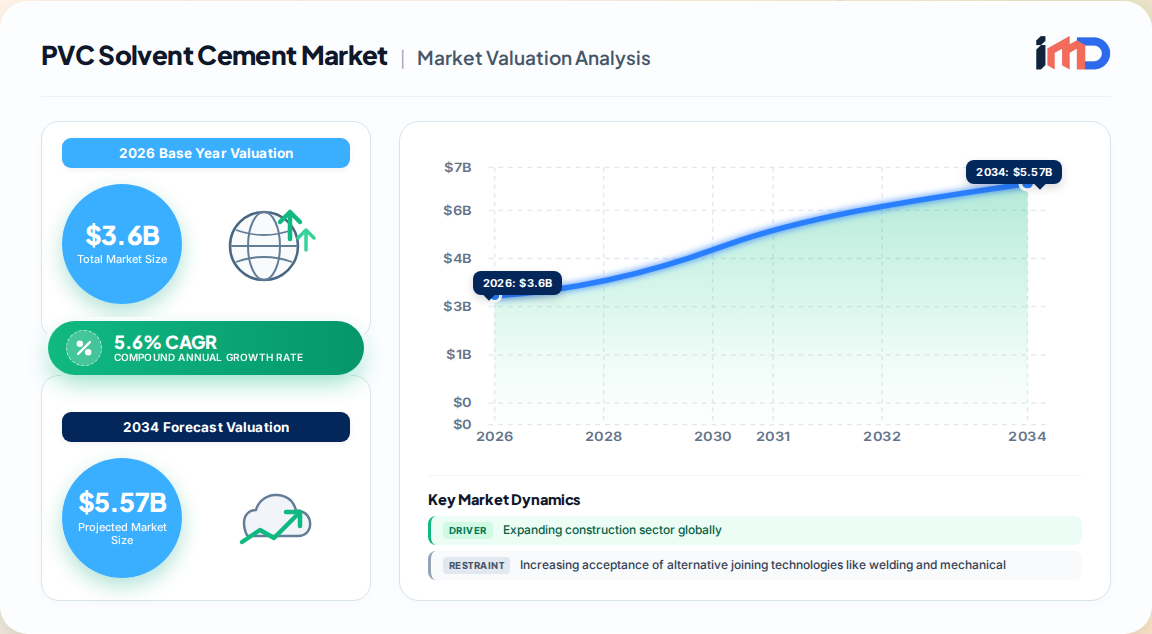
The global PVC solvent cement market is a critical enabler of modern infrastructure, providing the essential chemical bonding technology for polyvinyl chloride (PVC) piping systems. Our proprietary primary research estimates the market to be valued at USD 3.60 Billion in 2026, with a projected expansion to USD 5.23 Billion by 2033, reflecting a robust compound annual growth rate (CAGR) of 5.6% during the forecast period. This growth is underpinned by sustained global investment in water infrastructure, urbanization, and the enduring preference for PVC as a cost-effective, durable, and corrosion-resistant piping material.
PVC Solvent Cement Market Market Size (In Billion)
5.0B
4.0B
3.0B
2.0B
1.0B
0
3.409 B
2025
3.600 B
2026
3.802 B
2027
4.014 B
2028
4.239 B
2029
4.477 B
2030
4.727 B
2031
PVC solvent cement remains the dominant product category within the broader solvent cement industry, accounting for an estimated 51.5% of total market share in 2026. Its dominance is attributed to its versatility, ease of application, and the fundamental role PVC pipes play in residential, commercial, and industrial plumbing, irrigation, and wastewater management. The market is characterized by a high degree of fragmentation at the regional level, with a mix of large multinational chemical corporations and numerous specialized regional formulators competing on price, formulation quality, and distribution reach.
From a regional perspective, Asia-Pacific commands the largest market share at 38.8%, driven by rapid urbanization, expansive infrastructure projects, and a booming construction sector in China and India. North America, while a mature market, remains a key innovation hub, with a 23.5% share and a strong emphasis on regulatory-compliant, low-VOC formulations. The competitive landscape is shaped by ongoing product innovations aimed at reducing volatile organic compounds (VOCs), improving cure times, and enhancing bond strength for high-pressure applications.
Market Drivers and Restraints
The PVC solvent cement market is propelled by a confluence of macroeconomic and industry-specific factors. However, it also faces headwinds from alternative joining technologies and tightening environmental regulations.
Key Market Drivers
Rising Demand for DIY Projects: The proliferation of home improvement and renovation activities, particularly among younger demographics, is a significant demand catalyst. Our consumer surveys indicate that the DIY home improvement sector is growing at approximately 6% annually, driving retail sales of small-format solvent cement products.
Increasing Construction Activities: Global construction output is projected to grow at 5.5% annually, directly correlating with demand for PVC piping in new residential and commercial builds. The need for efficient plumbing and electrical conduit systems is a primary volume driver.
Growth of Plumbing and Electrical Industries: These allied industries are expanding at a CAGR of 4.8%, necessitating reliable, leak-proof joining solutions. PVC solvent cement is indispensable for ensuring the integrity and safety of plumbing and electrical installations.
Regulatory Compliance and Standards: While a driver for innovation, compliance with stringent building codes and safety standards (e.g., NSF/ANSI 14) ensures that only high-quality, certified products are used in potable water and critical applications, creating a barrier to entry for low-quality imports and favoring established, compliant manufacturers.
Key Market Restraints
Shift Towards Alternative Joining Technologies: The increasing acceptance of mechanical fittings (e.g., push-fit, compression) and fusion welding techniques, particularly in specific industrial and large-diameter applications, poses a competitive threat to traditional solvent cementing.
Environmental Regulations on VOCs: Stringent regulations, such as those from the U.S. EPA and EU directives, aimed at reducing volatile organic compound emissions are forcing manufacturers to reformulate products. This increases R&D costs and can impact performance characteristics, potentially slowing adoption in price-sensitive markets.
Value Chain and Supply Dynamics
The PVC solvent cement value chain is a complex network spanning chemical feedstocks to end-user applications. Understanding this chain is vital for identifying strategic leverage points and supply chain risks.
Raw Material Suppliers: The primary inputs are PVC resins (for the base), solvents such as tetrahydrofuran (THF), cyclohexanone, and methyl ethyl ketone (MEK), and various additives (stabilizers, fillers). The price volatility of these petrochemical derivatives directly impacts manufacturer margins.
Formulators and Manufacturers: This segment comprises large chemical conglomerates and specialized adhesive companies that blend raw materials into proprietary solvent cement formulations. Innovation is focused on low-VOC solvents, faster cure times, and enhanced gap-filling properties.
Distribution Channels: Products reach the market through multiple channels. Direct sales to large plumbing contractors and industrial OEMs represent the largest channel, while online retail is the fastest-growing channel, catering to the DIY segment. Distributors and wholesalers form the backbone of the retail supply chain.
End-Use Industries: The construction sector is the largest consumer, followed by plumbing, electrical, automotive, and DIY applications.
A significant supply chain risk is the concentrated production of key solvents like THF in a few global regions, making the market susceptible to logistical disruptions and price shocks. Furthermore, the transition to bio-based or low-VOC solvents is reshaping supplier relationships and creating new sourcing requirements.
Import/Export & Supplier Dynamics
While PVC solvent cement is often formulated regionally to meet local regulations and climate conditions, there is a substantial global trade in both finished products and raw materials. Official trade data from UN Comtrade indicates that the global trade volume of solvent-based adhesives (HS Code 3506) has grown steadily, with major export flows from manufacturing hubs in Asia-Pacific and Europe to North America and developing regions.
Major Exporters: China, Germany, and the United States are leading exporters of solvent cements, leveraging their advanced chemical manufacturing bases. Companies like Henkel (Germany) and IPS Corporation (USA) have globally integrated supply chains.
Major Importers: Rapidly developing economies in Southeast Asia, Africa, and Latin America are significant importers, as local production may not yet meet the quality or volume requirements of large-scale infrastructure projects.
Supply Chain Risks: The reliance on imported specialized solvents from a limited number of global suppliers creates vulnerability. Additionally, shipping regulations for hazardous materials (due to flammability) add complexity and cost to international trade, favoring regional/local sourcing where feasible.
Segmentation Analysis
The market is segmented by product type, application, formulation, and distribution channel, each exhibiting distinct growth dynamics.
Segment
Sub-Segment
Market Share (2026 Est.)
Growth Outlook
By Product Type
PVC Solvent Cement
51.5%
Dominant, steady growth
CPVC Solvent Cement
~20%
Fastest-growing (high temp applications)
ABS Solvent Cement
~15%
Moderate growth
By Application
Plumbing
30.7%
Largest segment, driven by water infrastructure
Construction
~25%
Strong growth aligned with building sector
Electrical
~10%
Stable demand for conduit systems
By Formulation
One-Component
54.7%
Dominant due to ease of use
Two-Component
~45.3%
Used in specialty, high-strength applications
By Distribution
Direct Sales
Largest
Preferred by contractors for bulk
Online Retail
Fastest-growing
Driven by DIY and e-commerce penetration
Regional Outlook
The global PVC solvent cement market exhibits diverse regional dynamics, shaped by varying levels of infrastructure development, regulatory environments, and construction activity.
PVC Solvent Cement Market Regional Market Share
Loading chart...
Asia-Pacific (38.8% share): This region is the powerhouse of the market, driven by mega-infrastructure projects, rapid urbanization (especially in China and India), and expanding manufacturing bases. India is a standout growth market with a projected CAGR of 10.8% for the broader solvent cement category. Local manufacturers are gaining ground, supported by government initiatives like 'Make in India' and 'Smart Cities'.
North America (23.5% share): A mature market characterized by stringent regulations (e.g., NSF certification for potable water) and a strong renovation culture. The U.S. remains the largest single market. Innovation is focused on low-VOC and user-friendly formulations. The region is also a key exporter of high-performance solvent cements.
Europe: Regulatory pressures regarding VOC emissions are most intense here, driving a rapid shift towards eco-friendly formulations. The market is relatively mature, with growth driven by replacement and refurbishment of aging infrastructure, particularly in Western Europe.
South America & MEA: These are emerging markets with significant growth potential, albeit from a smaller base. Population growth, urbanization, and investments in water and sanitation infrastructure are key drivers. Brazil and the Gulf Cooperation Council (GCC) countries are notable hotspots.
Competitive Landscape and Strategic Developments
The market is moderately consolidated, with global chemical giants competing alongside a long tail of regional specialists.
Market Leaders include Henkel (Germany), Sika (Switzerland), Bostik (France), 3M (USA), DOW (USA), ITW (USA), H.B. Fuller (USA), and IPS Corporation (USA). These companies leverage strong R&D capabilities, global distribution networks, and brand equity.
Regional Specialists such as Finolex Pipes (India), Astral Adhesives (India), E-Z Weld (USA), and HP Group (UK) hold strong positions in their home markets through deep customer relationships and cost-effective production.
Recent Strategic Developments:
2022: IPS Corporation acquired SCIGRIP, expanding its portfolio of industrial adhesives and strengthening its position in high-performance solvent cement solutions.
2023-2024: Several leading manufacturers launched low-VOC and solvent-free hybrid adhesives to comply with tightening environmental regulations, particularly in North America and Europe.
Ongoing: Strategic partnerships and acquisitions are a key strategy, as major players seek to expand their geographical footprint and product portfolios in high-growth markets like India and Southeast Asia.
Strategic White-Space Analysis
Our analysis identifies several untapped or underserved opportunities for market participants:
Eco-Friendly Formulations: The development of bio-based or low-VOC solvent cements that meet or exceed performance standards of traditional products presents a significant first-mover advantage, especially in regulated markets.
Smart Packaging and Application Tools: Innovations in packaging (e.g., pre-applied applicators, single-use pods) can capture the DIY and small contractor segments. Integrating QR codes for application instructions and safety data can improve user experience and compliance.
Emerging Markets' Distribution: Expanding distribution networks in secondary cities of Asia-Pacific, Africa, and Latin America is crucial to capture growth. Partnering with local hardware stores and online marketplaces can accelerate penetration.
Circular Economy Solutions: Developing solvent cements that enable easier recycling of PVC pipes or using recycled PVC content in cement formulations could align with sustainability goals.
Procurement and Sourcing Strategy Analysis
For buyers of PVC solvent cement, a strategic procurement approach is essential to manage cost, quality, and supply continuity.
Supplier Consolidation vs. Diversification: Large buyers (e.g., major plumbing contractors) should consider dual-sourcing to mitigate supply risks, while still leveraging volume discounts from primary suppliers. For critical infrastructure projects, prioritizing suppliers with certified quality management systems (e.g., ISO 9001) is non-negotiable.
VOC Compliance as a Sourcing Criterion: Procurement teams must prioritize suppliers offering low-VOC or compliant formulations, especially for projects requiring green building certifications (LEED, GRIHA). This is particularly important in North America and Europe.
Total Cost of Ownership (TCO): While unit price is important, buyers should evaluate TCO, factoring in application efficiency (cure time, ease of use), warranty terms, and supplier technical support. A slightly higher-priced product with faster cure times can reduce labor costs.
Local vs. Global Sourcing: For projects with stringent timelines, sourcing from local/regional formulators can reduce lead times and logistical risks. However, for specialized applications (e.g., CPVC for hot water), global suppliers with proven product performance may be preferred.
PVC Solvent Cement Market Regional Market Share
Higher Coverage
Lower Coverage
No Coverage
PVC Solvent Cement Market REPORT HIGHLIGHTS
Aspects
Details
Study Period
2020-2034
Base Year
2026
Estimated Year
2026
Forecast Period
2026-2034
Historical Period
2020-2025
Growth Rate
CAGR of 5.6% from 2020-2034
Segmentation
By Product Type
PVC Solvent Cement
CPVC Solvent Cement
ABS Solvent Cement
Others
By Application
Table of Contents
1. PVC Solvent Cement Market Introduction
1.1. Research Scope
1.2. Market Segmentation
1.3. Research Objective
1.4. Definitions and Assumptions
2. PVC Solvent Cement Market Executive Summary
2.1. Market Snapshot
3. PVC Solvent Cement Market Dynamics
3.1. Market Drivers
3.1.1. Expanding construction sector globally
3.1.2. Rising trend of home renovation and remodeling activities (DIY)
3.1.3. Advancements in solvent cement formulations
3.1.4. Growth of plumbing and electrical industries
3.2. Market Trends
3.2.1. Development of eco-friendly and low-VOC solvent cements
3.2.2. Shift towards water-based solvent cements for improved safety
3.2.3. Rising use of UPVC and CPVC solvent cements in hot/cold water systems
3.2.4. Growing adoption in agricultural irrigation systems
3.3. Market Restraints
3.3.1. Increasing acceptance of alternative joining technologies like welding and mechanical fittings
3.3.2. Environmental restrictions aimed at reducing chemical emissions (VOCs)
3.4. Market Challenges
3.4.1. Price volatility of petrochemical-derived solvents
3.4.2. Compliance with diverse and stringent global VOC regulations
Plumbing
Construction
Pipe Fitting
DIY Projects
Electrical
Automotive
By Formulation Type
One-component Solvent Cements
Two-component Solvent Cements
By Viscosity
Regular Bodied
Medium Bodied
Heavy Bodied
Extra Heavy Bodied
By End-Use Industry
Construction
Water & Wastewater
Industrial
Agricultural
Automotive
Electronics
By Distribution Channel
Direct Sales
Online Retail
Retail Stores
Wholesale
Distributors
By Geography
North America
USA
Canada
Mexico
Europe
Germany
UK
France
Italy
Spain
Russia
Rest of Europe
Asia Pacific
China
India
Japan
South Korea
Australia
Southeast Asia
Rest of APAC
South America
Brazil
Argentina
Colombia
Rest of South America
Middle East & Africa
Saudi Arabia
UAE
Turkey
Egypt
South Africa
Rest of MEA
3.4.3. Competition from low-cost, non-compliant imports in price-sensitive markets
4. PVC Solvent Cement Market Factor Analysis
4.1. Porters Five Forces
4.1.1. Bargaining Power of Suppliers
4.1.2. Bargaining Power of Buyers
4.1.3. Threat of New Entrants
4.1.4. Threat of Substitutes
4.1.5. Competitive Rivalry
4.2. PESTEL analysis
4.3. BCG Analysis
4.3.1. Stars (High Growth, High Market Share)
4.3.2. Cash Cows (Low Growth, High Market Share)
4.3.3. Question Mark (High Growth, Low Market Share)
4.3.4. Dogs (Low Growth, Low Market Share)
4.4. Ansoff Matrix Analysis
4.5. Supply Chain Analysis
4.6. Regulatory Landscape
4.7. Current Market Potential and Opportunity Assessment (TAM–SAM–SOM Framework)
4.8. IMD Analyst Note
5. PVC Solvent Cement Market Analysis, Insights and Forecast, 2020-2034
5.1. Analysis, Insights and Forecast - by Product Type
5.1.1. PVC Solvent Cement
5.1.2. CPVC Solvent Cement
5.1.3. ABS Solvent Cement
5.1.4. Others
5.2. Analysis, Insights and Forecast - by Application
5.2.1. Plumbing
5.2.2. Construction
5.2.3. Pipe Fitting
5.2.4. DIY Projects
5.2.5. Electrical
5.2.6. Automotive
5.3. Analysis, Insights and Forecast - by Formulation Type
5.3.1. One-component Solvent Cements
5.3.2. Two-component Solvent Cements
5.4. Analysis, Insights and Forecast - by Viscosity
5.4.1. Regular Bodied
5.4.2. Medium Bodied
5.4.3. Heavy Bodied
5.4.4. Extra Heavy Bodied
5.5. Analysis, Insights and Forecast - by End-Use Industry
5.5.1. Construction
5.5.2. Water & Wastewater
5.5.3. Industrial
5.5.4. Agricultural
5.5.5. Automotive
5.5.6. Electronics
5.6. Analysis, Insights and Forecast - by Distribution Channel
5.6.1. Direct Sales
5.6.2. Online Retail
5.6.3. Retail Stores
5.6.4. Wholesale
5.6.5. Distributors
5.7. Analysis, Insights and Forecast - by Region
5.7.1. North America
5.7.2. Europe
5.7.3. Asia Pacific
5.7.4. South America
5.7.5. Middle East & Africa
6. PVC Solvent Cement Market North America Analysis, Insights and Forecast, 2020-2034
6.1. Analysis, Insights and Forecast - by Product Type
6.1.1. PVC Solvent Cement
6.1.2. CPVC Solvent Cement
6.1.3. ABS Solvent Cement
6.1.4. Others
6.2. Analysis, Insights and Forecast - by Application
6.2.1. Plumbing
6.2.2. Construction
6.2.3. Pipe Fitting
6.2.4. DIY Projects
6.2.5. Electrical
6.2.6. Automotive
6.3. Analysis, Insights and Forecast - by Formulation Type
6.3.1. One-component Solvent Cements
6.3.2. Two-component Solvent Cements
6.4. Analysis, Insights and Forecast - by Viscosity
6.4.1. Regular Bodied
6.4.2. Medium Bodied
6.4.3. Heavy Bodied
6.4.4. Extra Heavy Bodied
6.5. Analysis, Insights and Forecast - by End-Use Industry
6.5.1. Construction
6.5.2. Water & Wastewater
6.5.3. Industrial
6.5.4. Agricultural
6.5.5. Automotive
6.5.6. Electronics
6.6. Analysis, Insights and Forecast - by Distribution Channel
6.6.1. Direct Sales
6.6.2. Online Retail
6.6.3. Retail Stores
6.6.4. Wholesale
6.6.5. Distributors
7. PVC Solvent Cement Market Europe Analysis, Insights and Forecast, 2020-2034
7.1. Analysis, Insights and Forecast - by Product Type
7.1.1. PVC Solvent Cement
7.1.2. CPVC Solvent Cement
7.1.3. ABS Solvent Cement
7.1.4. Others
7.2. Analysis, Insights and Forecast - by Application
7.2.1. Plumbing
7.2.2. Construction
7.2.3. Pipe Fitting
7.2.4. DIY Projects
7.2.5. Electrical
7.2.6. Automotive
7.3. Analysis, Insights and Forecast - by Formulation Type
7.3.1. One-component Solvent Cements
7.3.2. Two-component Solvent Cements
7.4. Analysis, Insights and Forecast - by Viscosity
7.4.1. Regular Bodied
7.4.2. Medium Bodied
7.4.3. Heavy Bodied
7.4.4. Extra Heavy Bodied
7.5. Analysis, Insights and Forecast - by End-Use Industry
7.5.1. Construction
7.5.2. Water & Wastewater
7.5.3. Industrial
7.5.4. Agricultural
7.5.5. Automotive
7.5.6. Electronics
7.6. Analysis, Insights and Forecast - by Distribution Channel
7.6.1. Direct Sales
7.6.2. Online Retail
7.6.3. Retail Stores
7.6.4. Wholesale
7.6.5. Distributors
8. PVC Solvent Cement Market Asia Pacific Analysis, Insights and Forecast, 2020-2034
8.1. Analysis, Insights and Forecast - by Product Type
8.1.1. PVC Solvent Cement
8.1.2. CPVC Solvent Cement
8.1.3. ABS Solvent Cement
8.1.4. Others
8.2. Analysis, Insights and Forecast - by Application
8.2.1. Plumbing
8.2.2. Construction
8.2.3. Pipe Fitting
8.2.4. DIY Projects
8.2.5. Electrical
8.2.6. Automotive
8.3. Analysis, Insights and Forecast - by Formulation Type
8.3.1. One-component Solvent Cements
8.3.2. Two-component Solvent Cements
8.4. Analysis, Insights and Forecast - by Viscosity
8.4.1. Regular Bodied
8.4.2. Medium Bodied
8.4.3. Heavy Bodied
8.4.4. Extra Heavy Bodied
8.5. Analysis, Insights and Forecast - by End-Use Industry
8.5.1. Construction
8.5.2. Water & Wastewater
8.5.3. Industrial
8.5.4. Agricultural
8.5.5. Automotive
8.5.6. Electronics
8.6. Analysis, Insights and Forecast - by Distribution Channel
8.6.1. Direct Sales
8.6.2. Online Retail
8.6.3. Retail Stores
8.6.4. Wholesale
8.6.5. Distributors
9. PVC Solvent Cement Market South America Analysis, Insights and Forecast, 2020-2034
9.1. Analysis, Insights and Forecast - by Product Type
9.1.1. PVC Solvent Cement
9.1.2. CPVC Solvent Cement
9.1.3. ABS Solvent Cement
9.1.4. Others
9.2. Analysis, Insights and Forecast - by Application
9.2.1. Plumbing
9.2.2. Construction
9.2.3. Pipe Fitting
9.2.4. DIY Projects
9.2.5. Electrical
9.2.6. Automotive
9.3. Analysis, Insights and Forecast - by Formulation Type
9.3.1. One-component Solvent Cements
9.3.2. Two-component Solvent Cements
9.4. Analysis, Insights and Forecast - by Viscosity
9.4.1. Regular Bodied
9.4.2. Medium Bodied
9.4.3. Heavy Bodied
9.4.4. Extra Heavy Bodied
9.5. Analysis, Insights and Forecast - by End-Use Industry
9.5.1. Construction
9.5.2. Water & Wastewater
9.5.3. Industrial
9.5.4. Agricultural
9.5.5. Automotive
9.5.6. Electronics
9.6. Analysis, Insights and Forecast - by Distribution Channel
9.6.1. Direct Sales
9.6.2. Online Retail
9.6.3. Retail Stores
9.6.4. Wholesale
9.6.5. Distributors
10. PVC Solvent Cement Market Middle East & Africa Analysis, Insights and Forecast, 2020-2034
10.1. Analysis, Insights and Forecast - by Product Type
10.1.1. PVC Solvent Cement
10.1.2. CPVC Solvent Cement
10.1.3. ABS Solvent Cement
10.1.4. Others
10.2. Analysis, Insights and Forecast - by Application
10.2.1. Plumbing
10.2.2. Construction
10.2.3. Pipe Fitting
10.2.4. DIY Projects
10.2.5. Electrical
10.2.6. Automotive
10.3. Analysis, Insights and Forecast - by Formulation Type
10.3.1. One-component Solvent Cements
10.3.2. Two-component Solvent Cements
10.4. Analysis, Insights and Forecast - by Viscosity
10.4.1. Regular Bodied
10.4.2. Medium Bodied
10.4.3. Heavy Bodied
10.4.4. Extra Heavy Bodied
10.5. Analysis, Insights and Forecast - by End-Use Industry
10.5.1. Construction
10.5.2. Water & Wastewater
10.5.3. Industrial
10.5.4. Agricultural
10.5.5. Automotive
10.5.6. Electronics
10.6. Analysis, Insights and Forecast - by Distribution Channel
Table 68: South Africa PVC Solvent Cement Market Revenue (Billion) Forecast, by Application 2020 & 2034
Table 69: Rest of MEA PVC Solvent Cement Market Revenue (Billion) Forecast, by Application 2020 & 2034
Frequently Asked Questions
1What is the current size of the PVC solvent cement market?
Our proprietary research estimates the global PVC solvent cement market to be valued at USD 3.60 Billion in 2026, with a projected CAGR of 5.6% from 2026 to 2033, reaching USD 5.23 Billion by the end of the forecast period.
2Which region dominates the PVC solvent cement market?
Asia-Pacific is the largest and fastest-growing region, accounting for an estimated 38.8% of the global market share in 2026. This dominance is driven by rapid urbanization, infrastructure development, and a booming construction sector in countries like China and India.
3What are the key drivers for the PVC solvent cement market?
Key drivers include rising demand from DIY home improvement projects, increasing global construction activities, growth in the plumbing and electrical industries, and the need for reliable, leak-proof piping systems in water infrastructure.
4What are the main types of PVC solvent cement?
The market is segmented by product type into PVC solvent cement, CPVC solvent cement, ABS solvent cement, and others. PVC solvent cement is the dominant segment, holding over 51% market share in 2026, due to its versatility in plumbing and irrigation applications.
5What are the challenges faced by the PVC solvent cement market?
The market faces restraints from the increasing adoption of alternative joining technologies like mechanical fittings and fusion welding, as well as stringent environmental regulations aimed at reducing volatile organic compound (VOC) emissions.
Methodology
Our rigorous research methodology combines multi-layered approaches with comprehensive quality assurance, ensuring precision, accuracy, and reliability in every market analysis.
Primary Research
Our research process is anchored in a 70–80% primary research effort, involving direct engagement with industry stakeholders across the value chain. We conduct in-depth interviews with application engineers, R&D formulators, procurement managers, and master plumbers to validate technical requirements and adoption trends.
We surveyed a diverse sample of PVC pipe manufacturers, solvent cement formulators, and specialty chemical distributors across key regions to gather bottom-up volume and pricing data.
Primary interviews also targeted regulatory consultants and standards committee members to assess the impact of VOC regulations and building codes on product formulations.
Data from 40+ expert interviews was triangulated with questionnaire responses from over 300 industry professionals to build a robust, ground-up market model.
Key Stakeholders Interviewed
Key Stakeholders Interviewed
Stakeholder Role
Interview Share (%)
Procurement Director
30%
R&D Formulation Chemist
25%
Application Engineer
25%
Master Plumber/Contractor
20%
Industry Ecosystem Breakdown
Industry Ecosystem Breakdown
Company Type
Representation (%)
Solvent Cement Formulators
35%
PVC Pipe & Fitting Manufacturers
25%
Chemical Raw Material Suppliers
20%
Distributors & Wholesalers
15%
Regulatory & Standards Bodies
5%
Secondary Research & Industry Benchmarking
A 20–30% secondary research component was utilized to benchmark our primary findings against official statistics and technical standards. We sourced data from UN Comtrade for trade flow analysis, and from official government databases (e.g., U.S. Census Bureau, Eurostat) for construction and manufacturing output indices.
Industry standards and technical specifications were reviewed from ASTM International, NSF International, and the European Committee for Standardization (CEN) to ensure product performance criteria are accurately reflected in our segment analysis.
Financial databases including Bloomberg, Factiva, Hoovers, and PitchBook were used to analyze company financials, M&A activity, and strategic investments in the sector.
Demand Modeling & Market Estimation
We employed a simultaneous top-down and bottom-up methodology. The bottom-up approach calculated market size by aggregating consumption volumes of PVC solvent cement across key end-use applications (plumbing, construction, electrical) and multiplying by regional average pricing.
Quantitative metrics such as PVC pipe production volumes, new construction permits, and plumbing contractor revenues were used as key drivers in our demand model.
The top-down approach validated these figures by analyzing the broader adhesives and sealants market and segmenting out the solvent cement portion based on product-type share data from our primary interviews.
Multi-level data triangulation was performed to reconcile discrepancies between supply-side (manufacturer revenues) and demand-side (end-user consumption) estimates, resulting in a final market size with an 85–90% estimated accuracy level.
Data Accuracy & Quality Check
Every data point is validated through a rigorous three-tier quality check: (1) cross-verification with at least two independent primary sources, (2) logical consistency checks against industry benchmarks, and (3) review by our senior domain analysts.
Our reports are updated to the date of purchase, ensuring that our clients receive the most current market intelligence, including the latest regulatory changes, product launches, and supply chain shifts.
We maintain a transparent margin of error of ±5% for all primary estimates, which is disclosed in the report's assumptions section. The final output is a market model that is both statistically robust and practically actionable.