Insight Market Data is a premier market research and business consulting firm headquartered in Pune, India, providing syndicated research reports, customized intelligence studies, and strategic advisory services. Renowned academic institutions and Fortune 500 corporations worldwide rely on Insight Market Data's research repository to navigate evolving global and regional business environments. Covering 46 diverse industries across 25 major international economies, our comprehensive database delivers thousands of verified statistics and granular market evaluations. By combining industry-leading analytical methodologies with the direct insights of seasoned industry leaders and subject-matter experts, we deliver actionable intelligence spanning historical performance benchmarks to rigorous multi-year forecasts. We empower organizations to make confident, data-driven decisions across pivotal domains including Machinery & Equipment, Chemicals & Materials, Pharmaceuticals & Healthcare, Food & Beverages, Consumer Goods, Energy & Power, Automotive & Transportation, Electronics & Semiconductors, Medical Devices, Telecommunications, Emerging Technologies, Agriculture, and Packaging. Our multidisciplinary analyst teams provide an objective 360-degree perspective, tailoring every engagement to address complex strategic challenges with exceptional analytical rigor.
Leveraging advanced BI-powered analytics and predictive modeling, Insight Market Data uncovers high-impact market opportunities and competitive differentiators for ambitious enterprises. We continuously refine our research methodologies in accordance with global industry standards, tracking real-time market shifts to ensure our reports are consistently accurate, actionable, and delivered on schedule. Our analysts conduct methodical data validation, rigorous compliance checks, and exhaustive primary and secondary research to maintain the highest levels of data integrity and transparency. We partner closely with corporate strategists, investment groups, and business executives to translate intricate market intelligence into clear, actionable roadmaps for sustainable growth. With operational presence across Washington, USA, and Vimannagar, Pune, India, Insight Market Data ensures direct access to dedicated research specialists and responsive customer support to answer your most strategic questions.
UAE Luxury Goods Market by Type (Travel and Hotel, Cars, Personal Luxury Goods, Food and Drinks, Others), by Gender (Male, Female), by Distribution Channel (Monobrand Stores, Multi-Brand Stores, Online, Others), by Dubai, by Abu Dhabi, by Sharjah & Northern Emirates Forecast 2026-2034
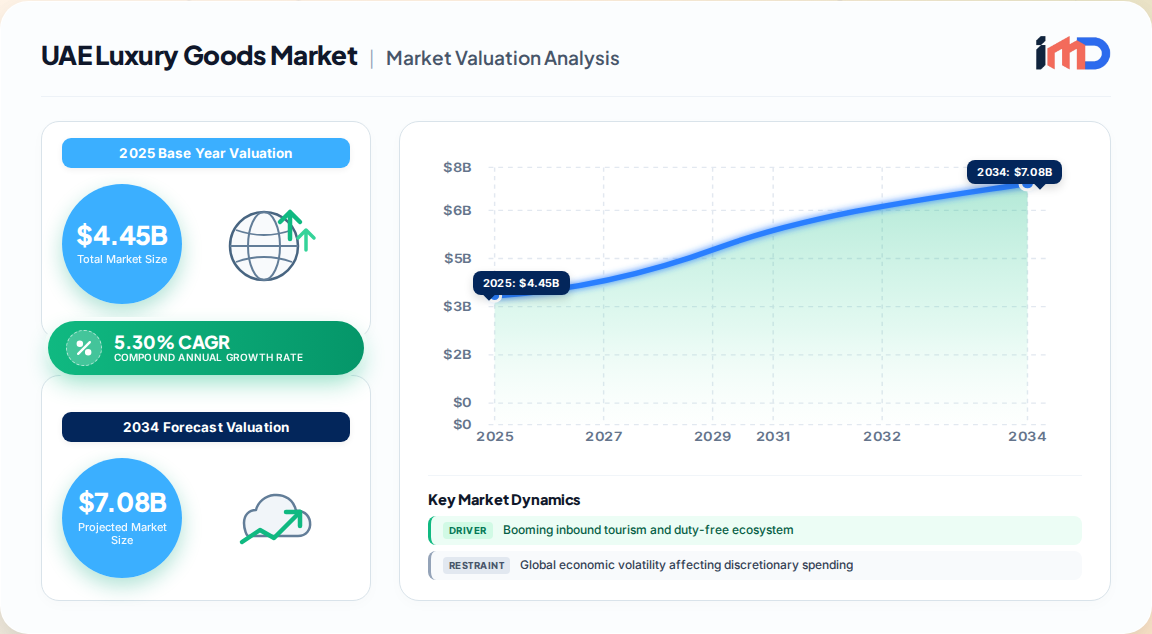
The UAE luxury goods market is a cornerstone of the region's diversified economy, having matured into a global epicenter for high-end retail and experiential consumption. Our proprietary primary research estimates the market at USD 4.45 Billion in 2025, with a projected trajectory to USD 7.09 Billion by 2034, expanding at a 5.30% CAGR.
UAE Luxury Goods Market Market Size (In Billion)
7.5B
6.0B
4.5B
3.0B
1.5B
0
4.450 B
2025
4.686 B
2026
4.934 B
2027
5.196 B
2028
5.471 B
2029
5.761 B
2030
6.066 B
2031
This growth is underpinned by a confluence of unique structural advantages: a tax-advantaged environment, world-class aviation and hospitality infrastructure, and a resident population with one of the highest concentrations of high-net-worth individuals (HNWIs) globally. The market is characterized by a sophisticated consumer base that views luxury as both a statement of status and an investment in quality and experience.
Key Market Snapshot (2025):
Market Size: USD 4.45 Billion
Forecast (2034): USD 7.09 Billion
CAGR (2026-2034): 5.30%
Leading Segment: Travel & Hotel (34% share)
Leading Channel: Monobrand Stores (43% share)
Dominant Consumer Group: Male (55% share)
The market's resilience is further evidenced by robust macroeconomic fundamentals. According to World Bank data, the UAE's GDP reached USD 514.13 Billion in 2023, with a GNI per capita of USD 49,020, providing a powerful foundation for sustained luxury spending.
Market Drivers & Restraints
Drivers:
Booming Inbound Tourism: Dubai alone welcomed 9.88 million overnight visitors in H1 2025, a 6% year-on-year increase. This influx directly fuels demand for luxury hospitality, retail, and experiential offerings.
Tax-Free Shopping and Duty-Free Ecosystem: Dubai Duty Free achieved record sales of AED 7.9 Billion in 2024, underscoring the critical role of travel retail. The digital VAT refund system further incentivizes tourist spending.
Affluent Demographics and Wealth Migration: The UAE continues to attract HNWIs and ultra-high-net-worth individuals (UHNWIs) from across the globe, driving demand for premium real estate, exclusive vehicles, and bespoke services.
Retail Infrastructure Expansion: Mega-projects such as the AED 1.5 billion expansion of Dubai Mall and Majid Al Futtaim's USD 1.36 billion upgrade of Mall of the Emirates are creating unparalleled retail destinations.
Global Economic Volatility: Fluctuations in oil prices and global economic uncertainty can impact the discretionary spending of both tourists and residents.
Counterfeit and Grey Market Goods: Despite stricter IP enforcement, the availability of counterfeit luxury items poses a challenge to brand integrity and revenue.
Talent and Operational Costs: The high cost of doing business and attracting top-tier retail talent can pressure profit margins for brands.
Segmentation Analysis
By Type: The Travel and Hotel segment leads with a 34% share in 2025, reflecting the UAE's status as a premier tourism destination. Luxury hotels, resorts, and branded residences are key growth drivers. The Cars segment follows, driven by a strong affinity for premium automobiles. Personal Luxury Goods (apparel, leather goods, watches, jewelry) remain a significant and growing segment, projected to expand at a 7.22% CAGR for watches through 2031.
By Gender: Male consumers dominate with a 55% share, largely due to high spending on luxury automobiles, watches, and premium lifestyle products. However, female participation is rising, with women accounting for 60.98% of the personal luxury goods market in 2025, particularly in apparel and jewelry.
By Distribution Channel:Monobrand stores hold the largest share at 43%, offering immersive brand experiences and personalized services. Online luxury stores are the fastest-growing channel, advancing at a 7.1% CAGR, as brands invest in omnichannel strategies.
Competitive Landscape
The market is moderately concentrated, with global luxury conglomerates and regional players vying for share. Key players include LVMH, Kering SA, Hermès International, Rolex SA, Chanel SA, and Compagnie Financière Richemont. These groups leverage extensive brand portfolios and flagship stores in prime locations such as Dubai Mall and The Galleria Al Maryah Island.
Strategic initiatives focus on:
Experiential Retail: Brands are creating immersive in-store experiences, including AR try-on and AI-powered styling consultations.
Localization: Limited-edition collections incorporating UAE heritage, such as Hublot's Arabic calligraphy watches, resonate strongly with collectors.
Sustainability: Initiatives like Cloudset's luxury rental platform cater to the growing demand for conscious consumption.
Regulatory & Trade Environment
The UAE's trade policy is highly conducive to luxury goods. In 2023, the simple average tariff was 3.95%, with 27.04% of tariff lines duty-free, facilitating the smooth import of high-end products. The total value of imports (CIF) reached USD 470.54 Billion in 2023, highlighting the country's role as a major trading hub.
Gold, a core luxury material, features prominently in trade. The UAE imported USD 75.73 Billion of unwrought non-monetary gold in 2023, while exporting USD 51.82 Billion, reflecting its position as a key node in the global gold trade.
Future Outlook & Strategic Opportunities
The UAE luxury goods market is poised for sustained growth, with strategic opportunities in:
Hyper-Personalization: Leveraging data and AI to offer bespoke products and services.
Experiential Luxury: Expanding offerings in fine dining, private members' clubs, and exclusive travel experiences.
Digital Integration: Seamless omnichannel platforms that blend the convenience of e-commerce with the assurance of physical boutiques.
Sustainability: Developing circular luxury models and eco-friendly product lines to appeal to conscious consumers.
By capitalizing on these trends, stakeholders can solidify the UAE's position as the world's leading luxury destination.
Value Chain Analysis
The luxury goods value chain in the UAE is characterized by a high degree of import dependence for finished goods, with local value addition primarily in retail, hospitality, and customization.
Design & Manufacturing: Primarily located in Europe (France, Italy, Switzerland).
Logistics & Distribution: The UAE serves as a major re-export hub, with Jebel Ali Port and Dubai International Airport facilitating global distribution.
Retail & Experience: Dominated by monobrand boutiques and department stores, with a growing emphasis on experiential retail.
After-Sales Services: Authorized service centers for watches, jewelry, and automobiles are critical for maintaining brand equity.
Import/Export & Supplier Dynamics
The UAE's luxury market is intrinsically linked to global trade flows. In 2023, the country's total imports stood at USD 470.5 Billion, with key partners including China (16.45%), India (6.47%), and the United States (5.71%).
Gold and jewelry are particularly significant. The UAE imported USD 16.43 Billion of jewelry articles in 2023, indicating strong domestic demand and re-export activity. The import of automobiles with reciprocating piston engines reached USD 10.89 Billion, underscoring the luxury car segment's importance.
The re-export of luxury goods is a key economic driver, with the UAE exporting USD 192.8 Billion in consumer goods in 2023, a 33.81% share of total exports.
Dubai: The undisputed capital of luxury retail, accounting for an estimated 62% of the market. Continuous investment in mega-malls and experiential retail ensures its dominance.
Abu Dhabi: A growing contender, with cultural investments like the Louvre Abu Dhabi and Saadiyat Island's luxury developments attracting a discerning clientele. Estimated 23% market share.
Sharjah & Northern Emirates: Emerging as niche destinations for boutique luxury and eco-luxury, with Ras Al Khaimah's Al Marjan Island gaining traction. Estimated 15% market share.
Investment in retail real estate, hospitality, and digital infrastructure is expected to yield high returns as the market expands.
UAE Luxury Goods Market Regional Market Share
Loading chart...
UAE Luxury Goods Market Regional Market Share
Higher Coverage
Lower Coverage
No Coverage
UAE Luxury Goods Market REPORT HIGHLIGHTS
Aspects
Details
Study Period
2020-2034
Base Year
2025
Estimated Year
2026
Forecast Period
2026-2034
Historical Period
2020-2025
Growth Rate
CAGR of 5.30% from 2020-2034
Segmentation
By Type
Travel and Hotel
Cars
Personal Luxury Goods
Food and Drinks
Others
By Gender
Male
Female
By Distribution Channel
Monobrand Stores
Multi-Brand Stores
Online
Others
By Geography
Dubai
Abu Dhabi
Sharjah & Northern Emirates
Table of Contents
1. UAE Luxury Goods Market Introduction
1.1. Research Scope
1.2. Market Segmentation
1.3. Research Objective
1.4. Definitions and Assumptions
2. UAE Luxury Goods Market Executive Summary
2.1. Market Snapshot
3. UAE Luxury Goods Market Dynamics
3.1. Market Drivers
3.1.1. Booming inbound tourism and duty-free ecosystem
3.1.2. Expansion of luxury shopping malls and retail real-estate
3.1.3. Affluent demographics and wealth migration
3.1.4. Tax-free shopping environment
3.2. Market Trends
3.2.1. Rising experiential luxury and personalization
3.2.2. Digital transformation and omnichannel integration
3.2.3. Sustainable and conscious luxury consumption
3.3. Market Restraints
3.3.1. Global economic volatility affecting discretionary spending
3.3.2. Counterfeit and grey market goods
3.3.3. High operational costs
3.4. Market Challenges
3.4.1. Attracting and retaining top retail talent
3.4.2. Balancing exclusivity with digital accessibility
3.4.3. Adapting to rapidly changing consumer preferences
4. UAE Luxury Goods Market Factor Analysis
4.1. Porters Five Forces
4.1.1. Bargaining Power of Suppliers
4.1.2. Bargaining Power of Buyers
4.1.3. Threat of New Entrants
4.1.4. Threat of Substitutes
4.1.5. Competitive Rivalry
4.2. PESTEL analysis
4.3. BCG Analysis
4.3.1. Stars (High Growth, High Market Share)
4.3.2. Cash Cows (Low Growth, High Market Share)
4.3.3. Question Mark (High Growth, Low Market Share)
4.3.4. Dogs (Low Growth, Low Market Share)
4.4. Ansoff Matrix Analysis
4.5. Supply Chain Analysis
4.6. Regulatory Landscape
4.7. Current Market Potential and Opportunity Assessment (TAM–SAM–SOM Framework)
4.8. IMD Analyst Note
5. UAE Luxury Goods Market Analysis, Insights and Forecast, 2020-2034
5.1. Analysis, Insights and Forecast - by Type
5.1.1. Travel and Hotel
5.1.2. Cars
5.1.3. Personal Luxury Goods
5.1.4. Food and Drinks
5.1.5. Others
5.2. Analysis, Insights and Forecast - by Gender
5.2.1. Male
5.2.2. Female
5.3. Analysis, Insights and Forecast - by Distribution Channel
Table 7: Dubai UAE Luxury Goods Market Revenue Billion Forecast, by Distribution Channel 2020 & 2034
Table 8: Dubai UAE Luxury Goods Market Revenue Billion Forecast, by Country 2020 & 2034
Table 9: Abu Dhabi UAE Luxury Goods Market Revenue Billion Forecast, by Type 2020 & 2034
Abu Dhabi UAE Luxury Goods Market Revenue Billion Forecast, by Gender 2020 & 2034
Frequently Asked Questions
1What is the current size of the UAE luxury goods market?
The UAE luxury goods market was valued at USD 4.45 Billion in 2025, as per our proprietary research.
2What is the expected growth rate of the UAE luxury market?
The market is projected to grow at a CAGR of 5.30% from 2026 to 2034, reaching USD 7.09 Billion by 2034.
3Which segment dominates the UAE luxury market?
Travel and Hotel is the leading segment, accounting for a 34% share in 2025, driven by the UAE's thriving tourism sector.
4Who are the major players in the UAE luxury goods market?
Key players include LVMH Moët Hennessy Louis Vuitton, Kering SA, Hermès International, Rolex SA, and Chanel SA, among others.
Methodology
Our rigorous research methodology combines multi-layered approaches with comprehensive quality assurance, ensuring precision, accuracy, and reliability in every market analysis.
Primary Research
Our research process is anchored in a 70–80% primary research effort, involving direct engagement with industry stakeholders across the UAE luxury value chain.
We conducted extensive interviews with 4–5 specific company types: luxury brand executives (e.g., regional managers of LVMH, Kering), high-end retailers (e.g., Al Tayer Group, Chalhoub Group), hospitality and travel operators (e.g., Jumeirah Group, Emirates Palace), real estate developers (e.g., Emaar, Majid Al Futtaim), and digital platform providers.
We also engaged with 3–4 real industry associations/regulatory bodies: Dubai Chamber of Commerce, UAE Ministry of Economy (for trade and IP regulations), World Travel & Tourism Council (WTTC), and the Dubai Department of Economy and Tourism (DET).
Primary data collection focuses on 3–4 quantitative metrics: average transaction value per luxury consumer, store footfall and conversion rates, online vs. offline revenue split, and tourist spending per capita in luxury categories.
Key Stakeholders Interviewed
Key Stakeholders Interviewed
Stakeholder Role
Interview Share (%)
Chief Marketing Officer
25%
Retail Operations Director
30%
Luxury Brand Manager
25%
Procurement Director
20%
Industry Ecosystem Breakdown
Industry Ecosystem Breakdown
Company Type
Representation (%)
9.3.1. Top 5 Companies Market Share Analysis
9.3.2. Top 3 Companies Market Share Analysis
9.4. List of Potential Customers
Figure 11: Abu Dhabi UAE Luxury Goods Market Revenue Share (%), by Type 2026 & 2034
Figure 12: Abu Dhabi UAE Luxury Goods Market Revenue (Billion), by Gender 2026 & 2034
Figure 13: Abu Dhabi UAE Luxury Goods Market Revenue Share (%), by Gender 2026 & 2034
Figure 14: Abu Dhabi UAE Luxury Goods Market Revenue (Billion), by Distribution Channel 2026 & 2034
Figure 15: Abu Dhabi UAE Luxury Goods Market Revenue Share (%), by Distribution Channel 2026 & 2034
Figure 16: Abu Dhabi UAE Luxury Goods Market Revenue (Billion), by Country 2026 & 2034
Figure 17: Abu Dhabi UAE Luxury Goods Market Revenue Share (%), by Country 2026 & 2034
Figure 18: Sharjah & Northern Emirates UAE Luxury Goods Market Revenue (Billion), by Type 2026 & 2034
Figure 19: Sharjah & Northern Emirates UAE Luxury Goods Market Revenue Share (%), by Type 2026 & 2034
Table 15: Sharjah & Northern Emirates UAE Luxury Goods Market Revenue Billion Forecast, by Distribution Channel 2020 & 2034
Table 16: Sharjah & Northern Emirates UAE Luxury Goods Market Revenue Billion Forecast, by Country 2020 & 2034
Luxury Brand Executives
30%
High-End Retailers
25%
Hospitality & Travel Operators
20%
Real Estate Developers
15%
Digital Platform Providers
10%
Secondary Research & Industry Benchmarking
This is complemented by 20–30% secondary research, drawing from authoritative sources such as the World Bank, UN Comtrade, OECD, and WTO.
We also use standard financial databases like Bloomberg, Factiva, Hoovers, and PitchBook to extract company-level financials, brand performance, and investment trends.
Industry reports from non-profit trade associations (e.g., World Luxury Association) and government publications (e.g., UAE Federal Competitiveness and Statistics Centre) are analyzed to benchmark market growth and consumer behavior.
Demand Modeling & Market Estimation
We employ a top-down and bottom-up approach simultaneously. Top-down modeling uses macroeconomic indicators (GDP, HNWI population, tourism arrivals) to size the overall market.
Bottom-up modeling aggregates revenue from individual brands, retail channels, and segments, validated through multi-level data triangulation.
For the UAE, we specifically model tourism-driven demand by correlating inbound visitor numbers (e.g., 9.88 million in H1 2025) with average luxury spend per tourist, derived from duty-free sales and retail surveys.
Data Accuracy & Quality Check
We guarantee an 85–90% estimated data accuracy level through rigorous validation.
All data is cross-verified with at least three independent sources, and our analysts conduct sanity checks against historical trends and industry benchmarks.
Every report is updated to the date of purchase, ensuring the latest market insights are reflected. Our proprietary forecasting framework incorporates real-time economic indicators and expert interviews to maintain accuracy.
Surfing apparel and accessories market valued at $10.36B in 2025, growing at 4.8% CAGR to reach $15.81B by 2034. Explore drivers, trends, and regional insights.
RFID in retail market to grow at 13.2% CAGR, reaching $96.98 Billion by 2035. In-depth analysis of item-level tagging, supply chain, and regional trends.
Nov 2026|251 pages
$2900.00
The global men's apparel market is valued at USD 602.8 Billion in 2025 and is projected to reach USD 754.3 Billion by 2034, growing at a CAGR of 2.6%.
Nov 2026|260 pages
$2900.00
Germany luxury goods market to reach US$ 22.78 billion by 2035 at 3.42% CAGR. Explore premium segments, sustainability, and digital commerce trends.
Nov 2026|186 pages
$2900.00
Refillable skincare market to reach $9.17B by 2033 at 9.1% CAGR. Airless pumps and refill pods drive sustainable beauty packaging growth.