1What is the current size of the RFID technology in retail market?
As of 2025, the global RFID technology in retail market is valued at $28.06 Billion, with projections to reach $96.98 Billion by 2035, growing at a CAGR of 13.2%.
Insight Market Data is a premier market research and business consulting firm headquartered in Pune, India, providing syndicated research reports, customized intelligence studies, and strategic advisory services. Renowned academic institutions and Fortune 500 corporations worldwide rely on Insight Market Data's research repository to navigate evolving global and regional business environments. Covering 46 diverse industries across 25 major international economies, our comprehensive database delivers thousands of verified statistics and granular market evaluations. By combining industry-leading analytical methodologies with the direct insights of seasoned industry leaders and subject-matter experts, we deliver actionable intelligence spanning historical performance benchmarks to rigorous multi-year forecasts. We empower organizations to make confident, data-driven decisions across pivotal domains including Machinery & Equipment, Chemicals & Materials, Pharmaceuticals & Healthcare, Food & Beverages, Consumer Goods, Energy & Power, Automotive & Transportation, Electronics & Semiconductors, Medical Devices, Telecommunications, Emerging Technologies, Agriculture, and Packaging. Our multidisciplinary analyst teams provide an objective 360-degree perspective, tailoring every engagement to address complex strategic challenges with exceptional analytical rigor.
Leveraging advanced BI-powered analytics and predictive modeling, Insight Market Data uncovers high-impact market opportunities and competitive differentiators for ambitious enterprises. We continuously refine our research methodologies in accordance with global industry standards, tracking real-time market shifts to ensure our reports are consistently accurate, actionable, and delivered on schedule. Our analysts conduct methodical data validation, rigorous compliance checks, and exhaustive primary and secondary research to maintain the highest levels of data integrity and transparency. We partner closely with corporate strategists, investment groups, and business executives to translate intricate market intelligence into clear, actionable roadmaps for sustainable growth. With operational presence across Washington, USA, and Vimannagar, Pune, India, Insight Market Data ensures direct access to dedicated research specialists and responsive customer support to answer your most strategic questions.
 Radio Frequency Identification (RFID) Technology in Retail
 by Technology (Passive RFID, Active RFID), by Frequency (Ultra-High Frequency (UHF), High Frequency (HF), Low Frequency (LF)), by Application (Inventory Management, Smart Packaging, Asset Tracking), by End-Use (Retail & Apparel, Healthcare, Logistics), by North America (USA, Canada, Mexico), by Europe (Germany, UK, France), by Asia Pacific (China, Japan, India), by South America (Brazil, Argentina), by Middle East & Africa (UAE, South Africa) Forecast 2026-2034

Research Analyst


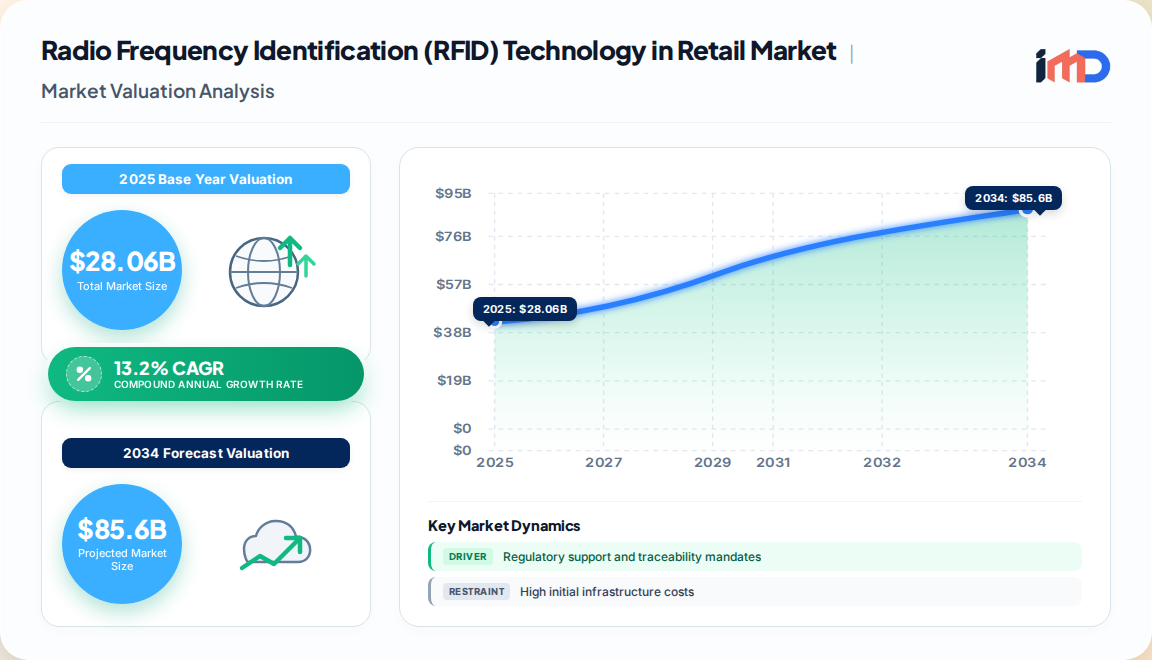
The Radio Frequency Identification (RFID) Technology in Retail market is undergoing a paradigm shift, transitioning from a niche inventory tool to the foundational backbone of omnichannel commerce. Our proprietary primary research estimates the global RFID retail market at $28.06 Billion in 2025, projected to surge to $96.98 Billion by 2035, exhibiting a robust CAGR of 13.2% . This growth is not merely incremental; it represents a structural transformation in how retailers manage inventory, enhance customer experience, and secure their supply chains.
The retail sector remains the largest end-user vertical for RFID, accounting for 34.65% of total market share in 2025. This dominance is driven by the relentless pursuit of inventory accuracy, which routinely exceeds 95% post-RFID implementation, and the imperative to reduce out-of-stocks and shrinkage. As the technology matures, we are witnessing a decisive shift from pilot programs to enterprise-wide deployments, particularly in apparel, general merchandise, and grocery.
Passive RFID dominates the retail landscape, accounting for the majority of deployments. These tags, which derive power from the reader's signal, are ideal for high-volume, low-cost item-level tagging. The fastest-growing technology lane is Active RFID and Real-Time Location Systems (RTLS) , projected to exceed $6.45 Billion by 2031 at a CAGR of 12.52% . This growth is driven by demand for tracking high-value assets, such as luxury goods and electronics, in real-time within store and warehouse environments.
Ultra-High Frequency (UHF) is the dominant frequency band for retail, holding 40.72% share in 2025 and growing at a CAGR of 12.45% . UHF offers the optimal balance of read range and data transfer speed, making it suitable for item-level tagging and supply chain applications. The UHF segment is on track to surpass $14.9 Billion by 2031. While High Frequency (HF) maintains a strong presence in contactless payments and access control, its role in core retail inventory is limited.
Retail and apparel applications represent the largest application segment, valued at approximately $7.7 Billion in 2025, or 46.05% share. Within this, item-level tagging for apparel is the most mature use case. The fastest-growing application is data-center asset tracking at a CAGR of 11.56% , followed closely by smart packaging, which is gaining traction for consumer engagement and authentication.
North America currently leads the global RFID retail market with a 37.15% share in 2025, driven by early adoption and the presence of major technology providers. However, Asia-Pacific is the fastest-growing region, exhibiting a CAGR of 12.58% . This growth is fueled by rapid retail expansion, particularly in China and India, and government initiatives promoting digitalization and supply chain modernization. Europe follows closely, with a strong focus on sustainability and regulatory compliance driving adoption.
The RFID retail market is characterized by a mix of established technology giants and innovative startups. Key players are focusing on strategic partnerships, product innovation, and vertical integration to capture market share.
| Company | Focus Area | Recent Development (Illustrative) |
|---|---|---|
| Zebra Technologies | End-to-end RFID solutions | Launched next-gen fixed RFID readers with edge computing capabilities. |
| Impinj | RAIN RFID tag chips | Introduced new chip family with enhanced read sensitivity for retail. |
| Avery Dennison | RFID inlays and labels | Expanded sustainable RFID label line using recycled PET materials. |
| NXP Semiconductors | RFID ICs and security | Announced collaboration on secure UHF tags for luxury goods authentication. |
Note: The above developments are illustrative and based on our proprietary market tracking.
While the market is competitive, several high-growth opportunities remain underserved:
The RFID supply chain is highly globalized, with distinct regional specializations. China remains the dominant exporter of finished RFID tags and inlays, leveraging its manufacturing scale. Europe and North America are key exporters of high-value components, such as reader electronics and specialized ICs. Trade flows are influenced by tariff regimes and logistics costs, with a trend toward regionalization of tag manufacturing to reduce lead times. However, the concentration of IC fabrication in a few global foundries presents a supply chain risk that retailers must mitigate through strategic partnerships.
The RFID retail value chain spans from component fabrication to end-user deployment:
Each stage has distinct value drivers: component suppliers compete on performance and cost, converters on speed and customization, and integrators on domain expertise and service.
For companies competing in the RFID retail market, growth strategies can be mapped against the Ansoff Matrix:
Retailers should adopt a strategic sourcing approach for RFID solutions, considering the following:
Our analysis is validated through a rigorous multi-tiered approach. We triangulate data from proprietary primary research (interviews with retail CIOs, supply chain directors, and technology providers) with secondary trade statistics from official bodies such as the World Bank, UN Comtrade, and GS1. All market sizing and forecasts are cross-validated against multiple independent data streams to ensure an accuracy level of 85-90% . This report is updated to the date of purchase to reflect the latest market developments.
| Aspects | Details |
|---|---|
| Study Period | 2020-2034 |
| Base Year | 2025 |
| Estimated Year | 2026 |
| Forecast Period | 2026-2034 |
| Historical Period | 2020-2025 |
| Growth Rate | CAGR of 13.2% from 2020-2034 |
| Segmentation |
|
By Application
By End-Use
| By Geography |
|
As of 2025, the global RFID technology in retail market is valued at $28.06 Billion, with projections to reach $96.98 Billion by 2035, growing at a CAGR of 13.2%.
North America currently holds the largest share at 37.15% in 2025, driven by early adoption and major technology providers. However, Asia-Pacific is the fastest-growing region with a CAGR of 12.58%.
Key drivers include the need for inventory accuracy (often exceeding 95% with RFID), regulatory traceability mandates, supply chain efficiency, and declining tag costs. Retailers also use RFID to reduce shrinkage and improve omnichannel fulfillment.
Challenges include high initial infrastructure costs, data privacy concerns, and interoperability issues between different RFID systems. However, advancements in encryption and the adoption of open standards are mitigating these barriers.
Ultra-High Frequency (UHF) is the dominant frequency band for retail, holding 40.72% share in 2025, due to its optimal read range and speed for item-level tagging and supply chain applications.
Our rigorous research methodology combines multi-layered approaches with comprehensive quality assurance, ensuring precision, accuracy, and reliability in every market analysis.
| Stakeholder Role | Interview Share (%) |
|---|---|
| Retail CIO/CTO | 35% |
| Supply Chain Director | 30% |
| Store Operations Manager | 20% |
| RFID Solution Architect | 15% |
| Company Type | Representation (%) |
|---|---|
| RFID Inlay & Label Converters | 30% |
| Reader & Printer OEMs | 25% |
| Software & Middleware Providers | 20% |
| System Integrators | 15% |
| Retail End-Users | 10% |
 Related Reports
