1What is the current size of the global men's apparel market?
The global men's apparel market was valued at USD 602.8 Billion in 2025 and is expected to reach USD 754.3 Billion by 2034, growing at a CAGR of 2.6%.
Insight Market Data is a premier market research and business consulting firm headquartered in Pune, India, providing syndicated research reports, customized intelligence studies, and strategic advisory services. Renowned academic institutions and Fortune 500 corporations worldwide rely on Insight Market Data's research repository to navigate evolving global and regional business environments. Covering 46 diverse industries across 25 major international economies, our comprehensive database delivers thousands of verified statistics and granular market evaluations. By combining industry-leading analytical methodologies with the direct insights of seasoned industry leaders and subject-matter experts, we deliver actionable intelligence spanning historical performance benchmarks to rigorous multi-year forecasts. We empower organizations to make confident, data-driven decisions across pivotal domains including Machinery & Equipment, Chemicals & Materials, Pharmaceuticals & Healthcare, Food & Beverages, Consumer Goods, Energy & Power, Automotive & Transportation, Electronics & Semiconductors, Medical Devices, Telecommunications, Emerging Technologies, Agriculture, and Packaging. Our multidisciplinary analyst teams provide an objective 360-degree perspective, tailoring every engagement to address complex strategic challenges with exceptional analytical rigor.
Leveraging advanced BI-powered analytics and predictive modeling, Insight Market Data uncovers high-impact market opportunities and competitive differentiators for ambitious enterprises. We continuously refine our research methodologies in accordance with global industry standards, tracking real-time market shifts to ensure our reports are consistently accurate, actionable, and delivered on schedule. Our analysts conduct methodical data validation, rigorous compliance checks, and exhaustive primary and secondary research to maintain the highest levels of data integrity and transparency. We partner closely with corporate strategists, investment groups, and business executives to translate intricate market intelligence into clear, actionable roadmaps for sustainable growth. With operational presence across Washington, USA, and Vimannagar, Pune, India, Insight Market Data ensures direct access to dedicated research specialists and responsive customer support to answer your most strategic questions.
 Men's Apparel Market
 by Coats & Jackets (Jackets, Coats, Rain Jackets), by Blazers (Indoor Jackets, Sport Coats, Separately Sold Blazers), by Suits (Jackets, Suit Trousers), by Trousers (Cloth Trousers, Jeans, Shorts), by Shirts (Formal Shirts, Casual Shirts), by Jerseys, by Sweatshirts & Pullovers (Knitwear, Sweatshirts, Jerseys, Sweaters, Turtleneck Sweaters, Under-Sweaters), by Sports & Swimwear (Sports-Inspired Apparel, Performance Apparel, Swimwear), by Night & Underwear (Underpants, Bathrobes, Nightwear), by T-Shirts (Upper Body Clothes Worn Beneath Outerwear), by Socks (Hosiery), by Clothing Accessories & Other Clothes (Gloves, Shawls & Scarves, Belts, Hats & Caps, Ties & Bow Ties, Leather Clothes, Felt, Fur & Other Clothes), by North America (USA, Canada, Mexico), by Europe (Germany, UK, France, Italy, Spain), by Asia Pacific (China, Japan, India, South Korea, Australia), by South America (Brazil, Argentina), by Middle East & Africa (Saudi Arabia, UAE, South Africa) Forecast 2026-2034


Research Analyst

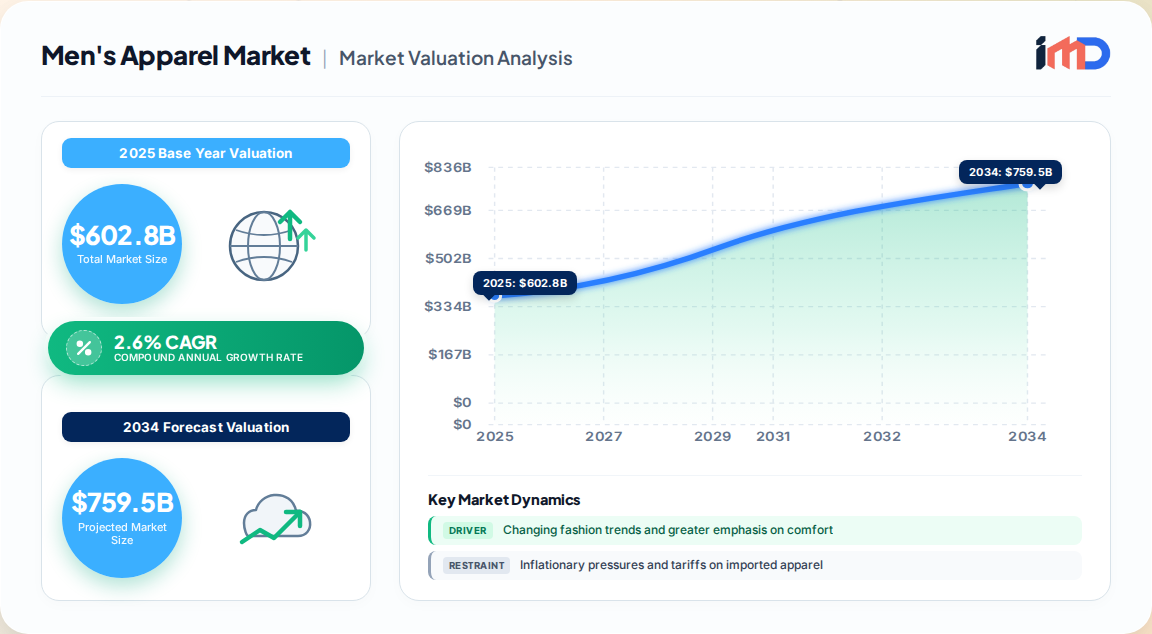
The global Men's Apparel Market represents a cornerstone of the consumer goods landscape, valued at USD 602.8 Billion in 2025. Our proprietary primary research and econometric modeling indicate the market will expand to USD 754.3 Billion by 2034, registering a steady CAGR of 2.6% over the forecast period. This growth is underpinned by shifting consumer attitudes toward comfort, durability, and self-expression, alongside the continued digital transformation of retail channels.
The United States remains the single largest national market, generating an estimated USD 154.5 Billion in 2025, supported by a robust culture of casual wear, smart-casual office attire, and lifestyle-driven fashion purchases. However, the pace of growth is shifting toward emerging economies in Asia-Pacific and Latin America, where rising disposable incomes and a burgeoning young male demographic are accelerating demand for branded and contemporary apparel.
Key market segments, including Trousers, Shirts, and Jerseys/Sweatshirts, are undergoing a structural shift. The lines between formal, casual, and activewear are blurring, creating hybrid categories such as "athleisure" and "smart-casual" that command premium price points. This report dissects the market's value chain, trade dynamics, competitive strategies, and regional attractiveness to provide a 360-degree view for stakeholders across the supply chain.
The men's apparel value chain is complex, spanning from raw material suppliers to end consumers. Each stage is undergoing transformation to meet modern demands for speed, sustainability, and transparency.
| Stage | Key Activities | Major Players (Examples) | Value-Added Focus |
|---|---|---|---|
| Raw Materials | Cotton, wool, synthetic fibers, dyes | Fiber producers, chemical companies | Sustainable sourcing, traceability |
| Fabric & Trim | Weaving, knitting, dyeing, finishing | Textile mills, trim suppliers | Innovation in performance fabrics, eco-friendly dyeing |
| Apparel Manufacturing | Cutting, sewing, assembly, finishing | Contract manufacturers, vertically integrated brands | Cost efficiency, ethical labor practices, speed-to-market |
| Brand & Design | Concept, design, marketing, branding | Brand owners, designers, licensors | Brand equity, trend forecasting, storytelling |
| Distribution & Retail | Wholesale, e-commerce, physical retail | Retailers, e-tailers, department stores | Omnichannel experience, last-mile delivery |
| End Consumer | Purchase, use, disposal | Men of all ages and demographics | Convenience, personalization, value |
The men's apparel market is highly globalized, with production concentrated in Asia and consumption spread across developed and developing nations. According to the World Integrated Trade Solution (WITS) database, the United States imported USD 28.7 Billion in textiles and clothing from China in 2023, making it the single largest source of apparel imports. Vietnam (USD 15.5 Billion), India (USD 10.0 Billion), Bangladesh (USD 7.5 Billion), and Mexico (USD 5.4 Billion) are other key suppliers to the U.S. market.
This concentration exposes the supply chain to significant risks. Tariffs, trade disputes, and logistical bottlenecks can disrupt the flow of goods and increase costs. To mitigate these risks, brands are increasingly adopting nearshoring strategies (e.g., sourcing from Mexico or Central America for the U.S. market) and diversifying their supplier base across multiple countries. Furthermore, the push for sustainability is driving a shift toward regional supply chains with shorter transit times and greater traceability.
Asia-Pacific dominates the global men's apparel market, accounting for an estimated 41% of global revenue in 2025. This is driven by a massive population base, rising disposable incomes, and a strong cultural emphasis on fashion in countries like China, Japan, and South Korea. The region is also the world's manufacturing hub, with China, Bangladesh, and Vietnam serving as key export engines.
North America and Europe are mature markets, characterized by high per-capita spending but lower growth rates. The U.S. remains the largest single market, while Europe is a patchwork of diverse consumer preferences, with strong demand for premium and sustainable apparel in Northern and Western Europe.
South America and the Middle East & Africa represent emerging frontiers. Urbanization, a young population, and growing brand consciousness are driving demand. However, economic volatility and infrastructure challenges may temper growth in the short term.
The men's apparel market is highly fragmented, with a mix of global giants, regional players, and niche brands. Competition is intense, and success hinges on the ability to anticipate trends, manage supply chains efficiently, and build strong brand equity.
Key strategies observed among leading players include:
Our analysis identifies several underpenetrated segments offering significant growth opportunities for investors and brands:
For retailers and brands, procurement strategy is critical to balancing cost, quality, and risk. Key considerations include:
The Ansoff Matrix provides a framework for growth strategies in the men's apparel market:
| Existing Markets | New Markets | |
|---|---|---|
| Existing Products | Market Penetration: Increase marketing spend, expand distribution, offer promotions to gain share in current markets. | Market Development: Introduce core products (e.g., basics, denim) to new geographic regions (e.g., Southeast Asia, Africa). |
| New Products | Product Development: Launch sustainable lines, adaptive clothing, or smart apparel (e.g., moisture-wicking, temperature-regulating) for existing customers. | Diversification: Enter new product categories (e.g., men's grooming, footwear) or launch entirely new brands targeting untapped segments. |
| Aspects | Details |
|---|---|
| Study Period | 2020-2034 |
| Base Year | 2025 |
| Estimated Year | 2026 |
| Forecast Period | 2026-2034 |
| Historical Period | 2020-2025 |
| Growth Rate | CAGR of 2.6% from 2020-2034 |
| Segmentation |
|
By Suits
By Trousers
By Shirts
By Jerseys
By Sweatshirts & Pullovers
By Sports & Swimwear
By Night & Underwear
By T-Shirts
By Socks
By Clothing Accessories & Other Clothes
| By Geography |
|
The global men's apparel market was valued at USD 602.8 Billion in 2025 and is expected to reach USD 754.3 Billion by 2034, growing at a CAGR of 2.6%.
Asia-Pacific is the largest and fastest-growing region, accounting for approximately 41% of global revenue in 2025, driven by rising incomes and a large consumer base in countries like China and India.
Key drivers include the rising demand for athleisure and comfort-focused clothing, the influence of social media on fashion trends, growing interest in sustainability, and the expansion of e-commerce and DTC channels.
The market is highly fragmented, with key players including Nike, Adidas, Inditex (Zara), H&M, Uniqlo, Gap, PVH Corp (Calvin Klein, Tommy Hilfiger), Ralph Lauren, and VF Corporation.
Challenges include inflationary pressures, tariffs on imported apparel, supply chain disruptions, and shifting consumer spending priorities during economic uncertainty.
Key trends include the blurring of formal and casual wear (smart-casual), the continued influence of streetwear, the rise of sustainable and circular fashion, and the growing demand for customization and personalization.
Our rigorous research methodology combines multi-layered approaches with comprehensive quality assurance, ensuring precision, accuracy, and reliability in every market analysis.
| Stakeholder Role | Interview Share (%) |
|---|---|
| Chief Executive Officer | 30% |
| VP of Product Development | 25% |
| Head of Sourcing | 25% |
| Merchandising Director | 20% |
| Company Type | Representation (%) |
|---|---|
| Apparel Brand Owners | 40% |
| Contract Manufacturers | 25% |
| Raw Material Suppliers | 20% |
| Retail Channel Operators | 15% |
 Related Reports
