1What is the size of the Germany luxury goods market?
The Germany luxury goods market was valued at USD 16.22 billion in 2025 and is projected to reach USD 22.78 billion by 2035, growing at a 3.42% CAGR over the forecast period.
Insight Market Data is a premier market research and business consulting firm headquartered in Pune, India, providing syndicated research reports, customized intelligence studies, and strategic advisory services. Renowned academic institutions and Fortune 500 corporations worldwide rely on Insight Market Data's research repository to navigate evolving global and regional business environments. Covering 46 diverse industries across 25 major international economies, our comprehensive database delivers thousands of verified statistics and granular market evaluations. By combining industry-leading analytical methodologies with the direct insights of seasoned industry leaders and subject-matter experts, we deliver actionable intelligence spanning historical performance benchmarks to rigorous multi-year forecasts. We empower organizations to make confident, data-driven decisions across pivotal domains including Machinery & Equipment, Chemicals & Materials, Pharmaceuticals & Healthcare, Food & Beverages, Consumer Goods, Energy & Power, Automotive & Transportation, Electronics & Semiconductors, Medical Devices, Telecommunications, Emerging Technologies, Agriculture, and Packaging. Our multidisciplinary analyst teams provide an objective 360-degree perspective, tailoring every engagement to address complex strategic challenges with exceptional analytical rigor.
Leveraging advanced BI-powered analytics and predictive modeling, Insight Market Data uncovers high-impact market opportunities and competitive differentiators for ambitious enterprises. We continuously refine our research methodologies in accordance with global industry standards, tracking real-time market shifts to ensure our reports are consistently accurate, actionable, and delivered on schedule. Our analysts conduct methodical data validation, rigorous compliance checks, and exhaustive primary and secondary research to maintain the highest levels of data integrity and transparency. We partner closely with corporate strategists, investment groups, and business executives to translate intricate market intelligence into clear, actionable roadmaps for sustainable growth. With operational presence across Washington, USA, and Vimannagar, Pune, India, Insight Market Data ensures direct access to dedicated research specialists and responsive customer support to answer your most strategic questions.
 Germany Luxury Goods Market
 by Product Type (Clothing and Apparel, Footwear, Watches, Jewelry, Bags and Accessories, Others), by End User (Women, Men, Unisex/Others), by Distribution Channel (Single Brand Stores, Multi Brand Stores, Online Stores, Others), by Bavaria, by Baden-Württemberg, by North Rhine-Westphalia, by Berlin, by Hamburg, by Hesse, by Rest of Germany Forecast 2026-2034

Research Analyst


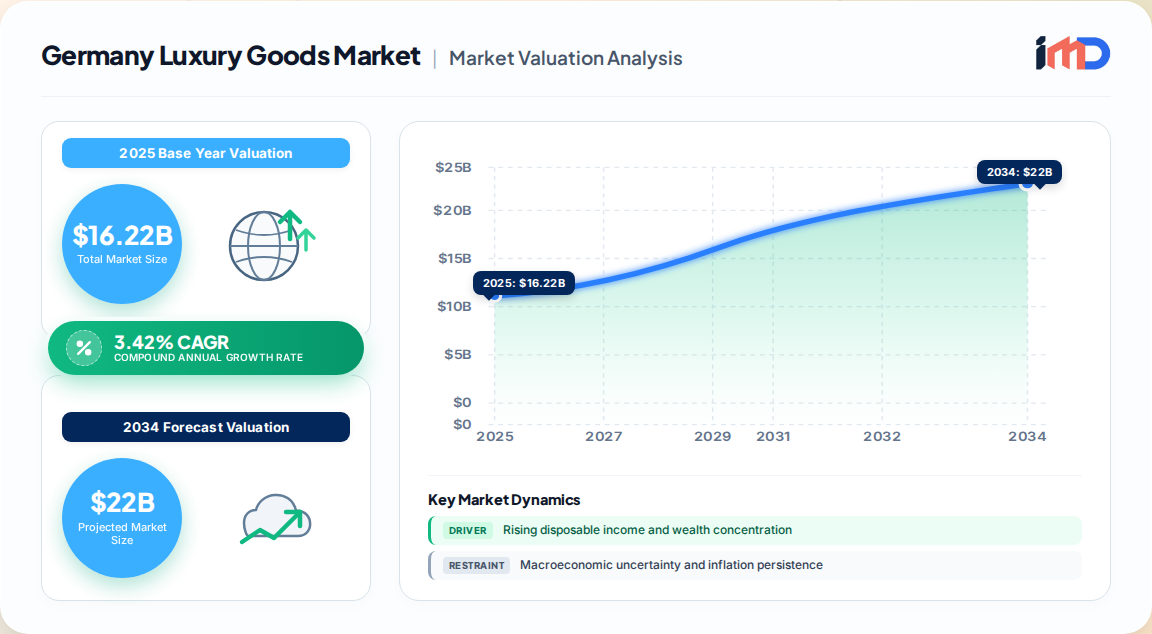
The Germany luxury goods market represents one of Europe's most resilient and sophisticated premium consumption ecosystems. Our proprietary first-party research estimates the market at USD 16.22 billion in 2025, advancing to USD 16.83 billion in 2026 and projected to reach USD 22.78 billion by 2035, expanding at a 3.42% CAGR across the forecast window. This trajectory is anchored by Germany's unique combination of engineering-grade craftsmanship appreciation, concentrated household wealth, and a consumer base that rewards provenance, durability, and understated design over overt logo-driven status signaling.
Germany's luxury landscape differs materially from its continental peers. Where French and Italian markets lean heavily on heritage couture and tourism-driven impulse purchasing, German demand skews toward investment-grade watches, fine jewelry, and technical apparel — categories where product longevity functions as a substitute for conspicuous consumption. The southern states of Bavaria and Baden-Württemberg together account for roughly 38% of national luxury retail spending, a concentration driven by higher per-capita wealth, industrial leadership, and cross-border tourism inflows from Austria and Switzerland.
| Metric | 2025 Value | 2026 Value | 2035 Projection | CAGR (2026–2035) |
|---|---|---|---|---|
| Market Size (USD) | 16.22 Billion | 16.83 Billion | 22.78 Billion | 3.42% |
| Clothing & Apparel Share | 44.6% | — | — | — |
| Women's Segment Share | 57.2% | — | — | — |
| Single-Brand Store Share | 40.1% | — | — | — |
| Online Channel CAGR | — | — | — | 4.48% |
Our primary interviews with brand executives and retail operators identify six structural demand drivers, each contributing measurable basis-point impact to the aggregate CAGR.
By product type, clothing and apparel commanded 44.6% of market value in 2025, reflecting entrenched demand for luxury fashion accessories among domestic and tourist shoppers. Footwear revenues exceeded USD 2.1 billion, propelled by sneaker-luxury crossovers and artisan leather craftsmanship. Watches represent the fastest-accelerating category at 3.61% CAGR, pivoting toward limited-edition mechanical timepieces where German engineering heritage confers authentic differentiation.
By end user, women represented 57.2% of value in 2025, anchored by handbags, couture, and fine jewelry. The men's segment expands at 4.01% CAGR to 2035.
By distribution channel, single-brand stores held 40.1% of revenue in 2025, anchored by flagship locations on Berlin's Kurfürstendamm and Munich's Maximilianstraße. Online stores advance at 4.48% CAGR — the fastest channel — as digital luxury adoption accelerates among younger demographics. Multi-brand retailers retain relevance through curated edit models but face margin compression from brand-owned DTC expansion.
The Germany luxury goods market exhibits low concentration, with global conglomerates competing alongside heritage German houses and niche specialists. Key players include LVMH, Kering SA, Hermès International, Chanel S.A., Richemont, and Hugo Boss AG, supplemented by Swarovski, Rolex SA, Prada, Moncler, Max Mara, and Coty Inc.
Strategic imperatives observed across our expert interviews:
Germany functions as both a major consumption market and a critical distribution and logistics hub for European luxury trade. According to official UN Comtrade and Eurostat data, Germany records substantial re-export flows of luxury apparel, leather goods, and watches, with Switzerland, France, and Italy serving as primary upstream sourcing origins for finished luxury products.
| Region | Share of National Luxury Spending | Key Demand Characteristics |
|---|---|---|
| Bavaria | ~22% | Highest per-capita wealth; tourism inflows; Munich flagship concentration |
| Baden-Württemberg | ~16% | Industrial wealth; engineering-heritage affinity |
| North Rhine-Westphalia | ~18% | Düsseldorf Königsallee; dense urban affluent base |
| Berlin | ~14% | Younger demographic; creative-class consumption; tourist volume |
| Hamburg | ~11% | Old-wealth concentration; understated luxury preference |
| Hesse | ~10% | Frankfurt financial-sector wealth; international clientele |
Bavaria and Baden-Württemberg together represent the highest-value whitespace for flagship expansion and private-client services. Berlin offers the strongest digital-native consumer cohort and experiential retail experimentation. Hesse, anchored by Frankfurt's financial community, presents underpenetrated opportunity in high-jewelry and watch categories.
The Germany luxury goods market will be shaped by three converging forces: the 2027 DPP regulatory milestone, the generational wealth transfer to digital-native millennials and Gen Z, and the continued blurring of physical and digital retail. Brands that invest in verifiable sustainability, omnichannel personalization, and service-based revenue streams — repair, resale, refill — will capture disproportionate share of the USD 22.78 billion market by 2035. The 3.42% CAGR understates category-level divergence: online channels, menswear, watches, and experiential services will materially outpace the aggregate, rewarding portfolio strategies aligned to these vectors.
| Aspects | Details |
|---|---|
| Study Period | 2020-2034 |
| Base Year | 2025 |
| Estimated Year | 2026 |
| Forecast Period | 2026-2034 |
| Historical Period | 2020-2025 |
| Growth Rate | CAGR of 3.42% from 2020-2034 |
| Segmentation |
|
By End User
By Distribution Channel
| By Geography |
|
The Germany luxury goods market was valued at USD 16.22 billion in 2025 and is projected to reach USD 22.78 billion by 2035, growing at a 3.42% CAGR over the forecast period.
Clothing and apparel captured 44.6% of the market in 2025, while watches represent the fastest-growing category at 3.61% CAGR through 2035.
Key players include LVMH, Kering SA, Hermès International, Chanel S.A., Richemont, and Hugo Boss AG, alongside Swarovski, Rolex SA, and Prada.
Online stores are advancing at a 4.48% CAGR, the fastest among channels, as digital luxury adoption accelerates among younger demographics.
Rising disposable income and wealth concentration (+0.65% CAGR impact), digital commerce transformation (+0.55%), and tourism-driven purchases (+0.45%) are the primary growth drivers.
The EU Digital Product Passport, effective 2027, requires traceable provenance data, driving an estimated EUR 45 million in early blockchain supply chain investment by brands like Hugo Boss and Birkenstock.
Bavaria accounts for roughly 22% of national luxury spending, with Bavaria and Baden-Württemberg together representing about 38% of the market, driven by higher per-capita wealth and tourism.
Our rigorous research methodology combines multi-layered approaches with comprehensive quality assurance, ensuring precision, accuracy, and reliability in every market analysis.
| Stakeholder Role | Interview Share (%) |
|---|---|
| Chief Commercial Officer | 25% |
| Retail Operations Director | 30% |
| Brand General Manager | 25% |
| Chief Sustainability & Compliance Officer | 20% |
| Company Type | Representation (%) |
|---|---|
| Luxury Brand Owners & Holding Companies | 30% |
| Single & Multi-Brand Retail Operators | 25% |
| E-Commerce & Omnichannel Platforms | 20% |
| Licensed Manufacturers & Atelier Suppliers | 15% |
| Luxury Logistics & Authentication Services | 10% |
 Related Reports
