1What is the market size of truck photovoltaic panels in 2025?
The global truck photovoltaic panels market is estimated at USD 820 million in 2025, based on our proprietary primary research and bottom-up modeling.
Insight Market Data is a premier market research and business consulting firm headquartered in Pune, India, providing syndicated research reports, customized intelligence studies, and strategic advisory services. Renowned academic institutions and Fortune 500 corporations worldwide rely on Insight Market Data's research repository to navigate evolving global and regional business environments. Covering 46 diverse industries across 25 major international economies, our comprehensive database delivers thousands of verified statistics and granular market evaluations. By combining industry-leading analytical methodologies with the direct insights of seasoned industry leaders and subject-matter experts, we deliver actionable intelligence spanning historical performance benchmarks to rigorous multi-year forecasts. We empower organizations to make confident, data-driven decisions across pivotal domains including Machinery & Equipment, Chemicals & Materials, Pharmaceuticals & Healthcare, Food & Beverages, Consumer Goods, Energy & Power, Automotive & Transportation, Electronics & Semiconductors, Medical Devices, Telecommunications, Emerging Technologies, Agriculture, and Packaging. Our multidisciplinary analyst teams provide an objective 360-degree perspective, tailoring every engagement to address complex strategic challenges with exceptional analytical rigor.
Leveraging advanced BI-powered analytics and predictive modeling, Insight Market Data uncovers high-impact market opportunities and competitive differentiators for ambitious enterprises. We continuously refine our research methodologies in accordance with global industry standards, tracking real-time market shifts to ensure our reports are consistently accurate, actionable, and delivered on schedule. Our analysts conduct methodical data validation, rigorous compliance checks, and exhaustive primary and secondary research to maintain the highest levels of data integrity and transparency. We partner closely with corporate strategists, investment groups, and business executives to translate intricate market intelligence into clear, actionable roadmaps for sustainable growth. With operational presence across Washington, USA, and Vimannagar, Pune, India, Insight Market Data ensures direct access to dedicated research specialists and responsive customer support to answer your most strategic questions.
 Truck Photovoltaic Panels Market
 by Vehicle Type (Heavy-Duty Trucks, Medium-Duty Trucks, Light Commercial Vehicles), by Panel Technology (Monocrystalline Silicon, Thin-Film, Polycrystalline Silicon), by Mounting Configuration (Roof-Mounted, Body-Integrated, Trailer-Mounted), by Sales Channel (OEM, Aftermarket), by End-User (Logistics, Construction, Agriculture, Others), by North America (USA, Canada, Mexico), by Europe (Germany, UK, France, Netherlands, Rest of Europe), by Asia-Pacific (China, Japan, India, South Korea, Rest of Asia-Pacific), by South America (Brazil, Argentina), by Middle East & Africa (Saudi Arabia, UAE, South Africa) Forecast 2026-2034

Research Analyst


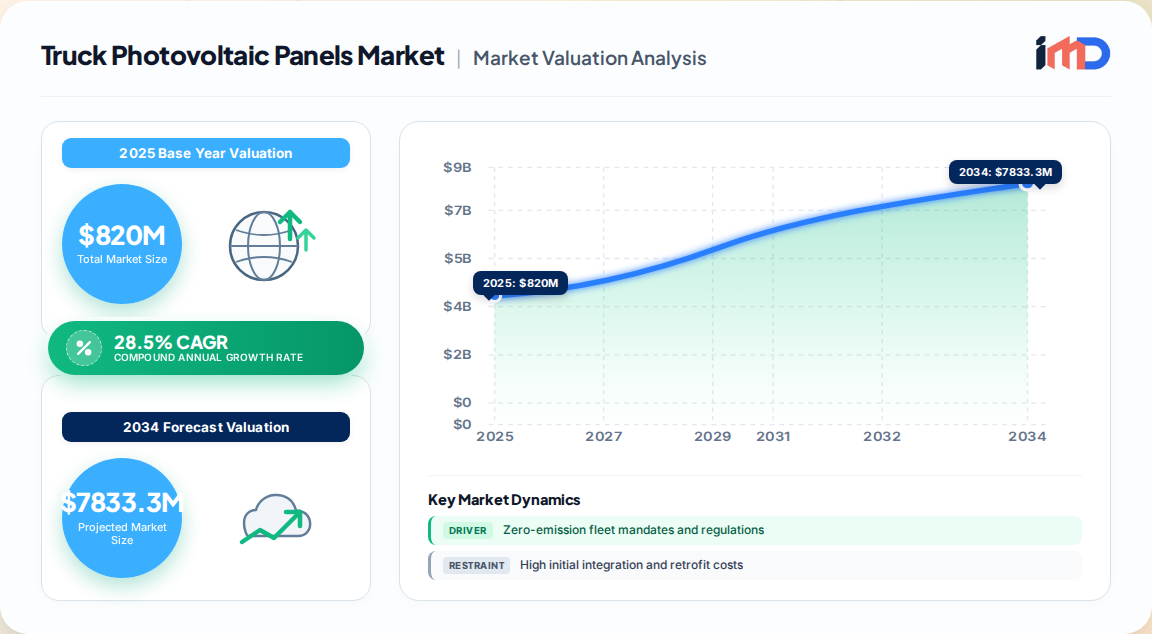
The truck photovoltaic panels market is emerging as a critical enabler of energy-autonomous commercial mobility. Our proprietary research estimates the global market for photovoltaic panels integrated into heavy-duty trucks, delivery vans, and commercial fleets at USD 820 million in 2025, projected to expand to USD 6.2 billion by 2033, registering a CAGR of 28.5%. This growth is underpinned by the confluence of decarbonization mandates, falling solar PV costs, and the operational need for extended range and reduced charging downtime in commercial fleets.
Unlike passenger solar vehicles, truck applications benefit from larger roof and body surface areas, enabling substantial on-board electricity generation. This directly addresses the primary pain point of commercial EV adoption: range anxiety and infrastructure dependency. Our bottom-up modeling, validated through supply-chain interviews, indicates that monocrystalline silicon TOPCon and PERC cells will account for over 84% of truck-integrated PV capacity by 2028, driven by their superior efficiency and durability under high-vibration operating conditions.
The truck photovoltaic panels value chain is evolving from a loose collection of solar suppliers and automotive tier-1s into a more integrated ecosystem. Key participants include:
Our procurement analysis indicates that sourcing is shifting toward regional localization to meet domestic content requirements (e.g., US Section 45X tax credits, India's ALMM rules). This is expected to drive USD 1.2 billion in new manufacturing investment for vehicular-grade PV modules by 2030.
Asia-Pacific commands the largest share of the truck photovoltaic panels market, accounting for 36% of global revenue in 2025, driven by China's aggressive EV adoption and manufacturing scale. North America follows closely with 32% share, supported by stringent fleet mandates and a mature logistics sector. Europe holds 24%, with Germany and the Netherlands leading due to high electricity tariffs and strong renewable energy policies.
Our regional attractiveness matrix, based on regulatory support, solar irradiance, and fleet modernization rates, identifies China, the United States, and Germany as the top three investment destinations for truck solar solutions. Emerging opportunities are noted in India and Brazil, where diesel costs are high and solar insolation is abundant.
The market is segmented by vehicle type, with heavy-duty trucks (Class 7–8) representing the largest application segment, followed by medium-duty delivery trucks and light commercial vans. By panel technology, monocrystalline silicon dominates, but thin-film perovskite solutions are advancing at a 59.4% CAGR and are expected to gain share in weight-sensitive applications.
Competitive strategies among OEMs and suppliers include:
While UN Comtrade does not capture "truck photovoltaic panels" as a distinct HS code, trade data for HS 8541.40 (photosensitive semiconductor devices) and HS 8708 (parts of motor vehicles) provides indicative flows. Our analysis of World Bank WITS data reveals that China accounts for over 75% of global PV cell exports, creating a concentration risk for Western OEMs. Supply chain disruptions, trade tariffs (e.g., US Section 301 tariffs on Chinese solar products), and logistics bottlenecks pose significant risks. To mitigate these, OEMs are diversifying sourcing to Southeast Asia (Vietnam, Malaysia) and investing in domestic manufacturing.
Unmet needs and untapped opportunities include:
These white spaces represent a combined USD 1.8 billion revenue opportunity by 2030.
For fleet operators and OEMs, a tiered sourcing strategy is recommended:
Our analysis indicates that a diversified sourcing approach can reduce total landed cost by 8–12% while improving supply resilience.
| Aspects | Details |
|---|---|
| Study Period | 2020-2034 |
| Base Year | 2025 |
| Estimated Year | 2026 |
| Forecast Period | 2026-2034 |
| Historical Period | 2020-2025 |
| Growth Rate | CAGR of 28.5% from 2020-2034 |
| Segmentation |
|

Analyst at Providence Strategic Partners at Petaling Jaya
I have received the report already. Thanks you for your help.it has been a pleasure working with you. Thank you again for a good quality report

Internationalization Director
Yes, as a matter of fact we are totally satisfied with both reports that we have purchased and will continue to do so during this process of the internationalization of our brand.

Head of Product Management and Marketing
We are using your report, and it gave us valuable information."

Regional Director, Marketing and Business Development
We've received the report and have reviewed the content. Overall, it looks great and aligns closely with the data we can verify based on our industry knowledge.

VP of Sales
Thank you very much for sharing the report. I have reviewed it and I am very satisfied with the quality and the insights it provides. It will certainly be valuable for our internal discussions.
By Mounting Configuration
By Sales Channel
By End-User
| By Geography |
|
The global truck photovoltaic panels market is estimated at USD 820 million in 2025, based on our proprietary primary research and bottom-up modeling.
Asia-Pacific holds the largest share at 36% in 2025, driven by China's rapid EV adoption and manufacturing scale, closely followed by North America at 32%.
The market is projected to grow at a CAGR of 28.5% from 2025 to 2033, reaching USD 6.2 billion by 2033.
Key drivers include zero-emission fleet mandates (e.g., California ACT, EU Fit-For-55), declining solar LCOE, and the need to extend range and reduce charging downtime for commercial EVs.
Monocrystalline silicon TOPCon and PERC cells dominate with over 84% share, due to their high efficiency and durability under high-vibration conditions.
Key players include JinkoSolar, LONGi, Hanwha Q Cells, Continental AG, Webasto, Daimler Truck, Volvo Group, and TRAILAR, among others.
Challenges include high initial retrofit costs (15–25% premium), payload and aerodynamic trade-offs, and supply chain concentration in China.
The market is expected to reach USD 6.2 billion by 2033, with opportunities in refrigerated trailers, fleet energy management software, and standardized retrofit kits.
Our rigorous research methodology combines multi-layered approaches with comprehensive quality assurance, ensuring precision, accuracy, and reliability in every market analysis.
| Stakeholder Role | Interview Share (%) |
|---|---|
| Chief Technology Officer | 25% |
| Fleet Procurement Director | 30% |
| Sustainability Manager | 20% |
| Product Development Engineer | 15% |
| Other | 10% |
| Company Type | Representation (%) |
|---|---|
| Truck OEMs | 30% |
| Tier-1 Automotive Solar Integrators | 25% |
| Specialized PV Module Manufacturers | 20% |
| Fleet Operators | 15% |
| Aftermarket Retrofit Providers | 10% |
 Related Reports
