1What is the current market size of the automotive emission sensor market?
According to our proprietary analysis, the global automotive emission sensor market was valued at USD 7.1 billion in 2025.
Insight Market Data is a premier market research and business consulting firm headquartered in Pune, India, providing syndicated research reports, customized intelligence studies, and strategic advisory services. Renowned academic institutions and Fortune 500 corporations worldwide rely on Insight Market Data's research repository to navigate evolving global and regional business environments. Covering 46 diverse industries across 25 major international economies, our comprehensive database delivers thousands of verified statistics and granular market evaluations. By combining industry-leading analytical methodologies with the direct insights of seasoned industry leaders and subject-matter experts, we deliver actionable intelligence spanning historical performance benchmarks to rigorous multi-year forecasts. We empower organizations to make confident, data-driven decisions across pivotal domains including Machinery & Equipment, Chemicals & Materials, Pharmaceuticals & Healthcare, Food & Beverages, Consumer Goods, Energy & Power, Automotive & Transportation, Electronics & Semiconductors, Medical Devices, Telecommunications, Emerging Technologies, Agriculture, and Packaging. Our multidisciplinary analyst teams provide an objective 360-degree perspective, tailoring every engagement to address complex strategic challenges with exceptional analytical rigor.
Leveraging advanced BI-powered analytics and predictive modeling, Insight Market Data uncovers high-impact market opportunities and competitive differentiators for ambitious enterprises. We continuously refine our research methodologies in accordance with global industry standards, tracking real-time market shifts to ensure our reports are consistently accurate, actionable, and delivered on schedule. Our analysts conduct methodical data validation, rigorous compliance checks, and exhaustive primary and secondary research to maintain the highest levels of data integrity and transparency. We partner closely with corporate strategists, investment groups, and business executives to translate intricate market intelligence into clear, actionable roadmaps for sustainable growth. With operational presence across Washington, USA, and Vimannagar, Pune, India, Insight Market Data ensures direct access to dedicated research specialists and responsive customer support to answer your most strategic questions.
 Automotive Emission Sensor Market
 by Sensor Type (O2 Sensors, NOx Sensors, Particulate Matter Sensors, Ammonia Sensors), by Application (Passenger Cars, Commercial Vehicles), by Vehicle Type (Passenger Vehicles, Commercial Vehicles(Light Commercial Vehicles, Heavy Commercial Vehicles)), by Propulsion (ICE, Hybrid, PHEV), by Sales Channel (OEM, Aftermarket), by North America (USA, Canada, Mexico), by Europe (Germany, UK, France, Italy, Spain), by Asia Pacific (China, Japan, South Korea, India), by South America (Brazil, Argentina), by Middle East & Africa (Saudi Arabia, UAE, South Africa) Forecast 2026-2034

Research Analyst


 Related Reports

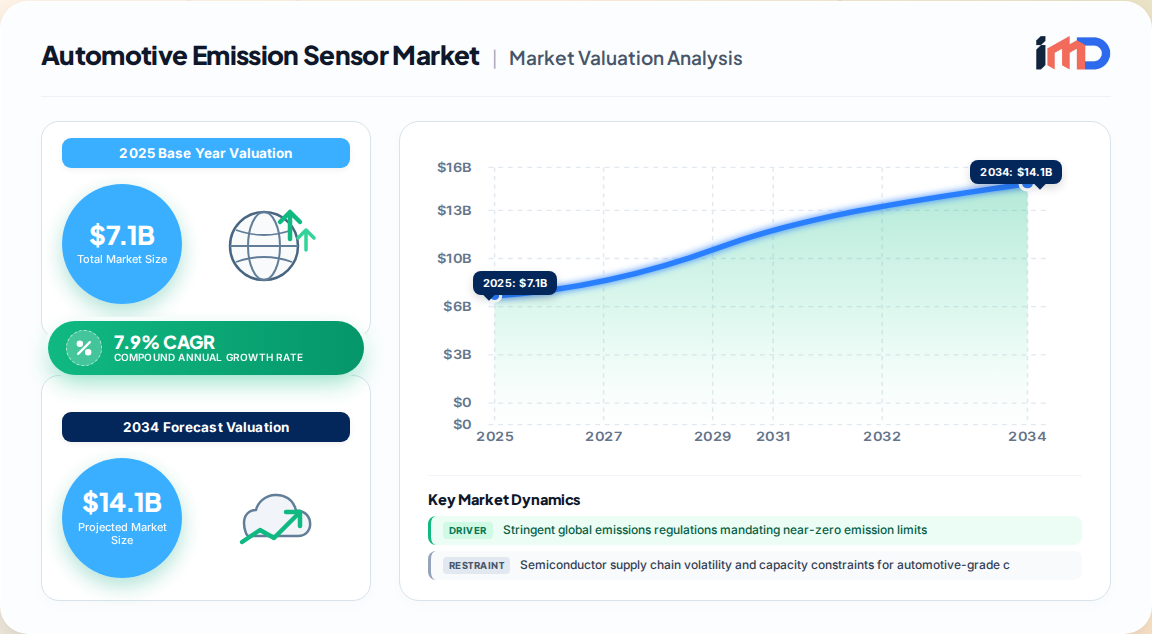
The global automotive emission sensor market represents a critical and rapidly evolving segment of the automotive sensor landscape, driven by an uncompromising global regulatory push toward decarbonization and air quality improvement. Our proprietary primary research estimates the market stood at USD 7.1 billion in 2025 and is forecast to expand at a robust CAGR of 7.9% to reach USD 12.6 billion by 2032. This growth trajectory is fundamentally decoupled from overall vehicle production volumes, instead being propelled by increasing sensor content per vehicle driven by tightening emissions standards (Euro 7, EPA 2027, China 6b) and the proliferation of hybrid and plug-in hybrid electric vehicles that require precise after-treatment monitoring.
The market is characterized by high barriers to entry, stringent qualification cycles, and a concentrated supplier base dominated by Tier 1 automotive electronics giants and specialized sensor manufacturers. The transition toward electrification does not eliminate emission sensors; rather, it shifts demand dynamics toward hybrid powertrains, which require sophisticated on-board diagnostics (OBD) and precise air-fuel ratio management to meet real-world driving emissions (RDE) limits.
The value chain for automotive emission sensors is complex and globally distributed. It begins with the sourcing of raw materials such as yttria-stabilized zirconia (YSZ) for O2 sensors and various metal oxides for NOx sensors. Specialized semiconductor foundries fabricate the MEMS and ASIC components, which are then assembled into sensor modules by Tier 1 suppliers. These suppliers integrate the sensors into after-treatment systems and supply them to OEMs for vehicle assembly. The aftermarket constitutes a secondary, yet significant, channel for replacement sensors.
Supply Chain Risks:
The market is highly concentrated, with the top five players—Robert Bosch GmbH, Denso Corporation, Continental AG, Sensata Technologies, and NGK Spark Plug—holding a combined estimated share of 56.5% in 2025. These companies compete on technological innovation, reliability, and systems integration capabilities. Recent strategic developments include:
| Region | Market Share (2025) | Growth Potential | Key Drivers | Investment Attractiveness |
|---|---|---|---|---|
| Asia-Pacific | 41% | High | China 6b, India BS VI, production volume | Very High |
| Europe | 24% | Moderate | Euro 7, RDE, hybrid penetration | High |
| North America | 22% | High | EPA 2027, CARB regulations | High |
| South America | 7% | Moderate | Gradual adoption of stricter standards | Medium |
| Middle East & Africa | 6% | Low-Moderate | Infrastructure and regulatory development | Low |
Asia-Pacific presents the most attractive investment opportunity due to its scale, regulatory momentum, and manufacturing base. Europe and North America offer high-value opportunities focused on advanced sensor technologies and system integration. The Middle East and Africa region, while smaller, offers niche opportunities for aftermarket and retrofitting solutions.
OEMs and Tier 1 suppliers are adopting multi-pronged procurement strategies to secure supply and manage costs. Key approaches include:
Our primary research indicates that supplier selection is increasingly based on total cost of ownership, including quality, reliability, and after-sales support, rather than just unit price.
| Aspects | Details |
|---|---|
| Study Period | 2020-2034 |
| Base Year | 2025 |
| Estimated Year | 2026 |
| Forecast Period | 2026-2034 |
| Historical Period | 2020-2025 |
| Growth Rate | CAGR of 7.9% from 2020-2034 |
| Segmentation |
|
By Vehicle Type
By Propulsion
By Sales Channel
| By Geography |
|
According to our proprietary analysis, the global automotive emission sensor market was valued at USD 7.1 billion in 2025.
The market is expected to grow at a CAGR of 7.9% from 2025 to 2032, reaching USD 12.6 billion by the end of the forecast period.
Asia-Pacific dominates the market, accounting for an estimated 41% of global market value in 2025, driven by stringent regulations in China and high vehicle production volumes.
The main types are O2 sensors (lambda sensors), NOx sensors, particulate matter (PM) sensors, and ammonia (NH3) sensors. O2 sensors currently hold the largest market share, while NOx sensors are the fastest-growing segment.
The market is dominated by key players such as Robert Bosch GmbH, Denso Corporation, Continental AG, Sensata Technologies, and NGK Spark Plug, which collectively held an estimated 56.5% market share in 2025.
The rise of hybrid electric vehicles (HEVs) and plug-in hybrid electric vehicles (PHEVs) is a significant driver, as these vehicles require advanced emission sensors to manage after-treatment systems during frequent engine start-stop cycles, increasing sensor content per vehicle.
Our rigorous research methodology combines multi-layered approaches with comprehensive quality assurance, ensuring precision, accuracy, and reliability in every market analysis.
| Stakeholder Role | Interview Share (%) |
|---|---|
| Procurement Director | 30% |
| Powertrain Engineer | 25% |
| Product Manager | 20% |
| CEO/VP | 15% |
| Emission Compliance Manager | 10% |
| Company Type | Representation (%) |
|---|---|
| Sensor Manufacturers | 35% |
| Tier 1 Automotive Suppliers | 25% |
| Automotive OEMs | 20% |
| Aftermarket Distributors | 12% |
| Regulatory & Standards Bodies | 8% |