1What is the EV battery market forecast for 2036?
The global EV battery market is projected to reach **USD 567.5 billion by 2036**, growing from USD 115.6 billion in 2026 at a CAGR of 17.2%, according to our proprietary analysis.
Insight Market Data is a premier market research and business consulting firm headquartered in Pune, India, providing syndicated research reports, customized intelligence studies, and strategic advisory services. Renowned academic institutions and Fortune 500 corporations worldwide rely on Insight Market Data's research repository to navigate evolving global and regional business environments. Covering 46 diverse industries across 25 major international economies, our comprehensive database delivers thousands of verified statistics and granular market evaluations. By combining industry-leading analytical methodologies with the direct insights of seasoned industry leaders and subject-matter experts, we deliver actionable intelligence spanning historical performance benchmarks to rigorous multi-year forecasts. We empower organizations to make confident, data-driven decisions across pivotal domains including Machinery & Equipment, Chemicals & Materials, Pharmaceuticals & Healthcare, Food & Beverages, Consumer Goods, Energy & Power, Automotive & Transportation, Electronics & Semiconductors, Medical Devices, Telecommunications, Emerging Technologies, Agriculture, and Packaging. Our multidisciplinary analyst teams provide an objective 360-degree perspective, tailoring every engagement to address complex strategic challenges with exceptional analytical rigor.
Leveraging advanced BI-powered analytics and predictive modeling, Insight Market Data uncovers high-impact market opportunities and competitive differentiators for ambitious enterprises. We continuously refine our research methodologies in accordance with global industry standards, tracking real-time market shifts to ensure our reports are consistently accurate, actionable, and delivered on schedule. Our analysts conduct methodical data validation, rigorous compliance checks, and exhaustive primary and secondary research to maintain the highest levels of data integrity and transparency. We partner closely with corporate strategists, investment groups, and business executives to translate intricate market intelligence into clear, actionable roadmaps for sustainable growth. With operational presence across Washington, USA, and Vimannagar, Pune, India, Insight Market Data ensures direct access to dedicated research specialists and responsive customer support to answer your most strategic questions.
 EV Battery Market Forecast
 by Battery Type (Lithium-ion, Nickel-metal hydride, Lead-acid, Solid-state), by Vehicle Type (Passenger Cars, Commercial Vehicles, Two-wheelers, Three-wheelers, E-bikes), by Application (Electric Vehicles, Hybrid Vehicles, Plug-in Hybrid Vehicles), by Battery Capacity (50-110 kWh, Below 50 kWh, Above 110 kWh), by North America (USA, Canada, Mexico), by Europe (Germany, UK, France, Italy, Spain), by Asia Pacific (China, Japan, South Korea, India), by South America (Brazil, Argentina), by Middle East & Africa (UAE, South Africa) Forecast 2026-2034

Research Analyst


 Related Reports

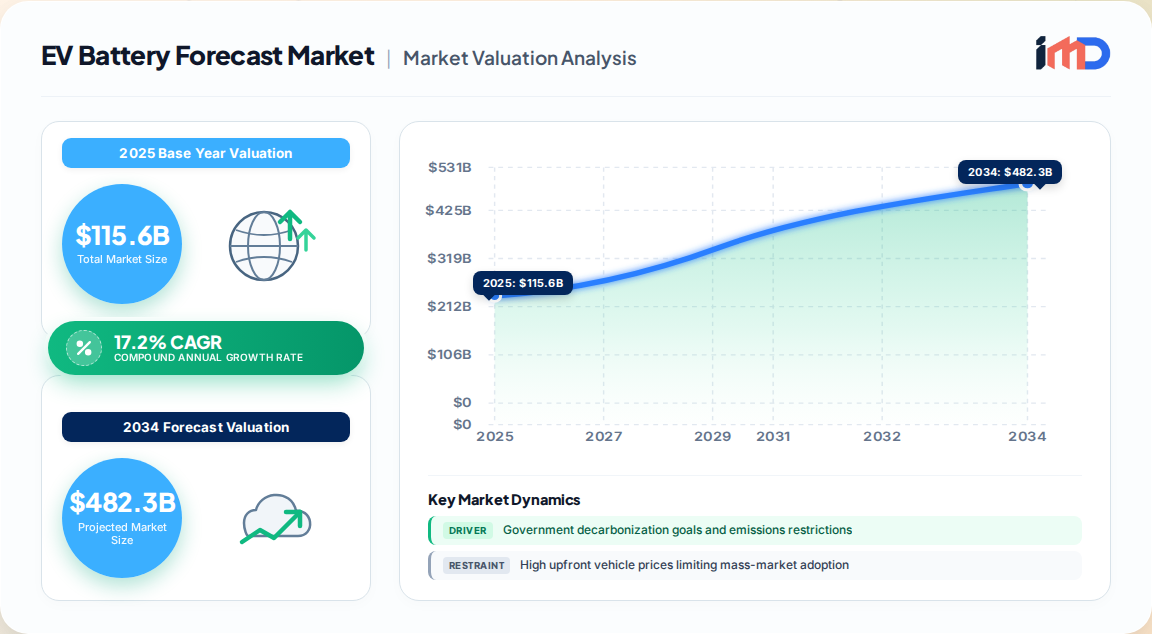
The global EV battery market is entering a period of unprecedented scale and structural transformation. Our proprietary analysis estimates the market at USD 98.6 billion in 2025, rising to USD 115.6 billion in 2026 and expanding to USD 567.5 billion by 2036, representing a robust CAGR of 17.2% across the forecast period. This trajectory adds approximately USD 451.9 billion in net new value over ten years, driven by the confluence of electric vehicle (EV) output growth, chemistry innovation, and the globalization of cell manufacturing.
The market's foundation is tightly coupled to vehicle electrification rates. In 2025, global electric car sales exceeded 20 million units, representing roughly one in four new cars sold. Each unit requires a traction battery, directly linking battery revenue to vehicle output. Beyond passenger cars, electric trucks reached 9% of global truck sales in 2025, and city bus fleets continue to electrify, creating demand for packs several times larger than those in passenger vehicles.
Supply-side dynamics are equally consequential. China accounted for over 80% of battery cell output in 2025, underscoring a concentrated production base that is gradually being diversified through gigafactory investments in Europe and North America. This report synthesizes primary interviews, trade data, and verified public benchmarks to deliver a granular, forward-looking assessment of the EV battery market forecast through 2036.
The EV battery value chain spans raw material extraction, cell component manufacturing, cell production, pack assembly, and end-of-life recycling. Upstream, lithium, nickel, cobalt, and graphite suppliers face pressure to secure long-term offtake agreements as cell plants lock in supply years before production begins. Cathode and anode material producers are scaling capacity in tandem with gigafactory construction.
At the cell manufacturing stage, competition is shifting from pure capacity expansion toward chemistry differentiation, energy density, charging performance, safety, and production efficiency. Suppliers capable of switching between lithium iron phosphate (LFP) and nickel-rich chemistries on the same production line are positioned to win multi-chemistry automaker programs. Downstream, battery pack assembly is increasingly localized near vehicle assembly plants to reduce freight costs and meet local content rules.
A critical emerging node is recycling and second-life applications. Regulatory frameworks such as the EU Batteries Regulation, which requires a QR code linked to a digital battery passport from February 2027, are transforming spent packs into tracked resources. This creates new revenue streams and supply chain resilience.
Lithium-ion batteries dominate the market, holding 71.4% share in 2026. Their high energy density and mature production lines make them suitable for nearly every EV platform. Within this category, LFP cells are gaining share in entry models due to lower cost and thermal stability, while nickel-rich cells retain a stronghold in long-range and performance vehicles. Nickel-metal hydride packs serve some hybrid applications, and lead-acid units remain in low-speed vehicles. Solid-state battery technology is emerging but volume production remains limited.
Passenger cars account for 58.3% of 2026 revenue, reflecting the breadth of electric model offerings from small hatchbacks to seven-seat SUVs. Commercial vehicles represent the next major volume source, with electric trucks and buses using substantially larger packs. Two-wheelers and three-wheelers contribute high unit volumes in South and Southeast Asia, driving demand for compact cells.
Electric vehicles capture 40.5% of 2026 value, as fully electric vehicles require the most battery capacity per unit and the most demanding thermal management. Hybrid and plug-in hybrid vehicles use smaller packs but continue to sell in significant volumes, supporting a diversified demand base.
The 50-110 kWh segment leads with 42.6% of 2026 revenue, as this range provides mainstream cars with usable range without excess pack weight. Larger packs serve premium and long-range models, while smaller packs dominate two-wheelers and entry-level vehicles.
Asia-Pacific is the largest and most established EV battery market, driven by China's dominant production base, mature battery supply chain, and supportive policy environment. High urban population density, affordable compact EV models, and extensive local charging networks accelerate adoption. Chinese cell manufacturers are expanding exports, reinforcing regional dominance. We estimate Asia-Pacific will maintain a 52% share of global market value through the forecast period.
Europe is scaling domestic battery production to reduce dependence on imported cells. The European Commission's Industrial Action Plan earmarks EUR 1.8 billion for a secure supply chain of battery raw materials, and the Innovation Fund's 2024 Battery call awarded EUR 643 million to five EV battery cell manufacturing projects expected to begin operations between 2027 and 2029. Germany leads regional growth at a projected 19.8% CAGR, supported by a large automotive industry converting model ranges to battery-electric drive.
North America is one of the fastest-growing BEV markets, supported by federal incentives, domestic manufacturing investment, and rising demand for electric pickups and SUVs. The United States is forecast to grow at 16.3% CAGR, though uneven buyer incentives create variability. Reshoring of battery supply chains and expansion of public fast-charging corridors are enhancing long-term market momentum.
Brazil is developing demand at an 18.1% CAGR, helped by a new vehicle program tying tax treatment to efficiency and recyclability. The Middle East and Africa remain nascent but offer long-term opportunities as charging infrastructure develops and governments pursue electrification targets.
The EV battery market is characterized by high concentration at the cell manufacturing level and intense competition among a growing number of suppliers. CATL leads the global EV battery market, while BYD held over 16% market share in the battery electric vehicle segment in 2025. The top five BEV players—BYD, Geely, General Motors, Tesla, and Volkswagen—collectively held 42% market share in 2025.
Cell manufacturers are investing heavily in materials innovation, manufacturing automation, and quality management to improve cost competitiveness and performance. Chinese suppliers including CALB Group, EVE Energy, Sunwoda, Farasis Energy, SVOLT Energy Technology, REPT BATTERO Energy, and Guoxuan High-tech are expanding capacity and evaluating overseas opportunities. Differentiation is increasingly based on battery chemistry, energy density, charging performance, safety, and supply chain integration rather than manufacturing scale alone.
Automakers should qualify at least two cell chemistries per platform to hedge against mineral price shifts and supply disruptions. Material suppliers should secure long-term offtake agreements for lithium, nickel, and graphite, as cell plants lock in supply years before production starts. Investors should weigh recycling and second-life capacity, given regulatory tailwinds and resource recovery economics.
The EV battery supply chain exhibits significant trade flows, with China as the primary export hub for cells and components. In 2025, global EV battery cell shipments reached approximately 1,495.1 GWh, with around 1,187 GWh installed in vehicles—highlighting the scale of manufacturing and the gap between production and installation that flows into storage and export channels.
European and North American markets rely heavily on imported cells, but domestic production is scaling. The EU's Innovation Fund projects and US manufacturing investments aim to localize cell production, reducing import dependence. Japan maintains a strong position in battery materials and hybrid vehicle batteries, though full-electric adoption starts from a low base with a projected 12.9% CAGR.
Key supplier dynamics include long-term contracts between automakers and cell manufacturers, vertical integration by leading players, and joint ventures to secure raw materials. Trade policy, including tariffs and local content requirements, will shape sourcing decisions through 2036.
| Aspects | Details |
|---|---|
| Study Period | 2020-2034 |
| Base Year | 2025 |
| Estimated Year | 2026 |
| Forecast Period | 2026-2034 |
| Historical Period | 2020-2025 |
| Growth Rate | CAGR of 17.2% from 2020-2034 |
| Segmentation |
|
By Application
By Battery Capacity
| By Geography |
|
The global EV battery market is projected to reach **USD 567.5 billion by 2036**, growing from USD 115.6 billion in 2026 at a CAGR of 17.2%, according to our proprietary analysis.
Lithium-ion batteries hold the largest share, accounting for **71.4% of the market in 2026**, due to their high energy density and mature production lines suited to nearly every EV platform.
Key drivers include electric vehicle adoption growth, government decarbonization mandates, falling battery costs, charging infrastructure expansion, and commercial fleet electrification.
Asia-Pacific dominates the market with an estimated **52% share**, driven by China's production scale, established supply chain, and supportive policies. Europe and North America are the fastest-growing regions.
CATL leads the global EV battery market. In the battery electric vehicle segment, BYD held over **16% market share** in 2025, and the top five players collectively held **42%**.
Our rigorous research methodology combines multi-layered approaches with comprehensive quality assurance, ensuring precision, accuracy, and reliability in every market analysis.
| Stakeholder Role | Interview Share (%) |
|---|---|
| Procurement Director | 30% |
| Battery Engineering Manager | 25% |
| Supply Chain VP | 25% |
| Chief Technology Officer | 20% |
| Company Type | Representation (%) |
|---|---|
| Cell Manufacturers | 35% |
| Automotive OEMs | 25% |
| Battery Material Suppliers | 20% |
| Battery Pack Assemblers | 12% |
| Recycling & Second-Life Firms | 8% |