1What is the current size of the automotive transparent antenna market?
The global automotive transparent antenna market was valued at USD 914.6 Million in 2024 and is projected to reach USD 1,992.9 Million by 2034, growing at a CAGR of 8.1%.
Insight Market Data is a premier market research and business consulting firm headquartered in Pune, India, providing syndicated research reports, customized intelligence studies, and strategic advisory services. Renowned academic institutions and Fortune 500 corporations worldwide rely on Insight Market Data's research repository to navigate evolving global and regional business environments. Covering 46 diverse industries across 25 major international economies, our comprehensive database delivers thousands of verified statistics and granular market evaluations. By combining industry-leading analytical methodologies with the direct insights of seasoned industry leaders and subject-matter experts, we deliver actionable intelligence spanning historical performance benchmarks to rigorous multi-year forecasts. We empower organizations to make confident, data-driven decisions across pivotal domains including Machinery & Equipment, Chemicals & Materials, Pharmaceuticals & Healthcare, Food & Beverages, Consumer Goods, Energy & Power, Automotive & Transportation, Electronics & Semiconductors, Medical Devices, Telecommunications, Emerging Technologies, Agriculture, and Packaging. Our multidisciplinary analyst teams provide an objective 360-degree perspective, tailoring every engagement to address complex strategic challenges with exceptional analytical rigor.
Leveraging advanced BI-powered analytics and predictive modeling, Insight Market Data uncovers high-impact market opportunities and competitive differentiators for ambitious enterprises. We continuously refine our research methodologies in accordance with global industry standards, tracking real-time market shifts to ensure our reports are consistently accurate, actionable, and delivered on schedule. Our analysts conduct methodical data validation, rigorous compliance checks, and exhaustive primary and secondary research to maintain the highest levels of data integrity and transparency. We partner closely with corporate strategists, investment groups, and business executives to translate intricate market intelligence into clear, actionable roadmaps for sustainable growth. With operational presence across Washington, USA, and Vimannagar, Pune, India, Insight Market Data ensures direct access to dedicated research specialists and responsive customer support to answer your most strategic questions.
 Automotive Transparent Antenna Industry
 by Frequency Range (High frequency, Very-high frequency, Ultra-high frequency), by Vehicle Propulsion (Internal Combustion Engines, Electric Vehicles), by Application (Sunroof, Windshield, Windows), by Vehicle Type (Passenger Cars, Commercial Vehicles), by Sales Channel (OEM, Aftermarket), by Material Type (Transparent Conductive Oxides, Nanowire, Conductive Polymer, Nano Carbon), by Component (Transceivers, ECU, Other Components), by North America (USA, Canada, Mexico), by Europe (Germany, UK, France, Italy, Spain, Rest of Europe), by Asia Pacific (China, Japan, South Korea, India, Rest of APAC), by South America (Brazil, Argentina, Rest of South America), by Middle East & Africa (Saudi Arabia, UAE, South Africa, Rest of MEA) Forecast 2026-2034

Research Analyst


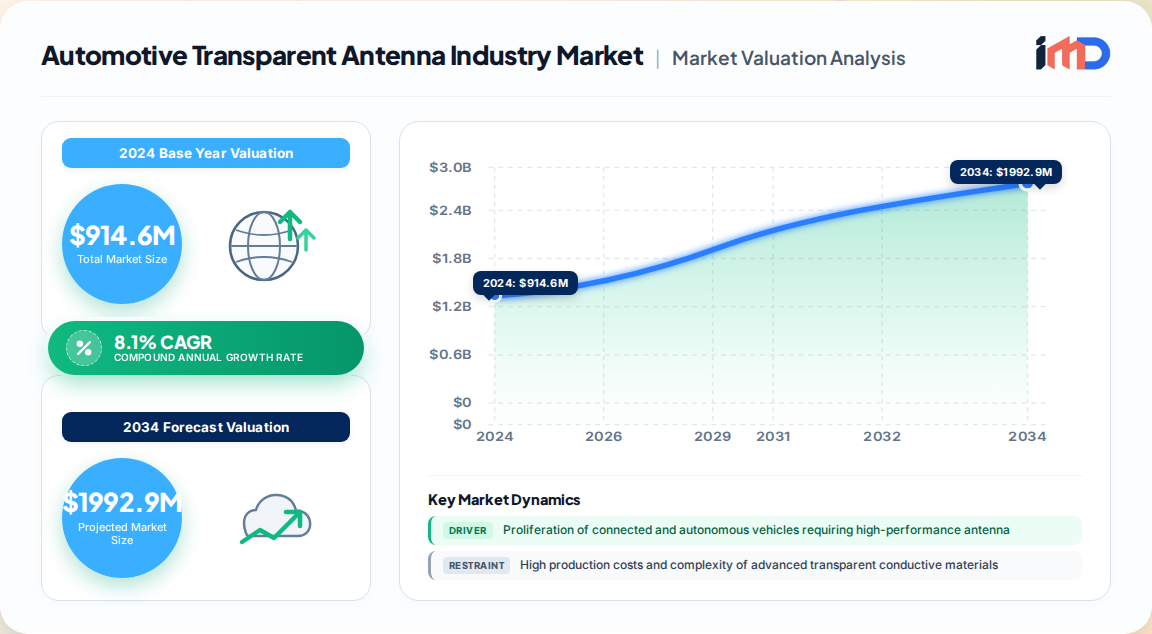
The Automotive Transparent Antenna Industry market represents a pivotal technological frontier in the connected and autonomous vehicle ecosystem. Our proprietary primary research estimates the global market at USD 914.6 Million in 2024, with a projected expansion to USD 1,992.9 Million by 2034, reflecting a steady CAGR of 8.1% during the forecast period (2025–2034). This growth is underpinned by the automotive sector's relentless pursuit of seamless, high-performance connectivity that does not compromise vehicle aesthetics or aerodynamic efficiency.
Transparent antennas are optically clear communication devices integrated directly into vehicle glass surfaces—windshields, sunroofs, and side windows—utilizing specialized conductive materials that permit visible light transmission while enabling high-frequency signal reception for 5G, GPS, V2X, and Wi-Fi applications. The shift from conspicuous external antennas (whips, shark fins) to invisible, integrated solutions is not merely a design trend; it is a functional imperative for the next generation of smart vehicles.
Our analysis of the value chain reveals that original equipment manufacturers (OEMs) account for approximately 86.1% of the revenue share, indicating that transparent antennas are predominantly designed into vehicles at the factory level rather than retrofitted. This integration ensures optimal performance, design compatibility, and adherence to stringent safety and durability standards.
Key Market Metrics (2024–2034):
| Metric | Value |
|---|---|
| Base Year Market Size (2024) | USD 914.6 Million |
| Forecast Market Size (2034) | USD 1,992.9 Million |
| CAGR (2025–2034) | 8.1% |
| Dominant Frequency Range | Ultra-High Frequency (UHF) – 44.2% |
| Leading Application | Windshield – 52.9% |
| Largest Vehicle Type | Passenger Cars – 78.6% |
| Dominant Sales Channel | OEM – 86.1% |
| Leading Region | Europe – 35.7% |
Europe's leadership, with a 35.7% share (USD 326.5 Million in 2024), is largely attributable to its proactive regulatory environment, including the Euro NCAP's integration of vehicle-to-everything (V2X) communication into safety scoring, with significant scoring impacts beginning in 2026. The region's emphasis on premium automotive design and technological innovation further cements its position as the primary market for transparent antenna solutions.
The proliferation of connected and autonomous vehicles serves as the primary growth engine. As automakers integrate advanced driver-assistance systems (ADAS), infotainment platforms, and V2X communication modules, the demand for high-performance, multi-band antennas that can be seamlessly embedded into vehicle architecture has surged. The 2024 C-NCAP (China New Car Assessment Program) now incorporates C-V2X functionality into its active safety scoring, with up to 12.5% of crash prevention points tied to these systems, compelling OEMs to accelerate adoption.
Regulatory mandates for vehicle safety and connectivity are acting as powerful catalysts. Euro NCAP's decision to include V2X communication in its safety scoring framework (with penalties for non-compliance and up to 0.5 points added for implementation by 2026) is forcing automakers to prioritize transparent antenna technologies that support direct communication (sidelink/PC5).
The shift toward electric vehicles (EVs) and lightweight automotive components presents another significant driver. Transparent antennas, integrated into glass surfaces, reduce weight and drag compared to traditional metallic antennas, aligning with the automotive industry's push for energy efficiency and aerodynamic design. Moreover, the ability to eliminate visible protrusions enhances the sleek, minimalist aesthetic that consumers increasingly demand.
Technological advancements in materials science, particularly the development of transparent conductive films (TCFs) such as nanowire, conductive polymers, and nano carbon, are expanding the performance envelope of transparent antennas. These materials offer improved conductivity and optical transparency, enabling broader adoption across vehicle segments.
Despite strong growth fundamentals, the market faces several challenges. High production costs associated with advanced materials and precision manufacturing processes represent a significant barrier, particularly for mass-market vehicle segments. Antennas utilizing TCFs typically achieve efficiencies below 40% at transparency levels exceeding 70%, and improving this trade-off remains a technical hurdle.
Technical limitations related to signal performance in certain frequency bands, coupled with the need for sophisticated multi-band compatibility, pose ongoing challenges. The integration of transparent antennas into curved glass surfaces requires advanced design and manufacturing capabilities, limiting the number of qualified suppliers.
Adoption in commercial vehicles remains limited due to different design priorities and cost sensitivities. While passenger vehicles dominate the market (78.6% share), commercial vehicle adoption is expected to grow more slowly, constrained by fleet economics and the longer replacement cycles of commercial fleets.
Geopolitical tensions and regulatory hurdles further impact the supply chain, particularly for critical materials such as indium (used in ITO films) and rare-earth elements. Trade restrictions and supply chain disruptions could increase costs and lead times for transparent antenna manufacturers.
Our granular segmentation analysis reveals distinct pockets of growth and value creation within the market. The synthesis of proprietary primary research and rigorous demand modeling provides a nuanced view of market dynamics.
Ultra-High Frequency (UHF) dominates with a 44.2% share, driven by its superior performance in modern automotive communication systems. UHF bands offer higher bandwidth for faster data transfer, making them essential for 5G, V2V, and V2I communications. The balance between range and data rate in UHF antennas makes them well-suited for automotive environments, where interference and multipath propagation are significant concerns. High Frequency (HF) and Very-High Frequency (VHF) segments remain relevant for legacy applications such as AM/FM radio and basic telematics but are growing at a slower pace.
The windshield is the most prominent application, commanding 52.9% of the market. The windshield's large surface area, optimal positioning for signal reception, and high visibility make it the ideal integration point for transparent antennas. Sunroof and window applications are also gaining traction, particularly in premium vehicles where panoramic sunroofs are increasingly popular. The sunroof segment is expected to grow as automakers seek to add connectivity features without increasing the antenna count on the vehicle exterior.
Internal Combustion Engine (ICE) vehicles currently dominate with a 65.5% share, primarily because they constitute the vast majority of the global vehicle fleet and rely on traditional communication systems that require robust antenna solutions. However, the EV segment is expected to grow at a faster rate, driven by the higher connectivity content in EVs and the need for lightweight, integrated antennas that support advanced telematics and OTA update capabilities. Transparent antennas are particularly well-suited for EVs, as they can be integrated into glass surfaces, reducing weight and improving efficiency.
Passenger cars hold a 78.6% share, reflecting the segment's emphasis on design, comfort, and advanced features. The adoption of transparent antennas in commercial vehicles (trucks, buses) is more gradual, constrained by cost pressures and the longer development cycles of commercial vehicle platforms. However, as fleet operators recognize the benefits of connectivity for logistics, telematics, and safety, commercial vehicle adoption is expected to accelerate.
Our regional analysis identifies Europe as the leading market, accounting for 35.7% of global consumption in 2024, with a value of USD 326.5 Million. The region's dominance is driven by a confluence of factors: stringent safety and emissions regulations, a strong automotive manufacturing base (particularly in Germany), and a consumer base that values both aesthetics and advanced technology. The Euro NCAP V2X scoring mandate is a key regulatory driver, compelling automakers to adopt transparent antennas that support direct communication.
Asia-Pacific is the fastest-growing region, with a projected market share of 31% and a robust CAGR. The region's growth is fueled by exponential vehicle production in China, Japan, and South Korea, coupled with rapid urbanization and increasing awareness of vehicle connectivity among younger buyers. China, in particular, is a powerhouse, accounting for nearly half of the automotive antenna market in the region. The 2024 C-NCAP C-V2X scoring criteria further accelerate adoption in this market.
North America holds a substantial share (22%), driven by the early adoption of connected car technologies and a strong demand for premium vehicles. The region's regulatory landscape, including potential mandates for V2X communication, is expected to support steady growth. South America and Middle East & Africa represent smaller but emerging markets, with growth potential linked to rising vehicle sales and the increasing availability of connected car features.
The competitive landscape is characterized by intense R&D activity, strategic partnerships, and a focus on material innovation. Key players in this market include glass manufacturers, antenna specialists, and automotive Tier-1 suppliers. Companies such as AGC Inc., Saint-Gobain Sekurit, Nippon Sheet Glass (NSG Group), TE Connectivity, Amphenol Corporation, Laird Connectivity, Ficosa International, Harada Industry, and Hella GmbH are at the forefront of developing transparent antenna solutions.
Material innovation is a central battleground. Companies are investing heavily in transparent conductive films (TCFs) based on nanowire, conductive polymers, and graphene to improve the trade-off between optical transparency and electrical conductivity. For instance, Meta Materials Inc. has developed transparent 5G antennas using its proprietary NANOWEB material, a highly transparent metal mesh that maintains high conductivity without sacrificing electromagnetic behavior. Similarly, Nippon Electric Glass Co., Ltd. has developed a transparent antenna for 5G millimeter-wave communication using a glass substrate and radio wave lenses.
Strategic partnerships between antenna technology firms, automotive OEMs, and semiconductor giants facilitate rapid prototyping and integration. The trend toward vertical integration is also evident, with some OEMs exploring in-house development of transparent antennas to ensure supply chain security and design exclusivity. OEMs dominate the sales channel with an 86.1% share, underscoring the importance of early design-in partnerships for antenna suppliers.
The aftermarket segment, while small, is expected to grow as retrofit solutions gain traction, particularly in regions with a strong vehicle customization culture. However, the complexity of integrating transparent antennas into existing vehicles limits the aftermarket's potential.
The transparent antenna industry relies on a complex global supply chain for critical materials, including transparent conductive oxides (ITO), nanowires, conductive polymers, and specialized glass substrates. Indium, a key component of ITO, is subject to significant supply risk due to its concentration in a few countries (notably China and South Korea). Trade restrictions, export quotas, and geopolitical tensions can disrupt supply and drive price volatility.
Our supply chain analysis identifies Europe and Asia-Pacific as the primary manufacturing hubs for transparent antennas, with China dominating the production of raw materials and components. The United States and Germany are key producers of high-end antenna systems and materials, but they are increasingly reliant on imported raw materials. The COVID-19 pandemic exposed vulnerabilities in global supply chains, prompting OEMs to pursue nearshoring and supply chain diversification strategies.
Logistics also play a critical role, particularly for glass-based antennas, which are bulky and susceptible to breakage during transport. Regional manufacturing and assembly are therefore favored to minimize logistics costs and risks. The trend toward localization is expected to accelerate, with OEMs and suppliers establishing regional production facilities to serve major automotive hubs.
Our research identifies several strategic white spaces that represent high-growth opportunities for industry participants:
The Automotive Transparent Antenna Industry market is at an inflection point. With a CAGR of 8.1% and a projected value of USD 1,992.9 Million by 2034, the market offers compelling opportunities for investors and industry stakeholders. The convergence of regulatory mandates, technological advancements, and consumer demand for seamless connectivity and aesthetic design will continue to drive adoption. However, success will require navigating material supply risks, managing cost pressures, and investing in R&D to push the boundaries of transparency and performance. Stakeholders who strategically position themselves in high-growth segments—such as UHF antennas, windshield applications, and EV platforms—and regions—particularly Europe and Asia-Pacific—will be well-placed to capture value in this evolving market.
| Aspects | Details |
|---|---|
| Study Period | 2020-2034 |
| Base Year | 2024 |
| Estimated Year | 2026 |
| Forecast Period | 2026-2034 |
| Historical Period | 2020-2025 |
| Growth Rate | CAGR of 8.1% from 2020-2034 |
| Segmentation |
|
By Application
By Vehicle Type
By Sales Channel
By Material Type
By Component
| By Geography |
|
The global automotive transparent antenna market was valued at USD 914.6 Million in 2024 and is projected to reach USD 1,992.9 Million by 2034, growing at a CAGR of 8.1%.
Europe leads the market with a 35.7% share, equivalent to USD 326.5 Million in 2024, driven by stringent safety regulations and a strong automotive manufacturing base.
The primary drivers include the proliferation of connected and autonomous vehicles, regulatory mandates for V2X communication (e.g., Euro NCAP and C-NCAP), and the shift toward electric vehicles that benefit from lightweight, integrated antennas.
Ultra-High Frequency (UHF) antennas dominate with a 44.2% market share, as they offer higher bandwidth and are essential for 5G, V2V, and V2I communications.
Key players include AGC Inc., Saint-Gobain Sekurit, Nippon Sheet Glass (NSG Group), TE Connectivity, Amphenol Corporation, Laird Connectivity, Ficosa International, Harada Industry, and Hella GmbH, among others.
Our rigorous research methodology combines multi-layered approaches with comprehensive quality assurance, ensuring precision, accuracy, and reliability in every market analysis.
| Stakeholder Role | Interview Share (%) |
|---|---|
| Procurement Director | 30% |
| Antenna Design Engineer | 25% |
| Materials Scientist | 25% |
| Regulatory Affairs Manager | 20% |
| Company Type | Representation (%) |
|---|---|
| Automotive OEMs | 35% |
| Tier-1 Antenna Suppliers | 25% |
| Glass & Materials Manufacturers | 20% |
| Semiconductor & Component Providers | 12% |
| Research & Standards Organizations | 8% |
 Related Reports
