1How big is the sunscreen cosmetics market?
The global sunscreen cosmetics market was valued at USD 12.0 Billion in 2026 and is projected to reach USD 19.4 Billion by 2033, growing at a CAGR of 7.1%.
Insight Market Data is a premier market research and business consulting firm headquartered in Pune, India, providing syndicated research reports, customized intelligence studies, and strategic advisory services. Renowned academic institutions and Fortune 500 corporations worldwide rely on Insight Market Data's research repository to navigate evolving global and regional business environments. Covering 46 diverse industries across 25 major international economies, our comprehensive database delivers thousands of verified statistics and granular market evaluations. By combining industry-leading analytical methodologies with the direct insights of seasoned industry leaders and subject-matter experts, we deliver actionable intelligence spanning historical performance benchmarks to rigorous multi-year forecasts. We empower organizations to make confident, data-driven decisions across pivotal domains including Machinery & Equipment, Chemicals & Materials, Pharmaceuticals & Healthcare, Food & Beverages, Consumer Goods, Energy & Power, Automotive & Transportation, Electronics & Semiconductors, Medical Devices, Telecommunications, Emerging Technologies, Agriculture, and Packaging. Our multidisciplinary analyst teams provide an objective 360-degree perspective, tailoring every engagement to address complex strategic challenges with exceptional analytical rigor.
Leveraging advanced BI-powered analytics and predictive modeling, Insight Market Data uncovers high-impact market opportunities and competitive differentiators for ambitious enterprises. We continuously refine our research methodologies in accordance with global industry standards, tracking real-time market shifts to ensure our reports are consistently accurate, actionable, and delivered on schedule. Our analysts conduct methodical data validation, rigorous compliance checks, and exhaustive primary and secondary research to maintain the highest levels of data integrity and transparency. We partner closely with corporate strategists, investment groups, and business executives to translate intricate market intelligence into clear, actionable roadmaps for sustainable growth. With operational presence across Washington, USA, and Vimannagar, Pune, India, Insight Market Data ensures direct access to dedicated research specialists and responsive customer support to answer your most strategic questions.
 Sunscreen Cosmetics Market
 by Product (SPF Foundation, Tinted Moisturizers, Sunscreen & Sunblock, Moisturizers, Lip Balm, Others), by Type (Conventional, Organic), by Distribution Channel (Hypermarkets & Supermarkets, Specialty Stores, E-Commerce, Others), by Form (Lotion, Cream, Spray, Gels, Sticks, Others), by SPF Level (SPF Below 30, SPF 30-49, SPF 50 and Above), by Age Group (Adult, Children, Infant & Baby), by North America (USA, Canada, Mexico), by Europe (Germany, UK, France, Italy, Spain, Russia, Sweden, Denmark, Switzerland, Luxembourg, Rest of Europe), by Asia Pacific (China, Japan, South Korea, India, Australia, Singapore, Taiwan, South East Asia, Rest of APAC), by South America (Brazil, Argentina, Colombia, Peru, Chile, Rest of South America), by Middle East (Saudi Arabia, Turkey, UAE, Egypt, Qatar, Rest of Middle East), by Africa (South Africa, East Africa, West Africa, North Africa) Forecast 2026-2034

Research Analyst


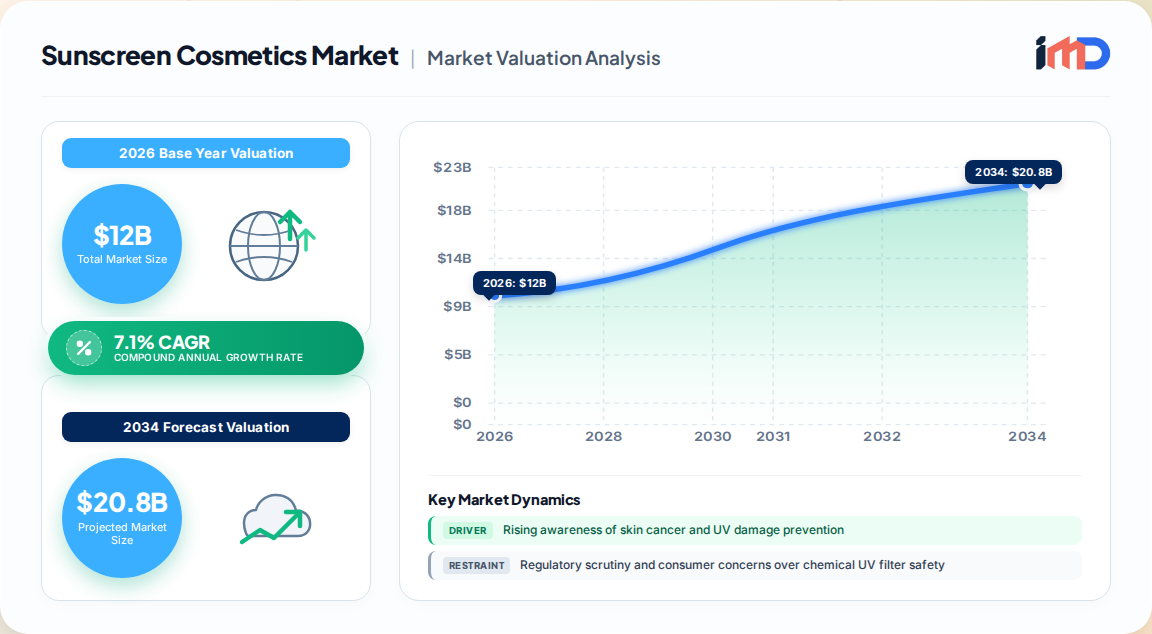
The global sunscreen cosmetics market represents one of the most dynamic and resilient segments within the broader beauty and personal care industry. Our proprietary primary research estimates the market at USD 12.0 Billion in 2026, with a projected expansion to USD 19.4 Billion by 2033, registering a robust CAGR of 7.1% over the forecast period. This growth trajectory underscores a fundamental shift in consumer behavior: sun protection has evolved from a seasonal, beach-centric ritual into an integral component of daily skincare and cosmetic regimens worldwide.
Asia-Pacific commands the largest regional share at 39.6% of global revenue in 2025, driven by high adoption rates in China, Japan, and South Korea, where sun protection is deeply embedded in daily beauty routines. North America follows as a mature yet innovation-driven market, while Europe presents a regulatory landscape that is reshaping formulation strategies.
From a segmentation standpoint, conventional formulations dominate with 83.2% of revenue share, yet organic and mineral-based variants are outpacing the overall market with notably higher growth rates. The SPF foundation product segment led with 23.3% share in 2025, reflecting the accelerating convergence of cosmetics and sun care. Hypermarkets and supermarkets remain the leading distribution channel at 33.7%, though e-commerce is capturing share at an accelerated pace.
Asia-Pacific leads the global market with 39.6% revenue share in 2025, driven by strong beauty standards, rising disposable incomes, and high awareness in China, Japan, South Korea, and India. China represents the largest country market, supported by a vast consumer base and growing demand for multifunctional cosmetics.
North America remains a significant market, characterized by high consumer awareness and a strong shift toward mineral-based and clean-label sunscreens. The U.S. leads with stringent regulatory oversight and a culture of daily sun protection adoption, though there is substantial room for growth as only about 13.5% of Americans use sunscreen daily.
Europe presents a stable, regulation-driven market. The EU's strict cosmetic safety regulations and emphasis on UV filter approval influence product formulations. Germany, the UK, and France are key markets, with demand for organic and reef-safe products rising.
South America, the Middle East, and Africa offer emerging opportunities. Brazil is a major market in South America, while rising temperatures and outdoor lifestyles in the Middle East drive demand. Africa presents untapped potential as awareness grows.
The sunscreen cosmetics market is characterized by a mix of established global players and innovative indie brands. Key strategic imperatives include:
International trade in sunscreen cosmetics is influenced by the harmonized system (HS) code 3304 (beauty or make-up preparations and preparations for the care of the skin), which encompasses sunscreen products. According to the UN Comtrade database, global trade in these products has shown steady growth, with major exporters including the United States, Germany, France, and China. Asia-Pacific is a net exporter, with China and South Korea driving significant volumes. Raw material suppliers of zinc oxide, titanium dioxide, and chemical UV filters are concentrated in a few regions, creating supply chain dependencies. Recent disruptions have prompted manufacturers to localize sourcing and invest in alternative supply networks to mitigate risk.
Significant white-space opportunities exist in:
The sunscreen cosmetics market is poised for sustained growth, underpinned by a shift toward daily sun protection, continuous product innovation, and expanding e-commerce channels. CAGR of 7.1% is expected from 2026 to 2033, with the market reaching USD 19.4 Billion. Investment opportunities are most attractive in the following areas:
In conclusion, the sunscreen cosmetics market offers a compelling blend of volume growth and premiumization. Stakeholders across the value chain, from raw material suppliers to retailers, must prioritize agility, regulatory compliance, and consumer-centric innovation to capture emerging opportunities in this evolving landscape.
| Aspects | Details |
|---|---|
| Study Period | 2020-2034 |
| Base Year | 2026 |
| Estimated Year | 2026 |
| Forecast Period | 2026-2034 |
| Historical Period | 2020-2025 |
| Growth Rate | CAGR of 7.1% from 2020-2034 |
| Segmentation |
|
By Type
By Distribution Channel
By Form
By SPF Level
By Age Group
| By Geography |
|
The global sunscreen cosmetics market was valued at USD 12.0 Billion in 2026 and is projected to reach USD 19.4 Billion by 2033, growing at a CAGR of 7.1%.
Asia-Pacific holds the largest share, accounting for 39.6% of global revenue in 2025, driven by high adoption in China, Japan, and South Korea.
Key trends include the rise of multifunctional products like SPF foundations, a shift toward mineral and reef-safe formulations, and the growing influence of e-commerce and social media on purchasing decisions.
Organic and mineral-based sunscreens are the fastest-growing segment, fueled by clean beauty trends and environmental concerns, with the U.S. mineral sunscreen market projected to grow at 11.9% CAGR.
Challenges include regulatory scrutiny over chemical UV filters, high costs of reformulation, and seasonality in demand, particularly in regions with limited daily sun protection habits.
Key companies include Beiersdorf AG, L'Oréal S.A., Unilever, Johnson & Johnson, and Shiseido, among others, competing on innovation, sustainability, and brand trust.
E-commerce is the fastest-growing distribution channel, driven by internet penetration, social media marketing, and the rise of DTC brands. It offers convenience, product information, and personalized recommendations, especially for organic and specialty products.
Our rigorous research methodology combines multi-layered approaches with comprehensive quality assurance, ensuring precision, accuracy, and reliability in every market analysis.
| Stakeholder Role | Interview Share (%) |
|---|---|
| C-Level Executives | 25% |
| Product Managers | 30% |
| R&D Directors | 25% |
| Procurement Heads | 20% |
| Company Type | Representation (%) |
|---|---|
| Cosmetic Manufacturers | 30% |
| Raw Material Suppliers | 20% |
| Contract Manufacturers | 15% |
| Distributors/Retailers | 25% |
| Regulatory Consultants | 10% |
 Related Reports
