1What is the current size of the spinning disk confocal imaging system market?
The global market is estimated at USD 2.37 billion in 2025 and is projected to reach USD 4.49 billion by 2035, growing at a CAGR of 6.58%.
Insight Market Data is a premier market research and business consulting firm headquartered in Pune, India, providing syndicated research reports, customized intelligence studies, and strategic advisory services. Renowned academic institutions and Fortune 500 corporations worldwide rely on Insight Market Data's research repository to navigate evolving global and regional business environments. Covering 46 diverse industries across 25 major international economies, our comprehensive database delivers thousands of verified statistics and granular market evaluations. By combining industry-leading analytical methodologies with the direct insights of seasoned industry leaders and subject-matter experts, we deliver actionable intelligence spanning historical performance benchmarks to rigorous multi-year forecasts. We empower organizations to make confident, data-driven decisions across pivotal domains including Machinery & Equipment, Chemicals & Materials, Pharmaceuticals & Healthcare, Food & Beverages, Consumer Goods, Energy & Power, Automotive & Transportation, Electronics & Semiconductors, Medical Devices, Telecommunications, Emerging Technologies, Agriculture, and Packaging. Our multidisciplinary analyst teams provide an objective 360-degree perspective, tailoring every engagement to address complex strategic challenges with exceptional analytical rigor.
Leveraging advanced BI-powered analytics and predictive modeling, Insight Market Data uncovers high-impact market opportunities and competitive differentiators for ambitious enterprises. We continuously refine our research methodologies in accordance with global industry standards, tracking real-time market shifts to ensure our reports are consistently accurate, actionable, and delivered on schedule. Our analysts conduct methodical data validation, rigorous compliance checks, and exhaustive primary and secondary research to maintain the highest levels of data integrity and transparency. We partner closely with corporate strategists, investment groups, and business executives to translate intricate market intelligence into clear, actionable roadmaps for sustainable growth. With operational presence across Washington, USA, and Vimannagar, Pune, India, Insight Market Data ensures direct access to dedicated research specialists and responsive customer support to answer your most strategic questions.
 Spinning Disk Confocal Imaging System
 by Microscope Type (Inverted Spinning Disk Confocal Microscopes, Upright Spinning Disk Confocal Microscopes), by Light Source (Laser-based, LED-based), by Application (Cell Biology and Neuroscience, Live Cell Imaging, Drug Discovery and Toxicology, Developmental Biology and Embryology, Plant and Animal Science), by Disk Type (Borealis Disk, Yokogawa Disk), by Component (Accessories, Components, Microscope System, Software), by North America (USA, Canada, Mexico), by Europe (Germany, UK, France, Italy, Spain), by Asia Pacific (China, Japan, South Korea, India, Australia), by South America (Brazil, Mexico), by Middle East & Africa (GCC, South Africa) Forecast 2026-2034

Research Analyst


 Related Reports

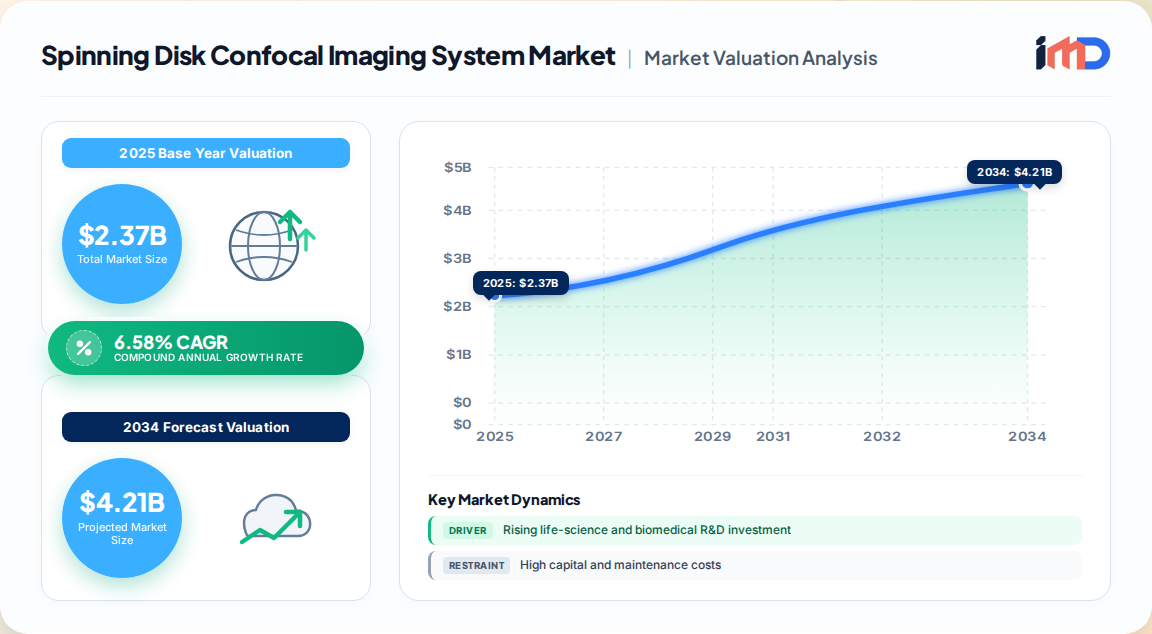
The global spinning disk confocal imaging system market is estimated at USD 2.37 billion in 2025 and is projected to reach USD 4.49 billion by 2035, expanding at a CAGR of 6.58% over the forecast period. This growth is underpinned by a structural shift in life-science research toward live-cell, longitudinal, and high-throughput imaging workflows where phototoxicity and acquisition speed are as critical as resolution.
Spinning disk confocal systems use a rotating pinhole disk to distribute illumination across many points simultaneously, enabling rapid optical sectioning with lower dwell times per point compared with point-scanning confocal architectures. This design advantage is particularly valuable in dynamic biological applications, including live-cell imaging, developmental biology, neuroscience, organoid research, and drug discovery.
From a supply-side perspective, the market remains moderately concentrated, with established optical and photonics incumbents controlling core disk, detector, and software IP. Demand is increasingly shaped by integrated platform purchases that bundle incubation, autofocus, synchronized stimulation, and AI-assisted analysis rather than standalone microscope hardware.
The market is being propelled by five intersecting demand drivers, each with measurable impact on procurement budgets and instrument design priorities.
Despite strong fundamentals, several constraints temper the pace of adoption, particularly in cost-sensitive and resource-limited settings.
Segmentation in this market is defined by instrument architecture, light source, application, and end-user context. The following table summarizes the principal product and technology segments, their relative standing, and growth trajectory.
| Segment Dimension | Dominant Segment | Fastest-Growing Segment |
|---|---|---|
| Microscope Type | Inverted spinning disk confocal | Upright spinning disk confocal |
| Light Source | Laser-based | LED-based |
| Application | Cell biology and neuroscience | Live-cell imaging |
| Disk Type | Yokogawa-style disk | Borealis disk (emerging) |
Regional demand is closely tied to research funding, core-facility density, and local manufacturing capability.
The competitive environment is defined by a mix of established optical and photonics leaders and specialized component and software providers. Key players include Nikon Corporation, Zeiss Group, Leica Microsystems, Olympus Corporation, Andor Technology, Hamamatsu Photonics, Molecular Devices, PerkinElmer, and Becton Dickinson.
Recent strategic activity indicates a continued push toward integration, AI-enabled analysis, and application-specific configurations.
The competitive dynamic is shifting from hardware specification competition toward workflow integration, software interoperability, and service-level differentiation. Vendors that can deliver reproducible, supported imaging workflows—including calibration, metadata capture, and analysis pipelines—are better positioned to capture share in core facilities and multi-site research networks.
The most attractive strategic white-space lies at the intersection of live-cell workflow integration, AI-assisted analysis, and scalable shared-resource deployment.
For procurement leaders, the key evaluation criteria increasingly include total cost of ownership, service response time, software interoperability, and compatibility with existing laboratory information systems. Acquisition decisions should weigh not only nominal resolution and speed but also the ability to sustain reproducible workflows across operators and sites.
Spinning disk confocal imaging systems are high-value capital equipment traded globally, with supply chains concentrated among a relatively small number of optical, laser, detector, and disk manufacturers.
| Aspects | Details |
|---|---|
| Study Period | 2020-2034 |
| Base Year | 2025 |
| Estimated Year | 2026 |
| Forecast Period | 2026-2034 |
| Historical Period | 2020-2025 |
| Growth Rate | CAGR of 6.58% from 2020-2034 |
| Segmentation |
|
By Application
By Disk Type
By Component
| By Geography |
|
The global market is estimated at USD 2.37 billion in 2025 and is projected to reach USD 4.49 billion by 2035, growing at a CAGR of 6.58%.
North America is the largest market, while Asia-Pacific is the fastest-growing region, supported by expanding biotechnology research and government funding for neuroscience and imaging infrastructure.
Key applications include cell biology and neuroscience, live-cell imaging, drug discovery and toxicology, developmental biology, and plant and animal science. Live-cell imaging is the fastest-growing application segment.
Major players include Nikon Corporation, Zeiss Group, Leica Microsystems, Olympus Corporation, Andor Technology, Hamamatsu Photonics, Molecular Devices, PerkinElmer, and Becton Dickinson.
Our rigorous research methodology combines multi-layered approaches with comprehensive quality assurance, ensuring precision, accuracy, and reliability in every market analysis.
| Stakeholder Role | Interview Share (%) |
|---|---|
| Director of Research Core Facilities | 35% |
| Principal Investigator (Cell Biology/Neuroscience) | 30% |
| Imaging Application Scientist | 20% |
| Procurement Manager for Capital Equipment | 15% |
| Company Type | Representation (%) |
|---|---|
| Microscope System OEMs | 40% |
| Optical & Laser Component Manufacturers | 25% |
| Spinning Disk & Pinhole Disk Specialists | 15% |
| Software & AI Image-Analysis Providers | 12% |
| Academic Core Facilities & Research Institutes | 8% |