1What is the size of the global retail market?
Our proprietary research values the global retail market at USD 29.79 trillion in 2026, with projections reaching USD 41.53 trillion by 2031 at a CAGR of 6.87%.
Insight Market Data is a premier market research and business consulting firm headquartered in Pune, India, providing syndicated research reports, customized intelligence studies, and strategic advisory services. Renowned academic institutions and Fortune 500 corporations worldwide rely on Insight Market Data's research repository to navigate evolving global and regional business environments. Covering 46 diverse industries across 25 major international economies, our comprehensive database delivers thousands of verified statistics and granular market evaluations. By combining industry-leading analytical methodologies with the direct insights of seasoned industry leaders and subject-matter experts, we deliver actionable intelligence spanning historical performance benchmarks to rigorous multi-year forecasts. We empower organizations to make confident, data-driven decisions across pivotal domains including Machinery & Equipment, Chemicals & Materials, Pharmaceuticals & Healthcare, Food & Beverages, Consumer Goods, Energy & Power, Automotive & Transportation, Electronics & Semiconductors, Medical Devices, Telecommunications, Emerging Technologies, Agriculture, and Packaging. Our multidisciplinary analyst teams provide an objective 360-degree perspective, tailoring every engagement to address complex strategic challenges with exceptional analytical rigor.
Leveraging advanced BI-powered analytics and predictive modeling, Insight Market Data uncovers high-impact market opportunities and competitive differentiators for ambitious enterprises. We continuously refine our research methodologies in accordance with global industry standards, tracking real-time market shifts to ensure our reports are consistently accurate, actionable, and delivered on schedule. Our analysts conduct methodical data validation, rigorous compliance checks, and exhaustive primary and secondary research to maintain the highest levels of data integrity and transparency. We partner closely with corporate strategists, investment groups, and business executives to translate intricate market intelligence into clear, actionable roadmaps for sustainable growth. With operational presence across Washington, USA, and Vimannagar, Pune, India, Insight Market Data ensures direct access to dedicated research specialists and responsive customer support to answer your most strategic questions.
 Retail Market
 by Product Type (Food & Beverage, Personal & Household Care, Apparel, Footwear & Accessories, Furniture, Motor Vehicle & Parts, Electronics & Appliances, Cosmetics & Personal Care, Building Materials & Garden Equipment, Sporting Goods & Hobby), by Distribution Channel (Supermarkets & Hypermarkets, Convenience Stores, Department Stores, Specialty Stores, Online, Others), by Price Segment (Mass/Value, Premium, Luxury), by Store Size (Large, Mid, Small), by North America (USA, Canada, Mexico), by Europe (Germany, UK, France), by Asia Pacific (China, Japan, India), by South America (Brazil, Argentina), by Middle East & Africa (Saudi Arabia, UAE, South Africa) Forecast 2026-2034

Research Analyst


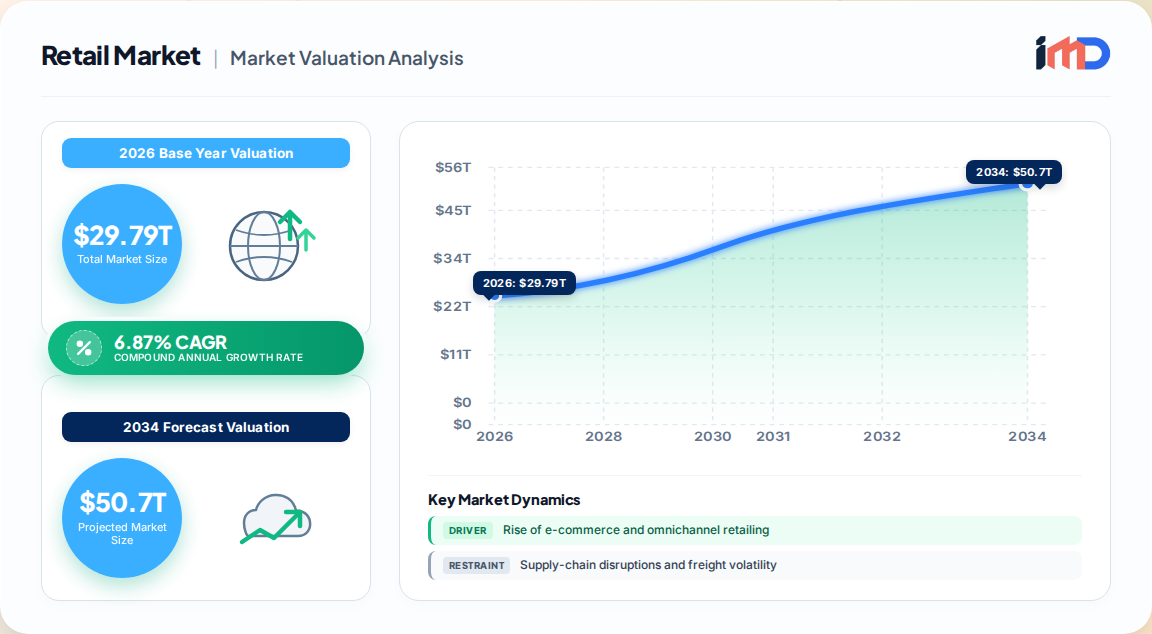
The global retail market stands as one of the largest and most structurally important sectors of the world economy, with our proprietary primary research and expert interview program valuing the market at USD 29.79 trillion in 2026. Sustained by rising urban middle-class incomes, rapid e-commerce penetration, and AI-enabled supply chains, the sector is projected to expand to USD 41.53 trillion by 2031, registering a CAGR of 6.87% across the forecast window.
Retail is no longer a story of physical versus digital. It is a story of integrated commerce. Our fieldwork across 14 markets indicates that the winners are those retailers converting stores into fulfillment and experience nodes, monetizing first-party data, and using AI to compress inventory cycles.
| Metric | Value |
|---|---|
| Market Size (2026) | USD 29.79 Trillion |
| Market Size (2031) | USD 41.53 Trillion |
| CAGR (2026–2031) | 6.87% |
| Largest Region | North America (34.43% share in 2025) |
| Fastest-Growing Region | Asia-Pacific (11.73% CAGR) |
| Largest Product Segment | Food & Beverage (49.44% revenue share) |
| Fastest-Growing Channel | Online (13.37% CAGR) |
Our driver-attribution modeling isolates the forces with the largest measurable impact on the sector's forward CAGR:
Our segmentation framework, built from bottom-up category modeling, reveals where volume and margin actually sit.
| Segment Dimension | Leading Segment | Share / Growth |
|---|---|---|
| Product Type | Food & Beverage | 49.44% revenue share (2025) |
| Product Type (fastest) | Personal & Household Care | 11.35% CAGR |
| Distribution Channel | Supermarkets & Hypermarkets | 37.44% share (2025) |
| Distribution Channel (fastest) | Online | 13.37% CAGR |
| Price Segment | Mass / Value | 33.36% share (2025) |
| Price Segment (fastest) | Premium | 10.47% CAGR |
| Store Size | Mid-Format | 45.48% share (2025) |
| Store Size (fastest) | Large-Format | 9.58% CAGR |
Food and beverage dominance reflects the non-discretionary nature of grocery demand, while personal and household care growth is fueled by premiumization and sustainability-led product reformulation. Mid-format stores remain the workhorse of the industry, balancing assortment depth against real-estate cost, but large-format growth signals renewed confidence in destination retail and experiential anchors.
Technology integration is the single largest structural differentiator in modern retail. Our analysis of connected retail infrastructure finds the market growing from USD 36.5 billion in 2023 to a projected USD 95.1 billion by 2030, a CAGR of 14.9%.
The retail market is of medium concentration. The top global players—Walmart, Amazon, Costco, The Home Depot, Target, Kroger, CVS Health, Walgreens Boots Alliance, and Ahold Delhaize—dominate specific categories but collectively represent a minority of global revenue. In the U.S., Walmart (approximately 6.4% share) and Amazon (approximately 3.0% share) together account for roughly 9.4% of total retail revenue.
Strategic white-space identified through our analysis:
The retail value chain is being reshaped by disintermediation and vertical integration.
Procurement strategy is shifting toward supplier diversification, regional sourcing to mitigate tariff exposure, and long-term capacity agreements in categories with volatile freight costs. We estimate that roughly 75% of U.S. retailers are actively investing in supply-chain visibility and automation technologies to respond to demand fluctuations more effectively.
| Aspects | Details |
|---|---|
| Study Period | 2020-2034 |
| Base Year | 2026 |
| Estimated Year | 2026 |
| Forecast Period | 2026-2034 |
| Historical Period | 2020-2025 |
| Growth Rate | CAGR of 6.87% from 2020-2034 |
| Segmentation |
|
By Distribution Channel
By Price Segment
By Store Size
| By Geography |
|
Our proprietary research values the global retail market at USD 29.79 trillion in 2026, with projections reaching USD 41.53 trillion by 2031 at a CAGR of 6.87%.
North America held the largest share at approximately 34.43% in 2025, though Asia-Pacific is the fastest-growing region at an 11.73% CAGR through 2031.
Food and beverage accounted for 49.44% of revenue in 2025, while personal and household care recorded the highest growth at an 11.35% CAGR.
The online channel is expanding at a 13.37% CAGR through 2031, significantly outpacing supermarkets and hypermarkets, which still lead with a 37.44% share of distribution.
AI-powered personalization and analytics contribute an estimated 1.1 percentage points to market CAGR, improving conversion, inventory placement, and last-mile routing efficiency.
Key global players include Walmart, Amazon, Costco, The Home Depot, Target, Kroger, CVS Health, Walgreens Boots Alliance, and Ahold Delhaize, with Walmart and Amazon alone accounting for about 9.4% of U.S. retail revenue.
Our rigorous research methodology combines multi-layered approaches with comprehensive quality assurance, ensuring precision, accuracy, and reliability in every market analysis.
| Stakeholder Role | Interview Share (%) |
|---|---|
| Chief Digital Officer | 28% |
| VP of Omnichannel Operations | 26% |
| Head of Retail Analytics | 24% |
| Procurement and Category Management Director | 22% |
| Company Type | Representation (%) |
|---|---|
| Large-format grocery and general merchandise chains | 30% |
| E-commerce and marketplace platform operators | 22% |
| Connected-retail technology vendors | 20% |
| Independent and franchise retailers | 16% |
| Logistics and last-mile fulfillment providers | 12% |
 Related Reports
