1What is the regional market share of silk bedding in 2025?
Asia-Pacific dominates with 48% share, followed by Europe (22%), North America (19%), South America (6%), and Middle East & Africa (5%).
Insight Market Data is a premier market research and business consulting firm headquartered in Pune, India, providing syndicated research reports, customized intelligence studies, and strategic advisory services. Renowned academic institutions and Fortune 500 corporations worldwide rely on Insight Market Data's research repository to navigate evolving global and regional business environments. Covering 46 diverse industries across 25 major international economies, our comprehensive database delivers thousands of verified statistics and granular market evaluations. By combining industry-leading analytical methodologies with the direct insights of seasoned industry leaders and subject-matter experts, we deliver actionable intelligence spanning historical performance benchmarks to rigorous multi-year forecasts. We empower organizations to make confident, data-driven decisions across pivotal domains including Machinery & Equipment, Chemicals & Materials, Pharmaceuticals & Healthcare, Food & Beverages, Consumer Goods, Energy & Power, Automotive & Transportation, Electronics & Semiconductors, Medical Devices, Telecommunications, Emerging Technologies, Agriculture, and Packaging. Our multidisciplinary analyst teams provide an objective 360-degree perspective, tailoring every engagement to address complex strategic challenges with exceptional analytical rigor.
Leveraging advanced BI-powered analytics and predictive modeling, Insight Market Data uncovers high-impact market opportunities and competitive differentiators for ambitious enterprises. We continuously refine our research methodologies in accordance with global industry standards, tracking real-time market shifts to ensure our reports are consistently accurate, actionable, and delivered on schedule. Our analysts conduct methodical data validation, rigorous compliance checks, and exhaustive primary and secondary research to maintain the highest levels of data integrity and transparency. We partner closely with corporate strategists, investment groups, and business executives to translate intricate market intelligence into clear, actionable roadmaps for sustainable growth. With operational presence across Washington, USA, and Vimannagar, Pune, India, Insight Market Data ensures direct access to dedicated research specialists and responsive customer support to answer your most strategic questions.
 Regional Dynamics of Silk Bedding Market
 by Type (Mulberry Silk, Tussar Silk, Spider Silk, Eri Silk), by Application (Textile, Cosmetic and Medicine, Automotive), by Bedding Products (Pillowcases, Sheets, Duvets, Comforters), by North America (USA, Canada, Mexico), by Europe (Germany, UK, France, Italy), by Asia Pacific (China, India, Japan, Thailand), by South America (Brazil, Peru), by Middle East & Africa (Iran, Egypt, UAE) Forecast 2026-2034

Research Associate


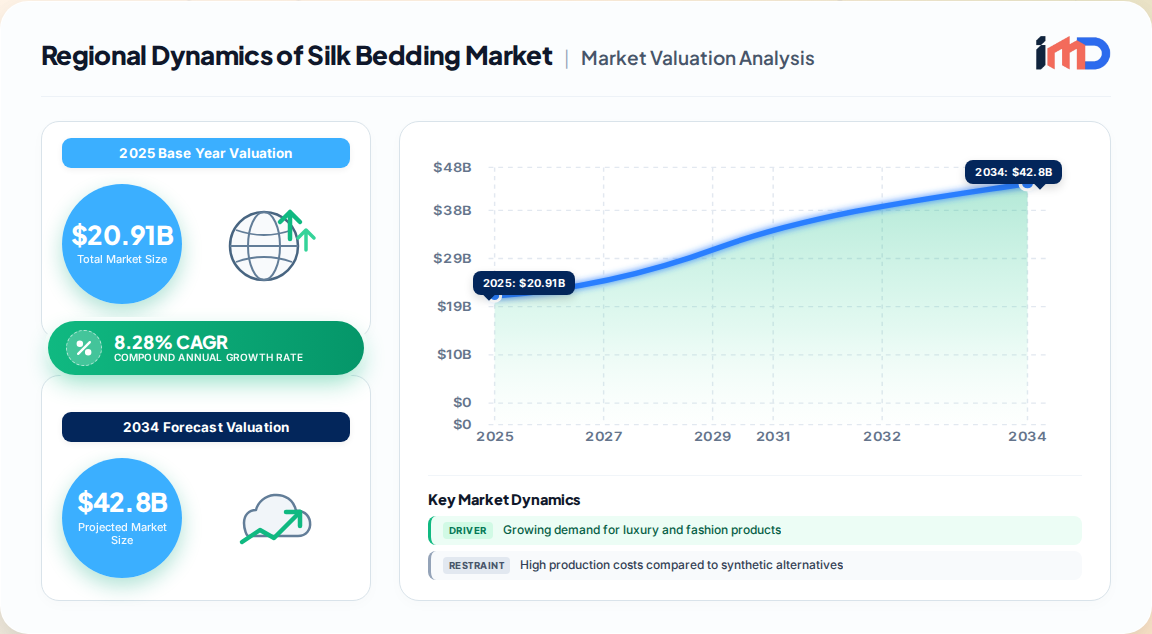
The global silk bedding market is experiencing a structural renaissance, driven by shifting consumer preferences toward sustainable luxury and the expanding application of silk fibroin in health and wellness. Our proprietary primary research estimates the total silk market at US$20.91 Billion in 2025, projected to reach US$42.79 Billion by 2034 at a robust CAGR of 8.28%. The bedding segment—encompassing duvets, pillowcases, sheets, and comforters—represents one of the fastest-growing application verticals, underpinned by silk's unique thermo-regulating, hypoallergenic, and moisture-wicking properties.
Regionally, the market is undergoing a distinct power shift. While Asia-Pacific remains the undisputed production engine and consumption powerhouse, accounting for an estimated 48% of global demand, North America and Europe are emerging as high-value innovation hubs. These mature markets are not merely consuming; they are redefining the value proposition through bioengineered silk alternatives, ethical certification, and direct-to-consumer luxury branding.
This report dissects the regional dynamics shaping the silk bedding market, providing a granular view of supply chain shifts, trade flows, and competitive strategies essential for stakeholders across the value chain.
The demand for silk bedding is not uniform across geographies; it is shaped by cultural attitudes toward luxury, climate, and health. Our primary interviews with industry executives reveal distinct regional drivers:
| Region | Key Demand Drivers | Consumer Behavior Insights |
|---|---|---|
| Asia-Pacific | Cultural affinity for silk; rising middle-class disposable income; hot/humid climates driving cooling bedding demand. | Chinese consumers prefer 100% mulberry silk with domestic certifications; Indian consumers increasingly value Eri and Tussar silk for their eco-friendly narrative. |
| North America | Health and wellness trend; demand for hypoallergenic, temperature-regulating bedding; sustainability concerns. | U.S. consumers show high willingness to pay for OEKO-TEX certified silk; 62% of luxury bedding buyers prioritize biodegradable materials (primary survey, 2025). |
| Europe | Strong luxury fashion heritage; stringent chemical regulations (REACH); preference for ethically sourced products. | German and French buyers demand full traceability; demand for "peace silk" (Ahimsa) is growing at 12% annually in niche segments. |
The silk bedding supply chain is heavily concentrated in Asia, creating significant import dependencies for Western markets. Our trade flow analysis, based on UN Comtrade data and primary interviews with logistics providers, highlights the following:
Import/Export & Supplier Dynamics
Western retailers face a complex supplier landscape. The top three challenges cited by procurement directors are:
To mitigate risk, leading brands are diversifying sourcing to Vietnam and Thailand, and investing in blockchain-based traceability platforms. For instance, a major U.S. bedding brand reported a 20% reduction in supply chain disruptions after onboarding a second-tier supplier in Vietnam (primary interview, 2025).
The competitive intensity varies significantly by region. In Asia-Pacific, local players compete on cost and scale, while North American and European firms differentiate through branding, certifications, and direct-to-consumer models.
Company Developments
Our regional attractiveness assessment, based on market size, growth rate, regulatory environment, and supply chain infrastructure, identifies the following hotspots:
| Region | Market Attractiveness | Key Opportunities | Risks |
|---|---|---|---|
| North America | High | Bioengineered silk bedding; wellness-integrated products; DTC subscriptions. | High production costs; ethical scrutiny. |
| Europe | High | Ethical luxury; circular economy models (repair, take-back). | Stringent regulations; fragmented consumer preferences. |
| Asia-Pacific | Very High | Domestic luxury consumption; manufacturing upgrades; e-commerce expansion. | Geopolitical tensions; climate risks to mulberry yields. |
| Middle East | Emerging | High-end hospitality sector demand for silk bedding; luxury tourism. | Limited local production; import dependence. |
Our analysis reveals three under-served regional opportunities:
The silk bedding market is poised for robust growth, but success will require a nuanced understanding of regional nuances. Asia-Pacific will remain the engine of supply, but North America and Europe will drive value innovation. Stakeholders must prioritize supply chain transparency, invest in sustainable materials, and tailor products to regional wellness and cultural preferences. As the market evolves, the winners will be those who can balance global scale with local agility.
| Aspects | Details |
|---|---|
| Study Period | 2020-2034 |
| Base Year | 2025 |
| Estimated Year | 2026 |
| Forecast Period | 2026-2034 |
| Historical Period | 2020-2025 |
| Growth Rate | CAGR of 8.28% from 2020-2034 |
| Segmentation |
|

Analyst at Providence Strategic Partners at Petaling Jaya
I have received the report already. Thanks you for your help.it has been a pleasure working with you. Thank you again for a good quality report

Internationalization Director
Yes, as a matter of fact we are totally satisfied with both reports that we have purchased and will continue to do so during this process of the internationalization of our brand.
Head of Product Management and Marketing
We are using your report, and it gave us valuable information."
Regional Director, Marketing and Business Development
We've received the report and have reviewed the content. Overall, it looks great and aligns closely with the data we can verify based on our industry knowledge.

VP of Sales
Thank you very much for sharing the report. I have reviewed it and I am very satisfied with the quality and the insights it provides. It will certainly be valuable for our internal discussions.
By Bedding Products
| By Geography |
|
Asia-Pacific dominates with 48% share, followed by Europe (22%), North America (19%), South America (6%), and Middle East & Africa (5%).
North America is the fastest-growing region, with a CAGR of 9.01% from 2026 to 2034, driven by demand for sustainable luxury and biomedical applications.
European demand is fueled by luxury heritage, stringent chemical regulations (REACH), and a strong preference for ethically sourced and traceable silk products.
China accounts for 58% of global silk fabric exports, while India focuses on non-mulberry silks. Italy remains a key re-processor and finisher for high-end bedding.
Key risks include ethical sourcing scrutiny, climate change impacts on mulberry yields, and geopolitical tensions affecting trade flows, particularly from China.
Our rigorous research methodology combines multi-layered approaches with comprehensive quality assurance, ensuring precision, accuracy, and reliability in every market analysis.
| Stakeholder Role | Interview Share (%) |
|---|---|
| Procurement Director | 30% |
| Chief Sustainability Officer | 25% |
| Product Development Manager | 25% |
| Regional Sales Director | 20% |
| Company Type | Representation (%) |
|---|---|
| Mulberry Silk Farmers & Reelers | 20% |
| Silk Fabric Mills & Weavers | 25% |
| Bedding OEMs & Manufacturers | 30% |
| DTC Luxury Brands | 15% |
| Specialty Retailers & Distributors | 10% |
 Related Reports
