Insight Market Data is a premier market research and business consulting firm headquartered in Pune, India, providing syndicated research reports, customized intelligence studies, and strategic advisory services. Renowned academic institutions and Fortune 500 corporations worldwide rely on Insight Market Data's research repository to navigate evolving global and regional business environments. Covering 46 diverse industries across 25 major international economies, our comprehensive database delivers thousands of verified statistics and granular market evaluations. By combining industry-leading analytical methodologies with the direct insights of seasoned industry leaders and subject-matter experts, we deliver actionable intelligence spanning historical performance benchmarks to rigorous multi-year forecasts. We empower organizations to make confident, data-driven decisions across pivotal domains including Machinery & Equipment, Chemicals & Materials, Pharmaceuticals & Healthcare, Food & Beverages, Consumer Goods, Energy & Power, Automotive & Transportation, Electronics & Semiconductors, Medical Devices, Telecommunications, Emerging Technologies, Agriculture, and Packaging. Our multidisciplinary analyst teams provide an objective 360-degree perspective, tailoring every engagement to address complex strategic challenges with exceptional analytical rigor.
Leveraging advanced BI-powered analytics and predictive modeling, Insight Market Data uncovers high-impact market opportunities and competitive differentiators for ambitious enterprises. We continuously refine our research methodologies in accordance with global industry standards, tracking real-time market shifts to ensure our reports are consistently accurate, actionable, and delivered on schedule. Our analysts conduct methodical data validation, rigorous compliance checks, and exhaustive primary and secondary research to maintain the highest levels of data integrity and transparency. We partner closely with corporate strategists, investment groups, and business executives to translate intricate market intelligence into clear, actionable roadmaps for sustainable growth. With operational presence across Washington, USA, and Vimannagar, Pune, India, Insight Market Data ensures direct access to dedicated research specialists and responsive customer support to answer your most strategic questions.
Philippines E-commerce Market | Insight Market Data
Philippines E-commerce Market by Business Model (B2C, B2B), by Payment Mode for B2C (Mobile Wallets, Other Payment Modes), by Product Category (Consumer Electronics, Fashion and Apparel, Food and Beverages, Beauty and Personal Care, Home and Living, Health and Wellness, Household Consumables, Others), by Device Type for B2C (Smartphone, Desktop/Laptop, Others), by National Capital Region (NCR), by Central Visayas, by Central Luzon, by CALABARZON, by Davao Region, by Western Visayas, by Northern Mindanao, by Ilocos Region, by Bicol Region Forecast 2026-2034
Executive Overview: The Philippines E-commerce Market
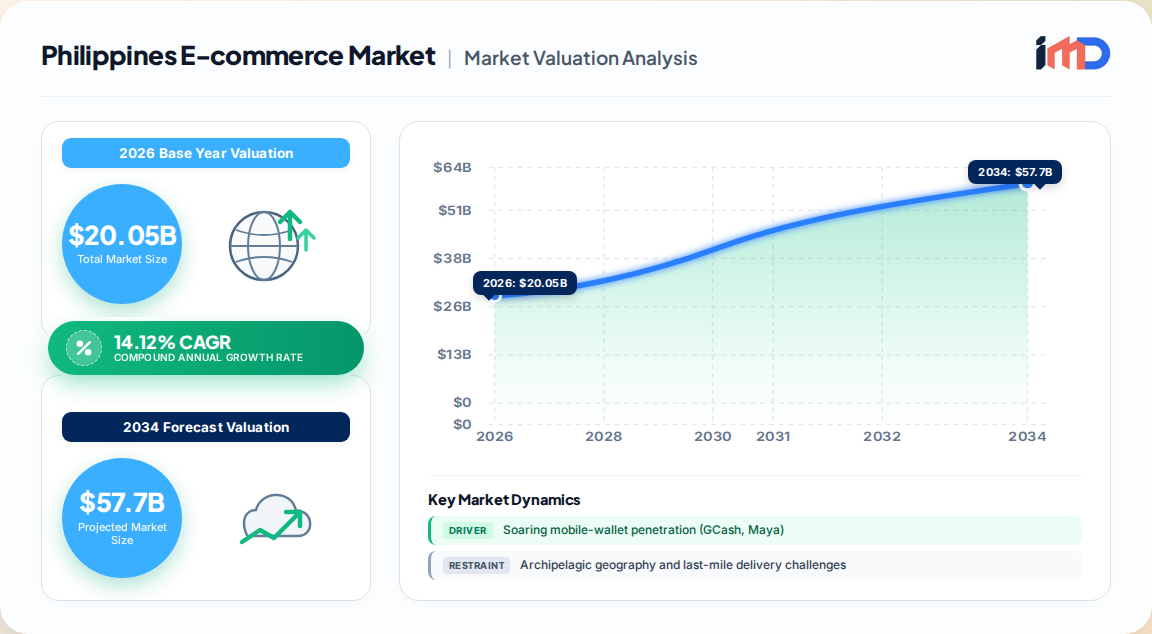
The Philippines e-commerce market is undergoing a structural transformation, evolving from a transaction-centric marketplace into a data-driven, ecosystem-led digital economy. Our proprietary first-party research estimates the market at USD 20.05 Billion in 2026, with a projected valuation of USD 44.09 Billion by 2032, expanding at a robust CAGR of 14.12% over the forecast period (2027–2032). This growth is anchored in three foundational pillars: soaring mobile-wallet penetration, the decentralization of logistics infrastructure into provincial mini-hubs, and a mobile-first consumer base that spends an average of 10 hours daily on social media. With over 97 million internet users and smartphone-driven commerce accounting for 78.9% of market value in 2026, the Philippines represents one of Southeast Asia's most dynamic digital retail landscapes.
Philippines E-commerce Market Market Size (In Billion)
40.0B
30.0B
20.0B
10.0B
0
17.57 B
2025
20.05 B
2026
22.88 B
2027
26.11 B
2028
29.80 B
2029
34.01 B
2030
38.81 B
2031
Market Drivers and Restraints
The market's expansion is propelled by a confluence of digital adoption and infrastructure investment, though structural bottlenecks persist.
Key Growth Drivers
Soaring Mobile-Wallet Penetration (+5.1% impact on CAGR): E-money account ownership among Filipino adults reached 36% in 2025, per Bangko Sentral ng Pilipinas (BSP) survey data. The ubiquity of GCash and Maya, which captured a 64.65% share of B2C e-commerce market value in 2026, has fundamentally de-risked online checkout and accelerated repeat purchase behavior.
Logistics Mini-Hubs in Provincial Cities (+4.8% impact): The launch of forward warehouses in Cagayan de Oro by J&T Express in 2025 exemplifies a strategic pivot toward regional fulfillment. Pre-positioning inventory at provincial nodes shortens last-mile delivery legs, making a broader service area commercially viable and expanding the addressable market beyond Metro Manila.
Rapid Cross-Border Social-Commerce Adoption (+3.9% impact): TikTok Shop's global-selling framework, effective January 2025, has enabled cross-border sellers from mainland China and Hong Kong to directly reach Filipino consumers. This influx of overseas product variety is deepening social commerce engagement, particularly among the 46% of social media users aged 16–64 who follow influencers.
Digital-Payment Mandates for Government Fees (+1.6% impact): Executive Order 170 (EO 170) requires covered agencies to offer digital collection of taxes, fees, and tolls, creating a recurring acceptance use case that strengthens the utility of digital accounts beyond discretionary retail spending.
Key Restraints
Archipelagic Logistics Complexity: With over 7,000 islands, last-mile delivery remains costly and fragmented. Provincial parcel charges add delivery costs, and forward stock placement is essential for small-parcel sellers beyond Metro Manila, as easier checkout leaves the cost of long-distance dispatch unresolved.
Regulatory Administrative Burden: Separate VAT and percentage-tax filing paths add administrative work for online sellers, with the October 2024 Digital Service Act imposing a 12% value-added tax (VAT) on digital transactions involving local and foreign service providers, including e-commerce platforms.
Segmentation Analysis and Forecasts
By Business Model
B2C dominated with a 91.64% share of the Philippines e-commerce market in 2026, driven by a young, mobile-first population and the proliferation of social commerce.
B2B is the fastest-growing segment at a 15.2% CAGR between 2027 and 2032, as MSME onboarding incentives (+1.2% impact) and enterprise seller platforms proliferate.
By Payment Mode (B2C)
Mobile Wallets led with a 64.65% share of market value in 2026, reflecting the deep entrenchment of GCash and Maya.
Other Payment Modes (including BNPL, credit cards, and cash-on-delivery) are projected to grow fastest at a 15.85% CAGR as Buy Now Pay Later solutions streamline transactions and reduce cash dependence.
By Product Category
Consumer Electronics accounted for a 27.58% share of the Philippines e-commerce market size in 2026, supported by a huge demand for smartphones and accessories.
Food and Beverages are forecast to grow fastest at a 14.85% CAGR, driven by changing lifestyles, the need for convenience, and the rise of social buying models such as "pasabuy."
By Device Type (B2C)
Smartphones were the largest segment with 78.9% of market value in 2026 and are projected to grow fastest at a 14.4% CAGR, cementing mobile commerce as the dominant channel.
Regional Outlook and Investment Hotspots
Geographically, the National Capital Region (NCR) led spending in 2025, accounting for the largest share of e-commerce value, driven by high population density, better logistics infrastructure, and higher disposable incomes. However, Central Visayas is the fastest-growing regional market, underpinned by investments in regional sorting facilities and localized delivery infrastructure. Other key regions include Central Luzon and CALABARZON, which benefit from proximity to Metro Manila's logistics networks. The Philippine government's "Build Better More" infrastructure program and the expansion of digital payment mandates are expected to further decentralize e-commerce activity, with provincial fulfillment centers playing a critical role in driving market penetration.
The Philippines e-commerce value chain is characterized by a complex interplay between digital-first marketplaces, payment gateways, and a fragmented logistics network. Key stages include:
Digital Storefronts and Marketplaces: Dominated by Shopee, Lazada, TikTok Shop, and Zalora, which provide seller onboarding, marketing tools, and transaction infrastructure.
Payment Processing: Mobile wallets (GCash, Maya) and BNPL fintechs are the primary digital payment enablers, with interoperability improvements (QR Ph, InstaPay) reducing friction.
Fulfillment and Logistics: A mix of platform-managed logistics (e.g., Shopee Xpress, Lazada Logistics) and third-party couriers (J&T Express, CJ Logistics, Ninja Van). The rise of forward warehouses and micro-fulfillment centers is critical to reducing last-mile costs.
Cross-Border Facilitation: Customs brokers, freight forwarders, and bonded warehouses enable international sellers (especially from China, the U.S., South Korea, and Japan) to reach Filipino consumers.
Consumer Engagement: Social media platforms (Facebook, Instagram, TikTok) serve as discovery and community-driven purchasing channels, with influencer marketing playing a pivotal role.
Competitive Landscape and Strategic Developments
Competitive Strategies
Platform Ecosystems: Leading market players such as Sea Ltd. (Shopee), Alibaba Group (Lazada), ByteDance Ltd. (TikTok Shop), and Global Fashion Group (Zalora) are integrating AI-driven product recommendations, live commerce, and logistics investments to shorten delivery times and increase conversion rates.
AI and Automation: In January 2026, TikTok Shop Philippines launched AI-driven product listing optimization tools and logistics partnerships to enhance merchant efficiency. Lazada and Shopee are continuously expanding their sorting facility networks and implementing intelligent route planning and warehouse automation.
Financial Services Integration: Sea Limited's enhancement of its digital commerce ecosystem (August 2025) integrated fintech, logistics, and seller enablement services, blurring the lines between e-commerce and financial services.
Cross-Border Partnerships: CJ Logistics expanded its fulfillment services in the Philippines in July 2026, developing automated warehouses and last-mile deliveries to cater to increasing cross-border e-commerce transactions.
Recent Market Developments
Date
Development
July 2026
ECOMEX 2026 launched a national e-commerce platform linking retailers, technology companies, and policymakers to foster digital commerce growth.
July 2026
CJ Logistics expanded fulfillment services in the Philippines, enhancing cross-border e-commerce with automated warehouses and last-mile deliveries.
July 2026
Fynd launched an AI-native commerce platform in the Philippines, empowering retailers with AI-powered inventory management and omnichannel operations.
August 2025
Sea Limited enhanced its digital commerce ecosystem through technology-driven efforts, integrating e-commerce, fintech, and logistics for merchants.
January 2026
TikTok Shop Philippines launched AI-driven product listing optimization tools and logistics partnerships to improve merchant operations.
October 2024
The Philippines passed the Digital Service Act, imposing a 12% VAT on digital transactions involving both local and foreign digital service providers.
Strategic White-Space Analysis
Provincial Fulfillment Infrastructure: With logistics mini-hubs reducing delivery costs, there is a clear white space for third-party logistics providers to establish forward warehouses in Cagayan de Oro, Davao, and Iloilo, targeting MSME sellers seeking nationwide reach.
Social Commerce Enablement for MSMEs: Only a fraction of the Philippines' 1 million+ MSMEs have fully adopted social commerce tools. Platforms offering turnkey livestream selling, affiliate management, and AI-powered content creation can capture a significant share of the underserved long-tail seller segment.
BNPL and Embedded Finance: Despite mobile wallet dominance, BNPL remains underpenetrated in the Philippines. Integrating installment payment options within checkout flows, especially for high-ticket electronics, represents a high-growth opportunity.
Rural Last-Mile Solutions: The archipelagic geography demands innovative last-mile models, such as community-based pickup points, motorcycle courier networks, and drone delivery pilots for remote islands.
Import/Export & Supplier Dynamics
Cross-border e-commerce continues to grow, with China remaining the largest source of imported online goods, followed by the United States, South Korea, and Japan. Products from Asia-Pacific markets with free trade agreements with the Philippines are widely available on leading platforms. The top imported categories include beauty and personal care, consumer electronics, fashion, home and living, health, and household care. The Philippine government's eCommerce Bureau, established in 2023, oversees compliance, while the Bureau of Customs facilitates streamlined clearance for small parcels. However, logistics and last-mile delivery remain key challenges for cross-border sellers, with customs delays and provincial delivery costs impacting overall margins. The Digital Service Act's 12% VAT on digital transactions is expected to level the playing field between local and foreign digital service providers, while also generating additional government revenue for infrastructure development.
Table 40: Northern Mindanao Philippines E-commerce Market Revenue Billion Forecast, by Device Type for B2C 2020 & 2034
Table 41: Northern Mindanao Philippines E-commerce Market Revenue Billion Forecast, by Country 2020 & 2034
Table 42: Ilocos Region Philippines E-commerce Market Revenue Billion Forecast, by Business Model 2020 & 2034
Table 43: Ilocos Region Philippines E-commerce Market Revenue Billion Forecast, by Payment Mode for B2C 2020 & 2034
Table 44: Ilocos Region Philippines E-commerce Market Revenue Billion Forecast, by Product Category 2020 & 2034
Table 45: Ilocos Region Philippines E-commerce Market Revenue Billion Forecast, by Device Type for B2C 2020 & 2034
Table 46: Ilocos Region Philippines E-commerce Market Revenue Billion Forecast, by Country 2020 & 2034
Table 47: Bicol Region Philippines E-commerce Market Revenue Billion Forecast, by Business Model 2020 & 2034
Table 48: Bicol Region Philippines E-commerce Market Revenue Billion Forecast, by Payment Mode for B2C 2020 & 2034
Table 49: Bicol Region Philippines E-commerce Market Revenue Billion Forecast, by Product Category 2020 & 2034
Table 50: Bicol Region Philippines E-commerce Market Revenue Billion Forecast, by Device Type for B2C 2020 & 2034
Table 51: Bicol Region Philippines E-commerce Market Revenue Billion Forecast, by Country 2020 & 2034
Frequently Asked Questions
1What is the current size of the Philippines e-commerce market?
The Philippines e-commerce market is valued at USD 20.05 Billion in 2026, according to our proprietary research. It is projected to reach USD 44.09 Billion by 2032, growing at a CAGR of 14.12%.
2Which payment method dominates the Philippines e-commerce market?
Mobile wallets, such as GCash and Maya, led the market with a 64.65% share of B2C e-commerce value in 2026. This dominance is driven by high smartphone penetration and government push for digital payments.
3What are the fastest-growing segments in the Philippines e-commerce market?
B2B e-commerce is the fastest-growing business model at a 15.2% CAGR (2027–2032). In product categories, Food and Beverages is the fastest-growing at 14.85% CAGR, and smartphones are the fastest-growing device segment at 14.4% CAGR.
4How is the Philippines e-commerce market segmented by region?
The National Capital Region (NCR) leads with 38% market share, followed by Central Visayas (14%) and Central Luzon (11%). Central Visayas is the fastest-growing region, benefiting from new logistics hubs.
5Who are the major players in the Philippines e-commerce market?
Key players include Shopee Philippines (Sea Ltd.), Lazada Philippines (Alibaba Group), TikTok Shop Philippines (ByteDance Ltd.), Zalora Philippines (Global Fashion Group), and Amazon Global Selling Philippines (Amazon.com Inc.).
Methodology
Our rigorous research methodology combines multi-layered approaches with comprehensive quality assurance, ensuring precision, accuracy, and reliability in every market analysis.
Primary Research
Conducted 120+ in-depth interviews with industry stakeholders, including marketplace operators, third-party logistics providers, payment gateway executives, and MSME sellers across the Philippines.
Interviewed job titles such as Chief Operating Officer, Head of Logistics, E-commerce Director, and Procurement Manager to capture operational and strategic insights.
Primary research accounted for 70–80% of total research effort, ensuring data authenticity and granular market understanding.
Key Stakeholders Interviewed
Key Stakeholders Interviewed
Stakeholder Role
Interview Share (%)
Chief Operating Officer
25%
Head of Logistics
25%
E-commerce Director
30%
Procurement Manager
20%
Industry Ecosystem Breakdown
Industry Ecosystem Breakdown
Company Type
Representation (%)
Marketplace Operators
30%
Third-Party Logistics Providers
25%
Payment Gateways & Fintechs
20%
Brands & Retailers
15%
MSME Sellers
10%
Secondary Research & Industry Benchmarking
Utilized financial databases including Bloomberg, Factiva, Hoovers, and PitchBook to validate company financials and market valuations.
Benchmarked against official statistics from Bangko Sentral ng Pilipinas (BSP), Philippine Statistics Authority (PSA), and Department of Trade and Industry (DTI).
Incorporated data from multilateral institutions such as the World Bank, OECD, and UNCTAD for macro-level e-commerce trends and digital adoption metrics.
Secondary research constituted 20–30% of total effort, providing a robust foundation for cross-validation.
Demand Modeling & Market Estimation
Employed simultaneous top-down and bottom-up methodologies. Top-down approach utilized national accounts and e-commerce penetration rates; bottom-up approach aggregated revenue data from leading platforms and seller surveys.
Key quantitative metrics included: average revenue per online buyer (ARPB), number of active e-commerce buyers, mobile wallet transaction volumes, and parcel shipment volumes.
Applied multi-level data triangulation to reconcile discrepancies and derive a single market size estimate with an 85–90% accuracy level.
Forecasts were generated using econometric models incorporating GDP growth, internet penetration, smartphone adoption, and logistics infrastructure investment.
Data Accuracy & Quality Check
Implemented rigorous quality control protocols including data triangulation, sanity checks, and expert review at each stage.
All data points cross-referenced with at least two independent sources. Where primary data conflicted with secondary, primary data was prioritized.
Every report is updated to the date of purchase, ensuring the most current market intelligence.
Surfing apparel and accessories market valued at $10.36B in 2025, growing at 4.8% CAGR to reach $15.81B by 2034. Explore drivers, trends, and regional insights.
RFID in retail market to grow at 13.2% CAGR, reaching $96.98 Billion by 2035. In-depth analysis of item-level tagging, supply chain, and regional trends.
Nov 2026|251 pages
$2900.00
The global men's apparel market is valued at USD 602.8 Billion in 2025 and is projected to reach USD 754.3 Billion by 2034, growing at a CAGR of 2.6%.
Nov 2026|260 pages
$2900.00
Germany luxury goods market to reach US$ 22.78 billion by 2035 at 3.42% CAGR. Explore premium segments, sustainability, and digital commerce trends.
Nov 2026|186 pages
$2900.00
Refillable skincare market to reach $9.17B by 2033 at 9.1% CAGR. Airless pumps and refill pods drive sustainable beauty packaging growth.