1What is the size of the outdoor performance apparel market?
The outdoor performance apparel market was valued at USD 26.7 billion in 2025 and is projected to reach USD 57.3 billion by 2035, growing at a CAGR of 7.9% from 2026 to 2035.
Insight Market Data is a premier market research and business consulting firm headquartered in Pune, India, providing syndicated research reports, customized intelligence studies, and strategic advisory services. Renowned academic institutions and Fortune 500 corporations worldwide rely on Insight Market Data's research repository to navigate evolving global and regional business environments. Covering 46 diverse industries across 25 major international economies, our comprehensive database delivers thousands of verified statistics and granular market evaluations. By combining industry-leading analytical methodologies with the direct insights of seasoned industry leaders and subject-matter experts, we deliver actionable intelligence spanning historical performance benchmarks to rigorous multi-year forecasts. We empower organizations to make confident, data-driven decisions across pivotal domains including Machinery & Equipment, Chemicals & Materials, Pharmaceuticals & Healthcare, Food & Beverages, Consumer Goods, Energy & Power, Automotive & Transportation, Electronics & Semiconductors, Medical Devices, Telecommunications, Emerging Technologies, Agriculture, and Packaging. Our multidisciplinary analyst teams provide an objective 360-degree perspective, tailoring every engagement to address complex strategic challenges with exceptional analytical rigor.
Leveraging advanced BI-powered analytics and predictive modeling, Insight Market Data uncovers high-impact market opportunities and competitive differentiators for ambitious enterprises. We continuously refine our research methodologies in accordance with global industry standards, tracking real-time market shifts to ensure our reports are consistently accurate, actionable, and delivered on schedule. Our analysts conduct methodical data validation, rigorous compliance checks, and exhaustive primary and secondary research to maintain the highest levels of data integrity and transparency. We partner closely with corporate strategists, investment groups, and business executives to translate intricate market intelligence into clear, actionable roadmaps for sustainable growth. With operational presence across Washington, USA, and Vimannagar, Pune, India, Insight Market Data ensures direct access to dedicated research specialists and responsive customer support to answer your most strategic questions.
 Outdoor Performance Apparel Market
 by Product Type (Jackets & Vests, Pants & Trousers, Boots & Shoes, Base Layers, Compression Wear, Others), by Fabric Type (Woven, Knit), by Material (Natural, Synthetic), by End-User (Recreational, Professional), by Price Range (Economy/Mass, Premium), by Activity (Running, Swimming & Water Sports, Cycling, Ski & Snow, Hunting & Fishing, Others), by Consumer (Men, Women, Children), by Distribution Channel (Store-based, Non-store-based), by North America (USA, Canada, Mexico), by Europe (Germany, UK, France, Italy, Spain, Rest of Europe), by Asia Pacific (China, India, Japan, South Korea, Australia, Rest of Asia Pacific), by South America (Brazil, Argentina, Rest of South America), by Middle East & Africa (South Africa, UAE, Rest of Middle East & Africa) Forecast 2026-2034

Research Analyst


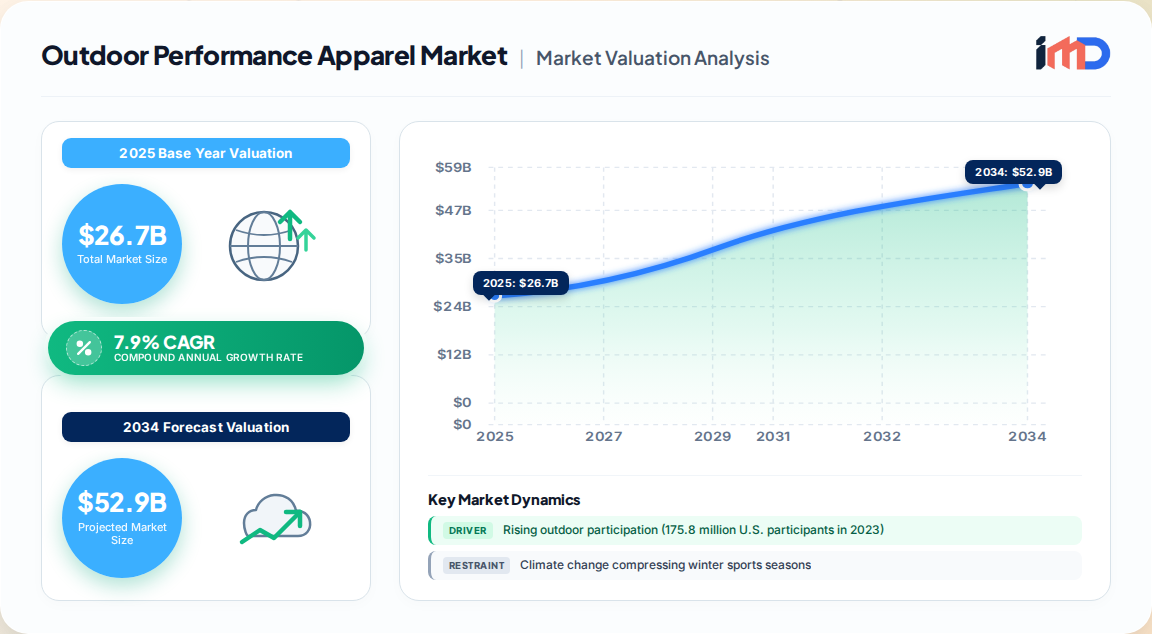
The global outdoor performance apparel market is a resilient and expanding segment of the broader apparel industry, characterized by functional design, technical fabrics, and a deep connection to outdoor recreation. Our proprietary primary research estimates the market at USD 26.7 billion in 2025, with a projected CAGR of 7.9% from 2026 to 2035, reaching USD 57.3 billion by 2035. This growth outpaces general apparel, driven by widening participation in outdoor activities, premiumization, and channel transformation.
Participation is the foundational demand driver. In the United States alone, 175.8 million people engaged in outdoor recreation in 2023, the ninth consecutive annual record, according to the Outdoor Industry Association. Crucially, participation is diversifying: women now represent 51.9% of participants, and hiking, camping, and fishing each added over two million participants in 2024. This broadening base expands the addressable market beyond core enthusiasts to families, casual hikers, and urban outdoor-lifestyle consumers.
However, growth is not uniform. Mature Western markets face replacement-cycle headwinds and promotional pressure, while Asia-Pacific emerges as the fastest-growing region, propelled by urbanization, premium brand expansion, and digital access. The competitive landscape is moderately concentrated, with the top five players—The North Face, Arc'teryx, Patagonia, Columbia Sportswear, and Salomon—holding 37.4% of 2025 revenue. Our analysis indicates that brands combining technical credibility with direct-to-consumer (DTC) agility and sustainability credentials are best positioned to capture disproportionate value.
The market is segmented by product type, fabric, material, end-user, price range, activity, consumer, and distribution channel. Our analysis reveals clear winners and laggards within each.
| Segment | Dominant Sub-segment (2025 share) | Fastest-Growing Sub-segment (CAGR) |
|---|---|---|
| Product Type | Jackets & Vests (largest) | Base Layers (fastest, ~8.5%) |
| Fabric Type | Woven (largest) | Knit (fastest, ~8.2%) |
| Material | Synthetic (largest) | Natural (fastest, ~8.0%) |
| End-User | Recreational (largest) | Professional (fastest, ~8.3%) |
| Price Range | Premium (largest) | Economy/Mass (fastest in APAC) |
| Distribution Channel | Specialty Stores (61.7% share) | Online Retail (10.6% CAGR) |
| Consumer | Men (53.3% share) | Women (8.1% CAGR) |
Product Type: Jackets and vests account for the largest revenue share, but base layers are growing fastest as consumers recognize layering systems for temperature regulation. Pants and trousers, boots and shoes, and compression wear also contribute significantly, with accessories forecast to grow at 6.22% CAGR through 2032.
Fabric & Material: Synthetic fabrics dominate with a 38.32% share, but natural fibers (wool, cotton) are gaining traction due to sustainability preferences. Smart and heated fabrics represent a niche but rapidly expanding segment, projected to grow at 6.83% CAGR.
End-User & Consumer: Men still account for over half of spending (53.27% in 2026), yet women's products are growing at 8.1% CAGR, outpacing the total market. This reflects deliberate product development focused on fit, size architecture, and activity-specific styling.
Distribution Channel: Specialty stores remain critical for high-touch technical purchases, but online retail is the growth engine, forecast to reach 47% of total revenue by 2035. DTC brands are leveraging digital channels to educate consumers and build community.
North America remains the largest market, with the U.S. accounting for the bulk of spending. The region benefits from a mature outdoor culture, high participation rates, and a strong premiumization trend. However, growth will moderate as replacement cycles lengthen and promotional intensity increases.
Asia-Pacific is the fastest-growing region, projected to grow at 6.66% CAGR (or higher, depending on the segment) through 2032. China alone reached approximately USD 2.70 billion in 2025 after a 39.2% CAGR during 2022-2025. Amer Sports reported 53.7% revenue growth in Greater China in fiscal 2024, followed by 43.4% in fiscal 2025, illustrating the scale of opportunity. India, while smaller at USD 0.27 billion, grew at 21.6% and offers a long runway as per-capita garment consumption rises.
Europe is a mature market with strong sustainability regulation shaping product design. The EU's ESPR and revised Waste Framework Directive are driving demand for eco-designed, repairable, and traceable apparel. Brands with GRS-certified and bluesign-compliant supply chains will capture margin benefits.
South America and the Middle East & Africa are smaller but present niche opportunities, particularly in adventure tourism and urban outdoor lifestyles. Our regional market share estimates are: North America 34%, Europe 26%, Asia-Pacific 28%, South America 6%, and Middle East & Africa 6%.
The market is moderately concentrated, with the top five players holding 37.4% of global revenue in 2025. The North Face leads with over 11.1% share, followed by Arc'teryx, Patagonia, Columbia Sportswear, and Salomon. Competition is intensifying as brands invest in DTC, sustainability, and technical innovation.
Recent strategic developments include:
Brands are also pursuing customization and personalization, supported by social media communities, to deepen engagement and differentiate in a crowded market.
The value chain spans raw material suppliers, fabric mills, apparel manufacturers, brand owners, and distribution channels. Technical fabrics, such as waterproof membranes and synthetic insulations, are concentrated among a few specialized suppliers, creating vulnerability. Many brands are diversifying sourcing and investing in fabric co-development partnerships to secure supply and drive innovation.
The shift to DTC is compressing the value chain, giving brands greater control over pricing, customer experience, and data. However, it also demands investment in logistics, returns management, and digital marketing. Specialty retailers remain vital for technical fitting and education, particularly for footwear and layering systems.
Sustainability is reshaping procurement. The EU's EPR schemes will incentivize design for recyclability and repairability, potentially raising costs for non-compliant products. Brands with transparent, certified supply chains (e.g., GRS, bluesign) will be better positioned to absorb regulatory costs and appeal to eco-conscious consumers.
Several underserved opportunities exist:
| Aspects | Details |
|---|---|
| Study Period | 2020-2034 |
| Base Year | 2025 |
| Estimated Year | 2026 |
| Forecast Period | 2026-2034 |
| Historical Period | 2020-2025 |
| Growth Rate | CAGR of 7.9% from 2020-2034 |
| Segmentation |
|
By Fabric Type
By Material
By End-User
By Price Range
By Activity
By Consumer
By Distribution Channel
| By Geography |
|
The outdoor performance apparel market was valued at USD 26.7 billion in 2025 and is projected to reach USD 57.3 billion by 2035, growing at a CAGR of 7.9% from 2026 to 2035.
North America is the largest market, accounting for approximately 34% of global revenue in 2025, driven by high outdoor participation rates and a strong premiumization trend.
Key drivers include rising outdoor participation (175.8 million participants in the U.S. in 2023), expansion of direct-to-consumer and e-commerce channels, premiumization through material innovation, and growing health and wellness consciousness.
The North Face leads with over 11.1% market share, followed by Arc'teryx, Patagonia, Columbia Sportswear, and Salomon. The top five players collectively held 37.4% of the market in 2025.
Asia-Pacific is the fastest-growing region, with China alone growing at a 39.2% CAGR from 2022 to 2025. By product, base layers and women's apparel are among the fastest-growing segments.
Our rigorous research methodology combines multi-layered approaches with comprehensive quality assurance, ensuring precision, accuracy, and reliability in every market analysis.
| Stakeholder Role | Interview Share (%) |
|---|---|
| Chief Marketing Officers | 25% |
| Product Development Directors | 30% |
| Supply Chain & Sourcing Managers | 25% |
| Sustainability Officers | 20% |
| Company Type | Representation (%) |
|---|---|
| Outdoor Brand Owners | 35% |
| Fabric & Material Suppliers | 20% |
| Apparel Manufacturers | 20% |
| Specialty Retailers | 15% |
| E-commerce Platforms | 10% |
 Related Reports


Analyst at Providence Strategic Partners at Petaling Jaya
I have received the report already. Thanks you for your help.it has been a pleasure working with you. Thank you again for a good quality report

Internationalization Director
Yes, as a matter of fact we are totally satisfied with both reports that we have purchased and will continue to do so during this process of the internationalization of our brand.
Head of Product Management and Marketing
We are using your report, and it gave us valuable information."
Regional Director, Marketing and Business Development
We've received the report and have reviewed the content. Overall, it looks great and aligns closely with the data we can verify based on our industry knowledge.

VP of Sales
Thank you very much for sharing the report. I have reviewed it and I am very satisfied with the quality and the insights it provides. It will certainly be valuable for our internal discussions.