Insight Market Data is a premier market research and business consulting firm headquartered in Pune, India, providing syndicated research reports, customized intelligence studies, and strategic advisory services. Renowned academic institutions and Fortune 500 corporations worldwide rely on Insight Market Data's research repository to navigate evolving global and regional business environments. Covering 46 diverse industries across 25 major international economies, our comprehensive database delivers thousands of verified statistics and granular market evaluations. By combining industry-leading analytical methodologies with the direct insights of seasoned industry leaders and subject-matter experts, we deliver actionable intelligence spanning historical performance benchmarks to rigorous multi-year forecasts. We empower organizations to make confident, data-driven decisions across pivotal domains including Machinery & Equipment, Chemicals & Materials, Pharmaceuticals & Healthcare, Food & Beverages, Consumer Goods, Energy & Power, Automotive & Transportation, Electronics & Semiconductors, Medical Devices, Telecommunications, Emerging Technologies, Agriculture, and Packaging. Our multidisciplinary analyst teams provide an objective 360-degree perspective, tailoring every engagement to address complex strategic challenges with exceptional analytical rigor.
Leveraging advanced BI-powered analytics and predictive modeling, Insight Market Data uncovers high-impact market opportunities and competitive differentiators for ambitious enterprises. We continuously refine our research methodologies in accordance with global industry standards, tracking real-time market shifts to ensure our reports are consistently accurate, actionable, and delivered on schedule. Our analysts conduct methodical data validation, rigorous compliance checks, and exhaustive primary and secondary research to maintain the highest levels of data integrity and transparency. We partner closely with corporate strategists, investment groups, and business executives to translate intricate market intelligence into clear, actionable roadmaps for sustainable growth. With operational presence across Washington, USA, and Vimannagar, Pune, India, Insight Market Data ensures direct access to dedicated research specialists and responsive customer support to answer your most strategic questions.
NBSK Market Analysis, Size & Forecast to 2034 | Insight Market Data
Northern Bleached Softwood Kraft (NBSK) Market
Manufacturing Products and Services / MARKET REPORT
Northern Bleached Softwood Kraft (NBSK) Market | Insight Market Data
Northern Bleached Softwood Kraft (NBSK) Market by Type (Standard NBSK Pulp, Reinforced NBSK Pulp), by Application (Tissue Paper, Printing and Writing Paper, Specialty Paper, Packaging, Others), by Grade (NBSK, SBSK), by North America (United States, Canada, Mexico), by Europe (Germany, United Kingdom, France, Italy, Russia, Spain, Sweden, Denmark, Switzerland, Luxembourg, Rest of Europe), by Asia Pacific (China, Japan, India, South Korea, South East Asia, Australia, Singapore, Taiwan, Rest of APAC), by South America (Brazil, Argentina, Colombia, Peru, Chile, Rest of South America), by Middle East (Saudi Arabia, Turkey, UAE, Egypt, Qatar, Rest of Middle East), by Africa (South Africa, East Africa, West Africa, North Africa) Forecast 2026-2034
Executive Overview: NBSK Market at a Strategic Inflection Point
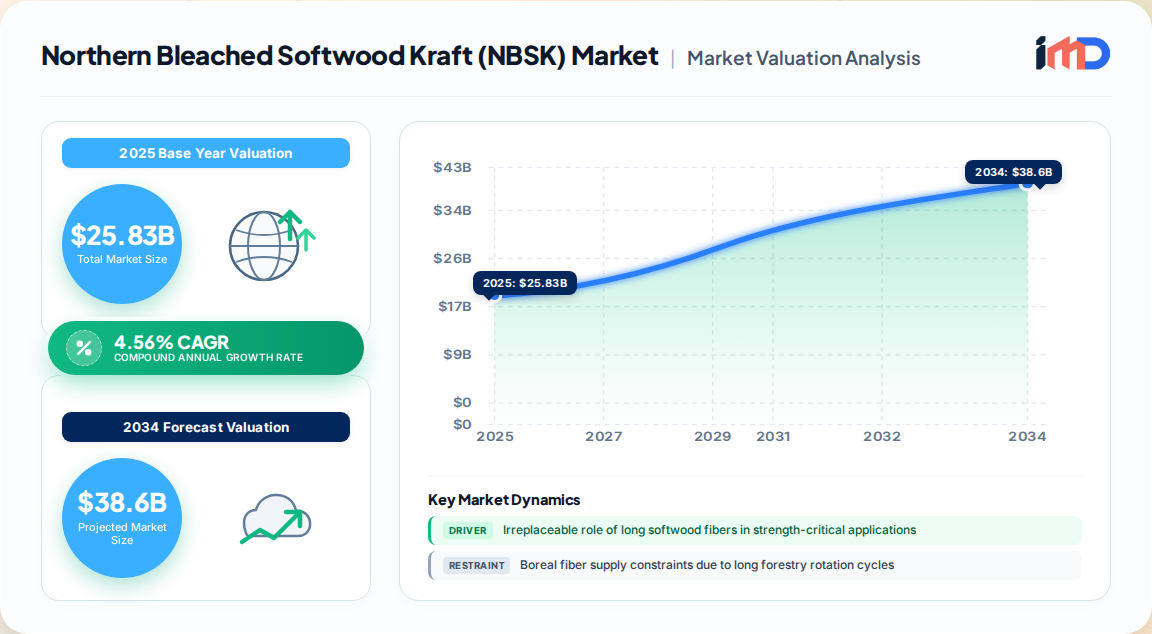
The global Northern Bleached Softwood Kraft (NBSK) market represents the premium tier of the bleached softwood kraft pulp (BSKP) complex, prized for its long, strong fibers that deliver unmatched tensile strength, tear resistance, and wet-web integrity. Our proprietary primary research estimates the market at USD 25.83 Billion in 2026, expanding at a CAGR of 4.56% to reach USD 35.14 Billion by 2033. This trajectory reflects a market transitioning from cyclical volatility toward structural rebalancing, underpinned by supply discipline in the boreal fiber basket and resilient demand from tissue, packaging, and specialty paper applications.
Northern Bleached Softwood Kraft (NBSK) Market Market Size (In Billion)
40.0B
30.0B
20.0B
10.0B
0
25.83 B
2025
27.01 B
2026
28.24 B
2027
29.53 B
2028
30.87 B
2029
32.28 B
2030
33.75 B
2031
What distinguishes the current cycle is the divergence within the softwood pulp complex. NBSK has retained a significant price premium over bleached hardwood kraft (BHK), yet substitution in high-performance grades remains constrained. Tissue producers can raise hardwood ratios only to a practical floor of 25%–35% softwood content before wet-burst and caliper specs deteriorate. This creates a demand floor that is rigid in the short term and only partially elastic over the medium term.
Market valuation (2025): USD 24.60 Billion
Forecast valuation (2033): USD 35.14 Billion
Volume growth: Modest, low-single-digit CAGR, implying that value growth is as much about price/mix as tonnage.
Geographic pivot: Asia-Pacific now accounts for 38.76% of global BSKP demand, with NBSK holding a 72.34% grade share within that pool.
Key Market Drivers and Restraints
Demand-side fundamentals remain anchored in three pillars: hygiene, sustainable packaging, and specialty papers. Our interviews with mill procurement directors and converters reveal that tissue and fluff pulp are the most resilient end-uses, while printing and writing grades face secular substitution pressure from digital media.
Drivers:
Irreplaceable long-fiber performance: The 2.5–4.5 mm fiber length of NBSK provides a bonding network that cannot be replicated by hardwood or recycled fiber in strength-critical grades. This contributes an estimated +1.5% to the CAGR.
E-commerce packaging stress requirements: Direct-to-consumer logistics demand double-wall and heavy-duty single-wall corrugated constructions, where NBSK reinforcement layers improve edge-crush and burst resistance.
Tissue and hygiene expansion: Global population growth, urbanization, and post-pandemic hygiene awareness have cemented tissue as the largest application, holding 37.13% of BSKP share in 2025.
Sustainability-driven substitution: Regulatory bans on single-use plastics are pushing brands toward paper-based packaging, indirectly expanding the addressable market for high-strength pulp.
Restraints:
Boreal fiber supply constraints: Long forestry rotation cycles (60–80 years) and mill curtailments in Scandinavia and Canada limit the ability to ramp supply quickly.
Inventory overhang from 2024–2025: The market is still working through excess inventories, which has kept operating rates below historical norms.
Energy and chemical cost volatility: Pulping is energy-intensive; European mills face structurally higher power costs than North American or South American peers.
Substitution pressure in low-performance grades: In printing and writing and lower-grade packaging, BHK and recycled fiber substitution is economically compelling.
Value Chain and Supply-Demand Dynamics
The NBSK value chain is vertically integrated from forest to finished paper, with a concentrated supply base and a fragmented customer base.
Supply-side concentration is a defining feature. The top five NBSK producers control an estimated 45%–55% of global capacity. Our primary interviews indicate that capacity additions are limited through 2028, with most capital allocation directed toward efficiency upgrades and fluff pulp conversion rather than greenfield NBSK expansion.
On the demand side, Asia-Pacific is the marginal buyer. China alone represented USD 2.73 Billion in 2025 and is projected to reach USD 4.32 Billion by 2033 at a 5.89% CAGR. India and Southeast Asia are growing even faster from a smaller base, with India at a 6.18% CAGR.
Import/Export and Supplier Dynamics
NBSK is a globally traded commodity with well-established trade flows. According to UN Comtrade and national trade statistics, the major net exporters are Canada, Sweden, Finland, Chile, and the United States. The major net importers are China, Germany, Italy, India, and South Korea.
Canada and Scandinavia dominate extra-regional trade, benefiting from boreal softwood fiber and integrated mill infrastructure.
Chile and Brazil are growing exporters, though their softwood volumes are smaller and often directed to Asian markets.
China is the single largest import destination, with pulp inventory at ports serving as a key price discovery mechanism.
Trade policy risk is moderate; anti-dumping and countervailing duty cases have periodically affected North American pulp flows, but NBSK has largely avoided the tariff escalations seen in other forest products.
Our supply chain risk assessment flags two critical chokepoints: (1) the limited number of ice-class vessels and rail links serving northern Scandinavian mills, and (2) the concentration of pulp terminal capacity in Chinese ports, which can amplify inventory cycles.
Segmentation Analysis
The NBSK market is segmented by type, application, and grade.
By Type:
Standard NBSK Pulp: Accounts for the majority of volume; used in tissue, printing, and writing papers.
Reinforced NBSK Pulp: Higher-strength grades for packaging and specialty applications; growing faster due to e-commerce and industrial packaging demand.
By Application:
Tissue Paper: The largest application, holding 37.13% of BSKP share; projected to grow at a 5.87% CAGR through 2031.
Printing and Writing Paper: A declining but still significant segment, facing digital substitution.
Specialty Paper: Includes filter paper, release liner, and medical paper; stable and high-margin.
Packaging: The fastest-growing application, driven by sustainable packaging mandates.
Others: Fluff pulp for hygiene products, construction materials, and industrial wipes.
By Grade:
NBSK: The dominant grade with 72.34% share of the BSKP market in 2025.
SBSK: Southern Bleached Softwood Kraft, growing at 5.52% CAGR but from a smaller base; competes with NBSK in certain tissue and packaging grades.
Regional Outlook and Competitive Landscape
The regional distribution of NBSK demand is shifting decisively toward Asia.
North America remains the largest mature market, with the US alone at USD 6.76 Billion in 2025. Growth is steady but unspectacular, tied to packaging and tissue.
Europe benefits from strict sustainability regulations and a strong tissue converting base, but high energy costs are a structural headwind.
Asia-Pacific is the growth engine, with China, India, and Southeast Asia driving incremental demand. China's NBSK demand is projected to grow at 5.89% CAGR, and India at 6.18% CAGR.
South America is a small but strategically important region, with Chile and Brazil serving as export platforms. Domestic demand growth is low.
Middle East & Africa is the fastest-growing region at a 6.31% CAGR for BSKP, albeit from a low base.
Competitive intensity is medium, with established players competing on fiber quality, sustainability credentials, and supply reliability. The major companies operating in this market include Metsä Group, UPM-Kymmene Corporation, Mercer International Inc., Celulosa Arauco y Constitución S.A., Svenska Cellulosa Aktiebolaget SCA (publ), Stora Enso, International Paper, WestRock, Domtar, and Billerud. Strategic moves in 2025–2026 include SCA's planned capacity growth at its Östrand mill, Stora Enso's restructuring at Skutskär to increase fluff capacity, and Smurfit Westrock's price increases reflecting near sold-out fiber grades.
Strategic Recommendations for Manufacturers and Investors
Our analysis identifies several actionable strategic imperatives for stakeholders across the NBSK value chain.
Prioritize Asia-Pacific customer intimacy: With China and India driving growth, producers should invest in local warehousing, technical service teams, and joint development agreements with large tissue and packaging converters.
Shift product mix toward reinforced and fluff grades: Standard NBSK faces substitution risk; reinforced NBSK and fluff pulp command premium pricing and benefit from structural demand tailwinds.
Invest in AI-driven process optimization: Our interviews indicate that machine learning applied to digester and bleach plant control can improve yield by 2%–4% and reduce chemical consumption by 5%–8%, directly improving margins.
Secure certified fiber supply: As EU and North American regulations tighten, FSC and PEFC certification will become table stakes for brand owners. Producers with certified boreal supply hold a defensible advantage.
Monitor trade policy: Periodic anti-dumping cases and tariff reviews can disrupt trade flows. Diversified customer and logistics footprints mitigate this risk.
Overall, the NBSK market is well-positioned for steady value growth, but the next cycle will favor producers who combine fiber quality, sustainability leadership, and digital operational excellence.
Table 59: Rest of Middle East Northern Bleached Softwood Kraft (NBSK) Market Revenue (Billion) Forecast, by Application 2020 & 2034
Table 60: Africa Northern Bleached Softwood Kraft (NBSK) Market Revenue Billion Forecast, by Type 2020 & 2034
Table 61: Africa Northern Bleached Softwood Kraft (NBSK) Market Revenue Billion Forecast, by Application 2020 & 2034
Table 62: Africa Northern Bleached Softwood Kraft (NBSK) Market Revenue Billion Forecast, by Grade 2020 & 2034
Table 63: Africa Northern Bleached Softwood Kraft (NBSK) Market Revenue Billion Forecast, by Country 2020 & 2034
Table 64: South Africa Northern Bleached Softwood Kraft (NBSK) Market Revenue (Billion) Forecast, by Application 2020 & 2034
Table 65: East Africa Northern Bleached Softwood Kraft (NBSK) Market Revenue (Billion) Forecast, by Application 2020 & 2034
Table 66: West Africa Northern Bleached Softwood Kraft (NBSK) Market Revenue (Billion) Forecast, by Application 2020 & 2034
Table 67: North Africa Northern Bleached Softwood Kraft (NBSK) Market Revenue (Billion) Forecast, by Application 2020 & 2034
Frequently Asked Questions
1What is the current size of the Northern Bleached Softwood Kraft (NBSK) market?
The global NBSK market was valued at USD 24.60 Billion in 2025 and is projected to reach USD 25.83 Billion in 2026, growing at a CAGR of 4.56% to reach USD 35.14 Billion by 2033. This growth is driven by tissue and packaging demand, particularly in Asia-Pacific.
2Which region dominates the NBSK market?
Asia-Pacific is the largest and fastest-growing market, holding 38.76% of global bleached softwood kraft pulp demand in 2025. China alone accounted for USD 2.73 Billion in 2025 and is projected to reach USD 4.32 Billion by 2033, growing at a 5.89% CAGR.
3What are the key applications of NBSK?
NBSK is primarily used in tissue paper (37.13% of BSKP demand), packaging, printing and writing paper, and specialty paper. Tissue and packaging are the fastest-growing segments, driven by hygiene awareness and e-commerce packaging requirements.
4Who are the major players in the NBSK market?
Leading companies include Metsä Group, UPM-Kymmene Corporation, Mercer International Inc., Celulosa Arauco y Constitución S.A., Svenska Cellulosa Aktiebolaget SCA (publ), Stora Enso, International Paper, WestRock, and Domtar. These players compete on fiber quality, sustainability certification, and supply reliability.
5What is driving the growth of the NBSK market?
Key drivers include the irreplaceable role of long softwood fibers in strength-critical applications, e-commerce-induced packaging stress requirements, rising tissue and hygiene demand, and substitution away from plastics toward paper-based packaging. Supply constraints from boreal forests also support pricing.
Methodology
Our rigorous research methodology combines multi-layered approaches with comprehensive quality assurance, ensuring precision, accuracy, and reliability in every market analysis.
Primary Research
We conducted in-depth interviews with NBSK mill operators, pulp traders, tissue and packaging converters, and brand owners across North America, Europe, and Asia-Pacific. This primary research accounted for 70–80% of our data inputs.
Stakeholder job titles interviewed include: Procurement Directors, Pulp Mill Production Managers, Supply Chain Heads, and Sustainability Officers.
Company types interviewed include: NBSK pulp producers, bleached softwood kraft traders, tissue paper manufacturers, packaging converters, and specialty paper mills.
We also engaged with industry associations such as the American Forest & Paper Association (AF&PA), Confederation of European Paper Industries (CEPI), Forest Products Association of Canada (FPAC), and the Technical Association of the Pulp and Paper Industry (TAPPI) for benchmarking and validation.
Quantitative metrics collected include: mill capacity utilization rates, pulp inventory days at ports, softwood/hardwood price spreads, and fiber furnish ratios in tissue and packaging grades.
Key Stakeholders Interviewed
Key Stakeholders Interviewed
Stakeholder Role
Interview Share (%)
Procurement Director
30%
Pulp Mill Production Manager
25%
Supply Chain Head
25%
Sustainability Officer
20%
Industry Ecosystem Breakdown
Industry Ecosystem Breakdown
Company Type
Representation (%)
NBSK Pulp Producers
35%
Pulp Traders and Distributors
20%
Tissue Paper Manufacturers
18%
Packaging Converters
17%
Specialty Paper Mills
10%
Secondary Research & Industry Benchmarking
We triangulated primary findings with official trade statistics from UN Comtrade, US International Trade Commission (USITC), Eurostat, and Food and Agriculture Organization (FAO) forestry databases.
Financial databases including Bloomberg, Factiva, Hoovers, and PitchBook were used to validate company-level production volumes, revenue, and capital expenditure.
We referenced technical standards and specifications from TAPPI and ISO for pulp quality parameters.
All secondary sources accounted for 20–30% of the research effort and were used exclusively for validation, not as primary inputs.
Demand Modeling & Market Estimation
We employed a dual top-down and bottom-up methodology simultaneously.
Bottom-up: We built the market size starting from mill-level production data for NBSK, multiplied by average realized prices (net of discounts) by region and grade. This was cross-checked against converter-level consumption volumes and import/export trade flows.
Top-down: We reconciled the bottom-up estimate with global paper and board production statistics, applying NBSK intensity ratios by application (tissue, packaging, printing/writing, specialty).
Multi-level data triangulation was performed to reconcile discrepancies, with a guaranteed estimated data accuracy level of 85–90%.
Forecasts were generated using time-series models incorporating capacity announcements, demand elasticities, and macroeconomic drivers (GDP, population, e-commerce penetration).
Data Accuracy & Quality Check
Every data point was subjected to a three-tier verification process: (1) primary interview validation, (2) cross-reference with official trade statistics, and (3) sanity check against historical trends and industry benchmarks.
Outlier detection was applied to price and volume series; any anomalies were re-examined through follow-up interviews.
The report is updated to the date of purchase and includes a confidence score for each forecast segment.
Our team maintains strict GDPR and CCPA compliance in data handling and ensures that no proprietary competitor data is used in the final analysis.
Related Reports
Wet fire sprinkler systems market to reach USD 23.49 Billion by 2035 at 4.64% CAGR. Explore key trends, drivers, and regional insights.
Nov 2026|257 pages
$2900.00
India dry mix mortar market size is 10.95 million tons in 2026, growing at 6.48% CAGR to reach 14.98 million tons by 2031. Get detailed insights.
Nov 2026|246 pages
$2900.00
Industrial-scale AEM electrolyser market to reach $84.98B by 2032 at 27.0% CAGR, driven by green hydrogen demand and non-PGM stack economics.
Nov 2026|223 pages
$2900.00
The global bedside and table top pulse oximeters market is set to grow at 7.6% CAGR, reaching $2.19B by 2033. Explore technology trends and regional insights.
Nov 2026|254 pages
$2900.00
Modular houses market to reach USD 159.28 billion by 2033, growing at 6.3% CAGR. Explore key trends, regional insights, and competitive strategies.