1What is the size of the India dry mix mortar market in 2026?
The India dry mix mortar market is estimated at 10.95 million tons in 2026, growing from 10.28 million tons in 2025. This represents a 6.48% CAGR from 2025 to 2026.
Insight Market Data is a premier market research and business consulting firm headquartered in Pune, India, providing syndicated research reports, customized intelligence studies, and strategic advisory services. Renowned academic institutions and Fortune 500 corporations worldwide rely on Insight Market Data's research repository to navigate evolving global and regional business environments. Covering 46 diverse industries across 25 major international economies, our comprehensive database delivers thousands of verified statistics and granular market evaluations. By combining industry-leading analytical methodologies with the direct insights of seasoned industry leaders and subject-matter experts, we deliver actionable intelligence spanning historical performance benchmarks to rigorous multi-year forecasts. We empower organizations to make confident, data-driven decisions across pivotal domains including Machinery & Equipment, Chemicals & Materials, Pharmaceuticals & Healthcare, Food & Beverages, Consumer Goods, Energy & Power, Automotive & Transportation, Electronics & Semiconductors, Medical Devices, Telecommunications, Emerging Technologies, Agriculture, and Packaging. Our multidisciplinary analyst teams provide an objective 360-degree perspective, tailoring every engagement to address complex strategic challenges with exceptional analytical rigor.
Leveraging advanced BI-powered analytics and predictive modeling, Insight Market Data uncovers high-impact market opportunities and competitive differentiators for ambitious enterprises. We continuously refine our research methodologies in accordance with global industry standards, tracking real-time market shifts to ensure our reports are consistently accurate, actionable, and delivered on schedule. Our analysts conduct methodical data validation, rigorous compliance checks, and exhaustive primary and secondary research to maintain the highest levels of data integrity and transparency. We partner closely with corporate strategists, investment groups, and business executives to translate intricate market intelligence into clear, actionable roadmaps for sustainable growth. With operational presence across Washington, USA, and Vimannagar, Pune, India, Insight Market Data ensures direct access to dedicated research specialists and responsive customer support to answer your most strategic questions.
 India Dry Mix Mortar Market
 by End-Use Sector (Residential, Commercial, Infrastructure, Industrial and Institutional), by Application (Plaster, Render, Tile Adhesive, Grouts, Concrete Protection and Renovation, Water-Proofing Slurries, Insulation and Finishing Systems, Others), by Product Type (Cement-based Mortar, Gypsum-based Mortar, Polymer-modified Mortar, Others), by North, by South, by West, by East Forecast 2026-2034

Senior Research Analyst


 Related Reports

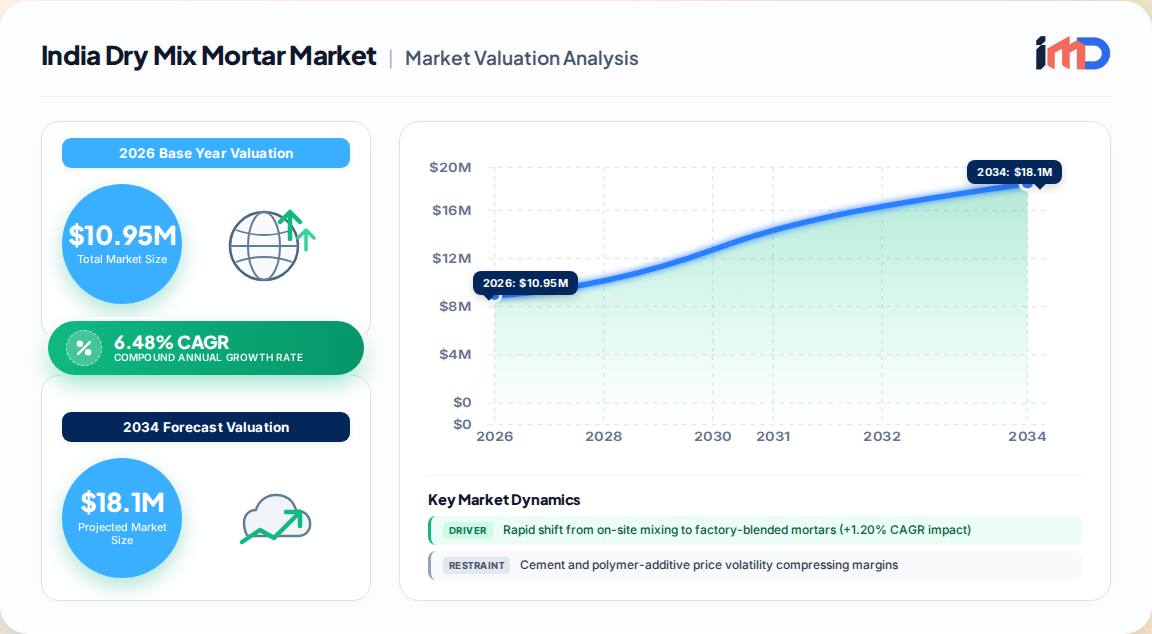
The India dry mix mortar market is undergoing a decisive structural transformation. Our proprietary primary research estimates the market at 10.28 million tons in 2025, expanding to 10.95 million tons in 2026 and projected to reach 14.98 million tons by 2031, registering a CAGR of 6.48% over the forecast period. In revenue terms, the market stood at USD 4.47 billion in 2025 and is forecast to reach USD 7.50 billion by 2033, reflecting a 6.7% CAGR.
This growth is not merely cyclical. It represents a fundamental shift from on-site sand-cement blending to factory-controlled, pre-bagged mortars. Contractors are abandoning traditional batch mixing due to skilled labor scarcity, tighter project timelines, and stricter quality audits. Factory-formulated products deliver batch-to-batch consistency, reduce rework, and shorten project schedules by 10–15% in large residential and infrastructure projects.
India accounts for approximately 8.1% of the global dry mix mortar market revenue, positioning it as the fastest-growing regional market in Asia Pacific. The residential sector remains the dominant end-use segment, while commercial construction is emerging as the most lucrative growth frontier.
The India dry mix mortar market is shaped by a confluence of accelerating demand drivers and persistent operational restraints. Our primary interviews with contractors, developers, and producers reveal the following dynamics:
| Driver | Impact on CAGR (Percentage Points) | Geographic Relevance | Timeline |
|---|---|---|---|
| Rapid shift from on-site mixing to factory-blended mortars | +1.20% | National, early adoption in metro cities | Medium term (2–4 years) |
| Affordable housing and PMAY-Urban pipeline | +1.10% | National, concentrated in tier-2 and tier-3 cities | Short term (≤ 2 years) |
| Growth of modular, prefab, and 3-D printed construction | +0.90% | Urban centers and industrial zones | Long term (≥ 4 years) |
| Commercialisation of low-carbon blends (GGBS/bio-char) | +0.80% | Metro cities with green building mandates | Medium term (2–4 years) |
| Mandatory EPR and PWM 2024 rules for recyclable packaging | +0.50% | National, stricter enforcement in industrialized states | Short term (≤ 2 years) |
| Restraint | Impact on CAGR (Percentage Points) | Geographic Relevance | Timeline |
|---|---|---|---|
| Cement and polymer-additive price volatility | -1.80% | National, higher impact in regions dependent on long-distance cement transport | Short term (≤ 2 years) |
| High capex for fully-automated dry-mix plants | -0.70% | Manufacturing hubs in Gujarat, Tamil Nadu, Maharashtra, Haryana | Medium term (2–4 years) |
| Compliance cost of EPR recycled-content mandates for multilayer sacks | -0.60% | National, stricter enforcement in industrialized states | Short term (≤ 2 years) |
Cement and polymer-additive price volatility remains the most significant restraint. In 2024, all-India cement quotations slid 7% while styrene-acrylate and redispersible-powder prices jumped 15% due to shipping bottlenecks, compressing margins for stand-alone mortar producers. Integrated cement majors have mitigated this by prioritizing in-house clinker consumption, whereas independent firms are reformulating with silica-fume substitutes to limit polymer dosage.
The India dry mix mortar market is segmented by end-use sector and application. Our primary research reveals distinct growth trajectories across each segment.
| End-Use Sector | Volume Share (2025) | Forecast CAGR (2026–2031) | Key Characteristics |
|---|---|---|---|
| Residential | 52.02% | 6.2% | Dominant segment; driven by PMAY-Urban and tier-2 city housing |
| Commercial | 24.5% | 7.35% | Fastest-growing; Grade A office expansion to 1.2 billion sq. ft. by 2030 |
| Infrastructure | 14.8% | 6.8% | Transport corridors, metro-rail packages, and airport projects |
| Industrial and Institutional | 8.68% | 5.9% | Factories, warehouses, hospitals, and educational institutions |
The residential sector accounted for 52.02% of volume share in 2025, with revenue share reaching 57.02%. Government backing for 20 million urban dwellings through FY 2025 and a budgetary allocation of INR 80,671 crore in FY 2024-25 have created predictable offtake for small-pack plaster lines. The commercial sector is projected to post the fastest growth at 7.35% CAGR, driven by Grade A office space expansion and a surge in shopping mall and retail developments across the top seven cities.
| Application | Volume Share (2025) | Forecast CAGR (2026–2031) |
|---|---|---|
| Plaster | 32.10% | 6.3% |
| Render | 18.5% | 6.0% |
| Tile Adhesive | 22.4% | 7.12% |
| Grouts | 8.2% | 6.5% |
| Waterproofing Slurries | 9.1% | 6.9% |
| Concrete Protection and Renovation | 4.8% | 5.8% |
| Insulation and Finishing Systems | 3.2% | 6.1% |
| Others | 1.7% | 5.5% |
Plaster led with 32.10% volume share in 2025, underpinned by large-scale wall rendering in residential and infrastructure projects. Tile adhesives are forecast to record the highest growth at 7.12% CAGR, driven by rising ceramic tile consumption and the shift toward thin-bed adhesive systems in modular construction.
The India dry mix mortar market is moderately consolidated, with the top five companies occupying approximately 49.72% of the market. The competitive field includes integrated cement majors, specialty chemical firms, and global construction material conglomerates.
Major players include Adani Group, UltraTech Cement Ltd., Sika AG, Pidilite Industries Ltd., Saint-Gobain, Asian Paints, Ramco Cements, MAPEI S.p.A., Ardex Group, LATICRETE International, MBCC Group, Tri Polarcon Pvt Ltd, and Fosroc.
Recent strategic developments include:
Demand for dry mix mortar in India is concentrated in the western and northern regions, but growth is accelerating in the south and east. Our regional analysis reveals the following distribution:
| Region | Market Share (2025) | Key Demand Drivers |
|---|---|---|
| North | 28% | NCR commercial and residential projects, infrastructure corridors |
| West | 26% | Mumbai and Pune metro-rail packages, industrial corridors in Gujarat |
| South | 24% | Bangalore IT corridors, Hyderabad green-building projects, Chennai retail |
| East | 22% | Kolkata and Bhubaneswar infrastructure, emerging tier-2 housing |
The western region, particularly Maharashtra and Gujarat, benefits from stricter enforcement of EPR rules, which is accelerating adoption of moisture-proof, recyclable sacks. The southern region is witnessing premium demand for GGBS-bearing tile adhesives, driven by IGBC-certified commercial projects.
The India dry mix mortar value chain is evolving rapidly, with producers expanding automated capacity near consumption hubs to reduce logistics costs and improve service levels.
India's dry mix mortar market is largely domestically supplied, with imports primarily limited to specialty polymer additives and high-performance admixtures from Europe and East Asia. Export activity remains nascent but is growing, particularly to neighboring markets in South Asia and the Middle East.
Our analysis identifies several high-potential white spaces for investors and market entrants:
The India dry mix mortar market is poised for sustained growth, with volume expanding from 10.95 million tons in 2026 to 14.98 million tons by 2031. Strategic investments in low-carbon formulations, automated capacity near consumption hubs, and tier-2 distribution networks will define competitive success in this evolving landscape.
| Aspects | Details |
|---|---|
| Study Period | 2020-2034 |
| Base Year | 2026 |
| Estimated Year | 2026 |
| Forecast Period | 2026-2034 |
| Historical Period | 2020-2025 |
| Growth Rate | CAGR of 6.48% from 2020-2034 |
| Segmentation |
|
By Product Type
| By Geography |
|
The India dry mix mortar market is estimated at 10.95 million tons in 2026, growing from 10.28 million tons in 2025. This represents a 6.48% CAGR from 2025 to 2026.
The residential sector dominates with a 52.02% volume share in 2025, driven by PMAY-Urban housing projects and tier-2 city construction. Commercial is the fastest-growing segment at 7.35% CAGR.
Major players include Adani Group, UltraTech Cement Ltd., Sika AG, Pidilite Industries Ltd., Saint-Gobain, Asian Paints, Ramco Cements, MAPEI S.p.A., and Ardex Group. The top five companies occupy approximately 49.72% of the market.
Factory-blended mortars reduce labor requirements, improve batch-to-batch consistency, and shorten project schedules by 10–15%. Builders in metro regions increasingly specify ready-to-use mortars to meet tighter quality audits and green-building credits.
The market is projected to grow at a 6.48% CAGR from 2026 to 2031, reaching 14.98 million tons by 2031. In revenue terms, the market is expected to expand at 6.7% CAGR from 2026 to 2033.
Our rigorous research methodology combines multi-layered approaches with comprehensive quality assurance, ensuring precision, accuracy, and reliability in every market analysis.
| Stakeholder Role | Interview Share (%) |
|---|---|
| Procurement Director | 30% |
| Plant Operations Manager | 25% |
| R&D Head | 25% |
| Project Manager | 20% |
| Company Type | Representation (%) |
|---|---|
| Integrated Cement Producers | 35% |
| Stand-alone Dry Mix Mortar Manufacturers | 25% |
| Specialty Chemical Additive Suppliers | 20% |
| Construction Contractors and Developers | 15% |
| Distributors and Retailers | 5% |