1What is the projected market size for bedside and table top pulse oximeters by 2033?
The global market is expected to reach USD 2,187.8 million by 2033, growing at a CAGR of 7.6% from 2024.
Insight Market Data is a premier market research and business consulting firm headquartered in Pune, India, providing syndicated research reports, customized intelligence studies, and strategic advisory services. Renowned academic institutions and Fortune 500 corporations worldwide rely on Insight Market Data's research repository to navigate evolving global and regional business environments. Covering 46 diverse industries across 25 major international economies, our comprehensive database delivers thousands of verified statistics and granular market evaluations. By combining industry-leading analytical methodologies with the direct insights of seasoned industry leaders and subject-matter experts, we deliver actionable intelligence spanning historical performance benchmarks to rigorous multi-year forecasts. We empower organizations to make confident, data-driven decisions across pivotal domains including Machinery & Equipment, Chemicals & Materials, Pharmaceuticals & Healthcare, Food & Beverages, Consumer Goods, Energy & Power, Automotive & Transportation, Electronics & Semiconductors, Medical Devices, Telecommunications, Emerging Technologies, Agriculture, and Packaging. Our multidisciplinary analyst teams provide an objective 360-degree perspective, tailoring every engagement to address complex strategic challenges with exceptional analytical rigor.
Leveraging advanced BI-powered analytics and predictive modeling, Insight Market Data uncovers high-impact market opportunities and competitive differentiators for ambitious enterprises. We continuously refine our research methodologies in accordance with global industry standards, tracking real-time market shifts to ensure our reports are consistently accurate, actionable, and delivered on schedule. Our analysts conduct methodical data validation, rigorous compliance checks, and exhaustive primary and secondary research to maintain the highest levels of data integrity and transparency. We partner closely with corporate strategists, investment groups, and business executives to translate intricate market intelligence into clear, actionable roadmaps for sustainable growth. With operational presence across Washington, USA, and Vimannagar, Pune, India, Insight Market Data ensures direct access to dedicated research specialists and responsive customer support to answer your most strategic questions.
 Bedside and Table Top Pulse Oximeters: A Technology Perspective
 by Product (Equipment, Sensors), by Technology (Connected, Conventional), by Age Group (Adults, Pediatric, Neonatal), by End-Use (Hospitals, Ambulatory Care Centers, Clinics, Home Healthcare), by North America (USA, Canada), by Europe (UK, Germany, France, Italy, Spain), by Asia Pacific (China, India, Japan, South Korea, Australia), by Latin America (Brazil, Mexico, Argentina), by Middle East & Africa (South Africa, Saudi Arabia, UAE) Forecast 2026-2034

Senior Research Analyst


 Related Reports

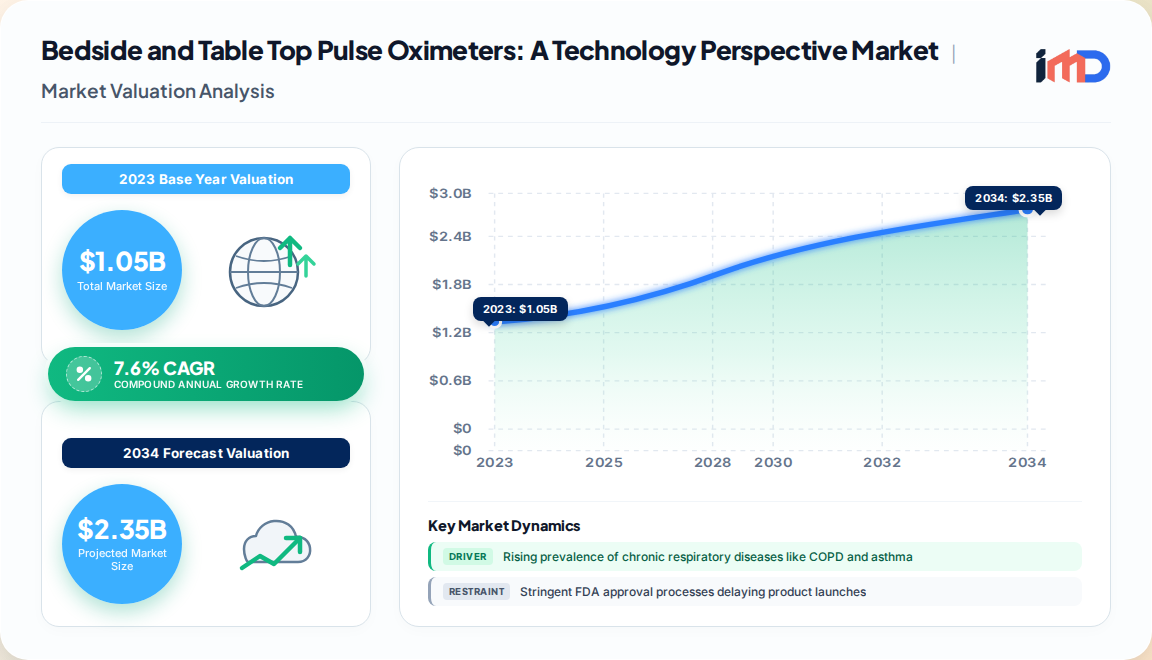
The global market for bedside and table top pulse oximeters is poised for robust expansion, with proprietary primary research projecting a compound annual growth rate (CAGR) of 7.6% from 2024 to 2033. Valued at USD 1,054.2 million in 2023, the market is forecast to nearly double to USD 2,187.8 million by 2033. These devices, critical for continuous monitoring of blood oxygen saturation (SpO2) and pulse rate in hospital and clinical settings, are experiencing renewed demand driven by an aging population, rising chronic respiratory diseases, and technological integration with hospital information systems.
North America remains the dominant regional market, accounting for 42% of global revenue in 2023, underpinned by advanced healthcare infrastructure and high respiratory disease prevalence. However, the Asia-Pacific region is expected to register the fastest growth, fueled by healthcare infrastructure investments and rising awareness. The competitive landscape is shaped by strategic acquisitions and partnerships aimed at expanding product portfolios and enhancing connectivity features.
Drivers:
Restraints:
The value chain for bedside and table top pulse oximeters comprises component suppliers, device manufacturers, distributors, and end-users (hospitals, clinics, ambulatory care centers). Key components include optical sensors, microprocessors, displays, and connectivity modules. Manufacturing is concentrated in regions with strong electronics ecosystems, notably China, which supplies over 40% of global pulse oximeter devices. The U.S. is the largest importer, accounting for approximately 25% of global imports, according to trade statistics from UN Comtrade.
Recent supply chain disruptions have underscored the importance of diversified sourcing. Manufacturers are increasingly investing in dual-sourcing strategies for critical components such as LEDs and photodetectors to mitigate risks. The integration of advanced semiconductors and wireless communication chips further emphasizes the need for resilient supplier networks.
By Product:
By Technology:
By Age Group:
By End-Use:
North America led the market with 42% share in 2023, valued at USD 442.8 million, driven by advanced healthcare systems, high R&D investment, and favorable reimbursement policies. Europe follows, supported by an aging population and strong emphasis on patient safety. Asia-Pacific is projected to be the fastest-growing region, with China and India at the forefront, owing to improving healthcare infrastructure and rising disposable incomes.
Key opportunities lie in expanding telehealth and home healthcare markets, particularly in emerging economies. The integration of pulse oximeters with mobile health apps and cloud platforms presents significant growth potential for remote patient monitoring.
The market is characterized by strategic mergers, acquisitions, and partnerships. Notable developments include:
Companies are focusing on product innovation, connectivity, and geographic expansion to capture growth in both developed and emerging markets.
Several trends are shaping the future of the bedside and table top pulse oximeter market:
The market is expected to see increased adoption of reflectance pulse oximetry, which allows for flexible sensor placement (e.g., forehead, chest) and is particularly useful for patients with poor peripheral circulation. Overall, the bedside and table top pulse oximeter market is on a steady growth trajectory, driven by technological innovation and expanding clinical applications.
| Aspects | Details |
|---|---|
| Study Period | 2020-2034 |
| Base Year | 2023 |
| Estimated Year | 2026 |
| Forecast Period | 2026-2034 |
| Historical Period | 2020-2025 |
| Growth Rate | CAGR of 7.6% from 2020-2034 |
| Segmentation |
|
By Age Group
By End-Use
| By Geography |
|
The global market is expected to reach USD 2,187.8 million by 2033, growing at a CAGR of 7.6% from 2024.
North America held the largest share at 42% in 2023, valued at USD 442.8 million, driven by advanced healthcare infrastructure.
The market is segmented into connected and conventional technologies, with connected devices capturing over 54% share in 2023 due to IoT integration.
Key players include Medtronic, Philips Healthcare, Masimo Corporation, Nonin Medical, and GE Healthcare, among others.
Growth is driven by the rising prevalence of respiratory diseases, an aging population, technological advancements, and government telehealth initiatives.
Hospitals accounted for the largest share at over 41% in 2023, followed by ambulatory care centers and clinics, with home healthcare showing significant potential.
Our rigorous research methodology combines multi-layered approaches with comprehensive quality assurance, ensuring precision, accuracy, and reliability in every market analysis.
| Stakeholder Role | Interview Share (%) |
|---|---|
| Procurement Director | 30% |
| Clinical Engineer | 25% |
| Product Manager | 25% |
| Regulatory Affairs Specialist | 20% |
| Company Type | Representation (%) |
|---|---|
| Optical Sensor and Component Suppliers | 25% |
| Pulse Oximeter Device OEMs | 35% |
| Hospital Procurement and Clinical Engineering | 20% |
| Distributors and Home Healthcare Providers | 20% |