1What is the size of the modular houses market in 2026?
The global modular houses market is estimated at USD 103.5 billion in 2026, growing at a CAGR of 6.3% to reach USD 159.28 billion by 2033.
Insight Market Data is a premier market research and business consulting firm headquartered in Pune, India, providing syndicated research reports, customized intelligence studies, and strategic advisory services. Renowned academic institutions and Fortune 500 corporations worldwide rely on Insight Market Data's research repository to navigate evolving global and regional business environments. Covering 46 diverse industries across 25 major international economies, our comprehensive database delivers thousands of verified statistics and granular market evaluations. By combining industry-leading analytical methodologies with the direct insights of seasoned industry leaders and subject-matter experts, we deliver actionable intelligence spanning historical performance benchmarks to rigorous multi-year forecasts. We empower organizations to make confident, data-driven decisions across pivotal domains including Machinery & Equipment, Chemicals & Materials, Pharmaceuticals & Healthcare, Food & Beverages, Consumer Goods, Energy & Power, Automotive & Transportation, Electronics & Semiconductors, Medical Devices, Telecommunications, Emerging Technologies, Agriculture, and Packaging. Our multidisciplinary analyst teams provide an objective 360-degree perspective, tailoring every engagement to address complex strategic challenges with exceptional analytical rigor.
Leveraging advanced BI-powered analytics and predictive modeling, Insight Market Data uncovers high-impact market opportunities and competitive differentiators for ambitious enterprises. We continuously refine our research methodologies in accordance with global industry standards, tracking real-time market shifts to ensure our reports are consistently accurate, actionable, and delivered on schedule. Our analysts conduct methodical data validation, rigorous compliance checks, and exhaustive primary and secondary research to maintain the highest levels of data integrity and transparency. We partner closely with corporate strategists, investment groups, and business executives to translate intricate market intelligence into clear, actionable roadmaps for sustainable growth. With operational presence across Washington, USA, and Vimannagar, Pune, India, Insight Market Data ensures direct access to dedicated research specialists and responsive customer support to answer your most strategic questions.
 Modular Houses Market
 by Structure Type (Multi-section, Single-section, Tiny Homes), by Application (Single-family, Multi-family), by Material (Timber, Concrete, Steel, Others), by Floor Area (Under 999 sq ft, 1000–1499 sq ft, 1500–1999 sq ft, 2000–2499 sq ft, Above 2500 sq ft), by North America (USA, Canada, Mexico), by Europe (Germany, UK, France, Russia, Spain, Italy), by Asia-Pacific (China, India, Japan, South Korea, Australia), by South America (Brazil, Argentina, Colombia), by Middle East & Africa (Saudi Arabia, UAE, South Africa) Forecast 2026-2034

Senior Research Analyst


 Related Reports

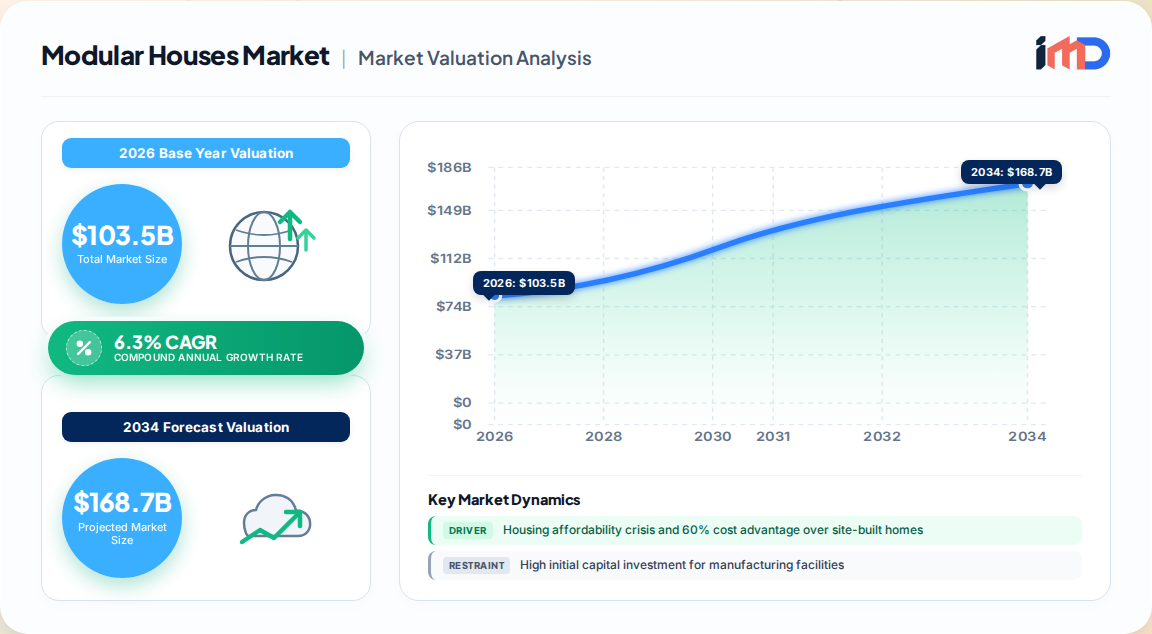
The global modular houses market is undergoing a structural transformation, shifting from a niche, cost-driven alternative to a mainstream, technology-enabled construction paradigm. Our proprietary primary research estimates the market at USD 97.7 billion in 2025, projected to expand to USD 103.5 billion in 2026 and reach USD 159.28 billion by 2033, registering a CAGR of 6.3% over the forecast period. This growth is underpinned by a confluence of persistent housing affordability crises, acute skilled-labor shortages, and accelerating policy mandates for off-site construction across major economies.
Unlike temporary or relocatable structures, modern modular houses are engineered permanent dwellings manufactured in controlled factory environments, transported as volumetric modules, and assembled on-site. This process delivers 30–50% faster build cycles and 60–65% cost advantages relative to conventional site-built housing, where average prices exceed USD 300,000 versus approximately USD 123,000 for factory-built equivalents before land.
Drivers:
Restraints:
The modular houses market is segmented by structure type, application, material, and floor area.
| Segment | Sub-segment | Market Share / CAGR (2025–2033) |
|---|---|---|
| By Structure Type | Multi-section homes | 57.8% share (2025) |
| Single-section homes | Steady growth | |
| Tiny homes | 7.71% CAGR | |
| By Application | Single-family | 76.4% share (2025) |
| Multi-family | 7.95% CAGR | |
| By Material | Timber | 49.1% share (2025) |
| Concrete | 8.11% CAGR (fastest) | |
| Steel | Moderate growth | |
| By Floor Area | Under 999 sq ft | High demand in affordable segment |
| 1000–1499 sq ft | Largest volume share | |
| 1500–2499 sq ft | Growing premium segment | |
| Above 2500 sq ft | Niche luxury |
Key Insight: Concrete-based modular systems represent the fastest-growing material segment, advancing at 8.11% CAGR, driven by durability and fire-safety requirements in multi-family and commercial applications. Timber remains dominant due to cost and sustainability advantages.
Asia-Pacific leads the market with a 36% revenue share in 2025, forecast to grow at 6.95% CAGR to reach USD 60.21 billion by 2033. China alone accounts for USD 14.14 billion in 2025, growing at 7.47% CAGR, driven by the 30% prefabrication mandate. India follows at USD 6.72 billion, growing at 7.43% CAGR, addressing a 10-million-unit housing shortfall.
North America holds 29% share (USD 28.63 billion in 2025), with the U.S. market at USD 22.72 billion. Growth is fueled by institutional investment in build-to-rent communities, HUD code modernization, and state-level zoning reforms (e.g., Texas Senate Bill 785).
Europe represents 21% share (USD 20.13 billion in 2025), with Germany (USD 3.64 billion), Russia (USD 2.44 billion), and the UK (USD 2.21 billion) as key markets. The region’s growth is tied to energy-efficiency mandates and affordable housing targets.
South America and Middle East & Africa each hold 7% share, with Brazil (USD 2.18 billion) and Saudi Arabia (USD 1.97 billion) as prominent markets. These regions are characterized by urbanization-driven demand and government-led housing programs.
The modular houses market is moderately concentrated, with leading players pursuing capacity expansion, vertical integration, and technology adoption.
Recent developments include:
The modular houses value chain spans design and engineering, off-site manufacturing, transportation and logistics, and on-site assembly.
Supply Chain Risks: Transportation constraints for large modules, dependence on specialized labor for factory operations, and regulatory fragmentation across regions.
| Strategy | Application |
|---|---|
| Market Penetration | Expand modular housing adoption in existing markets (North America, Europe) through developer partnerships and policy advocacy. |
| Market Development | Enter emerging markets (India, Southeast Asia, Middle East) with affordable housing solutions tailored to local regulations. |
| Product Development | Introduce concrete-based modular systems, tiny homes, and net-zero energy designs to capture premium and sustainable segments. |
| Diversification | Integrate smart home technology and modular healthcare/education facilities to diversify beyond residential. |
The modular houses market is characterized by regional manufacturing hubs rather than cross-border trade in finished modules, due to transportation costs. However, trade in prefabricated components and materials is significant.
Supplier Dynamics: Manufacturers are increasingly vertically integrating to secure material supply and reduce costs. Bulk material purchasing and factory-based assembly yield significant cost efficiencies, with modular projects achieving 5–10% budget variance versus 20–30% for site-built.
| Region | Market Size 2025 (USD Billion) | CAGR (2026–2033) | Attractiveness |
|---|---|---|---|
| Asia-Pacific | 35.17 | 6.95% | High (policy mandates, housing deficit) |
| North America | 28.63 | 5.93% | High (institutional capital, zoning reforms) |
| Europe | 20.13 | 6.10% | Moderate (energy mandates, affordable housing) |
| South America | 6.55 | 6.50% | Moderate (urbanization, government programs) |
| Middle East & Africa | 4.79 | 4.88% | Emerging (Saudi Vision 2030, urbanization) |
Investment Hotspots: China, India, and the U.S. offer the highest growth potential, driven by policy support, housing shortages, and institutional investment.
| Aspects | Details |
|---|---|
| Study Period | 2020-2034 |
| Base Year | 2026 |
| Estimated Year | 2026 |
| Forecast Period | 2026-2034 |
| Historical Period | 2020-2025 |
| Growth Rate | CAGR of 6.3% from 2020-2034 |
| Segmentation |
|
By Material
By Floor Area
| By Geography |
|
The global modular houses market is estimated at USD 103.5 billion in 2026, growing at a CAGR of 6.3% to reach USD 159.28 billion by 2033.
Asia-Pacific leads with a 36% revenue share in 2025, driven by China’s 30% prefabrication mandate and India’s affordable housing initiatives. North America and Europe follow with 29% and 21% shares, respectively.
Housing affordability crises, labor shortages, faster construction timelines, and supportive government policies are the primary drivers. Modular construction delivers 30–50% faster build cycles and 60–65% cost advantages over traditional methods.
Concrete-based modular systems are the fastest-growing material segment, advancing at an 8.11% CAGR through 2033, due to durability and fire-safety advantages in multi-family and commercial applications.
Leading companies include Daiwa House, Sekisui House, Greystar Real Estate Partners, Webcor, and Blackstone (through Tricon Residential). These players are investing in capacity expansion, technology integration, and build-to-rent portfolios.
Our rigorous research methodology combines multi-layered approaches with comprehensive quality assurance, ensuring precision, accuracy, and reliability in every market analysis.
| Stakeholder Role | Interview Share (%) |
|---|---|
| Chief Executive Officer / Managing Director | 30% |
| Head of Procurement | 25% |
| Project Director / Construction Manager | 25% |
| Chief Financial Officer / Investment Director | 20% |
| Company Type | Representation (%) |
|---|---|
| Modular Home Manufacturers | 40% |
| Developers & Contractors | 25% |
| Material Suppliers | 15% |
| Institutional Investors & REITs | 12% |
| Government & Regulatory Bodies | 8% |