1What is the size of the Netherlands DIY Home Improvement Market?
The Netherlands DIY Home Improvement Market was valued at USD 8.79 Billion in 2024 and is projected to reach USD 12.70 Billion by 2032, growing at a CAGR of 4.7% from 2025 to 2032.
Insight Market Data is a premier market research and business consulting firm headquartered in Pune, India, providing syndicated research reports, customized intelligence studies, and strategic advisory services. Renowned academic institutions and Fortune 500 corporations worldwide rely on Insight Market Data's research repository to navigate evolving global and regional business environments. Covering 46 diverse industries across 25 major international economies, our comprehensive database delivers thousands of verified statistics and granular market evaluations. By combining industry-leading analytical methodologies with the direct insights of seasoned industry leaders and subject-matter experts, we deliver actionable intelligence spanning historical performance benchmarks to rigorous multi-year forecasts. We empower organizations to make confident, data-driven decisions across pivotal domains including Machinery & Equipment, Chemicals & Materials, Pharmaceuticals & Healthcare, Food & Beverages, Consumer Goods, Energy & Power, Automotive & Transportation, Electronics & Semiconductors, Medical Devices, Telecommunications, Emerging Technologies, Agriculture, and Packaging. Our multidisciplinary analyst teams provide an objective 360-degree perspective, tailoring every engagement to address complex strategic challenges with exceptional analytical rigor.
Leveraging advanced BI-powered analytics and predictive modeling, Insight Market Data uncovers high-impact market opportunities and competitive differentiators for ambitious enterprises. We continuously refine our research methodologies in accordance with global industry standards, tracking real-time market shifts to ensure our reports are consistently accurate, actionable, and delivered on schedule. Our analysts conduct methodical data validation, rigorous compliance checks, and exhaustive primary and secondary research to maintain the highest levels of data integrity and transparency. We partner closely with corporate strategists, investment groups, and business executives to translate intricate market intelligence into clear, actionable roadmaps for sustainable growth. With operational presence across Washington, USA, and Vimannagar, Pune, India, Insight Market Data ensures direct access to dedicated research specialists and responsive customer support to answer your most strategic questions.
 Netherlands DIY Home Improvement Market
 by Product Type (Lumber and Landscape Management, Decor and Indoor Garden, Kitchen, Painting and Wallpaper, Tools and Hardware, Building Materials, Lighting, Plumbing and Equipment, Flooring, Repair and Replacement, Electrical Work), by Distribution Channel (DIY Home Improvement Stores, Specialty Stores, Online, Others), by North Brabant, by South Holland, by North Holland, by Gelderland, by Utrecht, by Limburg, by Overijssel, by Friesland, by Groningen, by Drenthe, by Zeeland Forecast 2026-2034

Research Associate


 Related Reports

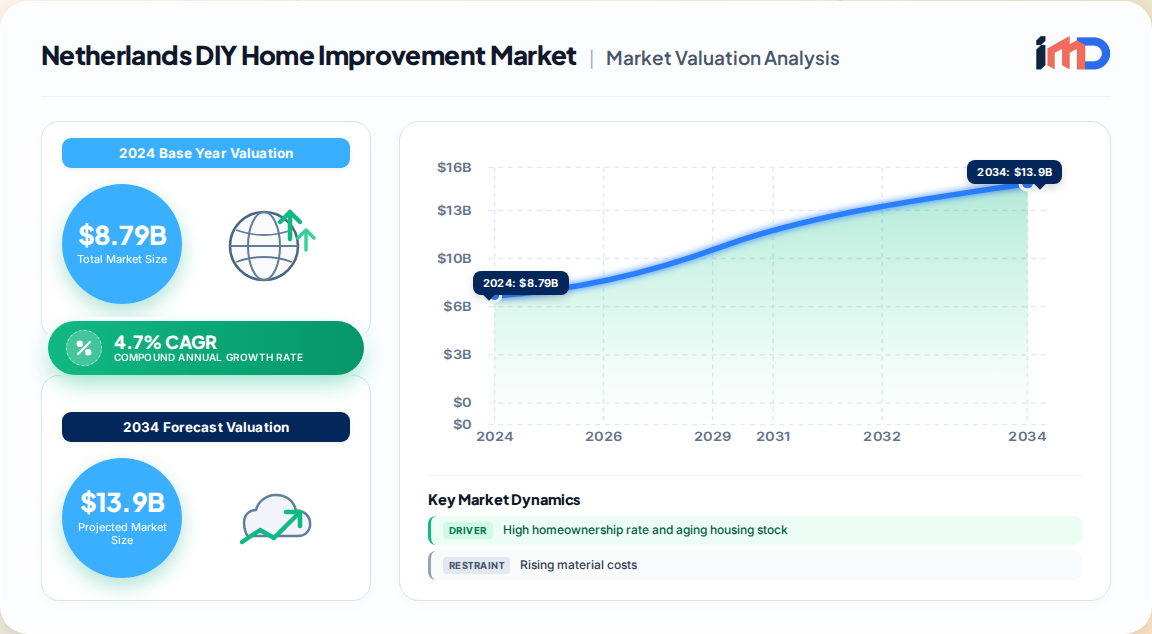
The Netherlands DIY home improvement market represents one of Europe’s most structurally mature and digitally sophisticated retail ecosystems. Our proprietary primary research, triangulated with official statistics from Statistics Netherlands (CBS) and Eurostat, values the market at USD 8.79 Billion in 2024. The market is projected to expand at a CAGR of 4.7% from 2025 to 2032, reaching USD 12.70 Billion by the end of the forecast period. This growth is not merely a post-pandemic normalization but a structural evolution driven by deep-rooted homeowner engagement, an aging housing stock, and a regulatory environment that aggressively incentivizes energy-efficient retrofits.
Unlike many European peers, the Dutch DIY market is characterized by a highly concentrated retail landscape juxtaposed with a fragmented supplier base. The country’s high homeownership rate (55% in 2023 per CBS) and a persistent housing shortage have created a cultural predisposition toward self-maintenance and incremental home upgrades. Our analysis of 2023 consumer survey data reveals that over 75% of Dutch DIY homeowners actively utilize online tutorials, a factor that has democratized complex tasks and sustained demand for advanced tools and building materials. The market is currently navigating a delicate balance between inflationary pressures on raw materials and an unprecedented wave of government-backed sustainability investments, which we identify as the single largest growth vector for the next decade.
The Dutch DIY market is being reshaped by a confluence of policy-driven demand and demographic shifts. Understanding these forces is critical for stakeholders across the value chain.
Key Growth Drivers:
Key Restraints and Challenges:
The Dutch DIY value chain is a study in omnichannel integration. The distinction between online and offline is blurring, with physical stores serving as experiential showrooms that support digital sales.
The Dutch DIY market is moderately concentrated, with a mix of large multinational retailers, cooperative buying groups, and agile local players. Our primary research identifies the following strategic archetypes:
Recent developments underscore the strategic pivot toward smart and sustainable living. In 2022, Miele launched a new suite of smart home products designed to monitor air quality and other vitals, while in 2021, Dyson introduced high-end humidifiers capable of filtering airborne pollutants. These innovations are not just product launches; they are efforts to upgrade the consumer from a one-time buyer to a participant in a connected home ecosystem.
While the Netherlands is a small, densely populated country, market dynamics vary significantly by province. Our regional analysis highlights the following patterns:
| Province | Estimated Market Share | Key Characteristics |
|---|---|---|
| North Brabant | 17% | Highest concentration of DIY retail stores (approx. 330 in 2021), strong renovation activity. |
| South Holland | 16% | Urban centers drive demand for interior design and smart home products. |
| North Holland | 15% | High disposable income, focus on premium kitchen and bathroom renovations. |
| Gelderland | 12% | Mix of urban and rural, strong demand for garden and landscape products. |
| Utrecht | 10% | Younger demographic, high online penetration, smart home adopters. |
| Limburg | 8% | Aging housing stock, demand for repair and maintenance materials. |
| Overijssel | 7% | Growing family households, demand for building materials and flooring. |
| Friesland | 6% | Rural DIY projects, focus on landscaping and energy efficiency. |
| Groningen | 4% | Sustainability-focused renovations, solar panel installations. |
| Drenthe | 3% | Low population density, niche DIY and hobbyist market. |
| Zeeland | 2% | Coastal, seasonal demand for outdoor and garden improvement. |
The Netherlands serves as a critical logistics gateway for the European DIY supply chain, with Rotterdam being the largest port in Europe. While the domestic market is largely served by regional distribution centers, the country’s trade flows reveal important dependencies.
For investors and market entrants, the Dutch DIY market offers several high-growth avenues that are currently under-served:
| Aspects | Details |
|---|---|
| Study Period | 2020-2034 |
| Base Year | 2024 |
| Estimated Year | 2026 |
| Forecast Period | 2026-2034 |
| Historical Period | 2020-2025 |
| Growth Rate | CAGR of 4.7% from 2020-2034 |
| Segmentation |
|
By Distribution Channel
| By Geography |
|
The Netherlands DIY Home Improvement Market was valued at USD 8.79 Billion in 2024 and is projected to reach USD 12.70 Billion by 2032, growing at a CAGR of 4.7% from 2025 to 2032.
Key players include IKEA, Vorwerk, Dyson, STIHL, Miele, Philips, Whirlpool, Geberit, Grohe, Electrolux, and Bissell, among others, operating across product categories such as smart home devices, appliances, and building materials.
Growth is driven by a high homeownership rate (55% in 2023), rising demand for energy-efficient renovations, the proliferation of online tutorials, and a growing interest in personalized interior design and smart home integration.
While online sales are growing, physical stores remain crucial. Approximately 84% of DIYers investigate products in-store before purchasing, with DIY home improvement stores and specialty stores accounting for the majority of sales.
Challenges include rising material costs (up 5.4% in 2023), time constraints for consumers, regulatory hurdles (28% of homeowners faced permit issues in 2023), and the need for expert assistance on complex projects (37% of DIYers required help).
Our rigorous research methodology combines multi-layered approaches with comprehensive quality assurance, ensuring precision, accuracy, and reliability in every market analysis.
| Stakeholder Role | Interview Share (%) |
|---|---|
| Procurement Director | 30% |
| Merchandising Manager | 25% |
| Store Operations Manager | 25% |
| E-commerce Head | 20% |
| Company Type | Representation (%) |
|---|---|
| DIY Home Improvement Retail Chains | 35% |
| Independent Specialty Stores | 20% |
| Building Material Suppliers | 20% |
| E-commerce Platforms | 15% |
| Tools and Hardware Manufacturers | 10% |