1What is the size of the merino wool clothing market?
The global merino wool clothing market was valued at USD 3.4 Billion in 2025 and is projected to reach USD 5.0 Billion by 2035, growing at a CAGR of 3.9% during the forecast period.
Insight Market Data is a premier market research and business consulting firm headquartered in Pune, India, providing syndicated research reports, customized intelligence studies, and strategic advisory services. Renowned academic institutions and Fortune 500 corporations worldwide rely on Insight Market Data's research repository to navigate evolving global and regional business environments. Covering 46 diverse industries across 25 major international economies, our comprehensive database delivers thousands of verified statistics and granular market evaluations. By combining industry-leading analytical methodologies with the direct insights of seasoned industry leaders and subject-matter experts, we deliver actionable intelligence spanning historical performance benchmarks to rigorous multi-year forecasts. We empower organizations to make confident, data-driven decisions across pivotal domains including Machinery & Equipment, Chemicals & Materials, Pharmaceuticals & Healthcare, Food & Beverages, Consumer Goods, Energy & Power, Automotive & Transportation, Electronics & Semiconductors, Medical Devices, Telecommunications, Emerging Technologies, Agriculture, and Packaging. Our multidisciplinary analyst teams provide an objective 360-degree perspective, tailoring every engagement to address complex strategic challenges with exceptional analytical rigor.
Leveraging advanced BI-powered analytics and predictive modeling, Insight Market Data uncovers high-impact market opportunities and competitive differentiators for ambitious enterprises. We continuously refine our research methodologies in accordance with global industry standards, tracking real-time market shifts to ensure our reports are consistently accurate, actionable, and delivered on schedule. Our analysts conduct methodical data validation, rigorous compliance checks, and exhaustive primary and secondary research to maintain the highest levels of data integrity and transparency. We partner closely with corporate strategists, investment groups, and business executives to translate intricate market intelligence into clear, actionable roadmaps for sustainable growth. With operational presence across Washington, USA, and Vimannagar, Pune, India, Insight Market Data ensures direct access to dedicated research specialists and responsive customer support to answer your most strategic questions.
 Merino Wool Clothing Market
 by Product Type (Apparel, Fiber, Home Textiles, Footwear, Accessories), by End Use (Fashion, Sportswear, Outdoor Clothing, Home Furnishings), by Distribution Channel (Online Retail, Offline Retail, Direct Sales), by Processing Type (Raw Wool, Processed Wool, Blended Wool), by Type (Worsted, Woollen), by Weave (Plain Weave, Twill), by Application (Woven, Knits), by North America (USA, Canada, Mexico), by Europe (Germany, UK, France, Italy), by Asia Pacific (China, India, Japan, Australia, New Zealand), by South America (Brazil, Argentina), by Middle East & Africa (South Africa, UAE) Forecast 2026-2034

Research Analyst


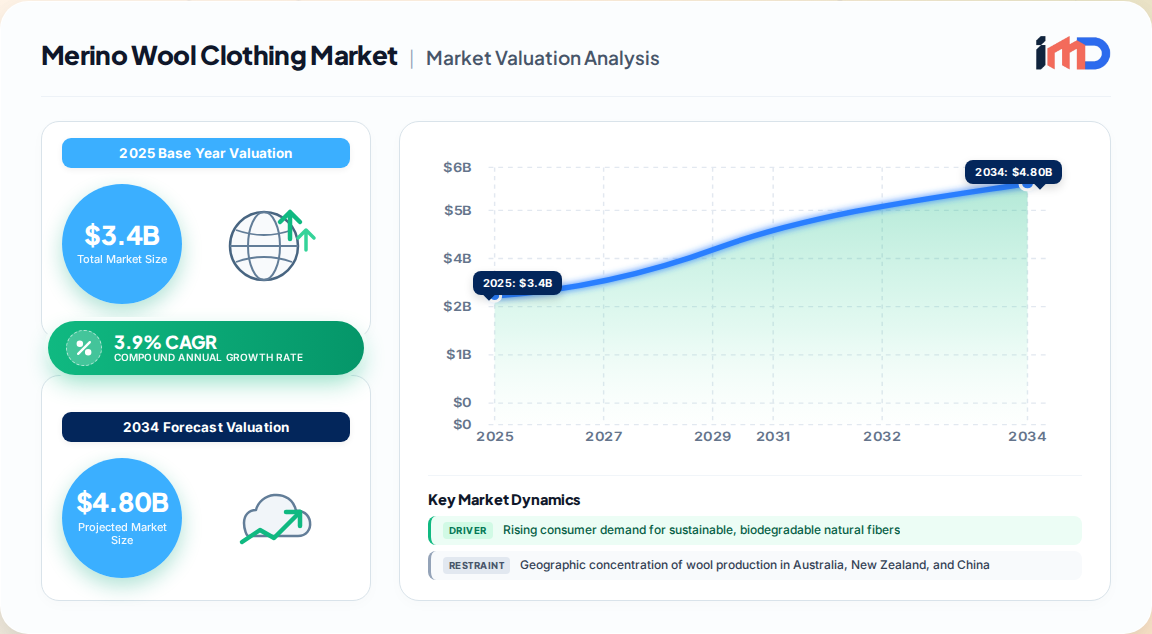
The global merino wool clothing market represents a premium, high-value segment within the broader natural fiber apparel industry. Our proprietary primary research estimates the market at USD 3.4 Billion in 2025, projected to expand to USD 5.0 Billion by 2035, registering a CAGR of 3.9% over the 2026-2035 forecast period. This growth is underpinned by a structural shift in consumer preference toward performance-driven natural fibers that offer superior thermoregulation, moisture management, and odor resistance without relying on synthetics.
Volume dynamics reveal a contrasting picture. Global merino wool fiber supply stands at approximately 305.2 thousand metric tons (KMT) in 2025, growing at a modest 0.40% CAGR to reach 317.7 KMT by 2035. The widening gap between value growth (3.9%) and volume growth (0.40%) underscores a clear premiumization trend: brands and consumers are increasingly willing to pay higher prices for certified, traceable, and high-performance merino garments. This value-over-volume paradigm is the central strategic driver reshaping the competitive landscape.
Drivers:
Restraints:
The merino wool clothing value chain is characterized by multiple stages of transformation, each adding significant value and traceability requirements.
| Stage | Key Activities | Value Addition | Key Stakeholders |
|---|---|---|---|
| Raw Fiber Production | Sheep farming, shearing, classing | Low to Moderate | Woolgrowers, cooperatives |
| Scouring & Carbonizing | Cleaning, impurity removal | Moderate | Scourers, logistics providers |
| Spinning & Weaving | Yarn formation, fabric production | High | Spinners, mills, knitters |
| Garment Manufacturing | Cut, make, trim | Moderate to High | Apparel OEMs, brand owners |
| Branding & Retail | Marketing, certification, distribution | Highest | Brands, retailers, e-commerce platforms |
The most significant margin capture occurs at the branding and retail stages, where certification (e.g., Woolmark) and traceability narratives command premium pricing. Vertically integrated players that control multiple stages—from fiber sourcing to finished garment—are best positioned to capture value and ensure quality consistency.
Merino wool trade flows remain dominated by Australia, which supplies the majority of global fine wool exports. China serves as the primary processing hub, importing raw wool for scouring, spinning, and garment manufacturing before re-exporting finished products to Europe and North America. This concentrated trade architecture introduces specific risks.
Key Supply Chain Risks:
Europe leads the merino wool clothing market, accounting for approximately 34% of global value, driven by strong demand for luxury and sustainable textiles across Germany, the UK, and France. The region's established luxury fashion houses and stringent sustainability regulations create a favorable environment for premium, certified merino products.
Asia-Pacific represents the fastest-growing region, with China and India driving demand expansion. Rising disposable incomes, urbanization, and growing awareness of sustainable fashion are key catalysts. China's dual role as both a major processor and an emerging consumer market positions it as a strategic pivot point for the industry.
North America maintains a significant market share (~24%), underpinned by performance apparel brands and a growing regenerative wool movement. The U.S. wool market alone is projected to reach USD 580.6 Million by 2033, growing at 4.1% CAGR.
Several underpenetrated opportunities exist for market participants:
The merino wool clothing market features a diverse competitive ecosystem spanning vertically integrated fiber producers, performance apparel brands, luxury fashion houses, and specialized mills.
| Company | Primary Focus | Strategic Positioning |
|---|---|---|
| The Woolmark Company | Certification & promotion | Industry standard-setter; drives consumer trust |
| Zegna Baruffa Lane Borgosesia | Luxury yarns | Premium Italian spinning; designer partnerships |
| Smartwool | Performance apparel | U.S. market leader in merino base layers |
| Icebreaker | Outdoor apparel | New Zealand heritage; global outdoor reach |
| Patagonia | Sustainable outdoor | Regenerative wool program; brand loyalty |
| Johnstons of Elgin | Luxury knitwear | Scottish heritage; traceable collections |
| Loro Piana S.P.A. | Luxury fabrics | Ultra-premium positioning |
| Merino & Co | Diversified merino | ASX-listed; global expansion focus |
Recent Developments:
For brands and manufacturers, securing reliable access to high-quality merino wool requires a multi-pronged sourcing strategy:
The merino wool clothing market is poised for steady value growth, driven by premiumization, sustainability imperatives, and performance attributes that align with evolving consumer preferences. Stakeholders across the value chain must navigate supply constraints and regulatory pressures while capitalizing on the significant opportunities presented by traceable, certified, and innovative merino products.
| Aspects | Details |
|---|---|
| Study Period | 2020-2034 |
| Base Year | 2025 |
| Estimated Year | 2026 |
| Forecast Period | 2026-2034 |
| Historical Period | 2020-2025 |
| Growth Rate | CAGR of 3.9% from 2020-2034 |
| Segmentation |
|
By Distribution Channel
By Processing Type
By Type
By Weave
By Application
| By Geography |
|
The global merino wool clothing market was valued at USD 3.4 Billion in 2025 and is projected to reach USD 5.0 Billion by 2035, growing at a CAGR of 3.9% during the forecast period.
Merino wool offers natural moisture-wicking, thermoregulation, and odor resistance properties without relying on synthetics. These performance attributes make it ideal for base layers, activewear, and outdoor clothing, driving demand among health-conscious consumers.
Europe leads the global merino wool clothing market, accounting for approximately 34% of value share, driven by strong demand for luxury and sustainable textiles. Asia-Pacific is the fastest-growing region, with China and India emerging as key consumption markets.
The market faces supply chain constraints due to geographic concentration of wool production in Australia, New Zealand, and China, alongside declining sheep flock inventories and limited scouring capacity. Competition from advanced synthetic fibers and price volatility also pose challenges.
Key companies include The Woolmark Company, Smartwool, Icebreaker, Patagonia, Zegna Baruffa Lane Borgosesia, Johnstons of Elgin, Loro Piana S.P.A., and Merino & Co, among others. These players compete on sustainability credentials, performance innovation, and traceability.
Our rigorous research methodology combines multi-layered approaches with comprehensive quality assurance, ensuring precision, accuracy, and reliability in every market analysis.
| Stakeholder Role | Interview Share (%) |
|---|---|
| Procurement Director | 35% |
| Sustainability Manager | 25% |
| Product Development Head | 20% |
| Supply Chain Director | 20% |
| Company Type | Representation (%) |
|---|---|
| Merino Wool Growers & Cooperatives | 25% |
| Scouring & Carbonizing Facilities | 15% |
| Spinning & Weaving Mills | 20% |
| Performance Apparel Brand Owners | 25% |
| Luxury Fashion Houses & Retailers | 15% |

Analyst at Providence Strategic Partners at Petaling Jaya
I have received the report already. Thanks you for your help.it has been a pleasure working with you. Thank you again for a good quality report

Internationalization Director
Yes, as a matter of fact we are totally satisfied with both reports that we have purchased and will continue to do so during this process of the internationalization of our brand.

Head of Product Management and Marketing
We are using your report, and it gave us valuable information."

Regional Director, Marketing and Business Development
We've received the report and have reviewed the content. Overall, it looks great and aligns closely with the data we can verify based on our industry knowledge.

VP of Sales
Thank you very much for sharing the report. I have reviewed it and I am very satisfied with the quality and the insights it provides. It will certainly be valuable for our internal discussions.
 Related Reports
