Insight Market Data is a premier market research and business consulting firm headquartered in Pune, India, providing syndicated research reports, customized intelligence studies, and strategic advisory services. Renowned academic institutions and Fortune 500 corporations worldwide rely on Insight Market Data's research repository to navigate evolving global and regional business environments. Covering 46 diverse industries across 25 major international economies, our comprehensive database delivers thousands of verified statistics and granular market evaluations. By combining industry-leading analytical methodologies with the direct insights of seasoned industry leaders and subject-matter experts, we deliver actionable intelligence spanning historical performance benchmarks to rigorous multi-year forecasts. We empower organizations to make confident, data-driven decisions across pivotal domains including Machinery & Equipment, Chemicals & Materials, Pharmaceuticals & Healthcare, Food & Beverages, Consumer Goods, Energy & Power, Automotive & Transportation, Electronics & Semiconductors, Medical Devices, Telecommunications, Emerging Technologies, Agriculture, and Packaging. Our multidisciplinary analyst teams provide an objective 360-degree perspective, tailoring every engagement to address complex strategic challenges with exceptional analytical rigor.
Leveraging advanced BI-powered analytics and predictive modeling, Insight Market Data uncovers high-impact market opportunities and competitive differentiators for ambitious enterprises. We continuously refine our research methodologies in accordance with global industry standards, tracking real-time market shifts to ensure our reports are consistently accurate, actionable, and delivered on schedule. Our analysts conduct methodical data validation, rigorous compliance checks, and exhaustive primary and secondary research to maintain the highest levels of data integrity and transparency. We partner closely with corporate strategists, investment groups, and business executives to translate intricate market intelligence into clear, actionable roadmaps for sustainable growth. With operational presence across Washington, USA, and Vimannagar, Pune, India, Insight Market Data ensures direct access to dedicated research specialists and responsive customer support to answer your most strategic questions.
Hair Care Products Market Growth, Size & Forecast to 2035 | Insight Market Data
Hair Care Products Market by Product Type (Shampoo, Conditioners, Hair Oil, Styling Products, Hair Color), by Category (Mass, Premium), by Ingredient Type (Conventional/Synthetic, Natural/Organic), by Distribution Channel (Supermarkets/Hypermarkets, Specialty Stores, Online Retail, Others), by North America (USA, Canada, Mexico), by Europe (Germany, UK, France, Italy, Spain), by Asia-Pacific (China, Japan, India, South Korea, Australia), by South America (Brazil, Argentina), by Middle East & Africa (Saudi Arabia, UAE, South Africa) Forecast 2026-2034
Executive Overview: The Hair-Health Ecosystem Takes Shape
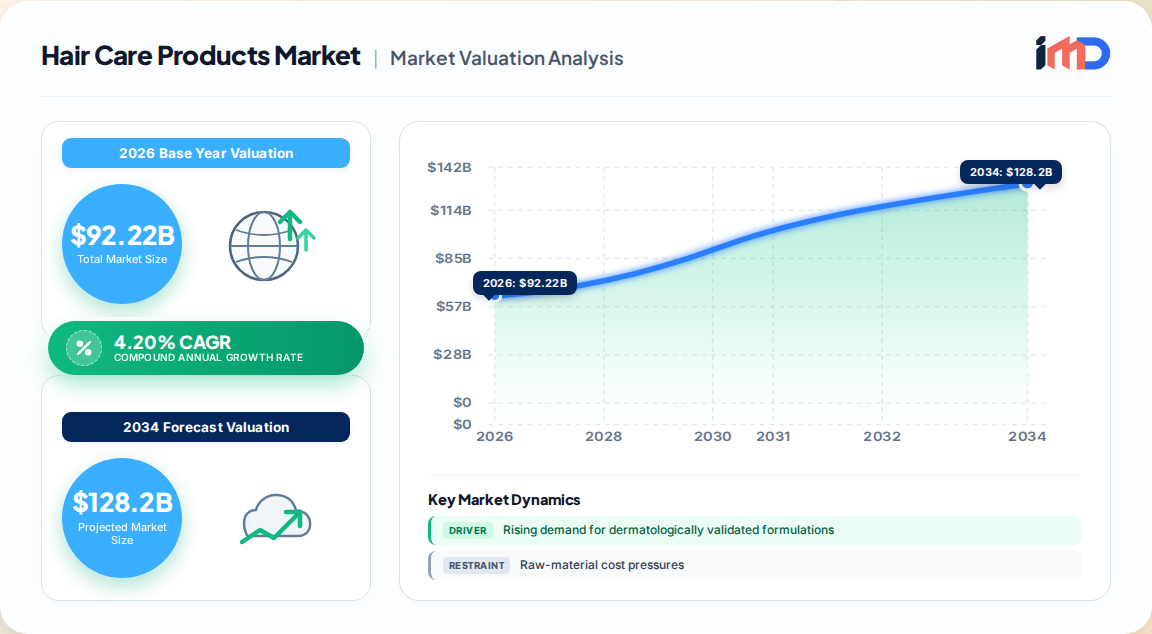
The global hair care products market is undergoing a structural transformation, moving decisively from a routine-based cleansing category toward a diversified hair-health and beauty ecosystem. Our proprietary primary research estimates the market at USD 92.22 billion in 2026, on a trajectory to reach USD 133.60 billion by 2035, representing a CAGR of 4.20%. This growth is not merely volume-driven; it reflects a fundamental re-rating of the category's value proposition, where efficacy, personalization, and scalp wellness command premium price points.
Hair Care Products Market Market Size (In Billion)
150.0B
100.0B
50.0B
0
88.50 B
2025
92.22 B
2026
96.09 B
2027
100.1 B
2028
104.3 B
2029
108.7 B
2030
113.3 B
2031
Three forces anchor this trajectory. First, rising consumer demand for dermatologically validated formulations, propelled by clinical research linking scalp microbiome health to follicle vitality, is expanding the addressable market beyond basic cleansing. Second, a global regulatory push toward ingredient transparency and clean-label mandates is rewarding brands that invest in reformulation and scientific substantiation. Third, per-capita spending on hair care across middle-income economies has climbed roughly 6% annually since 2022, widening the addressable base faster than population growth alone would suggest.
Metric
2025
2026
2035
CAGR (2026-2035)
Global Market Value
USD 88.50 Billion
USD 92.22 Billion
USD 133.60 Billion
4.20%
Shampoo Segment Share
43.4%
—
—
—
Mass-Market Share
70.4%
—
—
—
Online Retail Growth
—
—
—
7.05%
Asia-Pacific Share
38.1%
—
—
6.33%
The competitive landscape is moderately consolidated, with the top five multinationals holding a significant share, yet niche and indie brands are disrupting through ingredient-led positioning and digital-native distribution. The strategic imperative is clear: incumbents must combine scale with agility, while challengers must convert social discovery into repeat purchase.
Key Market Drivers: Science, Personalization, and Demographic Shift
Scalp-Science and Microbiome Research
Dermatological research has reframed the scalp as a complex ecological niche, where the equilibrium of microbial communities, including Cutibacterium and Malassezia, significantly influences barrier integrity and hair health. Industry leaders have intensified innovation, with major global beauty entities reporting cumulative annual research and innovation investments reaching approximately EUR 1.38 billion during the 2025 fiscal year. This driver alone is accretive by roughly 55 basis points to global CAGR.
E-Commerce and AI-Driven Personalization
Digital commerce has become a critical growth engine, with the global e-commerce personal care market valued at approximately USD 138.91 billion in 2026. AI-driven diagnostic tools now provide bespoke hair care recommendations, streamlining the consumer decision journey and supporting a projected expansion rate of 6.39% annually through 2031. This channel shift is particularly pronounced in North America and Asia-Pacific, where virtual try-on and replenishment subscription models are gaining traction.
Rising Middle-Class Spending in Emerging Economies
Expansion of the middle class in emerging Asia-Pacific economies is enabling a demographic upgrade from commodity goods to premium, branded solutions. Per-capita spending on hair care across middle-income economies has climbed roughly 6% annually since 2022, widening the addressable base. Asia-Pacific holds 38.1% of the global market and is the fastest-growing region at a 6.33% CAGR through 2035, supported by growing e-commerce logistics and rapid urbanization.
Clean-Label Regulatory Mandates
Regulatory frameworks are evolving to enhance product safety. The European Commission's stricter Cosmetic Products Regulation, which took effect in January 2025, restricted an additional 28 fragrance allergens, forcing reformulation across hundreds of SKUs. This has tipped cost structures in favor of science-driven incumbents with the R&D capacity to reformulate rapidly, while raising barriers for smaller, less-resourced players.
Restraints and Challenges: Cost Pressures and Counterfeit Proliferation
Raw-Material Cost Pressures
Volatility in petrochemical and agricultural input costs continues to pressure gross margins, particularly in mass-market tiers where price sensitivity is acute. Brands are responding through concentrated and waterless formats that reduce packaging and shipping costs, but reformulation cycles require significant lead time.
Counterfeit Product Proliferation
The expansion of e-commerce channels has been accompanied by a rise in counterfeit products, particularly in high-growth markets. This erodes brand equity and consumer trust, and necessitates investment in authentication technologies and channel governance.
SKU Proliferation and Decision Fatigue
An explosion of SKUs and specialized claims has created consumer decision fatigue, particularly in mature markets. Retailers are rationalizing shelf space, and brands are increasingly challenged to demonstrate measurable differentiation rather than incremental line extensions.
The market is segmented by product type, category, ingredient type, and distribution channel. The following table summarizes the key segment shares and growth rates derived from our primary research.
Segment
Base Year Share (2025)
Forecast CAGR
Key Insight
Shampoo
43.4%
—
Entrenched daily-use habits across demographics
Styling Products
—
6.06%
Social-media-influenced grooming routines
Mass-Market Products
70.4%
—
Volume dominance, but premium gaining momentum
Natural/Organic
—
6.39%
Paraben-free and cruelty-free credentials
Supermarkets/Hypermarkets
37.0%
—
High foot traffic and promotional shelf space
Online Retail
—
7.05%
Virtual try-on and AI-powered recommendations
By Product Type
Shampoo remains the anchor, accounting for 43.4% of the global market in 2025, reflecting entrenched daily-use consumption habits. However, styling products are forecast to expand at a 6.06% CAGR through 2035, driven by social-media-influenced grooming routines and professional-grade home-use innovation. Conditioners and hair oils follow as mature but stable segments, while hair masks and serums represent the fastest-growing treatment sub-segments.
By Category and Ingredient Type
Mass-market products held a 70.4% share in 2025, though premium lines are gaining momentum through clinical positioning and luxury packaging. Natural and organic formulations are on track for a 6.39% CAGR between 2026 and 2035, as consumers increasingly demand paraben-free and cruelty-free credentials. Conventional/synthetic lines remain dominant on volume, but the innovation frontier is shifting toward bio-based and clean-label formulations.
By Distribution Channel
Supermarkets and hypermarkets secured 37.0% of the market in 2025, leveraging high foot traffic and promotional shelf space. Online retail is the fastest-growing channel at a 7.05% CAGR, fueled by virtual try-on tools and AI-powered product recommendation engines. In the United States, hair was the only prestige beauty category in 2025 in which online represented the majority of retail sales, with convenience and replenishment identified as the leading purchase drivers.
Regional Outlook and Investment Attractiveness
Asia-Pacific leads the global market with 38.1% share in 2025, anchored by China's premiumization wave and India's expanding organized retail. The region is also the fastest-growing at a 6.33% CAGR through 2035, supported by growing e-commerce logistics networks and rapid urbanization. North America holds the second-largest share at 26.2%, where salon-grade retail crossover and direct-to-consumer subscription models maintain above-average basket sizes. Europe accounts for 23.5%, with refillable and waterless formats accelerating due to stricter sustainability regulations. South America posted a 5.15% CAGR, supported by Brazil's robust salon culture and rising disposable incomes.
Hair Care Products Market Regional Market Share
Loading chart...
Region
2025 Share
Growth Outlook
Strategic Priority
Asia-Pacific
38.1%
Fastest (6.33% CAGR)
Premiumization and D2C expansion
North America
26.2%
Moderate
Subscription models and scalp care
Europe
23.5%
Moderate
Sustainability and refillable formats
South America
—
5.15% CAGR
Salon-to-retail crossover
Middle East & Africa
—
Emerging
Affordability and hair-type specialization
For investors, the highest risk-adjusted returns are likely in Asia-Pacific premiumization and in cross-border digital-native brands targeting textured hair and scalp-health niches. Europe offers consolidation opportunities in sustainable packaging and refill infrastructure, while North America remains the innovation hub for clinical and technology-enabled personalization.
Competitive Strategies and Recent Developments
The competitive landscape is shaped by the ability to combine efficacy, targeted benefits, value, personalization, and digital accessibility across mass, masstige, and prestige price tiers. Key players include L'Oréal S.A., Unilever PLC, Procter & Gamble Co., Henkel AG, Kao Corporation, and Coty Inc., alongside a growing cohort of indie and celebrity-backed brands.
Recent developments underscore the strategic pivot toward scalp science and clinical claims:
2024: L'Oréal spent more than USD 1.2 billion on cosmetics research and development, with scalp-science platforms taking up an increasing portion of that funding.
2025: The European Commission's stricter Cosmetic Products Regulation restricted an additional 28 fragrance allergens, forcing reformulation across hundreds of SKUs.
2025: Major global beauty entities reported cumulative annual research and innovation investments reaching approximately EUR 1.38 billion.
2024: Dove launched its scalp + hair therapy collection, a premium six-product range incorporating niacinamide, peptides, and zinc, claiming 89% of women experienced thicker and stronger hair after using the Fullness Restore Scalp Serum.
Emerging brands are leveraging TikTok Shop, Amazon, and social discovery to lower barriers to entry, while incumbents are responding with targeted acquisitions and in-house venture units. The next competitive frontier is AI-powered diagnostics integrated into subscription platforms, which promise to convert one-time buyers into long-term regimen adherents.
Strategic White-Space Analysis
Several under-served intersections offer meaningful white space for growth:
Men's scalp and hair-loss treatments: With approximately two-thirds of American men experiencing some hair loss by age 35, clinically substantiated men's regimens remain under-penetrated outside the U.S.
Textured and curly hair in Asia-Pacific and Europe: Demand for curl-specific formulations is growing, yet localized product architecture remains limited.
Waterless and concentrated formats: Regulatory and sustainability pressures in Europe create a first-mover advantage for concentrated shampoos and refillable systems.
Post-partum and hormonal hair care: A clinically validated segment with high emotional investment and willingness to pay.
Companies that integrate ingredient research with digitally tailored customer interaction will be rewarded in the coming decade. The ability to translate microbiome science into consumer-legible claims, and to deliver those claims through convenient replenishment channels, will define the winners.
Hair Care Products Market Regional Market Share
Higher Coverage
Lower Coverage
No Coverage
Hair Care Products Market REPORT HIGHLIGHTS
Aspects
Details
Study Period
2020-2034
Base Year
2026
Estimated Year
2026
Forecast Period
2026-2034
Historical Period
2020-2025
Growth Rate
CAGR of 4.20% from 2020-2034
Segmentation
By Product Type
Shampoo
Conditioners
Hair Oil
Styling Products
Hair Color
By Category
Table of Contents
1. Hair Care Products Market Introduction
1.1. Research Scope
1.2. Market Segmentation
1.3. Research Objective
1.4. Definitions and Assumptions
2. Hair Care Products Market Executive Summary
2.1. Market Snapshot
3. Hair Care Products Market Dynamics
3.1. Market Drivers
3.1.1. Rising demand for dermatologically validated formulations
3.1.2. Growing emphasis on scalp health
3.1.3. Increasing awareness of male grooming
3.1.4. Advancements in product formulation technologies
3.1.5. Social media and beauty influencer impact
3.2. Market Trends
3.2.1. Scalp-science and microbiome research driving product innovation
3.2.2. E-commerce and AI-driven personalization
3.2.3. Rising middle-class spending in emerging economies
3.2.4. Clean-label regulatory mandates
3.2.5. Men's grooming category expansion
3.3. Market Restraints
3.3.1. Raw-material cost pressures
3.3.2. Counterfeit product proliferation
3.3.3. SKU proliferation and decision fatigue
3.4. Market Challenges
3.4.1. Regulatory compliance and reformulation costs
3.4.2. Supply chain volatility and ingredient sourcing
Mass
Premium
By Ingredient Type
Conventional/Synthetic
Natural/Organic
By Distribution Channel
Supermarkets/Hypermarkets
Specialty Stores
Online Retail
Others
By Geography
North America
USA
Canada
Mexico
Europe
Germany
UK
France
Italy
Spain
Asia-Pacific
China
Japan
India
South Korea
Australia
South America
Brazil
Argentina
Middle East & Africa
Saudi Arabia
UAE
South Africa
3.4.3. Intense competition from indie and private-label brands
4. Hair Care Products Market Factor Analysis
4.1. Porters Five Forces
4.1.1. Bargaining Power of Suppliers
4.1.2. Bargaining Power of Buyers
4.1.3. Threat of New Entrants
4.1.4. Threat of Substitutes
4.1.5. Competitive Rivalry
4.2. PESTEL analysis
4.3. BCG Analysis
4.3.1. Stars (High Growth, High Market Share)
4.3.2. Cash Cows (Low Growth, High Market Share)
4.3.3. Question Mark (High Growth, Low Market Share)
4.3.4. Dogs (Low Growth, Low Market Share)
4.4. Ansoff Matrix Analysis
4.5. Supply Chain Analysis
4.6. Regulatory Landscape
4.7. Current Market Potential and Opportunity Assessment (TAM–SAM–SOM Framework)
4.8. IMD Analyst Note
5. Hair Care Products Market Analysis, Insights and Forecast, 2020-2034
5.1. Analysis, Insights and Forecast - by Product Type
5.1.1. Shampoo
5.1.2. Conditioners
5.1.3. Hair Oil
5.1.4. Styling Products
5.1.5. Hair Color
5.2. Analysis, Insights and Forecast - by Category
5.2.1. Mass
5.2.2. Premium
5.3. Analysis, Insights and Forecast - by Ingredient Type
5.3.1. Conventional/Synthetic
5.3.2. Natural/Organic
5.4. Analysis, Insights and Forecast - by Distribution Channel
5.4.1. Supermarkets/Hypermarkets
5.4.2. Specialty Stores
5.4.3. Online Retail
5.4.4. Others
5.5. Analysis, Insights and Forecast - by Region
5.5.1. North America
5.5.2. Europe
5.5.3. Asia-Pacific
5.5.4. South America
5.5.5. Middle East & Africa
6. Hair Care Products Market North America Analysis, Insights and Forecast, 2020-2034
6.1. Analysis, Insights and Forecast - by Product Type
6.1.1. Shampoo
6.1.2. Conditioners
6.1.3. Hair Oil
6.1.4. Styling Products
6.1.5. Hair Color
6.2. Analysis, Insights and Forecast - by Category
6.2.1. Mass
6.2.2. Premium
6.3. Analysis, Insights and Forecast - by Ingredient Type
6.3.1. Conventional/Synthetic
6.3.2. Natural/Organic
6.4. Analysis, Insights and Forecast - by Distribution Channel
6.4.1. Supermarkets/Hypermarkets
6.4.2. Specialty Stores
6.4.3. Online Retail
6.4.4. Others
7. Hair Care Products Market Europe Analysis, Insights and Forecast, 2020-2034
7.1. Analysis, Insights and Forecast - by Product Type
7.1.1. Shampoo
7.1.2. Conditioners
7.1.3. Hair Oil
7.1.4. Styling Products
7.1.5. Hair Color
7.2. Analysis, Insights and Forecast - by Category
7.2.1. Mass
7.2.2. Premium
7.3. Analysis, Insights and Forecast - by Ingredient Type
7.3.1. Conventional/Synthetic
7.3.2. Natural/Organic
7.4. Analysis, Insights and Forecast - by Distribution Channel
7.4.1. Supermarkets/Hypermarkets
7.4.2. Specialty Stores
7.4.3. Online Retail
7.4.4. Others
8. Hair Care Products Market Asia-Pacific Analysis, Insights and Forecast, 2020-2034
8.1. Analysis, Insights and Forecast - by Product Type
8.1.1. Shampoo
8.1.2. Conditioners
8.1.3. Hair Oil
8.1.4. Styling Products
8.1.5. Hair Color
8.2. Analysis, Insights and Forecast - by Category
8.2.1. Mass
8.2.2. Premium
8.3. Analysis, Insights and Forecast - by Ingredient Type
8.3.1. Conventional/Synthetic
8.3.2. Natural/Organic
8.4. Analysis, Insights and Forecast - by Distribution Channel
8.4.1. Supermarkets/Hypermarkets
8.4.2. Specialty Stores
8.4.3. Online Retail
8.4.4. Others
9. Hair Care Products Market South America Analysis, Insights and Forecast, 2020-2034
9.1. Analysis, Insights and Forecast - by Product Type
9.1.1. Shampoo
9.1.2. Conditioners
9.1.3. Hair Oil
9.1.4. Styling Products
9.1.5. Hair Color
9.2. Analysis, Insights and Forecast - by Category
9.2.1. Mass
9.2.2. Premium
9.3. Analysis, Insights and Forecast - by Ingredient Type
9.3.1. Conventional/Synthetic
9.3.2. Natural/Organic
9.4. Analysis, Insights and Forecast - by Distribution Channel
9.4.1. Supermarkets/Hypermarkets
9.4.2. Specialty Stores
9.4.3. Online Retail
9.4.4. Others
10. Hair Care Products Market Middle East & Africa Analysis, Insights and Forecast, 2020-2034
10.1. Analysis, Insights and Forecast - by Product Type
10.1.1. Shampoo
10.1.2. Conditioners
10.1.3. Hair Oil
10.1.4. Styling Products
10.1.5. Hair Color
10.2. Analysis, Insights and Forecast - by Category
10.2.1. Mass
10.2.2. Premium
10.3. Analysis, Insights and Forecast - by Ingredient Type
10.3.1. Conventional/Synthetic
10.3.2. Natural/Organic
10.4. Analysis, Insights and Forecast - by Distribution Channel
10.4.1. Supermarkets/Hypermarkets
10.4.2. Specialty Stores
10.4.3. Online Retail
10.4.4. Others
11. Hair Care Products Market Competitive Analysis
11.1. Company Profiles
11.1.1. L'Oréal S.A.
11.1.1.1. Company Overview
11.1.1.2. Products
11.1.1.3. Company Financials
11.1.1.4. SWOT Analysis
11.1.2. Unilever PLC
11.1.2.1. Company Overview
11.1.2.2. Products
11.1.2.3. Company Financials
11.1.2.4. SWOT Analysis
11.1.3. Procter & Gamble Co.
11.1.3.1. Company Overview
11.1.3.2. Products
11.1.3.3. Company Financials
11.1.3.4. SWOT Analysis
11.1.4. Henkel AG & Co. KGaA
11.1.4.1. Company Overview
11.1.4.2. Products
11.1.4.3. Company Financials
11.1.4.4. SWOT Analysis
11.1.5. Kao Corporation
11.1.5.1. Company Overview
11.1.5.2. Products
11.1.5.3. Company Financials
11.1.5.4. SWOT Analysis
11.1.6. Coty Inc.
11.1.6.1. Company Overview
11.1.6.2. Products
11.1.6.3. Company Financials
11.1.6.4. SWOT Analysis
11.2. Market Entropy
11.2.1. Company's Key Areas Served
11.2.2. Recent Developments
11.3. Company Market Share Analysis, 2026
11.3.1. Top 5 Companies Market Share Analysis
11.3.2. Top 3 Companies Market Share Analysis
11.4. List of Potential Customers
List of Figures
Figure 1: Global Hair Care Products Market Revenue Breakdown (Billion, %) by Region 2026 & 2034
Figure 2: North America Hair Care Products Market Revenue (Billion), by Product Type 2026 & 2034
Figure 3: North America Hair Care Products Market Revenue Share (%), by Product Type 2026 & 2034
Figure 4: North America Hair Care Products Market Revenue (Billion), by Category 2026 & 2034
Figure 5: North America Hair Care Products Market Revenue Share (%), by Category 2026 & 2034
Figure 6: North America Hair Care Products Market Revenue (Billion), by Ingredient Type 2026 & 2034
Figure 7: North America Hair Care Products Market Revenue Share (%), by Ingredient Type 2026 & 2034
Figure 8: North America Hair Care Products Market Revenue (Billion), by Distribution Channel 2026 & 2034
Figure 9: North America Hair Care Products Market Revenue Share (%), by Distribution Channel 2026 & 2034
Figure 10: North America Hair Care Products Market Revenue (Billion), by Country 2026 & 2034
Figure 11: North America Hair Care Products Market Revenue Share (%), by Country 2026 & 2034
Figure 12: Europe Hair Care Products Market Revenue (Billion), by Product Type 2026 & 2034
Figure 13: Europe Hair Care Products Market Revenue Share (%), by Product Type 2026 & 2034
Figure 14: Europe Hair Care Products Market Revenue (Billion), by Category 2026 & 2034
Figure 15: Europe Hair Care Products Market Revenue Share (%), by Category 2026 & 2034
Figure 16: Europe Hair Care Products Market Revenue (Billion), by Ingredient Type 2026 & 2034
Figure 17: Europe Hair Care Products Market Revenue Share (%), by Ingredient Type 2026 & 2034
Figure 18: Europe Hair Care Products Market Revenue (Billion), by Distribution Channel 2026 & 2034
Figure 19: Europe Hair Care Products Market Revenue Share (%), by Distribution Channel 2026 & 2034
Figure 20: Europe Hair Care Products Market Revenue (Billion), by Country 2026 & 2034
Figure 21: Europe Hair Care Products Market Revenue Share (%), by Country 2026 & 2034
Figure 22: Asia-Pacific Hair Care Products Market Revenue (Billion), by Product Type 2026 & 2034
Figure 23: Asia-Pacific Hair Care Products Market Revenue Share (%), by Product Type 2026 & 2034
Figure 24: Asia-Pacific Hair Care Products Market Revenue (Billion), by Category 2026 & 2034
Figure 25: Asia-Pacific Hair Care Products Market Revenue Share (%), by Category 2026 & 2034
Figure 26: Asia-Pacific Hair Care Products Market Revenue (Billion), by Ingredient Type 2026 & 2034
Figure 27: Asia-Pacific Hair Care Products Market Revenue Share (%), by Ingredient Type 2026 & 2034
Figure 28: Asia-Pacific Hair Care Products Market Revenue (Billion), by Distribution Channel 2026 & 2034
Figure 29: Asia-Pacific Hair Care Products Market Revenue Share (%), by Distribution Channel 2026 & 2034
Figure 30: Asia-Pacific Hair Care Products Market Revenue (Billion), by Country 2026 & 2034
Figure 31: Asia-Pacific Hair Care Products Market Revenue Share (%), by Country 2026 & 2034
Figure 32: South America Hair Care Products Market Revenue (Billion), by Product Type 2026 & 2034
Figure 33: South America Hair Care Products Market Revenue Share (%), by Product Type 2026 & 2034
Figure 34: South America Hair Care Products Market Revenue (Billion), by Category 2026 & 2034
Figure 35: South America Hair Care Products Market Revenue Share (%), by Category 2026 & 2034
Figure 36: South America Hair Care Products Market Revenue (Billion), by Ingredient Type 2026 & 2034
Figure 37: South America Hair Care Products Market Revenue Share (%), by Ingredient Type 2026 & 2034
Figure 38: South America Hair Care Products Market Revenue (Billion), by Distribution Channel 2026 & 2034
Figure 39: South America Hair Care Products Market Revenue Share (%), by Distribution Channel 2026 & 2034
Figure 40: South America Hair Care Products Market Revenue (Billion), by Country 2026 & 2034
Figure 41: South America Hair Care Products Market Revenue Share (%), by Country 2026 & 2034
Figure 42: Middle East & Africa Hair Care Products Market Revenue (Billion), by Product Type 2026 & 2034
Figure 43: Middle East & Africa Hair Care Products Market Revenue Share (%), by Product Type 2026 & 2034
Figure 44: Middle East & Africa Hair Care Products Market Revenue (Billion), by Category 2026 & 2034
Figure 45: Middle East & Africa Hair Care Products Market Revenue Share (%), by Category 2026 & 2034
Figure 46: Middle East & Africa Hair Care Products Market Revenue (Billion), by Ingredient Type 2026 & 2034
Figure 47: Middle East & Africa Hair Care Products Market Revenue Share (%), by Ingredient Type 2026 & 2034
Figure 48: Middle East & Africa Hair Care Products Market Revenue (Billion), by Distribution Channel 2026 & 2034
Figure 49: Middle East & Africa Hair Care Products Market Revenue Share (%), by Distribution Channel 2026 & 2034
Figure 50: Middle East & Africa Hair Care Products Market Revenue (Billion), by Country 2026 & 2034
Figure 51: Middle East & Africa Hair Care Products Market Revenue Share (%), by Country 2026 & 2034
List of Tables
Table 1: Global Hair Care Products Market Revenue Billion Forecast, by Product Type 2020 & 2034
Table 2: Global Hair Care Products Market Revenue Billion Forecast, by Category 2020 & 2034
Table 3: Global Hair Care Products Market Revenue Billion Forecast, by Ingredient Type 2020 & 2034
Table 4: Global Hair Care Products Market Revenue Billion Forecast, by Distribution Channel 2020 & 2034
Table 5: Global Hair Care Products Market Revenue Billion Forecast, by Region 2020 & 2034
Table 6: North America Hair Care Products Market Revenue Billion Forecast, by Product Type 2020 & 2034
Table 7: North America Hair Care Products Market Revenue Billion Forecast, by Category 2020 & 2034
Table 8: North America Hair Care Products Market Revenue Billion Forecast, by Ingredient Type 2020 & 2034
Table 9: North America Hair Care Products Market Revenue Billion Forecast, by Distribution Channel 2020 & 2034
Table 10: North America Hair Care Products Market Revenue Billion Forecast, by Country 2020 & 2034
Table 11: USA Hair Care Products Market Revenue (Billion) Forecast, by Application 2020 & 2034
Table 12: Canada Hair Care Products Market Revenue (Billion) Forecast, by Application 2020 & 2034
Table 13: Mexico Hair Care Products Market Revenue (Billion) Forecast, by Application 2020 & 2034
Table 14: Europe Hair Care Products Market Revenue Billion Forecast, by Product Type 2020 & 2034
Table 15: Europe Hair Care Products Market Revenue Billion Forecast, by Category 2020 & 2034
Table 16: Europe Hair Care Products Market Revenue Billion Forecast, by Ingredient Type 2020 & 2034
Table 17: Europe Hair Care Products Market Revenue Billion Forecast, by Distribution Channel 2020 & 2034
Table 18: Europe Hair Care Products Market Revenue Billion Forecast, by Country 2020 & 2034
Table 19: Germany Hair Care Products Market Revenue (Billion) Forecast, by Application 2020 & 2034
Table 20: UK Hair Care Products Market Revenue (Billion) Forecast, by Application 2020 & 2034
Table 21: France Hair Care Products Market Revenue (Billion) Forecast, by Application 2020 & 2034
Table 22: Italy Hair Care Products Market Revenue (Billion) Forecast, by Application 2020 & 2034
Table 23: Spain Hair Care Products Market Revenue (Billion) Forecast, by Application 2020 & 2034
Table 24: Asia-Pacific Hair Care Products Market Revenue Billion Forecast, by Product Type 2020 & 2034
Table 25: Asia-Pacific Hair Care Products Market Revenue Billion Forecast, by Category 2020 & 2034
Table 26: Asia-Pacific Hair Care Products Market Revenue Billion Forecast, by Ingredient Type 2020 & 2034
Table 27: Asia-Pacific Hair Care Products Market Revenue Billion Forecast, by Distribution Channel 2020 & 2034
Table 28: Asia-Pacific Hair Care Products Market Revenue Billion Forecast, by Country 2020 & 2034
Table 29: China Hair Care Products Market Revenue (Billion) Forecast, by Application 2020 & 2034
Table 30: Japan Hair Care Products Market Revenue (Billion) Forecast, by Application 2020 & 2034
Table 31: India Hair Care Products Market Revenue (Billion) Forecast, by Application 2020 & 2034
Table 32: South Korea Hair Care Products Market Revenue (Billion) Forecast, by Application 2020 & 2034
Table 33: Australia Hair Care Products Market Revenue (Billion) Forecast, by Application 2020 & 2034
Table 34: South America Hair Care Products Market Revenue Billion Forecast, by Product Type 2020 & 2034
Table 35: South America Hair Care Products Market Revenue Billion Forecast, by Category 2020 & 2034
Table 36: South America Hair Care Products Market Revenue Billion Forecast, by Ingredient Type 2020 & 2034
Table 37: South America Hair Care Products Market Revenue Billion Forecast, by Distribution Channel 2020 & 2034
Table 38: South America Hair Care Products Market Revenue Billion Forecast, by Country 2020 & 2034
Table 39: Brazil Hair Care Products Market Revenue (Billion) Forecast, by Application 2020 & 2034
Table 40: Argentina Hair Care Products Market Revenue (Billion) Forecast, by Application 2020 & 2034
Table 41: Middle East & Africa Hair Care Products Market Revenue Billion Forecast, by Product Type 2020 & 2034
Table 42: Middle East & Africa Hair Care Products Market Revenue Billion Forecast, by Category 2020 & 2034
Table 43: Middle East & Africa Hair Care Products Market Revenue Billion Forecast, by Ingredient Type 2020 & 2034
Table 44: Middle East & Africa Hair Care Products Market Revenue Billion Forecast, by Distribution Channel 2020 & 2034
Table 45: Middle East & Africa Hair Care Products Market Revenue Billion Forecast, by Country 2020 & 2034
Table 46: Saudi Arabia Hair Care Products Market Revenue (Billion) Forecast, by Application 2020 & 2034
Table 47: UAE Hair Care Products Market Revenue (Billion) Forecast, by Application 2020 & 2034
Table 48: South Africa Hair Care Products Market Revenue (Billion) Forecast, by Application 2020 & 2034
Frequently Asked Questions
1What is the current size of the global hair care products market?
The global hair care products market was valued at USD 88.50 billion in 2025 and is estimated at USD 92.22 billion in 2026. It is projected to reach USD 133.60 billion by 2035, growing at a CAGR of 4.20%.
2Which region dominates the hair care products market?
Asia-Pacific leads the global market with a 38.1% share in 2025 and is also the fastest-growing region at a 6.33% CAGR through 2035, driven by premiumization in China and expanding organized retail in India.
3What are the key trends shaping the hair care products market?
Key trends include scalp-science and microbiome research, AI-driven personalization in e-commerce, rising middle-class spending in emerging economies, and clean-label regulatory mandates. Scalp care recorded its third consecutive year of double-digit growth in the U.S. prestige segment.
4Which product segment holds the largest share of the hair care market?
Shampoo accounted for 43.4% of the global hair care products market in 2025, reflecting entrenched daily-use consumption habits. Styling products are forecast to expand at a 6.06% CAGR through 2035.
5Who are the major companies operating in the hair care products market?
Major players include L'Oréal S.A., Unilever PLC, Procter & Gamble Co., Henkel AG, Kao Corporation, and Coty Inc. The market is moderately consolidated, with the top five multinationals holding a significant share, though niche brands are disrupting through ingredient-led positioning.
Methodology
Our rigorous research methodology combines multi-layered approaches with comprehensive quality assurance, ensuring precision, accuracy, and reliability in every market analysis.
Primary Research
Conducted 70–80% of total research effort through direct primary interviews and surveys with industry executives across the hair care value chain, ensuring first-hand validation of market dynamics.
Interviewed 4–5 specific company types: raw material and ingredient suppliers (e.g., surfactant and silicone producers), contract manufacturers and private-label formulators, brand owners and marketing organizations, distributors and wholesalers, and retail channel operators (salons, specialty beauty retailers, and e-commerce platforms).
Targeted 3–4 specific stakeholder job titles: Procurement Director, Head of R&D and Innovation, Category Manager (Hair Care), and Supply Chain Director.
Consulted 3–4 real, globally recognized industry associations and regulatory bodies: the Personal Care Products Council (PCPC), the European Cosmetic, Toiletry and Perfumery Association (Cosmetics Europe), the U.S. Food and Drug Administration (FDA), and the International Cooperation on Cosmetics Regulation (ICCR).
Gathered 3–4 specific quantitative metrics for bottom-up market sizing: per-capita hair care spending by country, unit volume consumption per household, average selling price by product tier, and retail shelf-space allocation by channel.
Allocated 20–30% of research effort to secondary validation and benchmarking, using official multilateral and governmental sources such as UN Comtrade, World Bank, OECD, US ITC, Eurostat, and national statistics offices.
Utilized standard financial databases: Bloomberg, Factiva, Hoovers, and PitchBook for company-level financial analysis and competitive benchmarking.
Cross-referenced trade statistics and regulatory filings to validate import/export flows and compliance-driven reformulation trends.
Demand Modeling & Market Estimation
Applied both top-down and bottom-up methodologies simultaneously, using multi-level data triangulation to reconcile estimates at global, regional, and segment levels.
Bottom-up analysis built from per-capita consumption and pricing data across 40+ countries, aggregated and calibrated against corporate revenue disclosures.
Top-down analysis anchored to total beauty and personal care spending, with hair care share derived from retail scanner data and trade association benchmarks.
Surfing apparel and accessories market valued at $10.36B in 2025, growing at 4.8% CAGR to reach $15.81B by 2034. Explore drivers, trends, and regional insights.
RFID in retail market to grow at 13.2% CAGR, reaching $96.98 Billion by 2035. In-depth analysis of item-level tagging, supply chain, and regional trends.
Nov 2026|251 pages
$2900.00
The global men's apparel market is valued at USD 602.8 Billion in 2025 and is projected to reach USD 754.3 Billion by 2034, growing at a CAGR of 2.6%.
Nov 2026|260 pages
$2900.00
Germany luxury goods market to reach US$ 22.78 billion by 2035 at 3.42% CAGR. Explore premium segments, sustainability, and digital commerce trends.
Nov 2026|186 pages
$2900.00
Refillable skincare market to reach $9.17B by 2033 at 9.1% CAGR. Airless pumps and refill pods drive sustainable beauty packaging growth.