1What is the size of the luxury hotel industry market?
The global luxury hotel industry market was valued at USD 118.4 billion in 2026 and is projected to reach USD 196.7 billion by 2033, growing at a CAGR of 7.5% during the forecast period.
Insight Market Data is a premier market research and business consulting firm headquartered in Pune, India, providing syndicated research reports, customized intelligence studies, and strategic advisory services. Renowned academic institutions and Fortune 500 corporations worldwide rely on Insight Market Data's research repository to navigate evolving global and regional business environments. Covering 46 diverse industries across 25 major international economies, our comprehensive database delivers thousands of verified statistics and granular market evaluations. By combining industry-leading analytical methodologies with the direct insights of seasoned industry leaders and subject-matter experts, we deliver actionable intelligence spanning historical performance benchmarks to rigorous multi-year forecasts. We empower organizations to make confident, data-driven decisions across pivotal domains including Machinery & Equipment, Chemicals & Materials, Pharmaceuticals & Healthcare, Food & Beverages, Consumer Goods, Energy & Power, Automotive & Transportation, Electronics & Semiconductors, Medical Devices, Telecommunications, Emerging Technologies, Agriculture, and Packaging. Our multidisciplinary analyst teams provide an objective 360-degree perspective, tailoring every engagement to address complex strategic challenges with exceptional analytical rigor.
Leveraging advanced BI-powered analytics and predictive modeling, Insight Market Data uncovers high-impact market opportunities and competitive differentiators for ambitious enterprises. We continuously refine our research methodologies in accordance with global industry standards, tracking real-time market shifts to ensure our reports are consistently accurate, actionable, and delivered on schedule. Our analysts conduct methodical data validation, rigorous compliance checks, and exhaustive primary and secondary research to maintain the highest levels of data integrity and transparency. We partner closely with corporate strategists, investment groups, and business executives to translate intricate market intelligence into clear, actionable roadmaps for sustainable growth. With operational presence across Washington, USA, and Vimannagar, Pune, India, Insight Market Data ensures direct access to dedicated research specialists and responsive customer support to answer your most strategic questions.
 Luxury Hotel Industry
 by Category (Chain, Independent), by Type (Business Hotels, Airport Hotels, Holiday Hotels, Resorts, Suite Hotels, Others), by Room Type (Suites, Standard Luxury Room, Villas/Bungalows, Upper-Upscale, Upscale), by Booking Mode (Direct Booking, Travel Agents, Online Travel Agencies), by North America (USA, Canada, Mexico), by Europe (Germany, UK, France, Italy, Spain), by Asia Pacific (China, Japan, India, Australia, Southeast Asia), by Middle East & Africa (UAE, Saudi Arabia, South Africa), by Central & South America (Brazil, Argentina, Chile) Forecast 2026-2034

Research Associate


 Related Reports

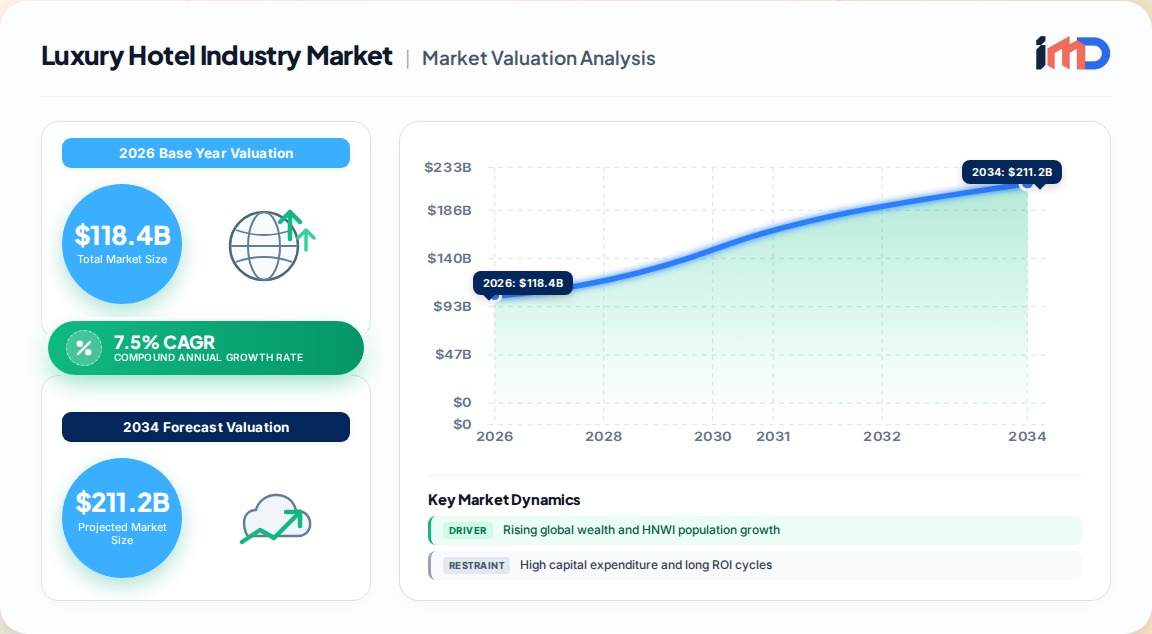
The global luxury hotel industry market represents a resilient and expanding segment of the premium hospitality sector, characterized by high-net-worth traveler demand, experiential service delivery, and premium asset development. Our proprietary primary research estimates the market at USD 118.4 billion in 2026, projected to reach USD 196.7 billion by 2033, advancing at a robust CAGR of 7.5% over the forecast period. This growth trajectory outpaces the broader hospitality sector, reflecting structural shifts in wealth distribution, travel frequency among affluent cohorts, and the premiumization of leisure experiences.
North America remains the largest regional market, commanding a 36.1% revenue share in 2025, supported by a dense concentration of ultra-luxury urban and resort properties, a mature corporate travel ecosystem—including group booking demand estimated at 28% of total revenue—and a deep base of domestic high-net-worth travelers. Meanwhile, Asia Pacific is positioned as the fastest-growing region, driven by expanding disposable incomes in China and India, the proliferation of branded luxury chains into tier-2 destinations, and a rebound in international tourism across the region.
The luxury hotel value chain is characterized by multiple specialized participants, each contributing to the final guest experience. Our primary research indicates that effective coordination across these segments is critical to maintaining brand standards and pricing power.
| Value Chain Stage | Key Activities | Representative Participants |
|---|---|---|
| Asset Ownership & Development | Land acquisition, financing, construction, asset management | Real estate developers, institutional investors, family offices |
| Brand Management & Operations | Brand standards, reservations systems, loyalty programs, staff training | Luxury hotel chains, independent luxury operators |
| Technology & Systems Integration | Property management systems, digital booking platforms, IoT and AI concierge | Hospitality technology providers, software vendors |
| Guest Experience & Amenities | Food & beverage, wellness, spa, butler service, curated excursions | Hotel operations teams, third-party service providers |
| Distribution & Channel Management | Direct booking, OTAs, travel agents, corporate travel desks | Online travel agencies, global distribution systems, travel management companies |
A notable trend is the growing integration of local artisanal suppliers into the luxury guest experience. For instance, boutique distilleries and specialty food producers now collaborate with luxury hotel groups to create private-label spirits, signature vermouths, and bespoke culinary offerings, enhancing destination authenticity and creating differentiated value for guests.
The luxury hotel industry market is segmented by category, type, room type, booking mode, and region. Our analysis of segment-level primary data reveals the following structural insights:
| Region | 2025/2026 Revenue Share | Growth Outlook | Key Market Characteristics |
|---|---|---|---|
| North America | 36.1% (2025) | Moderate growth | Mature market, high ADR, strong domestic demand, significant group booking share |
| Europe | 37.08% (2026) | Steady growth | Heritage properties, strong intra-regional travel, luxury corridor connectivity |
| Asia Pacific | 21.2% (2026 est.) | Fastest-growing at 11.2% CAGR | Rising disposable incomes, tier-2 city expansion, tourism recovery |
| Middle East & Africa | 8.1% (2026 est.) | Growth tempered by geopolitics | Iconic ultra-luxury developments, corridor risk, high development activity |
| Central & South America | 7.0% (2026 est.) | Emerging opportunity | Growing affluent class, untapped resort destinations |
Asia Pacific presents the strongest white-space opportunity, particularly in India, where the luxury hotel market is projected to grow from USD 3.3 billion in 2026 to USD 6.3 billion by 2034 at a CAGR of 8.48%. Branded luxury chains are actively expanding into tier-2 cities—such as Udaipur, where Indian Hotels Company opened the 155-key Taj Lalit Bagh in October 2025—combining local heritage with premium branded service. In China, per-capita disposable income rose 5% in real terms in 2025, and luxury hotel room-consumption heat points increased 4.6% year-on-year in August 2026, signaling sustained premium demand.
The luxury hotel industry is fragmented, with globally recognized brands competing alongside strong regional operators. Our primary research identifies the following leading players: Accor (Fairmont, Raffles), Four Seasons Hotels & Resorts, Hilton Worldwide (Waldorf Astoria, Conrad), Hyatt Hotels Corporation (Park Hyatt, Andaz), Marriott International (The Ritz-Carlton, St. Regis), Mandarin Oriental Hotel Group, Belmond Management Limited, Aman Resorts, and Indian Hotels Company (Taj).
Key strategic developments observed in our primary research include:
Our analysis identifies several high-potential strategic opportunities for luxury hotel operators and investors:
| Aspects | Details |
|---|---|
| Study Period | 2020-2034 |
| Base Year | 2026 |
| Estimated Year | 2026 |
| Forecast Period | 2026-2034 |
| Historical Period | 2020-2025 |
| Growth Rate | CAGR of 7.5% from 2020-2034 |
| Segmentation |
|
By Room Type
By Booking Mode
| By Geography |
|
The global luxury hotel industry market was valued at USD 118.4 billion in 2026 and is projected to reach USD 196.7 billion by 2033, growing at a CAGR of 7.5% during the forecast period.
North America holds the largest revenue share at 36.1% in 2025, driven by a mature luxury hospitality ecosystem and a large base of high-net-worth domestic travelers. Europe follows closely with a 37.08% share in 2026.
Key trends include a shift toward experiential and personalized travel, the rise of eco-luxury and sustainable operations, digital integration with AI and IoT technologies, and the expansion of branded luxury chains into tier-2 cities, particularly in Asia Pacific.
Resorts are the fastest-growing type segment, forecast to expand at a CAGR of 13.2% through 2032, driven by demand for experiential leisure and wellness tourism. Online travel agencies are the fastest-growing booking channel at a 13.5% CAGR.
Leading companies include Accor, Four Seasons Hotels & Resorts, Hilton Worldwide, Hyatt Hotels Corporation, Marriott International, Mandarin Oriental Hotel Group, Belmond Management Limited, Aman Resorts, and Indian Hotels Company.
Our rigorous research methodology combines multi-layered approaches with comprehensive quality assurance, ensuring precision, accuracy, and reliability in every market analysis.
| Stakeholder Role | Interview Share (%) |
|---|---|
| Vice President of Operations | 30% |
| Director of Revenue Management | 25% |
| Chief Financial Officer | 25% |
| General Manager, Luxury Property | 20% |
| Company Type | Representation (%) |
|---|---|
| Luxury Hotel Chains & Brand Operators | 30% |
| Independent Luxury Properties | 20% |
| Hotel Asset & Investment Management Firms | 20% |
| Hospitality Technology & Booking Platform Providers | 15% |
| Luxury Travel Advisory & Distribution Firms | 15% |