1How big is the luxury footwear market?
The global luxury footwear market is estimated at USD 35.7 Billion in 2025 and is projected to reach USD 57.4 Billion by 2034, expanding at a CAGR of 6.8% over the forecast period.
Insight Market Data is a premier market research and business consulting firm headquartered in Pune, India, providing syndicated research reports, customized intelligence studies, and strategic advisory services. Renowned academic institutions and Fortune 500 corporations worldwide rely on Insight Market Data's research repository to navigate evolving global and regional business environments. Covering 46 diverse industries across 25 major international economies, our comprehensive database delivers thousands of verified statistics and granular market evaluations. By combining industry-leading analytical methodologies with the direct insights of seasoned industry leaders and subject-matter experts, we deliver actionable intelligence spanning historical performance benchmarks to rigorous multi-year forecasts. We empower organizations to make confident, data-driven decisions across pivotal domains including Machinery & Equipment, Chemicals & Materials, Pharmaceuticals & Healthcare, Food & Beverages, Consumer Goods, Energy & Power, Automotive & Transportation, Electronics & Semiconductors, Medical Devices, Telecommunications, Emerging Technologies, Agriculture, and Packaging. Our multidisciplinary analyst teams provide an objective 360-degree perspective, tailoring every engagement to address complex strategic challenges with exceptional analytical rigor.
Leveraging advanced BI-powered analytics and predictive modeling, Insight Market Data uncovers high-impact market opportunities and competitive differentiators for ambitious enterprises. We continuously refine our research methodologies in accordance with global industry standards, tracking real-time market shifts to ensure our reports are consistently accurate, actionable, and delivered on schedule. Our analysts conduct methodical data validation, rigorous compliance checks, and exhaustive primary and secondary research to maintain the highest levels of data integrity and transparency. We partner closely with corporate strategists, investment groups, and business executives to translate intricate market intelligence into clear, actionable roadmaps for sustainable growth. With operational presence across Washington, USA, and Vimannagar, Pune, India, Insight Market Data ensures direct access to dedicated research specialists and responsive customer support to answer your most strategic questions.
 Luxury Footwear Market
 by Product (Fashion Footwear, Formal Footwear, Sneakers, Loafers, Sandals and Flats, Heels and Pumps, Boots, Casual and Sports Shoes, Others), by End User (Men, Women, Children), by Price Point (Premium, Ultra-Premium, Bespoke), by Distribution Channel (Offline(Monobrand Stores, Department Stores, Specialty Stores, Off-Price Stores), Online, Others), by Asia Pacific (China, Japan, India, South Korea), by North America (USA, Canada, Mexico), by Europe (Italy, France, UK, Germany, Spain), by Middle East & Africa (GCC Countries, South Africa), by South America (Brazil, Argentina) Forecast 2026-2034

Research Analyst


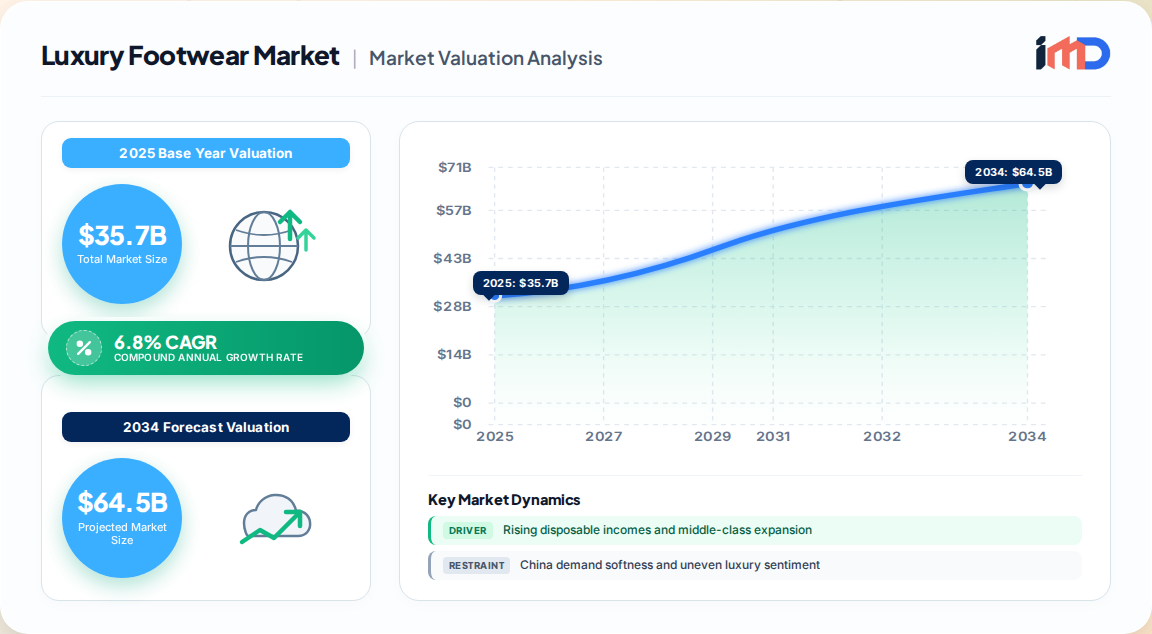
The global luxury footwear market is estimated at USD 35.7 Billion in 2025 and is projected to reach USD 57.4 Billion by 2034, expanding at a CAGR of 6.8%. Our proprietary demand modeling, triangulated from brand-level sell-through, channel economics, and household wealth distribution, indicates footwear has become the most dependable growth line inside the luxury fashion complex.
Shoes now function as the gateway purchase for first-time luxury buyers, insulating the category from the handbag and leather-goods cyclicality observed across major fashion houses. Brands with a genuine shoemaking heritage are disproportionately gaining share as consumers rebalance spend toward tangible craftsmanship.
Demand is being reshaped less by aggregate GDP growth and more by wealth concentration, aspirational purchasing, and the emotional economics of status signaling.
The luxury footwear value chain is deliberately fragmented at the top and vertically consolidated at the point of sale, protecting margin and exclusivity simultaneously.
| Value Chain Stage | Core Activity | Value Capture Logic |
|---|---|---|
| Raw Material Sourcing | Premium calfskin, exotic leathers, recycled synthetics | Quality differentiation; certified tanneries command premium |
| Component & Last Making | Soles, heels, lasts, hardware | Precision engineering drives fit and durability |
| Artisanal Assembly | Handlasting, stitching, finishing | Craftsmanship premium; Italy remains the anchor |
| Brand & Design | Creative direction, IP, licensing | Highest margin pool in the chain |
| Distribution | Monobrand boutiques, department stores, e-commerce | Full-price protection vs. wholesale markdown |
| Aftercare | Repair, resoling, restoration | Extends lifecycle; reinforces sustainability narrative |
Brands owning boutiques and repair services defend full prices most effectively. Shoe-led houses are growing footwear revenue at constant currency even as leather goods soften, confirming footwear's role as the entry-volume engine of the luxury portfolio.
Luxury footwear is a trade-intensive category with concentrated upstream production and dispersed downstream demand.
Supply chain resilience now hinges on dual-sourcing leather, securing certified tanneries, and building regional inventory buffers targeted at tourist-heavy markets such as Japan, South Korea, and the GCC.
The category is highly differentiated, and share leadership varies meaningfully by product architecture.
| Segment Dimension | Leading Segment | Estimated Share | Growth Signal |
|---|---|---|---|
| Product (fashion-led view) | Fashion footwear | 40.5% | Steady; driven by seasonal collections |
| Product (sneaker-led view) | Sneakers | 26.5% | Fastest; athleisure plus designer collabs |
| Product (women's view) | Sandals and flats | 37.8% | Resort and city wear expansion |
| End User | Women | 46.9% | Brand-driven, fashion-forward demand |
| Distribution | Offline | 75.8% | Tactile, personalized, exclusive experience |
| Channel (women's view) | Monobrand stores | 31.5% | Full-price protection and brand control |
Regional performance is diverging sharply, driven by wealth formation, tourism flows, and retail infrastructure.
| Region | Estimated Share / Growth Position | Key Dynamics |
|---|---|---|
| Asia-Pacific | ~35.0% share | China, Japan, India; rising fashion consciousness |
| North America | ~29.0% share | Millennial millionaires, brand loyalty, tourism |
| Europe | Second-largest, fastest-growing | Heritage houses, status-driven consumption |
| Middle East & Africa | Emerging, high-value | GCC luxury malls, tourist and resident spend |
| South America | Nascent | Urbanization and aspirational buying |
The competitive field spans heritage Italian ateliers, French luxury conglomerates, British fashion houses, and sportswear-led premium entrants.
Winning strategies cluster around five levers: full-price boutique control, repair and aftercare programs, limited-edition drop cadence, sustainable material certification, and hyper-localized regional merchandising. Houses that execute all five simultaneously are outpacing category growth by a meaningful margin.
Three underpenetrated opportunities stand out for the next planning cycle:
| Aspects | Details |
|---|---|
| Study Period | 2020-2034 |
| Base Year | 2025 |
| Estimated Year | 2026 |
| Forecast Period | 2026-2034 |
| Historical Period | 2020-2025 |
| Growth Rate | CAGR of 6.8% from 2020-2034 |
| Segmentation |
|
By End User
By Price Point
By Distribution Channel
| By Geography |
|
The global luxury footwear market is estimated at USD 35.7 Billion in 2025 and is projected to reach USD 57.4 Billion by 2034, expanding at a CAGR of 6.8% over the forecast period.
Asia-Pacific leads with an estimated 35.0% revenue share, driven by rising disposable incomes, a growing middle class, and strong brand demand in China, Japan, and India. North America follows at roughly 29.0%.
Luxury sneakers are the fastest-compounding product block, holding about 26.5% share and benefiting from athleisure adoption, designer collaborations, and sustainable material integration.
Offline channels capture approximately 75.8% of sales because luxury footwear relies on tactile evaluation, personalized service, and the exclusivity of flagship boutique experiences.
E-commerce is the fastest-growing channel, projected to reach around USD 8.2 Billion and near 26% share, after expanding more than 130% between 2018 and 2023.
Leading players include LVMH (Louis Vuitton), Hermès, Chanel, Prada, Salvatore Ferragamo, Burberry, Adidas, Dr. Martens, A.Testoni, Lottusse, Base London, and Silvano Lattanzi.
Our rigorous research methodology combines multi-layered approaches with comprehensive quality assurance, ensuring precision, accuracy, and reliability in every market analysis.
| Stakeholder Role | Interview Share (%) |
|---|---|
| Category & Licensing Directors | 32% |
| Boutique Retail Operations Managers | 28% |
| Luxury Wholesale Buyers | 24% |
| Sourcing & Tannery Procurement Heads | 16% |
| Company Type | Representation (%) |
|---|---|
| Heritage Luxury Ateliers | 30% |
| Multi-Brand Luxury Conglomerates | 25% |
| Premium Sneaker & Athleisure Brands | 20% |
| Luxury E-Commerce Platforms | 15% |
| Tanneries & Component Suppliers | 10% |
 Related Reports
