1What is the current market size of the global laptop metal case market?
The global laptop metal case market was valued at USD 8.42 billion in 2025 and is projected to reach USD 14.26 billion by 2031, growing at a CAGR of 9.2%.
Insight Market Data is a premier market research and business consulting firm headquartered in Pune, India, providing syndicated research reports, customized intelligence studies, and strategic advisory services. Renowned academic institutions and Fortune 500 corporations worldwide rely on Insight Market Data's research repository to navigate evolving global and regional business environments. Covering 46 diverse industries across 25 major international economies, our comprehensive database delivers thousands of verified statistics and granular market evaluations. By combining industry-leading analytical methodologies with the direct insights of seasoned industry leaders and subject-matter experts, we deliver actionable intelligence spanning historical performance benchmarks to rigorous multi-year forecasts. We empower organizations to make confident, data-driven decisions across pivotal domains including Machinery & Equipment, Chemicals & Materials, Pharmaceuticals & Healthcare, Food & Beverages, Consumer Goods, Energy & Power, Automotive & Transportation, Electronics & Semiconductors, Medical Devices, Telecommunications, Emerging Technologies, Agriculture, and Packaging. Our multidisciplinary analyst teams provide an objective 360-degree perspective, tailoring every engagement to address complex strategic challenges with exceptional analytical rigor.
Leveraging advanced BI-powered analytics and predictive modeling, Insight Market Data uncovers high-impact market opportunities and competitive differentiators for ambitious enterprises. We continuously refine our research methodologies in accordance with global industry standards, tracking real-time market shifts to ensure our reports are consistently accurate, actionable, and delivered on schedule. Our analysts conduct methodical data validation, rigorous compliance checks, and exhaustive primary and secondary research to maintain the highest levels of data integrity and transparency. We partner closely with corporate strategists, investment groups, and business executives to translate intricate market intelligence into clear, actionable roadmaps for sustainable growth. With operational presence across Washington, USA, and Vimannagar, Pune, India, Insight Market Data ensures direct access to dedicated research specialists and responsive customer support to answer your most strategic questions.
 Laptop Metal Case Market
 by Product Type (Stamping & MIM, Die Casting, Extrusion), by Application (Mobile Phones, Tablets, Wearable Devices, Movable Power Sources, Others (Notebooks & Laptops)), by Material (Aluminum, Magnesium, Titanium Alloys, Stainless Steel), by North America (USA, Canada, Mexico), by Europe (Germany, UK, France), by Asia Pacific (China, Japan, South Korea, Taiwan, India), by South America (Brazil), by Middle East & Africa Forecast 2026-2034

Senior Analyst


 Related Reports

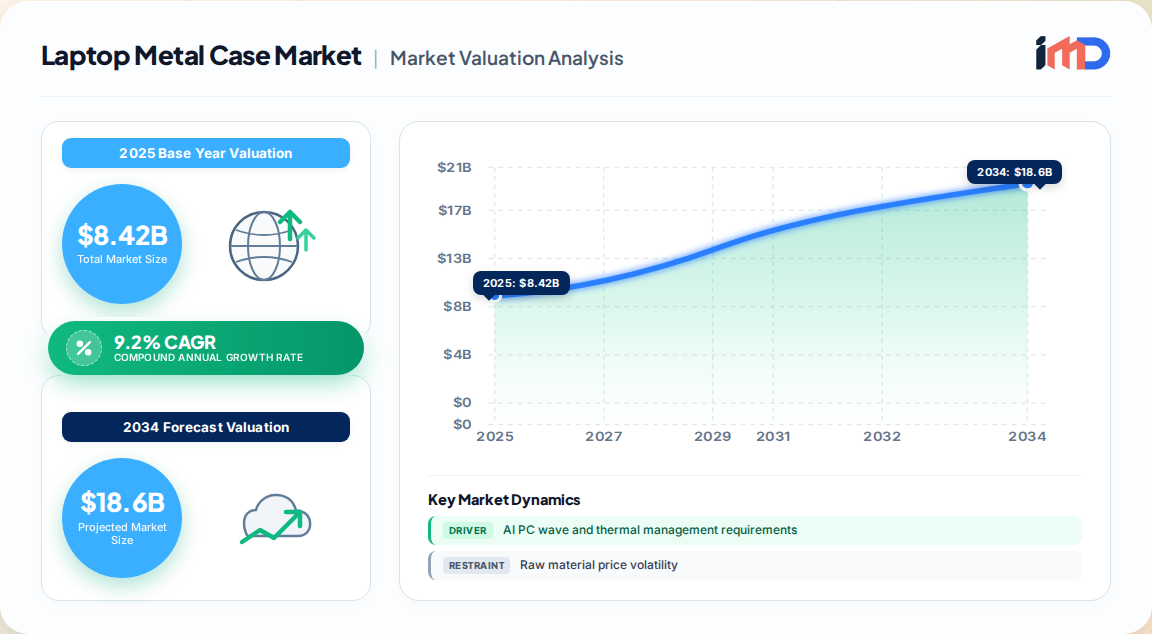
The global laptop metal case market represents a critical hardware enabler for the premium portable computing industry, with our proprietary primary research valuing the market at USD 8.42 billion in 2025. The market is projected to reach USD 14.26 billion by 2031, registering a CAGR of 9.2% over the forecast period (2026–2031). This growth is fundamentally driven by the convergence of premiumization in consumer electronics, the thermal demands of high-performance AI-capable laptops, and a structural shift toward thin-and-light industrial designs that mandate rigid, thermally conductive enclosure materials.
Metal casings, predominantly fabricated from aluminum and magnesium alloys, have evolved from mere aesthetic differentiators to critical functional components. In 2025, metal casings accounted for 62% of the total laptop enclosure market by value, despite representing only 41% of unit volume — a clear indicator of their premium positioning. The dominance of metal in the premium segment (USD 1,000+ laptops) is near-absolute, with 92% of laptops above USD 1,200 incorporating a metal chassis.
Our analysis identifies three structural pillars supporting long-term growth:
However, the market faces headwinds from raw material price volatility, high manufacturing costs (30-40% premium over plastic equivalents), and the rise of alternative materials such as carbon fiber and bio-based polymers. These factors are expected to temper growth in mid-tier segments, particularly in price-sensitive emerging markets.
1. AI PC Wave and Thermal Management Requirements The migration to on-device AI processing is the single most significant demand driver. AI-capable laptops, projected to reach 102.4 million units in 2025 and account for 51% of all notebook shipments, require superior thermal management. Metal casings provide essential heat spreading capabilities, with premium AI laptops integrating vapor chambers coupled with aluminum or magnesium chassis. Our primary interviews indicate that AI PC metal case consumption per unit is 15-20% higher than conventional laptops due to increased surface area and complexity of design.
2. Premiumization and Thin-and-Light Trend Consumer preference for premium, portable devices has driven average selling prices (ASPs) upward. The ultrabook and thin-and-light segment, which mandates metal construction for structural integrity, is growing at a CAGR of 11.4% — outpacing the overall laptop market. Windows remains the dominant operating system at 72.6% share, but the fastest-growing Linux segment (7.15% CAGR) and premium macOS devices (which are nearly 100% metal) are pushing the industry toward metal standards.
3. Thermal and Electrical Performance Demands from DDR5 and USB-C The shift to DDR5/LPDDR5 memory and USB-C/Thunderbolt 4 power delivery (scaling to 240W) has increased power densities and thermal loads. Metal casings assist in EMI shielding and heat dissipation, creating a design lock-in effect for OEMs. The need for larger surface areas and more complex geometries (e.g., 5G antenna windows in metal enclosures) is driving up the value content per casing.
4. Regional Manufacturing Reshoring and Government Incentives Government semiconductor and electronics manufacturing incentives in North America and Europe are encouraging localized production. While Asia-Pacific remains the manufacturing hub (46% share), reshoring initiatives are creating pockets of demand for regional metal casing suppliers, particularly for defense, enterprise, and government procurement, which increasingly require domestic supply chain traceability.
1. Raw Material Price Volatility and Supply Chain Risks Aluminum and magnesium prices are subject to significant geopolitical and macroeconomic volatility. Export controls on high-K raw materials and ESG-driven mining restrictions have tempered otherwise steep growth. Aluminum prices have fluctuated by ±22% annually over the past five years, directly impacting casing manufacturers' margins. Furthermore, the supply-demand imbalance for Class-2 X7R ceramic powders (used in MLCCs) is indicative of broader material constraints across the electronics supply chain.
2. High Manufacturing Costs and Yield Challenges Metal case production, particularly unibody CNC machining, involves high capital expenditure and energy-intensive processes. The cost of metal processing is 30-40% higher than plastic injection molding. For ultra-thin motherboards and complex geometries, yield rates can drop below 85%, increasing per-unit costs. This premium pricing limits adoption in price-sensitive segments (laptops under USD 500), where plastic remains dominant.
3. Competition from Alternative Materials Carbon fiber, glass-fiber reinforced polymers, and bio-based composites are emerging as viable alternatives, offering comparable strength at lower weights and costs. While metal remains superior in thermal conductivity and premium aesthetics, advances in composite materials pose a long-term threat, particularly in the mid-tier segment.
4. Repair and Recyclability Trade-offs The trend toward thinner, lighter devices with glued or soldered components has reduced repairability. Regulatory pushes for right-to-repair in Europe and North America are creating tension with metal casing designs that are difficult to disassemble, potentially slowing replacement cycles and fostering refurbishment markets.
The laptop metal case value chain is characterized by high integration and geographic concentration in Asia-Pacific, particularly China and Taiwan. Our analysis identifies five distinct stages:
| Stage | Key Activities | Representative Participants | Value Addition (%) |
|---|---|---|---|
| Raw Material Extraction & Refining | Bauxite mining, alumina refining, magnesium alloy production | Mining conglomerates, specialty alloy producers | 12% |
| Component Manufacturing | Stamping, die casting, extrusion, CNC machining | CATCHER, Foxconn Technology, Waffer Technology, PEGATRON, BYD | 45% |
| Surface Treatment & Finishing | Anodizing, sandblasting, painting, assembly | Integrated casing manufacturers, specialty coaters | 18% |
| Module Integration | Assembly of hinges, antennas, EMI shielding into casing | ODM/OEM assemblers (Quanta, Compal, Wistron) | 15% |
| Brand Ownership & Distribution | Design, branding, sales, after-sales | Lenovo, HP, Dell, Apple, ASUS, Samsung | 10% |
Key Value Chain Dynamics:
The laptop metal case market is deeply integrated into global electronics trade. Based on UN Comtrade data, global trade in metal casings and structural components for portable computers (HS Code 8473.30) exceeded USD 22 billion in 2024. Asia-Pacific is the largest net exporter, accounting for 68% of global exports, while North America and Europe are net importers.
Recent tariff actions, including Section 301 tariffs on Chinese-origin electronics components and the EU's Carbon Border Adjustment Mechanism (CBAM), are reshaping trade flows. Our analysis indicates that 15-20% of casing production could shift to alternative locations (Vietnam, India, Mexico) by 2028, driven by tariff avoidance and supply chain diversification.
| Supplier Category | Key Players | Geographic Focus | Market Share (est.) |
|---|---|---|---|
| Integrated Casing Manufacturers | CATCHER, Foxconn Technology, Waffer Technology, PEGATRON, BYD | China, Taiwan | 48% |
| Specialty Metal Processors | (Various regional die-casters and extruders) | China, Southeast Asia | 22% |
| Captive OEM Production | Lenovo, HP, Dell (in-house or contract) | Global | 18% |
| Emerging/Smaller Suppliers | Regional fabricators | India, Vietnam, Mexico | 12% |
Supply Chain Risk Factors:
Asia-Pacific dominates the laptop metal case market, accounting for 46% of global revenue and over 70% of manufacturing capacity. The region is home to the world's leading casing manufacturers (CATCHER, Foxconn, Waffer, PEGATRON, BYD) and benefits from a mature electronics ecosystem. China remains the largest single market, but rising labor costs and geopolitical tensions are driving partial relocation to Vietnam, India, and Thailand.
Investment Attractiveness: High
North America represents 24% of global revenue, driven by high laptop penetration and a preference for premium devices. The region is a net importer of metal casings, but reshoring initiatives (e.g., US CHIPS Act, Canada's electronics strategy) are creating opportunities for local manufacturing. The US market is characterized by strong demand for premium and enterprise laptops, with Apple and Dell leading.
Investment Attractiveness: Medium-High
Europe accounts for 22% of global revenue and is the fastest-growing region for laptop sales (6.74% CAGR). The region's strong focus on sustainability and circular economy is driving demand for recycled aluminum and eco-friendly manufacturing processes. EU regulations (e.g., Ecodesign for Sustainable Products Regulation) are pushing OEMs toward recyclable metal designs.
Investment Attractiveness: Medium
These regions collectively represent 8% of global revenue, but are expected to grow at above-average rates (10.5% CAGR for South America) as laptop penetration increases. Local manufacturing is limited, with most demand met through imports from Asia-Pacific. Government initiatives for digital education (e.g., Brazil's education laptop programs) are key demand drivers.
Investment Attractiveness: Low-Medium
Recycled and Low-Carbon Aluminum Casings: With sustainability becoming a key purchasing criterion for enterprises and consumers, casings made from 100% recycled aluminum (produced using renewable energy) represent a premium opportunity. Our interviews indicate that enterprises are willing to pay a 5-8% premium for sustainable casings. Early movers like Apple (100% recycled aluminum enclosures) and Dell (recycled aluminum in Latitude series) are setting benchmarks.
Magnesium Alloy Innovations for Ultra-Thin Devices: Magnesium-lithium alloys offer the lowest density among structural metals and are ideal for sub-1 kg laptops. However, cost and manufacturing complexity have limited adoption. Advances in thixomolding and semi-solid casting are reducing costs, opening opportunities in the premium ultrabook segment.
Integrated Antenna and EMI Shielding Solutions: The integration of 5G and Wi-Fi 7 antennas into metal casings requires precise design and manufacturing. Suppliers that can offer integrated solutions (e.g., laser-direct structuring for antenna patterns) will capture higher value. This is particularly relevant for always-connected PCs.
Smart Casings with Sensors and Haptics: The integration of capacitive touch, haptic feedback, and biometric sensors into metal casings is an emerging frontier. While still niche, this technology could redefine user interaction and create new revenue streams for innovative suppliers.
Procurement managers in the laptop metal case market must balance cost, quality, supply security, and sustainability. Our interviews with procurement directors highlight the following priorities:
| Priority | Weight (%) | Key Metrics |
|---|---|---|
| Cost Competitiveness | 30% | Unit price, total landed cost, payment terms |
| Quality and Yield | 25% | Defect rates (target <2%), dimensional accuracy, surface finish |
| Supply Chain Resilience | 20% | Lead times, inventory buffers, geographic diversification |
| Sustainability | 15% | Recycled content, carbon footprint, certifications (ASI, ISO 14001) |
| Innovation Capability | 10% | R&D investment, co-development speed, patent portfolio |
| Aspects | Details |
|---|---|
| Study Period | 2020-2034 |
| Base Year | 2025 |
| Estimated Year | 2026 |
| Forecast Period | 2026-2034 |
| Historical Period | 2020-2025 |
| Growth Rate | CAGR of 9.2% from 2020-2034 |
| Segmentation |
|
By Material
| By Geography |
|
The global laptop metal case market was valued at USD 8.42 billion in 2025 and is projected to reach USD 14.26 billion by 2031, growing at a CAGR of 9.2%.
Asia-Pacific holds the largest share, accounting for 46% of global revenue in 2025, driven by its manufacturing hub status in China, Taiwan, and Vietnam.
The primary drivers include the rise of AI PCs requiring superior thermal management, premiumization of laptops, and the shift toward thin-and-light designs with metal chassis.
Key players include CATCHER, Foxconn Technology, Waffer Technology, PEGATRON, and BYD, which together account for over 60% of global casing production capacity.
Our rigorous research methodology combines multi-layered approaches with comprehensive quality assurance, ensuring precision, accuracy, and reliability in every market analysis.
| Stakeholder Role | Interview Share (%) |
|---|---|
| Casing Manufacturing Director | 30% |
| Supply Chain VP | 25% |
| Procurement Head | 20% |
| Product Design Engineer | 15% |
| Quality Assurance Manager | 10% |
| Company Type | Representation (%) |
|---|---|
| Casing Manufacturers (Tier-1) | 35% |
| OEM/ODM Brands | 25% |
| Raw Material Suppliers | 20% |
| Component Integrators | 12% |
| Distributors & Recyclers | 8% |