1How big is the Italy beauty and personal care products market in 2026?
Our primary research estimates the Italy beauty and personal care products market at USD 16.42 billion in 2026, forecast to reach USD 22.14 billion by 2031 at a 6.15% CAGR.
Insight Market Data is a premier market research and business consulting firm headquartered in Pune, India, providing syndicated research reports, customized intelligence studies, and strategic advisory services. Renowned academic institutions and Fortune 500 corporations worldwide rely on Insight Market Data's research repository to navigate evolving global and regional business environments. Covering 46 diverse industries across 25 major international economies, our comprehensive database delivers thousands of verified statistics and granular market evaluations. By combining industry-leading analytical methodologies with the direct insights of seasoned industry leaders and subject-matter experts, we deliver actionable intelligence spanning historical performance benchmarks to rigorous multi-year forecasts. We empower organizations to make confident, data-driven decisions across pivotal domains including Machinery & Equipment, Chemicals & Materials, Pharmaceuticals & Healthcare, Food & Beverages, Consumer Goods, Energy & Power, Automotive & Transportation, Electronics & Semiconductors, Medical Devices, Telecommunications, Emerging Technologies, Agriculture, and Packaging. Our multidisciplinary analyst teams provide an objective 360-degree perspective, tailoring every engagement to address complex strategic challenges with exceptional analytical rigor.
Leveraging advanced BI-powered analytics and predictive modeling, Insight Market Data uncovers high-impact market opportunities and competitive differentiators for ambitious enterprises. We continuously refine our research methodologies in accordance with global industry standards, tracking real-time market shifts to ensure our reports are consistently accurate, actionable, and delivered on schedule. Our analysts conduct methodical data validation, rigorous compliance checks, and exhaustive primary and secondary research to maintain the highest levels of data integrity and transparency. We partner closely with corporate strategists, investment groups, and business executives to translate intricate market intelligence into clear, actionable roadmaps for sustainable growth. With operational presence across Washington, USA, and Vimannagar, Pune, India, Insight Market Data ensures direct access to dedicated research specialists and responsive customer support to answer your most strategic questions.
 Italy Beauty and Personal Care Products Market
 by Product Type (Facial Cosmetics, Eye Cosmetics, Lip and Nail Make-Up), by Category (Premium Products, Mass Products), by Ingredient Type (Natural and Organic, Conventional/Synthetic), by Distribution Channel (Specialty Stores, Supermarkets/Hypermarkets, Online Retail, Pharmacy, Other), by Broader Category (Skin Care(Face Skin Care, Body Care, Sun Protection, Baby & Child, Natural Skin Care), Hair Care, Color Cosmetics, Fragrances, Personal Care(Shower & Bath, Oral Care, Deodorants, Shaving), Beauty Tech), by Italy (Northern Italy, Central Italy, Southern Italy & Islands) Forecast 2026-2034

Research Analyst


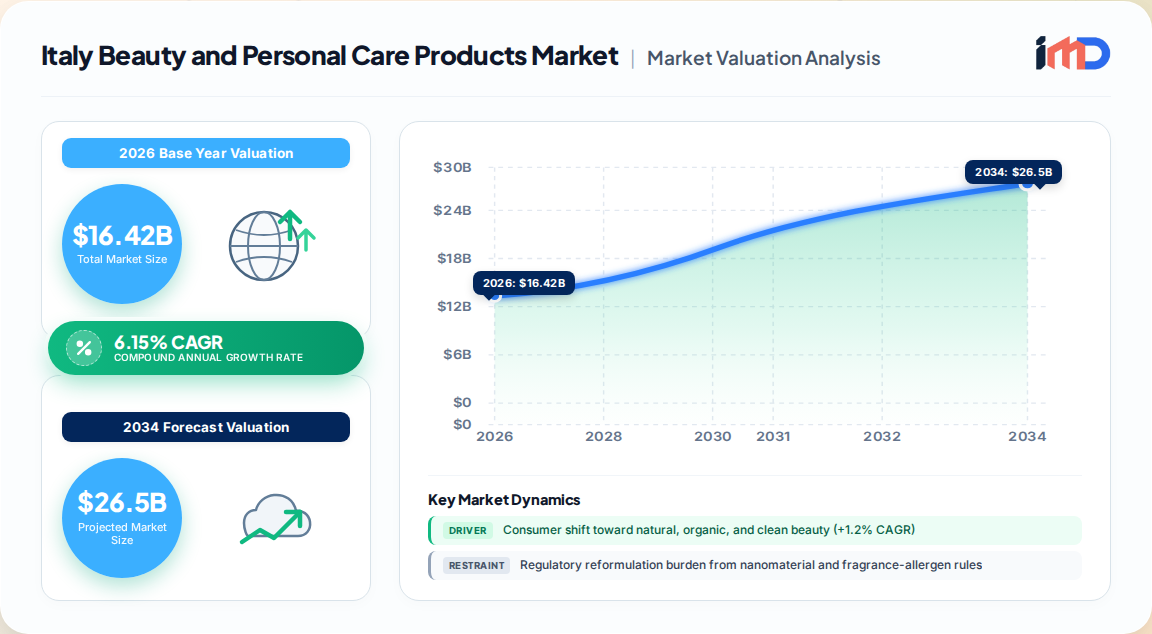
The Italian beauty and personal care products market represents one of Europe's most sophisticated, heritage-rich, and innovation-driven consumer landscapes. Our proprietary bottom-up modeling places the market at USD 16.42 billion in 2026, forecast to reach USD 22.14 billion by 2031, registering a CAGR of 6.15% over the forecast period. This trajectory outpaces the broader European beauty and personal care market, underscoring Italy's dual role as both a high-value consumption market and a global production powerhouse.
Italy's structural advantage is unmistakable. The country manufactures approximately 67% of Europe's makeup and accounts for roughly 55% of global cosmetics production volumes, anchored by the "Cosmetic Valley" cluster in Lombardy and Emilia-Romagna. Exports surged 12% year-on-year in 2024 to EUR 7.9 billion (USD 8.6 billion), confirming that Italian beauty is as much an export engine as it is a domestic retail story.
Within the broader beauty and personal care universe, the cosmetics sub-segment alone is valued at USD 2.21 billion in 2026, growing at 5.56% CAGR to USD 2.89 billion by 2031. Personal care—including hair care, shower and bath, oral care, and shaving—remains the largest single segment by revenue, while skin care and fragrances deliver the strongest premiumization upside.
| Market Metric | 2025 (Base) | 2026 (Estimated) | 2031 (Forecast) | CAGR 2026–2031 |
|---|---|---|---|---|
| Italy Beauty & Personal Care (Total) | USD 15.48 Billion | USD 16.42 Billion | USD 22.14 Billion | 6.15% |
| Italy Cosmetics (Sub-segment) | USD 2.09 Billion | USD 2.21 Billion | USD 2.89 Billion | 5.56% |
| Online Sales Share of Total Revenue | ~19.5% | ~21.8% | ~29.0% | — |
| Exports (2024 actual) | EUR 7.9 Billion | — | — | +12% YoY |
| Segment | 2025 Value Share | 2026–2031 CAGR | Strategic Read |
|---|---|---|---|
| Facial Cosmetics | 45.01% | ~5.4% | Anchor category; premium dermo-positioning key |
| Eye Cosmetics | — | 6.31% (fastest) | TikTok-driven statement looks fueling growth |
| Lip & Nail Make-Up | — | ~5.2% | Innovation-led, color-led replenishment |
The Italian market is characterized by medium concentration, layered with a vibrant artisanal and SME ecosystem. Global multinationals—L'Oréal, Estée Lauder, and LVMH—compete alongside a potent domestic cohort including BioNike, Kiko Milano, Collistar, Deborah Group, Bottega Verde, and Davines, plus ingredient innovators such as dsm-firmenich (which partnered with ExoLab Italia on plant-derived exosomes for anti-aging).
| Strategic Group | Representative Players | Core Advantage | Vulnerability |
|---|---|---|---|
| Global Premium Conglomerates | L'Oréal, Estée Lauder, LVMH | R&D scale, brand portfolios | Less agile on local regulatory reformulation |
| Italian Dermo-Cosmetic Champions | BioNike, Davines | Pharmacy gatekeeper trust, clinical validation | Narrow channel dependence |
| Mass & Value Specialists | Deborah Group, Kiko Milano | Price accessibility, store footprint | Margin pressure from premium trade-up |
| Natural & Artisanal Niches | Bottega Verde, ICEA-certified brands | Clean-beauty credibility, local sourcing | Sub-scale, reformulation costs |
| Ingredient & Contract Manufacturers | dsm-firmenich, ExoLab Italia | Innovation pipeline, EU compliance expertise | Customer concentration |
Strategic priorities for 2026–2031: (1) lock in COSMOS/ICEA certification before allergen-labeling deadlines; (2) invest in ingredient-transparency digital tools at point of sale; (3) scale online and subscription models (already growing at double digits); (4) leverage "Made-in-Italy" provenance for export premiums; and (5) pursue dermatologist and research-institution collaborations concentrated in Lombardy and Emilia-Romagna.
Italy runs a structural beauty trade surplus, powered by contract manufacturing scale and premium export demand.
| Macro-Region | Share of Market | Attractiveness Drivers |
|---|---|---|
| Northern Italy (Lombardy, Piedmont, Veneto, Emilia-Romagna) | ~47% | Cosmetic Valley manufacturing, highest disposable income, Milan fashion capital, retail innovation |
| Central Italy (Lazio, Tuscany, Umbria) | ~28% | Rome tourism-driven demand, Tuscany natural/organic sourcing, strong pharmacy networks |
| Southern Italy & Islands | ~25% | Volume-led mass-market growth, rising disposable income, underpenetrated premium and e-commerce |
Investment thesis: Northern Italy offers the strongest premium and R&D positioning; Central Italy offers tourism-linked fragrance and natural-beauty upside; the South presents underpenetrated e-commerce and mass-premium conversion opportunity. Priority white spaces include men's prestige grooming, personalized dermo-cosmetics, subscription replenishment models, and ingredient-traceability tech.
Between 2026 and 2031, the Italy beauty and personal care products market will add approximately USD 5.7 billion in incremental revenue. Growth will be led by natural and organic formulations (6.72% CAGR), online retail (6.41% CAGR), eye cosmetics (6.31% CAGR), and premium products (6.28% CAGR). The cosmetics sub-segment will expand from USD 2.21 billion to USD 2.89 billion.
Regulatory agility, transparency-first branding, and digital-first commerce will separate winners from laggards. Italy's unique fusion of manufacturing scale, heritage brand equity, and Mediterranean natural-ingredient provenance positions the market for sustained mid-single-digit-plus growth—delivering a projected 6.15% CAGR through 2031 and reinforcing the country's status as Europe's beauty production and innovation engine.
| Aspects | Details |
|---|---|
| Study Period | 2020-2034 |
| Base Year | 2026 |
| Estimated Year | 2026 |
| Forecast Period | 2026-2034 |
| Historical Period | 2020-2025 |
| Growth Rate | CAGR of 6.15% from 2020-2034 |
| Segmentation |
|
By Ingredient Type
By Distribution Channel
By Broader Category
| By Geography |
|
Our primary research estimates the Italy beauty and personal care products market at USD 16.42 billion in 2026, forecast to reach USD 22.14 billion by 2031 at a 6.15% CAGR.
Key drivers include the consumer shift toward natural and organic formulations (6.72% CAGR), ingredient transparency, men's grooming demand, dermo-cosmetic channel expansion, and Italy's premium heritage brand equity, with a 12% export jump to EUR 7.9 billion in 2024.
Online retail is the fastest-growing channel at a 6.41% CAGR, with e-commerce beauty sales already rising 13.5% to EUR 1.3 billion (USD 1.4 billion) in 2024, while specialty stores still lead with 36.52% revenue share.
Italy's cosmetics products market is valued at USD 2.21 billion in 2026 and is projected to reach USD 2.89 billion by 2031 at a 5.56% CAGR, with facial cosmetics holding a 45.01% value share.
Global players such as L'Oréal, Estée Lauder, and LVMH compete with domestic leaders including BioNike, Kiko Milano, Collistar, Deborah Group, Bottega Verde, and Davines, alongside ingredient innovator dsm-firmenich.
The February 2025 nanomaterial ban and the July 2026 expansion of fragrance-allergen labeling (from 26 to over 80 substances under Regulation 2023/1545) are accelerating reformulation cycles across Italian manufacturers.
Our rigorous research methodology combines multi-layered approaches with comprehensive quality assurance, ensuring precision, accuracy, and reliability in every market analysis.
| Stakeholder Role | Interview Share (%) |
|---|---|
| Procurement Director | 30% |
| Head of Regulatory Affairs | 25% |
| Marketing Director | 25% |
| R&D / Formulation Lead | 20% |
| Company Type | Representation (%) |
|---|---|
| Contract Manufacturers & OEM/ODM Producers | 28% |
| Dermo-Cosmetic & Pharmacy Brand Owners | 24% |
| Specialty Ingredient & Active Suppliers | 18% |
| Retail Buyers (Specialty, Grocery, Parapharmacy) | 18% |
| E-commerce & D2C Platform Operators | 12% |
 Related Reports
