1What is the size of the Italian luxury goods market?
The Italian luxury goods market was valued at USD 20.15 billion in 2026 and is projected to reach USD 24.07 billion by 2031, growing at a CAGR of 3.62%.
Insight Market Data is a premier market research and business consulting firm headquartered in Pune, India, providing syndicated research reports, customized intelligence studies, and strategic advisory services. Renowned academic institutions and Fortune 500 corporations worldwide rely on Insight Market Data's research repository to navigate evolving global and regional business environments. Covering 46 diverse industries across 25 major international economies, our comprehensive database delivers thousands of verified statistics and granular market evaluations. By combining industry-leading analytical methodologies with the direct insights of seasoned industry leaders and subject-matter experts, we deliver actionable intelligence spanning historical performance benchmarks to rigorous multi-year forecasts. We empower organizations to make confident, data-driven decisions across pivotal domains including Machinery & Equipment, Chemicals & Materials, Pharmaceuticals & Healthcare, Food & Beverages, Consumer Goods, Energy & Power, Automotive & Transportation, Electronics & Semiconductors, Medical Devices, Telecommunications, Emerging Technologies, Agriculture, and Packaging. Our multidisciplinary analyst teams provide an objective 360-degree perspective, tailoring every engagement to address complex strategic challenges with exceptional analytical rigor.
Leveraging advanced BI-powered analytics and predictive modeling, Insight Market Data uncovers high-impact market opportunities and competitive differentiators for ambitious enterprises. We continuously refine our research methodologies in accordance with global industry standards, tracking real-time market shifts to ensure our reports are consistently accurate, actionable, and delivered on schedule. Our analysts conduct methodical data validation, rigorous compliance checks, and exhaustive primary and secondary research to maintain the highest levels of data integrity and transparency. We partner closely with corporate strategists, investment groups, and business executives to translate intricate market intelligence into clear, actionable roadmaps for sustainable growth. With operational presence across Washington, USA, and Vimannagar, Pune, India, Insight Market Data ensures direct access to dedicated research specialists and responsive customer support to answer your most strategic questions.
 Italian Luxury Goods Market
 by Product Type (Clothing & Apparel, Footwear, Eyewear, Leather Goods, Jewelry, Watches, Beauty & Personal Care), by End User (Men, Women, Unisex), by Distribution Channel (Single-Brand Stores, Multi-Brand Stores, Online Stores), by Lombardy & Milan, by Veneto & Northeast, by Tuscany & Central Italy, by Piedmont & Northwest, by Lazio & Rome, by Southern Italy & Islands Forecast 2026-2034

Research Analyst


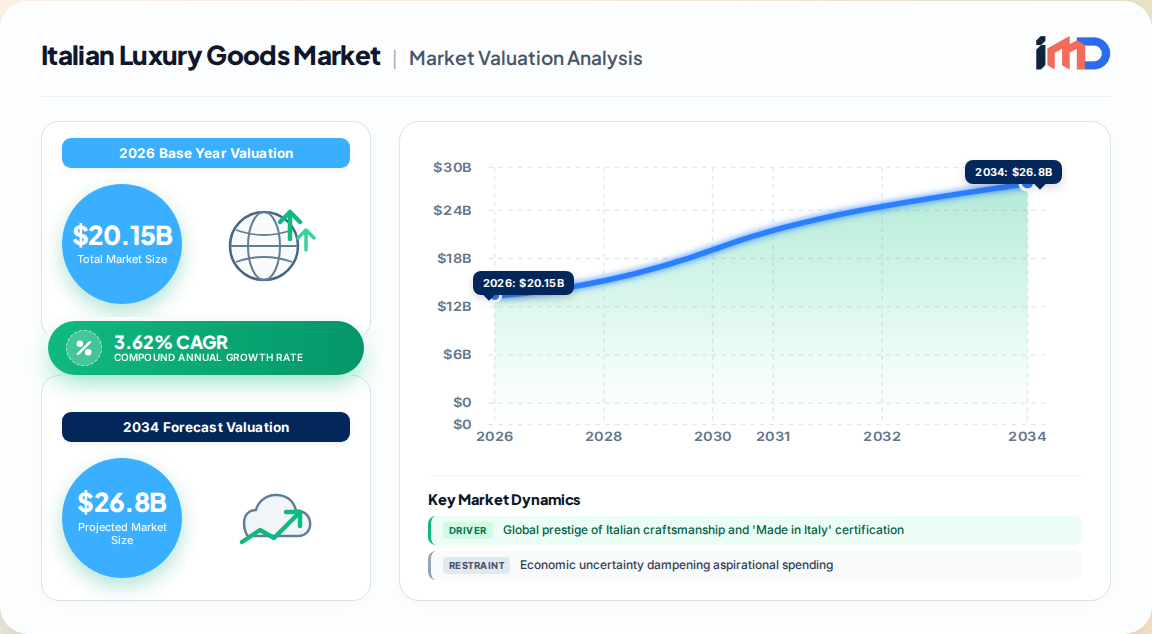
Italy remains the cultural and manufacturing heart of the global luxury goods industry. Our proprietary research values the Italian Luxury Goods Market at USD 20.15 billion in 2026, advancing at a CAGR of 3.62% to reach USD 24.07 billion by 2031. The market is transitioning from a post-pandemic reopening recovery—which saw a 7.39% historical CAGR from 2020 to 2025—into a phase of disciplined, client-led expansion.
Key structural indicators define the current landscape:
This report delivers a granular, primary-research-led assessment of the forces shaping Italy's luxury goods market, including tourism dependency, regulatory shifts, channel economics, and supply chain risk.
Italy's luxury market is propelled by deeply embedded structural advantages, yet constrained by macroeconomic fragility and consumer caution.
The Italian luxury value chain is uniquely decentralized, relying on thousands of specialized small and medium-sized enterprises (SMEs).
| Value Chain Stage | Key Activities | Economic Characteristics |
|---|---|---|
| Raw Material Sourcing | Leather, silk, wool, precious metals; increasing emphasis on traceable and certified inputs. | High input cost volatility; EU DPP compliance driving supplier audits. |
| Design & Prototyping | Creative direction, seasonal collections, material innovation. | Concentrated in Milan, Florence, and Como; high intellectual property value. |
| Manufacturing & Artisan Production | Handcrafted assembly, finishing, quality control. | Fragmented SME base; labor-intensive; apprenticeships critical for skills transfer. |
| Brand Management & Marketing | Brand equity building, celebrity endorsement, digital campaigns. | High marketing spend; social media ROI increasingly scrutinized. |
| Distribution & Retail | Single-brand flagships, multi-brand wholesale, e-commerce, travel retail. | Direct retail yields full margin; omnichannel integration is a strategic priority. |
| After-Sales Service | Repairs, personalization, clienteling. | Drives loyalty and repeat purchase; growing revenue stream for top clients. |
The value chain faces a critical succession risk as aging artisans retire without sufficient trained replacements. Brands are investing in internal academies and vertical integration to secure production capacity.
Italy operates as both a major exporter of finished luxury goods and an importer of raw materials and semi-finished components.
The Italian luxury market is undergoing a structural shift toward direct-to-consumer channels and hard luxury categories.
| Segment | 2025 Share | Growth Outlook (CAGR to 2031) |
|---|---|---|
| Clothing & Apparel | 47.85% | Moderate; anchored by heritage and seasonal innovation |
| Leather Goods | High | Steady; handbags drive repeat purchase |
| Footwear | Moderate | premium sneakers and artisanal leather |
| Watches | Moderate | 3.75% (fastest-growing) |
| Jewellery | Moderate | Rising; benefiting from top-client demand |
| Eyewear | Low | Licensing-dependent |
| Beauty & Personal Care | Low | Resilient; travel retail recovery |
Italy's luxury market is geographically concentrated in the north, with Milan serving as the undisputed capital.
Italy's competitive landscape is medium-concentrated, with a broad base of mid-sized producers and a few global powerhouses.
Key strategies observed across players include:
Despite maturity, several high-potential opportunity areas remain underpenetrated:
Italy operates as both a major exporter of finished luxury goods and an importer of raw materials and semi-finished components.
| Aspects | Details |
|---|---|
| Study Period | 2020-2034 |
| Base Year | 2026 |
| Estimated Year | 2026 |
| Forecast Period | 2026-2034 |
| Historical Period | 2020-2025 |
| Growth Rate | CAGR of 3.62% from 2020-2034 |
| Segmentation |
|
By End User
By Distribution Channel
| By Geography |
|
The Italian luxury goods market was valued at USD 20.15 billion in 2026 and is projected to reach USD 24.07 billion by 2031, growing at a CAGR of 3.62%.
Clothing and apparel is the largest product segment, accounting for 47.85% of the market share in 2025, driven by strong heritage brands like Prada, Armani, and Gucci.
Online stores are the fastest-growing distribution channel, expanding at a CAGR of 4.73% through 2031, as brands invest in omnichannel retail and digital clienteling.
Major players include Prada SpA, Moncler SpA, Giorgio Armani SpA, OTB Group, Ermenegildo Zegna, Dolce & Gabbana, and Valentino, among others.
Key drivers include the global prestige of Italian craftsmanship, rising international tourism, growing demand for sustainable luxury, and the influence of social media and celebrity endorsements.
Our rigorous research methodology combines multi-layered approaches with comprehensive quality assurance, ensuring precision, accuracy, and reliability in every market analysis.
| Stakeholder Role | Interview Share (%) |
|---|---|
| Procurement Director | 30% |
| Retail Operations Manager | 25% |
| Supply Chain and Logistics Head | 25% |
| Brand Strategy and Marketing Director | 20% |
| Company Type | Representation (%) |
|---|---|
| Luxury Brand Owners and Manufacturers | 40% |
| Specialized Raw Material Suppliers | 25% |
| Multi-Brand Retailers and Distributors | 20% |
| Technology and Logistics Providers | 15% |
 Related Reports
