1What is the high-speed rail brake disc market size in 2025?
The global market is valued at approximately USD 763 million in 2025, with annual sales volume of about 3 million units and average selling prices of USD 200–500 per unit.
Insight Market Data is a premier market research and business consulting firm headquartered in Pune, India, providing syndicated research reports, customized intelligence studies, and strategic advisory services. Renowned academic institutions and Fortune 500 corporations worldwide rely on Insight Market Data's research repository to navigate evolving global and regional business environments. Covering 46 diverse industries across 25 major international economies, our comprehensive database delivers thousands of verified statistics and granular market evaluations. By combining industry-leading analytical methodologies with the direct insights of seasoned industry leaders and subject-matter experts, we deliver actionable intelligence spanning historical performance benchmarks to rigorous multi-year forecasts. We empower organizations to make confident, data-driven decisions across pivotal domains including Machinery & Equipment, Chemicals & Materials, Pharmaceuticals & Healthcare, Food & Beverages, Consumer Goods, Energy & Power, Automotive & Transportation, Electronics & Semiconductors, Medical Devices, Telecommunications, Emerging Technologies, Agriculture, and Packaging. Our multidisciplinary analyst teams provide an objective 360-degree perspective, tailoring every engagement to address complex strategic challenges with exceptional analytical rigor.
Leveraging advanced BI-powered analytics and predictive modeling, Insight Market Data uncovers high-impact market opportunities and competitive differentiators for ambitious enterprises. We continuously refine our research methodologies in accordance with global industry standards, tracking real-time market shifts to ensure our reports are consistently accurate, actionable, and delivered on schedule. Our analysts conduct methodical data validation, rigorous compliance checks, and exhaustive primary and secondary research to maintain the highest levels of data integrity and transparency. We partner closely with corporate strategists, investment groups, and business executives to translate intricate market intelligence into clear, actionable roadmaps for sustainable growth. With operational presence across Washington, USA, and Vimannagar, Pune, India, Insight Market Data ensures direct access to dedicated research specialists and responsive customer support to answer your most strategic questions.
 High-Speed Rail Brake Disc Market
 by Type (Axle-mounted Type, Wheel-mounted Type), by Material (Synthetic Materials, Powder Metallurgy Materials, Composite Materials), by Market (OEM, Aftermarket), by Application (Above 250km/h, 150-250km/h, Below 150km/h), by Asia-Pacific (China, India, Japan, South Korea), by North America (USA, Canada, Mexico), by Europe (Germany, France, UK, Italy), by Latin America (Brazil, Argentina), by Middle East & Africa (Saudi Arabia, UAE, South Africa) Forecast 2026-2034

Research Analyst


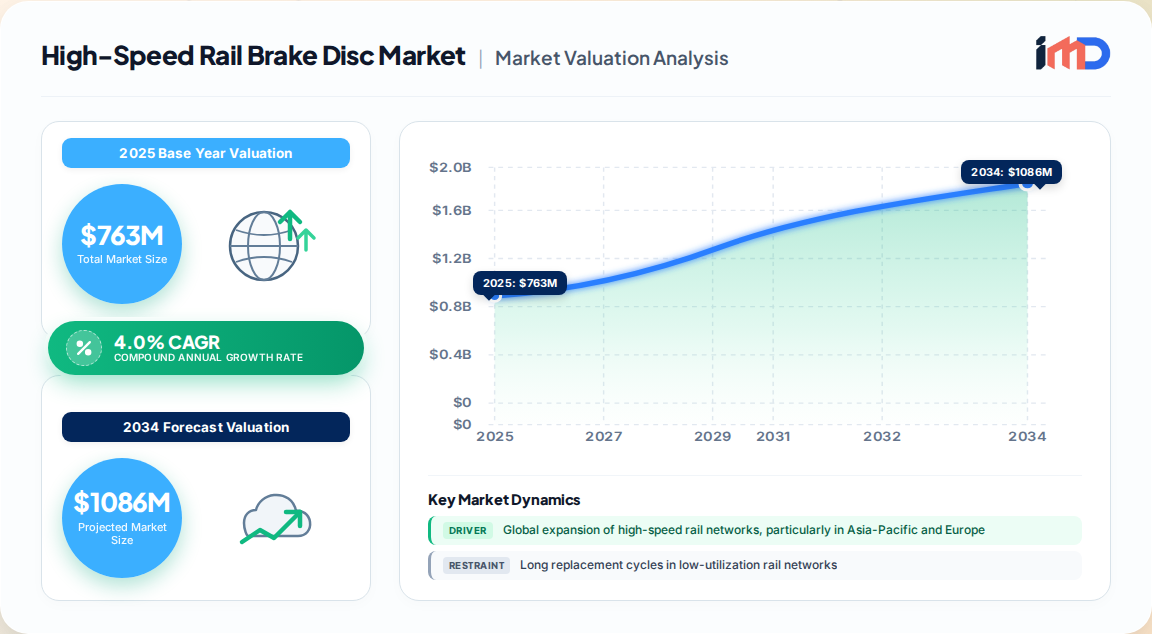
The global high-speed rail brake disc market is a safety-critical, specification-driven segment of the railway friction ecosystem. Our proprietary primary research places the market at USD 763 million in 2025, growing to USD 1,004.1 million by 2032, reflecting a steady 4.0% CAGR. Demand is anchored by two durable streams: new high-speed fleet deliveries requiring OEM-qualified disc and pad combinations, and a recurring aftermarket driven by predictable wear replacement and overhaul programs. Annual sales volume is approximately 3 million units, with average selling prices ranging from USD 200 to USD 500 per unit depending on material class, speed rating, and qualification status.
The competitive arena is shaped less by generic friction-material supply and more by proven performance, traceability, and certification for specific service categories. Suppliers compete on validated thermal stability, controlled wear, low noise, and minimal disc damage under repeated high-energy braking events.
Key market metrics (2025 baseline):
| Metric | Value |
|---|---|
| Base-year market value (2025) | USD 763 million |
| Forecast value (2032) | USD 1,004.1 million |
| CAGR (2026–2032) | 4.0% |
| Annual unit volume | ~3 million units |
| Average selling price | USD 200–500 per unit |
| Largest region | Asia-Pacific (45%) |
| Fastest-growing region | Asia-Pacific (4.9%) |
The value chain begins upstream with steel backing plates and friction-material constituents—resin-bonded composite ingredients or metallic powders for sintered formulations. Specialized manufacturing follows, including hot pressing and curing for organic pads or powder metallurgy and sintering for metallic pads, then bonding, riveting, machining, and surface finishing to meet tight thickness, flatness, and friction tolerances.
Because these are safety-critical wear parts, this stage includes heavy process control, traceability, dynamometer validation, and qualification/certification. Downstream, products are selected and qualified by train OEMs and brake-system integrators for new-build programs, then purchased repeatedly by rail operators and maintenance depots as consumables through scheduled inspection and replacement cycles.
| Stage | Key Activities | Value Drivers |
|---|---|---|
| Upstream materials | Steel backing plates, composite resins, metallic powders | Material consistency, cost stability |
| Component manufacturing | Hot pressing/curing, powder metallurgy, sintering | Process control, yield, throughput |
| Finishing & validation | Bonding, machining, dynamometer testing | Certification, traceability |
| OEM integration | Platform qualification, braking-system matching | Engineering capability, documentation |
| Aftermarket | Depot replacement, service agreements | Availability, lifecycle cost, support |
Trade in high-speed rail brake discs is dominated by intra-regional flows tied to OEM production hubs and maintenance depots. China is a major export origin for finished discs and pads, supported by domestic content policies and integrated rolling-stock supply chains. Europe remains a net exporter of premium, engineering-intensive brake systems, while North America relies on a mix of domestic production and imports for aftermarket replenishment.
Key supply risks include volatility in steel and composite raw-material prices, certification delays for new materials, and logistics bottlenecks affecting just-in-time depot replenishment. Operators increasingly mitigate risk through dual sourcing and long-term service agreements that lock in qualified suppliers. The shift toward lightweight composites introduces new qualification cycles that can slow adoption but ultimately reduce lifecycle wear and energy consumption.
Asia-Pacific leads with an estimated 45% share, driven by China's high-speed rail expansion and India's metro projects. The region is also the fastest-growing at 4.9% CAGR, reflecting both new-build demand and a rapidly expanding installed base entering aftermarket cycles.
Europe and North America each hold approximately 20% share. Europe benefits from stringent safety regulations and fleet modernization, with steady aftermarket demand from aging rolling stock. North America grows at a more modest 3.0%, shaped by transit expansion and freight rail utilization. Latin America (8% share) and the Middle East & Africa (7% share) offer niche growth from new rail projects, though long replacement cycles and budget constraints temper momentum.
| Region | Share | Growth Momentum |
|---|---|---|
| Asia-Pacific | 45% | 4.9% |
| North America | 20% | 3.0% |
| Europe | 20% | 3.3% |
| Latin America | 8% | 4.2% |
| Middle East & Africa | 7% | 3.7% |
The market segments by type, material, market, and application. Axle-mounted discs account for 57% share, favored in high-speed applications for reduced unsprung mass and improved braking stability. Wheel-mounted discs hold 43%, remaining relevant where cost and maintenance simplicity dominate.
By material, synthetic materials, powder metallurgy materials, and composite materials each serve distinct duty cycles. Composite and sintered-metal formulations grow fastest, driven by thermal stability and wear resistance requirements. By market, OEM and aftermarket streams both expand, with aftermarket outpacing OEM as the installed base grows and maintenance cycles shorten. By application, above 250 km/h accounts for 41% share, 150–250 km/h for 31%, and below 150 km/h for 28%.
Competition is structured around qualification regimes and reliability expectations. Leading suppliers defend premium positions through platform qualification, braking-system knowledge, and service capability, while regional suppliers compete on local service, approved specifications, and price discipline.
Key players include Knorr-Bremse, Wabtec, Beijing Tianyishangjia High-tech Materials, Akebono Brake Industry, Bremskerl, Tribo, Escorts, CRRC Qishuyan, Alstom Flertex, Dellner Frimatrail Frenoplast, Masu Brakes, Guangdong Huatie Tongda High-speed Railway Equipment, Youcaitec Material, and Beijing Puran Railway Braking High-tech. Strategic priorities include material innovation for lower emissions and longer life, digital maintenance integration, and lifecycle-oriented contracts that convert operating benefits into fewer interventions and greater train availability.
Recent developments in the broader rail braking ecosystem include continued investment in condition-based maintenance platforms and the expansion of high-speed rolling-stock programs in Asia-Pacific, which are expected to reshape qualification requirements and aftermarket timing over the forecast horizon.
| Aspects | Details |
|---|---|
| Study Period | 2020-2034 |
| Base Year | 2025 |
| Estimated Year | 2026 |
| Forecast Period | 2026-2034 |
| Historical Period | 2020-2025 |
| Growth Rate | CAGR of 4.0% from 2020-2034 |
| Segmentation |
|
By Market
By Application
| By Geography |
|
The global market is valued at approximately USD 763 million in 2025, with annual sales volume of about 3 million units and average selling prices of USD 200–500 per unit.
The market is projected to grow at a 4.0% CAGR from 2026 to 2032, reaching USD 1,004.1 million by 2032.
Asia-Pacific leads with an estimated 45% share, driven by China's high-speed rail expansion and India's metro projects, and is also the fastest-growing region at 4.9% CAGR.
The market segments by type (axle-mounted 57%, wheel-mounted 43%), material (synthetic, powder metallurgy, composite), market (OEM, aftermarket), and application (above 250 km/h 41%, 150–250 km/h 31%, below 150 km/h 28%).
Key players include Knorr-Bremse, Wabtec, Beijing Tianyishangjia High-tech Materials, Akebono Brake Industry, Bremskerl, CRRC Qishuyan, and Alstom Flertex, among others.
Our rigorous research methodology combines multi-layered approaches with comprehensive quality assurance, ensuring precision, accuracy, and reliability in every market analysis.
| Stakeholder Role | Interview Share (%) |
|---|---|
| Procurement Director | 30% |
| Chief Engineer – Braking Systems | 25% |
| Fleet Maintenance Manager | 25% |
| Supply Chain Head | 20% |
| Company Type | Representation (%) |
|---|---|
| Brake Disc and Pad Manufacturers | 35% |
| Friction-Material Suppliers | 20% |
| Rail OEMs and Brake-System Integrators | 25% |
| Maintenance Depots and Rail Operators | 15% |
| Distributors and Channel Partners | 5% |
 Related Reports
