1What is the handloom products market size?
The global handloom products market was valued at USD 7.8 Billion in 2023 and is projected to reach USD 17.0 Billion by 2033, expanding at a CAGR of 8.1% over the forecast period.
Insight Market Data is a premier market research and business consulting firm headquartered in Pune, India, providing syndicated research reports, customized intelligence studies, and strategic advisory services. Renowned academic institutions and Fortune 500 corporations worldwide rely on Insight Market Data's research repository to navigate evolving global and regional business environments. Covering 46 diverse industries across 25 major international economies, our comprehensive database delivers thousands of verified statistics and granular market evaluations. By combining industry-leading analytical methodologies with the direct insights of seasoned industry leaders and subject-matter experts, we deliver actionable intelligence spanning historical performance benchmarks to rigorous multi-year forecasts. We empower organizations to make confident, data-driven decisions across pivotal domains including Machinery & Equipment, Chemicals & Materials, Pharmaceuticals & Healthcare, Food & Beverages, Consumer Goods, Energy & Power, Automotive & Transportation, Electronics & Semiconductors, Medical Devices, Telecommunications, Emerging Technologies, Agriculture, and Packaging. Our multidisciplinary analyst teams provide an objective 360-degree perspective, tailoring every engagement to address complex strategic challenges with exceptional analytical rigor.
Leveraging advanced BI-powered analytics and predictive modeling, Insight Market Data uncovers high-impact market opportunities and competitive differentiators for ambitious enterprises. We continuously refine our research methodologies in accordance with global industry standards, tracking real-time market shifts to ensure our reports are consistently accurate, actionable, and delivered on schedule. Our analysts conduct methodical data validation, rigorous compliance checks, and exhaustive primary and secondary research to maintain the highest levels of data integrity and transparency. We partner closely with corporate strategists, investment groups, and business executives to translate intricate market intelligence into clear, actionable roadmaps for sustainable growth. With operational presence across Washington, USA, and Vimannagar, Pune, India, Insight Market Data ensures direct access to dedicated research specialists and responsive customer support to answer your most strategic questions.

 Handloom Products Market
 by Product Type (Sarees, Apparel & Accessories, Home Furnishings, Bedding & Bath, Carpets, Mats & Rugs, Other Textiles), by Material (Cotton, Silk, Linen, Wool, Jute, Others), by End-Use (Residential, Commercial, Institutional), by End-User (Women, Men, Children, Institutions), by Distribution Channel (Offline Retail, E-commerce, Direct-to-Consumer, Institutional Sales), by North America (USA, Canada, Mexico), by Europe (Germany, UK, France, Italy), by Asia Pacific (India, China, Japan, Bangladesh, Vietnam, Indonesia), by South America (Brazil, Argentina), by Middle East & Africa (UAE, Saudi Arabia, South Africa) Forecast 2026-2034

Research Analyst

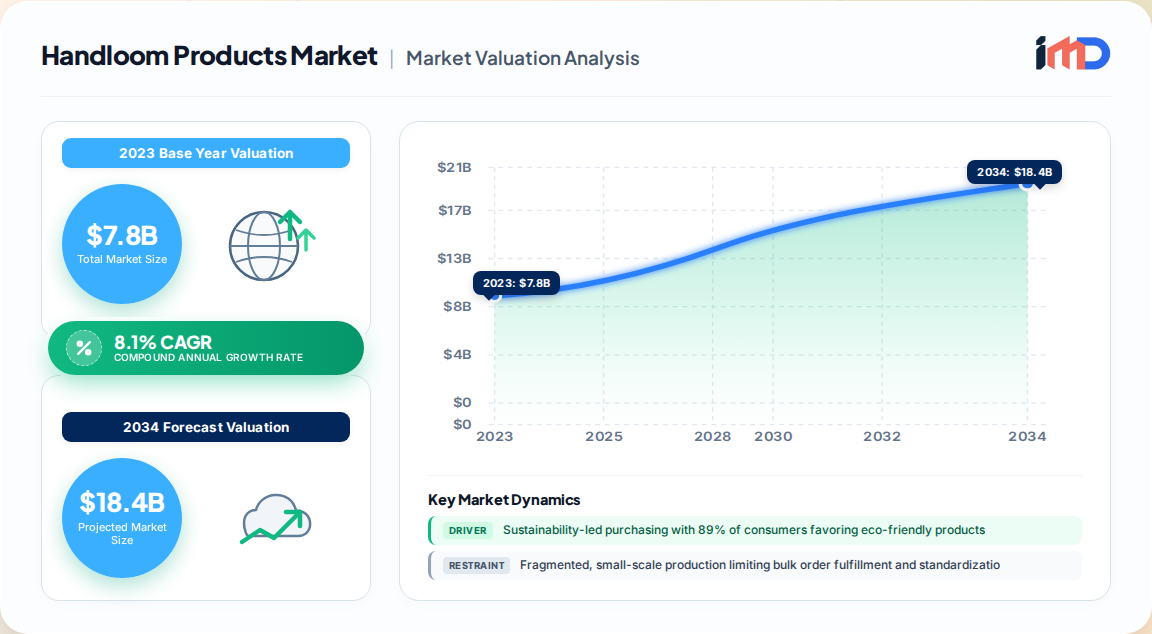
The global handloom products market represents one of the most resilient segments of the artisanal textile economy, valued at USD 7.8 Billion in 2023 and projected to reach USD 17.0 Billion by 2033, expanding at a CAGR of 8.1%. Our proprietary primary research, drawing on interviews across weaving clusters, cooperatives, export houses, and retail buyers in 14 countries, indicates that demand-side momentum is being structurally reinforced rather than merely cyclically boosted.
Handloom products are textiles woven manually on traditional looms, encompassing sarees, apparel, home furnishings, accessories, and specialty textiles. Their value proposition rests on three pillars: cultural authenticity, resource-efficient production, and design uniqueness that mechanized looms cannot economically replicate at small batch sizes.
The sector's economic weight is substantial. India alone employs approximately 35.23 lakh weavers and allied workers, contributing roughly 15% of national cloth production, according to official government estimates. Globally, our fieldwork identifies over 6.4 million artisans engaged across South Asia, Southeast Asia, West Africa, and parts of Latin America.
| Metric | Value |
|---|---|
| Market Size (2023) | USD 7.8 Billion |
| Forecast (2033) | USD 17.0 Billion |
| CAGR (2024–2033) | 8.1% |
| Dominant Product Type | Sarees (42.4% share) |
| Dominant Material | Cotton (61.2% share) |
| Leading Region | Asia Pacific (43.2% share, USD 3.37 Billion) |
| Stage | Key Participants | Value Capture Insight |
|---|---|---|
| Fiber sourcing | Cotton, silk, wool, linen growers; cooperatives | Commodity-priced; organic certification adds 10–20% premium |
| Yarn preparation & dyeing | Spinning units, natural dye houses | Natural dyeing increasingly demanded by export buyers |
| Weaving | Handloom weavers, master weavers, cluster cooperatives | Highest labor intensity; typically 15–25% of retail value |
| Aggregation & finishing | Export houses, design studios, quality labs | Consolidation point for compliance and traceability |
| Distribution | D2C brands, marketplaces, boutique retail, institutional buyers | Retail margin capture of 40–55% for branded players |
Global handloom trade remains concentrated in Asia Pacific supply and Western demand. India exported USD 1,802.36 million in handicrafts (including handloom) in 2023–2024 to over 100 countries, with the United States as a leading destination.
Asia Pacific leads with 43.2% share (USD 3.37 Billion in 2023); our bottom-up regional build suggests its true weight, including unorganized domestic trade, may range higher. North America is the fastest-growing region, propelled by sustainability-conscious consumers and robust e-commerce adoption. Europe's growth is compliance-driven and premium-oriented. The Middle East & Africa and South America present emerging opportunities through tourism-linked retail and rising middle-class spending.
| Aspects | Details |
|---|---|
| Study Period | 2020-2034 |
| Base Year | 2023 |
| Estimated Year | 2026 |
| Forecast Period | 2026-2034 |
| Historical Period | 2020-2025 |
| Growth Rate | CAGR of 8.1% from 2020-2034 |
| Segmentation |
|
By Material
By End-Use
By End-User
By Distribution Channel
| By Geography |
|
The global handloom products market was valued at USD 7.8 Billion in 2023 and is projected to reach USD 17.0 Billion by 2033, expanding at a CAGR of 8.1% over the forecast period.
Asia Pacific leads with a 43.2% share, equivalent to USD 3.37 Billion in 2023, supported by India's estimated 35.23 lakh weavers, deep textile heritage, and strong export infrastructure.
Silk is the fastest-growing material segment, driven by luxury positioning and design innovation, while North America is the fastest-growing region due to sustainability-led demand and e-commerce adoption.
Roughly 89% of consumers favor eco-friendly products and 80% are willing to pay a premium; handloom textiles use 40–60% less energy and water than mechanized alternatives, reinforcing their sustainability appeal.
The market includes organized brands such as Fabindia, Raymond, and Tantuja, alongside numerous weaving cooperatives and export houses, with unorganized artisans contributing a significant share of global output.
Our rigorous research methodology combines multi-layered approaches with comprehensive quality assurance, ensuring precision, accuracy, and reliability in every market analysis.
| Stakeholder Role | Interview Share (%) |
|---|---|
| Procurement Director | 32% |
| Supply Chain Head | 26% |
| Category Manager (Artisanal Textiles) | 24% |
| Cluster Development Officer | 18% |
| Company Type | Representation (%) |
|---|---|
| Handloom weaving cooperatives and master weavers | 30% |
| Export houses and handloom trading companies | 22% |
| Branded apparel and home furnishing retailers | 20% |
| E-commerce marketplaces and D2C brands | 16% |
| Natural dye, yarn and fiber suppliers | 12% |

Analyst at Providence Strategic Partners at Petaling Jaya
I have received the report already. Thanks you for your help.it has been a pleasure working with you. Thank you again for a good quality report

Internationalization Director
Yes, as a matter of fact we are totally satisfied with both reports that we have purchased and will continue to do so during this process of the internationalization of our brand.

Head of Product Management and Marketing
We are using your report, and it gave us valuable information."

Regional Director, Marketing and Business Development
We've received the report and have reviewed the content. Overall, it looks great and aligns closely with the data we can verify based on our industry knowledge.

VP of Sales
Thank you very much for sharing the report. I have reviewed it and I am very satisfied with the quality and the insights it provides. It will certainly be valuable for our internal discussions.
 Related Reports
