1What is the size of the Germany car insurance market?
The Germany car insurance market is valued at USD 58.86 billion in gross written premium for 2026 and is projected to reach USD 67.43 billion by 2031, growing at a 2.75% CAGR.
Insight Market Data is a premier market research and business consulting firm headquartered in Pune, India, providing syndicated research reports, customized intelligence studies, and strategic advisory services. Renowned academic institutions and Fortune 500 corporations worldwide rely on Insight Market Data's research repository to navigate evolving global and regional business environments. Covering 46 diverse industries across 25 major international economies, our comprehensive database delivers thousands of verified statistics and granular market evaluations. By combining industry-leading analytical methodologies with the direct insights of seasoned industry leaders and subject-matter experts, we deliver actionable intelligence spanning historical performance benchmarks to rigorous multi-year forecasts. We empower organizations to make confident, data-driven decisions across pivotal domains including Machinery & Equipment, Chemicals & Materials, Pharmaceuticals & Healthcare, Food & Beverages, Consumer Goods, Energy & Power, Automotive & Transportation, Electronics & Semiconductors, Medical Devices, Telecommunications, Emerging Technologies, Agriculture, and Packaging. Our multidisciplinary analyst teams provide an objective 360-degree perspective, tailoring every engagement to address complex strategic challenges with exceptional analytical rigor.
Leveraging advanced BI-powered analytics and predictive modeling, Insight Market Data uncovers high-impact market opportunities and competitive differentiators for ambitious enterprises. We continuously refine our research methodologies in accordance with global industry standards, tracking real-time market shifts to ensure our reports are consistently accurate, actionable, and delivered on schedule. Our analysts conduct methodical data validation, rigorous compliance checks, and exhaustive primary and secondary research to maintain the highest levels of data integrity and transparency. We partner closely with corporate strategists, investment groups, and business executives to translate intricate market intelligence into clear, actionable roadmaps for sustainable growth. With operational presence across Washington, USA, and Vimannagar, Pune, India, Insight Market Data ensures direct access to dedicated research specialists and responsive customer support to answer your most strategic questions.
 Germany Car Insurance Market
 by Vehicle Type (Personal, Commercial), by Insurance Type (Third-Party Liability, Comprehensive), by Distribution Channel (Direct, Agents, Brokers, Banks, Other Distribution Channels), by Germany (Bavaria, Baden-Württemberg, North Rhine-Westphalia, Lower Saxony, Hesse, Berlin, Other States) Forecast 2026-2034

Research Analyst


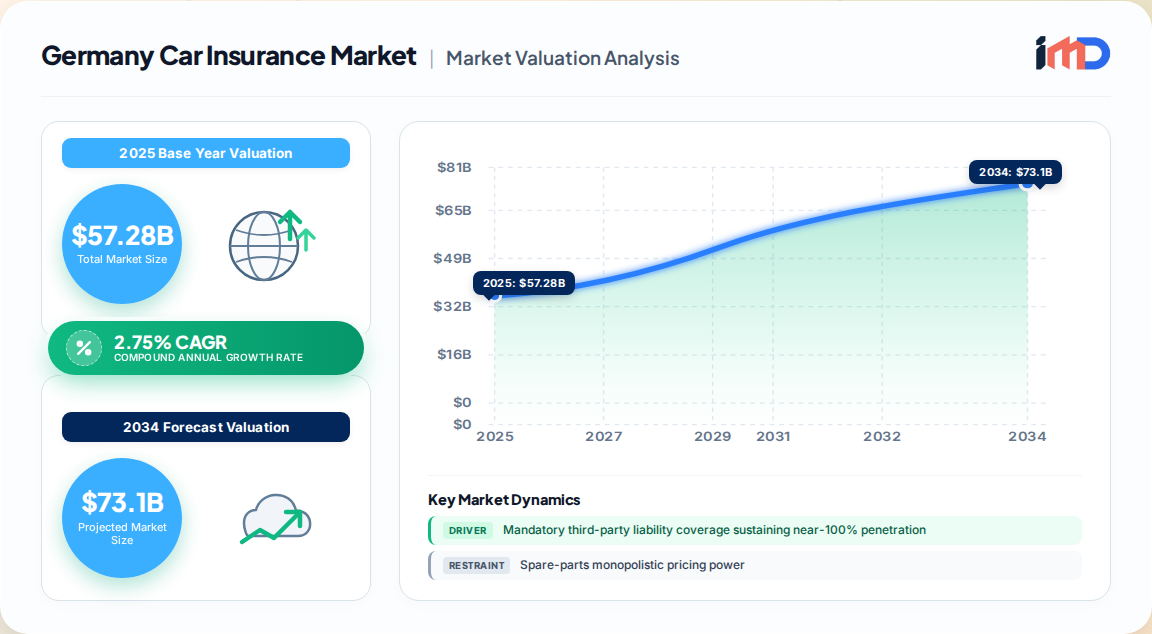
The Germany car insurance market represents one of Europe's most mature and structurally complex non-life insurance segments. Our proprietary first-party research estimates the market at USD 58.86 billion in gross written premium (GWP) for 2026, rising from USD 57.28 billion in 2025, and projects expansion to USD 67.43 billion by 2031, equivalent to a 2.75% CAGR. Penetration is effectively universal: motor third-party liability (MTPL) is legally mandated under the German Road Traffic Act (StVG) and the Mandatory Insurance Act (PflVG), keeping insurance attachment near 100% of the 49-plus million passenger cars and roughly 3.9 million commercial vehicles on German roads.
The market's defining paradox is volume stability paired with severe premium inflation. Since 2021, headline premium growth has been driven almost entirely by repair-cost catch-up rather than new risk pools. German insurers booked over EUR 3 billion in underwriting losses in 2023, forcing a 20% average premium uplift in 2024 and an additional 8–11% in 2025. This margin-recovery cycle has temporarily lifted revenue but compressed competitive differentiation, pushing incumbents toward telematics, embedded partnerships, and claims-expense industrialization.
Our driver attribution model isolates five primary growth levers, each weighted by impact on the 2026–2031 CAGR forecast.
| Driver | Estimated CAGR Impact | Geographic Relevance | Timeline |
|---|---|---|---|
| Inflation-linked repair-cost catch-up pricing | +1.2% | National; acute in dense urban corridors | Short term (≤2 years) |
| EV-specific loss-frequency gap vs. ICE | +0.4% | Bavaria and Baden-Württemberg EV clusters | Medium term (2–4 years) |
| Telematics-driven pricing sophistication | +0.3% | Country-wide, strongest in commercial fleets | Medium term (2–4 years) |
| Aggregator-fueled churn and re-rating cycle | +0.2% | Skewed to price-sensitive demographics | Short term (≤2 years) |
| OEM embedded and subscription partnerships | +0.3% | Premium and leasing vehicle segments | Long term (≥4 years) |
Repair-cost inflation is the single largest revenue driver. Workshop hourly rates averaged EUR 188 (USD 204) in 2024, an 8.6% year-on-year surge that outpaced headline CPI. Average repair invoices climbed from EUR 2,700 in 2017 to EUR 4,000 in 2023, driven by certified technician wage inflation, ADAS calibration labor, and intermittent parts shortages. Because these increases recapture margin erosion rather than create new profit pools, carriers are simultaneously deploying granular claims analytics and preferred-supplier networks to contain future severity shocks.
EV adoption introduces a bifurcated risk profile. Battery-electric vehicles exhibit 5–10% lower third-party liability claim frequency but 30–35% higher average repair costs, per our insurer interview panel. Insurers are responding with EV-specific rating factors covering battery capacity, thermal-runaway exposure, and certified high-voltage repair-shop scarcity. Early-adopting regions—Bavaria and Baden-Württemberg—already concentrate warranty-extension add-ons for battery degradation.
By vehicle type, commercial vehicles retained 27.65% of 2025 GWP and are forecast to expand at the fastest 3.39% CAGR through 2031. Fleet electrification, last-mile logistics expansion, and corporate safety-KPI-linked telematics programs underpin this outperformance.
By insurance type, comprehensive policies represented 32.90% of 2025 market value and are accelerating at a 3.76% CAGR—outpacing third-party liability as vehicle values, EV battery replacement costs, and consumer risk aversion rise. Third-party liability remains the volume anchor but offers limited margin headroom in a price-transparent market.
By distribution channel, agents still controlled 41.65% of 2025 premium share, reflecting the advisory intensity of commercial and high-value private lines. However, direct digital sales are booking a 3.98% CAGR, the fastest of any channel, as mobile-first journeys and embedded OEM checkouts capture younger, price-elastic cohorts.
| Segment Dimension | Leading Segment (2025 Share) | Fastest-Growing Segment (CAGR to 2031) |
|---|---|---|
| Vehicle Type | Personal vehicles (~72.35%) | Commercial vehicles (3.39%) |
| Insurance Type | Third-party liability (~67.10%) | Comprehensive (3.76%) |
| Distribution Channel | Agents (41.65%) | Direct digital (3.98%) |
The Germany car insurance market is highly fragmented, with no single company exceeding 5% share and the top ten groups controlling an estimated 60–65% of GWP. Competition pivots on claims servicing speed, ecosystem alliances, and real-time behavioral risk scoring rather than legacy branch reach.
Recent strategic activity underscores the shift toward data and ecosystem control: telematics-based tariffs now feature in the majority of new private motor quotes; several carriers have launched EV battery-degradation warranty add-ons; and consolidation of claims-supply chains through preferred repair networks is accelerating.
The value chain is reorganizing around three pressure points.
Premium concentration tracks vehicle density and income, with North Rhine-Westphalia, Bavaria, and Baden-Württemberg accounting for the largest GWP pools. Growth differentials are modest but strategically meaningful:
The 2026–2031 outlook is one of disciplined, inflation-driven premium expansion rather than volume-led growth. We expect tariff increases to moderate as repair-cost inflation normalizes, with margin recovery contingent on claims-expense industrialization and the successful underwriting of EV and telematics risk pools. Carriers that master behavioral risk scoring, embedded distribution, and transparent claims servicing will outperform in a market where price remains pivotal but service experience increasingly differentiates.
| Aspects | Details |
|---|---|
| Study Period | 2020-2034 |
| Base Year | 2025 |
| Estimated Year | 2026 |
| Forecast Period | 2026-2034 |
| Historical Period | 2020-2025 |
| Growth Rate | CAGR of 2.75% from 2020-2034 |
| Segmentation |
|
By Distribution Channel
| By Geography |
|
The Germany car insurance market is valued at USD 58.86 billion in gross written premium for 2026 and is projected to reach USD 67.43 billion by 2031, growing at a 2.75% CAGR.
Commercial vehicles are the fastest-growing vehicle segment at a 3.39% CAGR, while comprehensive policies lead insurance-type growth at 3.76% CAGR through 2031.
The market is highly fragmented with no company holding over 5% share. Leading groups include Allianz, HUK-Coburg, ERGO, AXA Germany, and Debeka, alongside emerging insurtech and OEM captive channels.
Inflation-linked repair-cost catch-up pricing is the largest driver, adding an estimated 1.2% to CAGR, as workshop rates rose 8.6% in 2024 and average repair invoices reached EUR 4,000.
EVs show 5–10% lower claim frequency but 30–35% higher average repair costs, prompting insurers to introduce EV-specific rating factors covering battery size, thermal-runaway risk, and certified repair-shop scarcity.
Agents held 41.65% of 2025 premium share, but direct digital sales are growing fastest at a 3.98% CAGR as mobile-first and embedded OEM checkouts expand.
Our rigorous research methodology combines multi-layered approaches with comprehensive quality assurance, ensuring precision, accuracy, and reliability in every market analysis.
| Stakeholder Role | Interview Share (%) |
|---|---|
| Chief Underwriting Officer | 30% |
| Head of Motor Claims | 25% |
| Chief Distribution Officer | 25% |
| Head of Pricing and Actuarial Analytics | 20% |
| Company Type | Representation (%) |
|---|---|
| Motor insurance carriers and multi-brand groups | 45% |
| Insurance brokers and independent agents | 20% |
| Comparison aggregators and digital distribution platforms | 15% |
| Claims management and repair-network operators | 12% |
| OEM captive and embedded insurance providers | 8% |
 Related Reports
