1How large is the EV solid state battery market?
Our primary research estimates the EV solid state battery market will reach **$2.08 billion in 2026** and is projected to grow to **$25.14 billion by 2035**, representing a **CAGR of 31.9%**.
Insight Market Data is a premier market research and business consulting firm headquartered in Pune, India, providing syndicated research reports, customized intelligence studies, and strategic advisory services. Renowned academic institutions and Fortune 500 corporations worldwide rely on Insight Market Data's research repository to navigate evolving global and regional business environments. Covering 46 diverse industries across 25 major international economies, our comprehensive database delivers thousands of verified statistics and granular market evaluations. By combining industry-leading analytical methodologies with the direct insights of seasoned industry leaders and subject-matter experts, we deliver actionable intelligence spanning historical performance benchmarks to rigorous multi-year forecasts. We empower organizations to make confident, data-driven decisions across pivotal domains including Machinery & Equipment, Chemicals & Materials, Pharmaceuticals & Healthcare, Food & Beverages, Consumer Goods, Energy & Power, Automotive & Transportation, Electronics & Semiconductors, Medical Devices, Telecommunications, Emerging Technologies, Agriculture, and Packaging. Our multidisciplinary analyst teams provide an objective 360-degree perspective, tailoring every engagement to address complex strategic challenges with exceptional analytical rigor.
Leveraging advanced BI-powered analytics and predictive modeling, Insight Market Data uncovers high-impact market opportunities and competitive differentiators for ambitious enterprises. We continuously refine our research methodologies in accordance with global industry standards, tracking real-time market shifts to ensure our reports are consistently accurate, actionable, and delivered on schedule. Our analysts conduct methodical data validation, rigorous compliance checks, and exhaustive primary and secondary research to maintain the highest levels of data integrity and transparency. We partner closely with corporate strategists, investment groups, and business executives to translate intricate market intelligence into clear, actionable roadmaps for sustainable growth. With operational presence across Washington, USA, and Vimannagar, Pune, India, Insight Market Data ensures direct access to dedicated research specialists and responsive customer support to answer your most strategic questions.
 EV Solid State Battery
 by Application (Electric Vehicles, Consumer & Portable Electronics, Energy Storage, Aerospace, Medical Devices), by Battery Type (Thin Film, Bulk), by Capacity (Below 20 mAh, 20mAh-500mAh, Above 500mAh), by Chemistry (Lithium Metal, Lithium Sulfur, Sodium Ion, Polymer), by End Use (Automotive, Consumer Devices, Industrial, Medical Devices), by Form Factor (Thin-Film, Prismatic, Cylindrical), by North America (USA, Canada, Mexico), by Europe (Germany, UK, France, Norway, Sweden), by Asia Pacific (China, Japan, South Korea, India, Taiwan), by South America (Brazil, Argentina), by Middle East & Africa (UAE, Saudi Arabia, South Africa) Forecast 2026-2034

Research Analyst


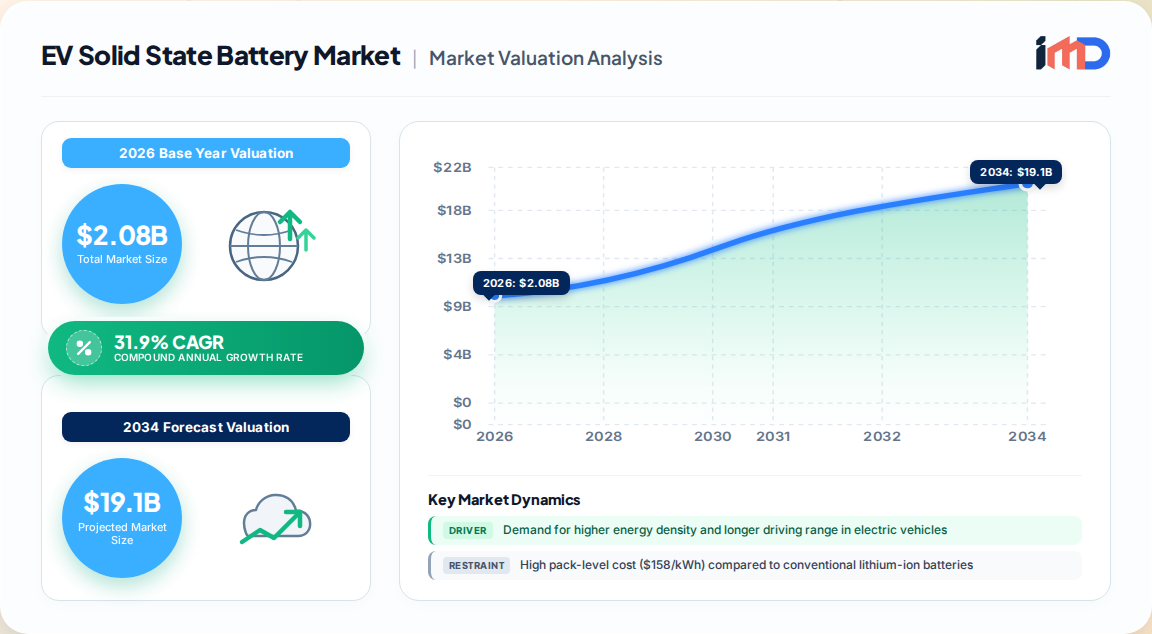
The global EV solid-state battery market is on the cusp of a transformative decade. Our proprietary primary research estimates the market for solid-state batteries specifically deployed in electric vehicles (EVs) reached $1.1 billion in 2025. This figure is projected to surge to $2.08 billion in 2026 and achieve a staggering $25.14 billion by 2035, representing a robust CAGR of 31.9% over the forecast period. This growth is not merely an extrapolation of general battery demand but a structural shift from laboratory validation to commercial-scale procurement. The market is transitioning from early-stage pilot programs into structured OEM qualification pipelines, a critical inflection point we anticipate fully materializing between 2027 and 2028.
Asia-Pacific commands a dominant 54.0% share of the global solid-state battery value chain, a position cemented by aggressive state-backed investment and the presence of major cell manufacturers. However, North America is emerging as the fastest-growing regional market, fueled by federal funding initiatives aimed at onshoring electrolyte production and establishing a resilient domestic supply chain.
The aggressive push toward solid-state EV batteries is underpinned by a confluence of technical, regulatory, and market forces.
Despite the compelling value proposition, the path to mass-market adoption is fraught with significant technical and economic hurdles.
The market is segmented by application, battery type, capacity, and end-use industry, revealing distinct strategic pathways.
The market is characterized by intense collaboration between automotive OEMs and battery technology developers, alongside established battery manufacturers.
The solid-state battery value chain is nascent and highly concentrated at key stages.
| Value Chain Stage | Key Activities | Representative Stakeholders | Concentration Risk |
|---|---|---|---|
| Raw Materials | Lithium, nickel, cobalt, sulfide precursors | Mining companies, chemical refiners | High, especially for lithium and cobalt |
| Electrolyte Production | Synthesis and purification of solid electrolytes | Solid Power, Idemitsu, Mitsui | Very High (limited global capacity) |
| Cell Manufacturing | Electrode coating, stacking, packaging | Samsung SDI, CATL, QuantumScape | High (pilot-scale only) |
| Pack Assembly | Integration of cells into modules and packs | Automotive OEMs, Tier-1 suppliers | Medium (concentrated in OEMs) |
| End-Use Application | Electric vehicles, consumer electronics | Tesla, Toyota, VW, Samsung Electronics | Low (diversified) |
The principal supply chain risk is the supply of high-purity solid electrolytes. The U.S. has almost no domestic production of automotive-grade sulfide electrolytes, creating a critical gap that the DOE funding seeks to address. This reliance on imports, primarily from Japan and South Korea, poses a risk to North American OEM production timelines. Furthermore, the need for dry-room environments and moisture-free processing adds a layer of operational complexity that is a significant capital expenditure barrier for new entrants.
The highest-value investment opportunities are in the intermediate stages of the value chain.
| Aspects | Details |
|---|---|
| Study Period | 2020-2034 |
| Base Year | 2026 |
| Estimated Year | 2026 |
| Forecast Period | 2026-2034 |
| Historical Period | 2020-2025 |
| Growth Rate | CAGR of 31.9% from 2020-2034 |
| Segmentation |
|
By Battery Type
By Capacity
By Chemistry
By End Use
By Form Factor
| By Geography |
|
Our primary research estimates the EV solid state battery market will reach **$2.08 billion in 2026** and is projected to grow to **$25.14 billion by 2035**, representing a **CAGR of 31.9%**.
Asia-Pacific holds the dominant share at **54.0%** in 2025, driven by major manufacturers like TDK, Samsung SDI, and CATL. North America is the fastest-growing region due to U.S. federal funding for domestic electrolyte production.
The main challenges are the high pack-level cost (around **$158 per kWh** vs. conventional alternatives) and technical difficulties in maintaining electrode-electrolyte interface stability across charge cycles. These factors currently limit adoption to premium vehicle segments.
Key players include technology developers like **QuantumScape**, **Solid Power**, and **ProLogium**, established battery manufacturers like **TDK Corporation**, **Samsung SDI**, and **CATL**, and automotive OEMs such as **Toyota** and **BMW** that are driving demand.
We anticipate the critical inflection point for mass-market adoption to occur between **2027 and 2028** as major OEMs transition from vehicle integration testing to committed volume supply agreements. Cost parity with liquid-state cells is expected only post-2030.
The current estimated pack-level cost for an assembled solid-state battery is **$158 per kWh**, significantly higher than conventional lithium-ion packs. This is largely due to the high cost of solid electrolytes (up to **$50 per kilogram**) and the complexity of manufacturing processes.
Our rigorous research methodology combines multi-layered approaches with comprehensive quality assurance, ensuring precision, accuracy, and reliability in every market analysis.
| Stakeholder Role | Interview Share (%) |
|---|---|
| Chief Technology Officer (CTO) | 30% |
| VP of Battery Engineering | 25% |
| Director of Procurement | 25% |
| Program Manager (EV Platforms) | 20% |
| Company Type | Representation (%) |
|---|---|
| Solid-State Battery Developers | 35% |
| Automotive OEMs & Tier-1 Suppliers | 25% |
| Solid Electrolyte Manufacturers | 20% |
| Manufacturing Equipment Suppliers | 10% |
| Raw Material Suppliers | 10% |
 Related Reports
