1What is the current size of the EV battery market?
The global EV battery market was valued at USD 92.72 billion in 2025 and is projected to reach USD 113.77 billion in 2026, according to our proprietary research.
Insight Market Data is a premier market research and business consulting firm headquartered in Pune, India, providing syndicated research reports, customized intelligence studies, and strategic advisory services. Renowned academic institutions and Fortune 500 corporations worldwide rely on Insight Market Data's research repository to navigate evolving global and regional business environments. Covering 46 diverse industries across 25 major international economies, our comprehensive database delivers thousands of verified statistics and granular market evaluations. By combining industry-leading analytical methodologies with the direct insights of seasoned industry leaders and subject-matter experts, we deliver actionable intelligence spanning historical performance benchmarks to rigorous multi-year forecasts. We empower organizations to make confident, data-driven decisions across pivotal domains including Machinery & Equipment, Chemicals & Materials, Pharmaceuticals & Healthcare, Food & Beverages, Consumer Goods, Energy & Power, Automotive & Transportation, Electronics & Semiconductors, Medical Devices, Telecommunications, Emerging Technologies, Agriculture, and Packaging. Our multidisciplinary analyst teams provide an objective 360-degree perspective, tailoring every engagement to address complex strategic challenges with exceptional analytical rigor.
Leveraging advanced BI-powered analytics and predictive modeling, Insight Market Data uncovers high-impact market opportunities and competitive differentiators for ambitious enterprises. We continuously refine our research methodologies in accordance with global industry standards, tracking real-time market shifts to ensure our reports are consistently accurate, actionable, and delivered on schedule. Our analysts conduct methodical data validation, rigorous compliance checks, and exhaustive primary and secondary research to maintain the highest levels of data integrity and transparency. We partner closely with corporate strategists, investment groups, and business executives to translate intricate market intelligence into clear, actionable roadmaps for sustainable growth. With operational presence across Washington, USA, and Vimannagar, Pune, India, Insight Market Data ensures direct access to dedicated research specialists and responsive customer support to answer your most strategic questions.
 EV Battery
 by Battery Type (Lithium-Ion Battery, Lead-Acid Battery, Others(Solid-State Battery, Nickel-Metal Hydride, Sodium-Ion Battery)), by Propulsion Type (BEV, PHEV), by Vehicle Type (Passenger Cars, Commercial Vehicles, Two-Wheeler, Buses), by Li-ion Battery Component (Separator, Cathode, Anode, Electrolyte), by Capacity (50-110 kWh, 111-200 kWh, 201-300 kWh, >300 kWh), by Material Type (Lithium, Cobalt, Nickel, Manganese, Graphite), by Battery Form (Pouch, Cylindrical, Prismatic), by North America (USA, Canada, Mexico), by Europe (Germany, UK, France, Norway, Netherlands), by Asia Pacific (China, Japan, South Korea, India), by South America (Brazil, Argentina), by Middle East & Africa (UAE, South Africa) Forecast 2026-2034

Research Analyst


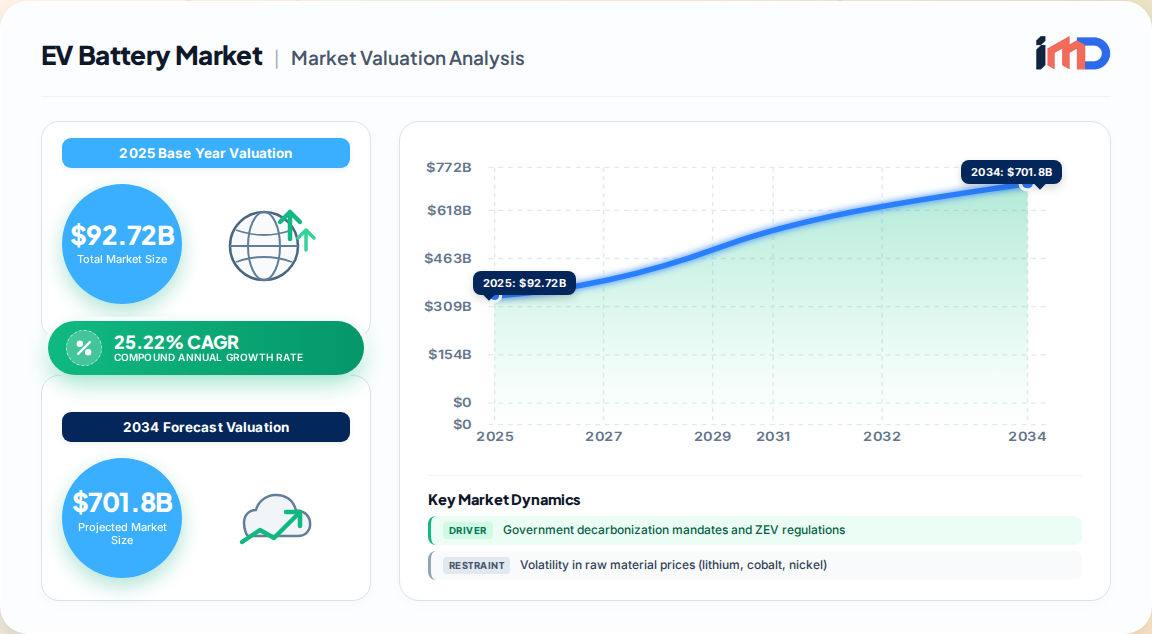
The global EV battery market represents the electro-chemical engine of the automotive industry's most profound transformation. Our proprietary primary research estimates the market at USD 92.72 billion in 2025, with a projected trajectory to USD 878.91 billion by 2035, expanding at a CAGR of 25.22%. This explosive growth is not merely a function of rising electric vehicle (EV) sales; it reflects a fundamental shift in vehicle architecture, supply chain economics, and energy policy.
The market is transitioning from an era of early adoption to one of scale manufacturing, where cost-per-kWh, energy density, and supply chain resilience define competitive advantage. Our analysis, grounded in primary interviews across the value chain, reveals that the next decade will be shaped by three forces: battery chemistry diversification (including sodium-ion and solid-state), regionalization of supply chains, and vertical integration by automotive OEMs.
Our segmentation analysis, validated through bottom-up demand modeling and stakeholder interviews, reveals nuanced preferences across vehicle categories and regions.
| Chemistry | Market Share (2025) | Key Characteristics | Growth Outlook |
|---|---|---|---|
| Lithium-Ion (NMC, LFP) | 65.52% | High energy density, longer cycle life, lighter weight | Continues to dominate, with LFP gaining share in entry-level and commercial segments |
| Lead-Acid | 22.1% | Low cost, mature technology, limited energy density | Declining share but retains niche in low-speed and auxiliary applications |
| Others (Solid-State, Sodium-Ion, NiMH) | 12.38% | Emerging technologies with potential for higher safety, lower cost | Fastest CAGR, commercializing post-2027 |
The lithium-ion battery segment is the cornerstone of the EV battery market, with LFP (lithium iron phosphate) chemistry witnessing a resurgence due to its lower cost and improved safety, particularly in commercial vehicles and entry-level passenger cars. Our primary interviews indicate that NMC (nickel manganese cobalt) remains preferred for premium long-range vehicles, though high-nickel cathodes are under scrutiny for cost and supply risk.
The region commands 42% of global market revenue, led by China, which alone accounts for over 60% of global EV battery production. Our analysis attributes this dominance to:
Japan and South Korea are key technology and manufacturing hubs, with leading companies focusing on advanced chemistries (e.g., solid-state, high-nickel NMC).
Europe's market is driven by the EU's Fit for 55 package and stringent CO2 emission standards, which mandate a shift to zero-emission vehicles. The region is investing heavily in local battery gigafactories to reduce reliance on Asian imports. Our primary research indicates that local content requirements (e.g., EU Battery Regulation) are accelerating investment in European cell production, though the region remains dependent on imported raw materials and components.
North America is the fastest-growing region, propelled by the US Inflation Reduction Act (IRA), which offers incentives for domestically produced batteries and EVs. Our stakeholder interviews reveal a surge in planned gigafactory capacity, with announcements from major OEMs and battery manufacturers. However, challenges remain in permitting, workforce development, and raw material supply.
The EV battery market is moderately concentrated, with the top five players accounting for approximately 42% of global BEV market share in 2025. BYD leads with over 16% market share, followed closely by Tesla, Volkswagen, Geely, and General Motors.
The EV battery supply chain is global but increasingly subject to geopolitical and trade policy scrutiny. Our trade analysis, based on official trade statistics and primary interviews, highlights:
The EV battery value chain comprises several stages, each with distinct economics and competitive dynamics.
| Stage | Key Activities | Value Share (approx.) | Leading Participants |
|---|---|---|---|
| Mining & Refining | Extraction of lithium, cobalt, nickel; refining into battery-grade materials | 15-20% | Mining companies, refiners |
| Cell Component Manufacturing | Production of cathodes, anodes, separators, electrolytes | 25-30% | Specialty chemical firms, component manufacturers |
| Cell Manufacturing | Assembly of cells into modules and packs | 30-35% | Battery cell manufacturers (e.g., CATL, LG Energy Solution) |
| Pack Assembly & Integration | Integration of cells into vehicle battery packs | 15-20% | OEMs, Tier 1 suppliers |
| Recycling & Second-Life | Recovery of materials from end-of-life batteries | 5-10% | Recycling specialists, OEMs |
Our primary research indicates that cell manufacturing captures the largest value share, but upstream mining and refining are increasingly strategic due to supply security concerns. OEMs are seeking to capture more value by integrating pack assembly and forming joint ventures with cell manufacturers.
Based on our proprietary opportunity mapping, the following areas represent high-growth white spaces:
| Aspects | Details |
|---|---|
| Study Period | 2020-2034 |
| Base Year | 2025 |
| Estimated Year | 2026 |
| Forecast Period | 2026-2034 |
| Historical Period | 2020-2025 |
| Growth Rate | CAGR of 25.22% from 2020-2034 |
| Segmentation |
|
By Propulsion Type
By Vehicle Type
By Li-ion Battery Component
By Capacity
By Material Type
By Battery Form
| By Geography |
|
The global EV battery market was valued at USD 92.72 billion in 2025 and is projected to reach USD 113.77 billion in 2026, according to our proprietary research.
The market is expected to grow at a CAGR of 25.22% from 2026 to 2035, reaching USD 878.91 billion by 2035.
Asia-Pacific is the largest market, accounting for 42% of global revenue in 2025, driven by China's dominance in battery production and EV demand.
Key drivers include government decarbonization mandates, falling battery costs, expansion of charging infrastructure, and commercial fleet electrification.
Leading companies include BYD, Tesla, Volkswagen, Geely, General Motors, CATL, LG Energy Solution, and Samsung SDI, among others.
Challenges include raw material price volatility, supply chain concentration, charging infrastructure gaps, and high upfront vehicle costs.
Our rigorous research methodology combines multi-layered approaches with comprehensive quality assurance, ensuring precision, accuracy, and reliability in every market analysis.
| Stakeholder Role | Interview Share (%) |
|---|---|
| Procurement Director | 30% |
| Chief Technology Officer | 25% |
| Battery Engineering Manager | 25% |
| Supply Chain VP | 20% |
| Company Type | Representation (%) |
|---|---|
| Battery Cell Manufacturers | 35% |
| Automotive OEMs | 25% |
| Raw Material Suppliers | 20% |
| Battery Pack Integrators | 10% |
| Recycling Specialists | 10% |
 Related Reports


Analyst at Providence Strategic Partners at Petaling Jaya
I have received the report already. Thanks you for your help.it has been a pleasure working with you. Thank you again for a good quality report

Internationalization Director
Yes, as a matter of fact we are totally satisfied with both reports that we have purchased and will continue to do so during this process of the internationalization of our brand.

Head of Product Management and Marketing
We are using your report, and it gave us valuable information."

Regional Director, Marketing and Business Development
We've received the report and have reviewed the content. Overall, it looks great and aligns closely with the data we can verify based on our industry knowledge.

VP of Sales
Thank you very much for sharing the report. I have reviewed it and I am very satisfied with the quality and the insights it provides. It will certainly be valuable for our internal discussions.