1What is the size of the Europe bus market?
The Europe bus market was valued at USD 15.02 billion in 2025 and is projected to reach USD 23.15 billion by 2034, growing at a CAGR of 4.92% from 2026 to 2034.
Insight Market Data is a premier market research and business consulting firm headquartered in Pune, India, providing syndicated research reports, customized intelligence studies, and strategic advisory services. Renowned academic institutions and Fortune 500 corporations worldwide rely on Insight Market Data's research repository to navigate evolving global and regional business environments. Covering 46 diverse industries across 25 major international economies, our comprehensive database delivers thousands of verified statistics and granular market evaluations. By combining industry-leading analytical methodologies with the direct insights of seasoned industry leaders and subject-matter experts, we deliver actionable intelligence spanning historical performance benchmarks to rigorous multi-year forecasts. We empower organizations to make confident, data-driven decisions across pivotal domains including Machinery & Equipment, Chemicals & Materials, Pharmaceuticals & Healthcare, Food & Beverages, Consumer Goods, Energy & Power, Automotive & Transportation, Electronics & Semiconductors, Medical Devices, Telecommunications, Emerging Technologies, Agriculture, and Packaging. Our multidisciplinary analyst teams provide an objective 360-degree perspective, tailoring every engagement to address complex strategic challenges with exceptional analytical rigor.
Leveraging advanced BI-powered analytics and predictive modeling, Insight Market Data uncovers high-impact market opportunities and competitive differentiators for ambitious enterprises. We continuously refine our research methodologies in accordance with global industry standards, tracking real-time market shifts to ensure our reports are consistently accurate, actionable, and delivered on schedule. Our analysts conduct methodical data validation, rigorous compliance checks, and exhaustive primary and secondary research to maintain the highest levels of data integrity and transparency. We partner closely with corporate strategists, investment groups, and business executives to translate intricate market intelligence into clear, actionable roadmaps for sustainable growth. With operational presence across Washington, USA, and Vimannagar, Pune, India, Insight Market Data ensures direct access to dedicated research specialists and responsive customer support to answer your most strategic questions.
 Europe Bus Market
 by Length (10–12 meter bus, Below 6 meters, 6–10 meters, Above 12 meters), by Fuel Type (Diesel, Electric(sub_Battery Electric, Plug-In Hybrid, Fuel Cell), Hybrid, CNG/LNG, Other), by Seating Capacity (Up to 30, 31–50, Above 50), by Application (Transit Bus, Intercity Coach, Tourist Bus, School Bus, Other), by Deck Type (Single Deck, Double Deck), by Consumer Type (Government & Municipal Agencies, Private Operators), by Germany, by France, by United Kingdom, by Italy, by Spain, by Nordics (Sweden, Denmark, Norway, Finland), by Benelux (Netherlands, Belgium, Luxembourg), by Rest of Europe Forecast 2026-2034

Research Analyst


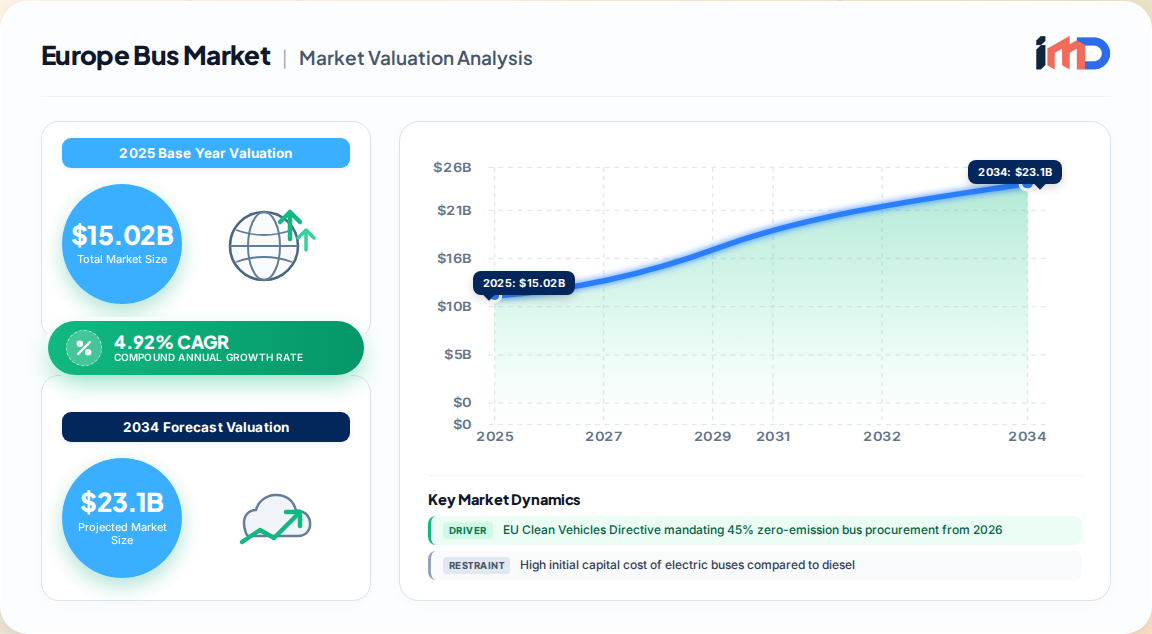
The Europe bus market is a cornerstone of the region's public mobility infrastructure, carrying over 60% of urban public transport journeys according to Eurostat. Our proprietary research estimates the market at USD 15.02 billion in 2025, rising to USD 15.76 billion in 2026 and forecast to reach USD 23.15 billion by 2034, reflecting a 4.92% CAGR over the 2026–2034 period. This growth trajectory is underpinned by a structural shift toward zero-emission fleets, substantial public funding, and the modernization of urban transit networks across the continent.
The market is characterized by a highly consolidated competitive landscape, with legacy heavy-duty OEMs transitioning rapidly toward electric and hydrogen platforms. Regulatory imperatives, particularly the EU Clean Vehicles Directive, are reshaping procurement strategies, while advances in battery technology and digital mobility platforms are creating new value pools. This report provides a data-driven, expert-led analysis of the key forces shaping the Europe bus market through 2034.
Expansion of Urban Mobility Networks: European cities are investing heavily in bus rapid transit (BRT) systems, dedicated bus lanes, and integrated ticketing to reduce congestion and emissions. Road transport accounts for nearly 20% of total CO₂ emissions in the EU, prompting municipalities to prioritize cleaner bus fleets. The European Green Deal's carbon-neutrality target for 2050 is a powerful catalyst for fleet replacement.
Government Funding and Subsidies: National and EU-level funding is accelerating the transition to sustainable transit. The European Investment Bank approved over €8 billion for green transport projects in 2023, including large-scale low-emission bus procurement. Countries like France and Sweden offer grants covering up to 50% of electric bus purchase costs, while Germany's BMDV program covers up to 80% of the incremental cost of zero-emission buses.
Regulatory Mandates: The revised Clean Vehicles Directive requires that 45% of new public bus procurements be zero-emission from August 2026, rising to 65% by 2030. This regulatory floor eliminates optionality for transit authorities, effectively mandating electrification and pulling forward orders.
High Initial Costs: Electric buses cost approximately two to three times more than conventional diesel models, and the need for charging infrastructure, upgraded depots, and grid enhancements adds to the total investment. This remains a significant barrier, particularly for budget-constrained operators in Southern and Eastern Europe.
Supply Chain Disruptions: The global semiconductor shortage and geopolitical tensions have caused delays of up to six months in receiving critical electronic components. Rising raw material prices for lithium, nickel, and copper further pressure production costs and timelines.
Western Europe, particularly Germany, France, and the UK, will continue to dominate market value, accounting for over 50% of regional revenue through 2034. However, the most dynamic growth will occur in Southern and Eastern Europe. Italy's PNRR-funded megatenders and Spain's MOVES III incentives are creating significant opportunities for OEMs and charging infrastructure providers. The Nordic region remains a pioneer in zero-emission adoption, with cities like Copenhagen and Stockholm leading in electric bus penetration.
Municipal zero-emission zones are proliferating: 35 cities across Europe have implemented or announced diesel bus bans, with London and Paris at the forefront. This regulatory fragmentation creates a two-tier market: urban operators face strict compliance deadlines, while suburban and rural operators have longer transition periods, driving demand for smaller buses and phased electrification solutions.
The Europe bus market is highly consolidated, featuring a mix of legacy European OEMs and aggressive Chinese entrants. Key players include Daimler AG (Mercedes-Benz Buses), Volvo Group, MAN Truck & Bus, Scania AB, Iveco Bus, VDL Bus & Coach, Solaris Bus & Coach, Alexander Dennis, Van Hool, Temsa, Irizar, and BYD Europe.
Recent strategic developments underscore the shift toward electrification and digitalization:
OEMs are increasingly bundling financing, telematics, and depot-integration services to differentiate their offerings. The rise of battery-as-a-service and residual-value guarantees is lowering upfront barriers and accelerating fleet turnover.
The bus value chain is undergoing a structural transformation, with battery supply and charging infrastructure emerging as critical bottlenecks. Upstream, battery cell production is dominated by Asian suppliers, but European gigafactory capacity from CATL and BYD is expected to come online by 2027, eliminating import tariffs and shortening lead times. Midstream, OEMs are integrating more software and telematics into their vehicles, shifting value from hardware to digital services. Downstream, fleet operators are grappling with depot electrification, grid connection delays, and driver shortages, which are impacting operational efficiency.
Supply chain risks remain elevated due to geopolitical tensions and raw material price volatility. The industry's dependence on lithium, nickel, and copper exposes manufacturers to price shocks, while the semiconductor shortage continues to affect production schedules. To mitigate these risks, OEMs are diversifying supplier bases and investing in localized production, while operators are exploring leasing models and battery refurbishment programs.
Several high-potential growth avenues are emerging in the Europe bus market:
Procurement strategies in the Europe bus market are evolving in response to regulatory mandates and funding availability. Transit authorities are increasingly adopting multi-year framework agreements to secure supply and lock in pricing, as seen with DB Regio's substantial order for thousands of electric buses. The use of total cost of ownership (TCO) models is becoming standard practice, with battery-electric buses achieving near-parity with diesel on high-mileage urban routes.
Subsidy stacking—combining EU, national, and local incentives—is a critical lever for reducing upfront costs. However, with subsidy reductions anticipated in some markets from 2026, operators are exploring alternative financing models such as battery leasing and residual-value guarantees. Chinese OEMs like BYD and Yutong are capitalizing on lower battery costs to win price-sensitive tenders, while European OEMs are countering with bundled service offerings and faster delivery times.
The Europe bus market is poised for steady but transformative growth. Between 2026 and 2034, the market will add USD 7.39 billion in value, with electric buses driving the majority of incremental revenue. By 2030, battery-electric buses are expected to account for over 50% of new urban bus sales, supported by TCO parity and regulatory mandates. The aftermarket and digital services segments will also expand, creating new revenue streams for OEMs and third-party providers.
Key risks to the forecast include the pace of depot electrification, grid capacity constraints, and the availability of skilled technicians. However, the long-term trajectory is unequivocally toward zero-emission mobility, with the bus sector leading the decarbonization of road transport in Europe.
| Aspects | Details |
|---|---|
| Study Period | 2020-2034 |
| Base Year | 2025 |
| Estimated Year | 2026 |
| Forecast Period | 2026-2034 |
| Historical Period | 2020-2025 |
| Growth Rate | CAGR of 4.92% from 2020-2034 |
| Segmentation |
|

Analyst at Providence Strategic Partners at Petaling Jaya
I have received the report already. Thanks you for your help.it has been a pleasure working with you. Thank you again for a good quality report

Internationalization Director
Yes, as a matter of fact we are totally satisfied with both reports that we have purchased and will continue to do so during this process of the internationalization of our brand.

Head of Product Management and Marketing
We are using your report, and it gave us valuable information."

Regional Director, Marketing and Business Development
We've received the report and have reviewed the content. Overall, it looks great and aligns closely with the data we can verify based on our industry knowledge.

VP of Sales
Thank you very much for sharing the report. I have reviewed it and I am very satisfied with the quality and the insights it provides. It will certainly be valuable for our internal discussions.
By Seating Capacity
By Application
By Deck Type
By Consumer Type
| By Geography |
|
The Europe bus market was valued at USD 15.02 billion in 2025 and is projected to reach USD 23.15 billion by 2034, growing at a CAGR of 4.92% from 2026 to 2034.
Diesel buses held the largest share at 58.4% in 2025, but electric buses are the fastest-growing segment with a projected CAGR of 26.7% through 2034.
Germany leads the Europe bus market with a 22.3% share in 2025, driven by federal subsidies and aggressive municipal electrification targets.
Key drivers include the expansion of urban mobility networks, government funding and subsidies for sustainable transit, and regulatory mandates such as the EU Clean Vehicles Directive requiring 45% zero-emission bus procurements from 2026.
Major players include Daimler AG (Mercedes-Benz Buses), Volvo Group, MAN Truck & Bus, Scania AB, Iveco Bus, VDL Bus & Coach, Solaris Bus & Coach, Alexander Dennis, Van Hool, Temsa, Irizar, and BYD Europe.
As of 2025, electric buses account for nearly 24% of EU bus sales, with London alone operating over 1,800 electric buses.
The average age of buses on EU roads is 12.2 years, indicating significant replacement demand and opportunities for fleet renewal.
Challenges include high initial costs of electric buses, supply chain disruptions, depot grid-connection delays, and a shortage of skilled technicians for advanced bus technologies.
Our rigorous research methodology combines multi-layered approaches with comprehensive quality assurance, ensuring precision, accuracy, and reliability in every market analysis.
| Stakeholder Role | Interview Share (%) |
|---|---|
| Chief Strategy Officer | 25% |
| Fleet Procurement Director | 30% |
| Head of Electrification | 20% |
| Operations Manager | 15% |
| Government Policy Advisor | 10% |
| Company Type | Representation (%) |
|---|---|
| Bus OEMs | 35% |
| Battery & Powertrain Suppliers | 20% |
| Charging Infrastructure Providers | 15% |
| Fleet Operators (Public & Private) | 20% |
| Technology & Telematics Vendors | 10% |
 Related Reports
