1What is the current size of the Environmental Engineering Service market?
The global market was valued at $66.95 Billion in 2025, based on our proprietary primary research and expert interviews.
Insight Market Data is a premier market research and business consulting firm headquartered in Pune, India, providing syndicated research reports, customized intelligence studies, and strategic advisory services. Renowned academic institutions and Fortune 500 corporations worldwide rely on Insight Market Data's research repository to navigate evolving global and regional business environments. Covering 46 diverse industries across 25 major international economies, our comprehensive database delivers thousands of verified statistics and granular market evaluations. By combining industry-leading analytical methodologies with the direct insights of seasoned industry leaders and subject-matter experts, we deliver actionable intelligence spanning historical performance benchmarks to rigorous multi-year forecasts. We empower organizations to make confident, data-driven decisions across pivotal domains including Machinery & Equipment, Chemicals & Materials, Pharmaceuticals & Healthcare, Food & Beverages, Consumer Goods, Energy & Power, Automotive & Transportation, Electronics & Semiconductors, Medical Devices, Telecommunications, Emerging Technologies, Agriculture, and Packaging. Our multidisciplinary analyst teams provide an objective 360-degree perspective, tailoring every engagement to address complex strategic challenges with exceptional analytical rigor.
Leveraging advanced BI-powered analytics and predictive modeling, Insight Market Data uncovers high-impact market opportunities and competitive differentiators for ambitious enterprises. We continuously refine our research methodologies in accordance with global industry standards, tracking real-time market shifts to ensure our reports are consistently accurate, actionable, and delivered on schedule. Our analysts conduct methodical data validation, rigorous compliance checks, and exhaustive primary and secondary research to maintain the highest levels of data integrity and transparency. We partner closely with corporate strategists, investment groups, and business executives to translate intricate market intelligence into clear, actionable roadmaps for sustainable growth. With operational presence across Washington, USA, and Vimannagar, Pune, India, Insight Market Data ensures direct access to dedicated research specialists and responsive customer support to answer your most strategic questions.

 Environmental Engineering Service
 by Application (Water Resource Management, Waste Management, Air Quality, Environmental Impact Assessment, Sustainability Consulting), by Service Type (Consulting, Design, Project Management, Compliance), by End-Use (Government, Industrial, Commercial, Residential), by Technology (Bioremediation, GIS, Environmental Monitoring, Waste Treatment), by Regulatory Framework (Environmental Regulations, Health & Safety, Sustainability Standards, Waste Policies), by North America (USA, Canada, Mexico), by Europe (Germany, UK, France, Netherlands, Denmark), by Asia-Pacific (China, India, Japan, Australia, Southeast Asia), by Middle East & Africa (UAE, Saudi Arabia, South Africa), by South America (Brazil, Argentina, Chile) Forecast 2026-2034

Senior Analyst

 Related Reports

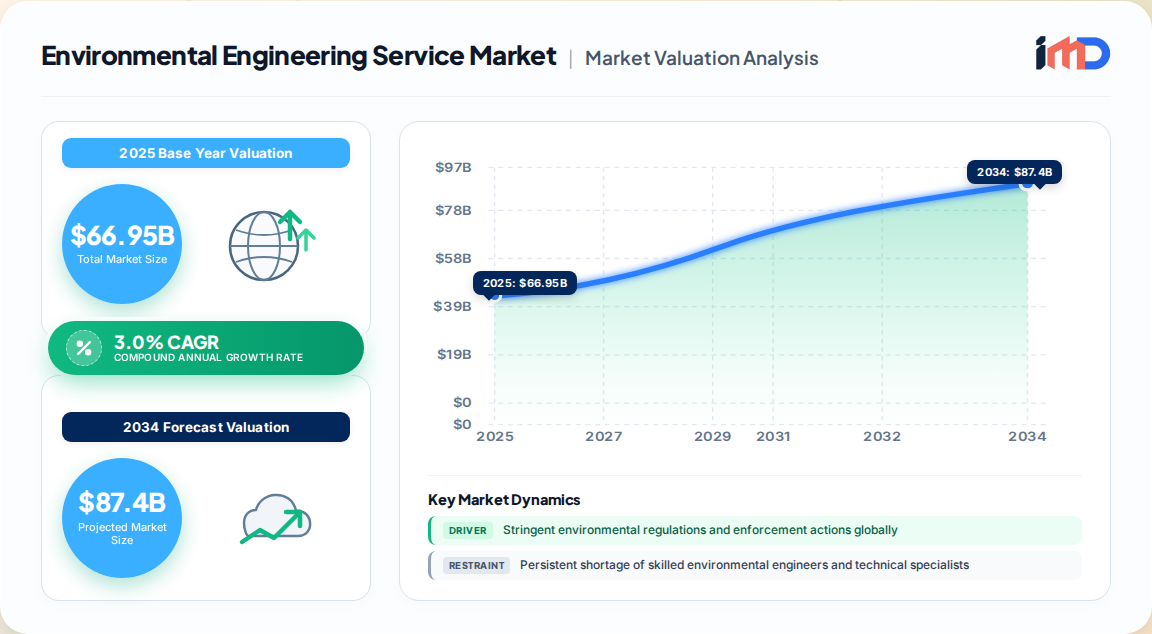
The global Environmental Engineering Service market represents a critical and expanding segment of the broader professional services landscape. Our proprietary primary research and expert interviews position the market at $66.95 Billion in 2025, with a steady projected expansion to $90.0 Billion by 2035, reflecting a compound annual growth rate (CAGR) of 3.0%. This growth, while moderate, is underpinned by an irreversible global shift toward regulatory compliance, corporate sustainability mandates, and climate-resilience infrastructure investment.
The market is characterized by high fragmentation and the dominance of multidisciplinary engineering firms that have integrated environmental consulting into their core service portfolios. The convergence of digital technologies—such as AI-driven environmental monitoring and GIS-based modeling—with traditional engineering disciplines is creating a new competitive frontier. Firms that can deliver integrated, data-rich solutions are capturing premium fees and fostering long-term client relationships.
The demand for environmental engineering services is propelled by three primary forces:
Despite positive fundamentals, the market faces notable headwinds:
The market is segmented by application, service type, end-use, and technology.
North America is the largest regional market, commanding a 38% share in 2025, supported by stringent regulations, a mature industrial base, and significant public infrastructure spending. Europe follows with a 27% share, driven by ambitious EU climate targets and a strong focus on circular economy practices. Asia-Pacific, at 22%, is the fastest-growing region, with a projected CAGR of 4.2% through 2035, as rapid industrialization and urbanization in countries like China and India necessitate large-scale environmental infrastructure and remediation projects.
The Middle East & Africa and South America regions, while smaller, present emerging opportunities tied to oil and gas sector cleanup, mining remediation, and water scarcity challenges.
The competitive landscape is moderately concentrated, with global engineering and consulting giants competing alongside specialized environmental firms. Key players include AECOM, Jacobs, Tetra Tech, WSP Global, Stantec, Arcadis, Ramboll, Golder Associates, SNC-Lavalin, and Environmental Resources Management (ERM).
Leading firms are pursuing two main strategies:
The environmental engineering service value chain comprises several stages:
Key inputs include skilled labor, regulatory knowledge, and proprietary data. The ability to integrate data across the value chain is becoming a key differentiator, enabling firms to offer holistic solutions.
Significant opportunities exist in:
Clients are increasingly adopting outcome-based procurement models, where fees are tied to environmental performance improvements rather than billable hours. This requires service providers to develop robust measurement and verification capabilities. Additionally, public-private partnerships (PPPs) are gaining traction for large-scale water and waste infrastructure projects, creating opportunities for firms with strong financial and operational expertise.
As a service-based market, environmental engineering services are not subject to traditional import/export tariffs. However, the supply of specialized talent and technology is global. Firms often source expertise from global talent pools, and proprietary software and data tools are licensed across borders. Trade in environmental services is governed by the WTO's General Agreement on Trade in Services (GATS), with many countries maintaining restrictions on foreign engineering firms. The primary supply chain risk is the availability of skilled labor, particularly in regions with aging workforces.
The Environmental Engineering Service market is poised for steady growth, driven by the global imperative to address climate change, resource scarcity, and pollution. The market will increasingly reward firms that can combine deep technical expertise with digital innovation and strategic advisory capabilities. With a projected CAGR of 3.0% and a market size reaching $90 Billion by 2035, the sector offers resilient opportunities for incumbents and new entrants alike.
| Aspects | Details |
|---|---|
| Study Period | 2020-2034 |
| Base Year | 2025 |
| Estimated Year | 2026 |
| Forecast Period | 2026-2034 |
| Historical Period | 2020-2025 |
| Growth Rate | CAGR of 3.0% from 2020-2034 |
| Segmentation |
|
By Service Type
By End-Use
By Technology
By Regulatory Framework
| By Geography |
|
The global market was valued at $66.95 Billion in 2025, based on our proprietary primary research and expert interviews.
The market is expected to grow at a CAGR of 3.0% from 2026 to 2035, reaching $90.0 Billion by 2035.
North America dominates the market with a 38% share in 2025, driven by stringent regulations and infrastructure investment.
Leading companies include AECOM, Jacobs, Tetra Tech, WSP Global, Stantec, Arcadis, Ramboll, Golder Associates, SNC-Lavalin, and ERM.
Key drivers include stringent environmental regulations, corporate sustainability goals, and infrastructure investment, particularly in water and climate resilience.
Water resource management is the largest application, accounting for approximately 35% of global revenue in 2025.
Our rigorous research methodology combines multi-layered approaches with comprehensive quality assurance, ensuring precision, accuracy, and reliability in every market analysis.
| Stakeholder Role | Interview Share (%) |
|---|---|
| Environmental Engineering Practice Directors | 35% |
| Chief Sustainability Officers (CSOs) | 25% |
| Infrastructure Project Managers | 20% |
| Regulatory Compliance Heads | 20% |
| Company Type | Representation (%) |
|---|---|
| Environmental Engineering Consultancies | 40% |
| Multidisciplinary Engineering Firms | 25% |
| Specialty Remediation Contractors | 15% |
| Government & Municipal Agencies | 10% |
| Technology & Software Providers | 10% |