About Insight Market Data

Insight Market Data is a premier market research and business consulting firm headquartered in Pune, India, providing syndicated research reports, customized intelligence studies, and strategic advisory services. Renowned academic institutions and Fortune 500 corporations worldwide rely on Insight Market Data's research repository to navigate evolving global and regional business environments. Covering 46 diverse industries across 25 major international economies, our comprehensive database delivers thousands of verified statistics and granular market evaluations. By combining industry-leading analytical methodologies with the direct insights of seasoned industry leaders and subject-matter experts, we deliver actionable intelligence spanning historical performance benchmarks to rigorous multi-year forecasts. We empower organizations to make confident, data-driven decisions across pivotal domains including Machinery & Equipment, Chemicals & Materials, Pharmaceuticals & Healthcare, Food & Beverages, Consumer Goods, Energy & Power, Automotive & Transportation, Electronics & Semiconductors, Medical Devices, Telecommunications, Emerging Technologies, Agriculture, and Packaging. Our multidisciplinary analyst teams provide an objective 360-degree perspective, tailoring every engagement to address complex strategic challenges with exceptional analytical rigor.

Leveraging advanced BI-powered analytics and predictive modeling, Insight Market Data uncovers high-impact market opportunities and competitive differentiators for ambitious enterprises. We continuously refine our research methodologies in accordance with global industry standards, tracking real-time market shifts to ensure our reports are consistently accurate, actionable, and delivered on schedule. Our analysts conduct methodical data validation, rigorous compliance checks, and exhaustive primary and secondary research to maintain the highest levels of data integrity and transparency. We partner closely with corporate strategists, investment groups, and business executives to translate intricate market intelligence into clear, actionable roadmaps for sustainable growth. With operational presence across Washington, USA, and Vimannagar, Pune, India, Insight Market Data ensures direct access to dedicated research specialists and responsive customer support to answer your most strategic questions.

report thumbnailChina Automotive Logistics Market
Automotive / MARKET REPORT

China Automotive Logistics Market | Insight Market Data

China Automotive Logistics Market by Service Type (Transportation, Warehousing, Inventory Management, Freight Forwarding), by Logistics Mode (Road, Rail, Air, Sea), by Vehicle Type (Passenger Cars, Commercial Vehicles, Electric Vehicles, Hybrid Vehicles), by Supply Chain Type (Inbound Logistics, Outbound Logistics, Third Party Logistics), by Yangtze River Delta, by Pearl River Delta, by Beijing-Tianjin-Hebei, by Chengdu-Chongqing Forecast 2026-2034

© Nov 21, 2026|Base Year: 2025|188 Pages
Sadashiv Parab

Sadashiv Parab

Research Analyst

Main Logo

China Automotive Logistics Market Size, Growth & Forecast 2035


/
/
Independent Intelligence for decisions that move markets
+12315155523[email protected]
  • Home
  • About Us
  • Industries
    • Automotive
    • Consumer Goods and Services
    • Financial Services and Investment Intelligence
    • Home and Property Improvement
    • Logistics
    • Retail
    • Agriculture
    • Healthcare
    • Animal Nutrition & Wellness
    • Chemicals & Materials
    • Energy & Power
    • Food & Beverage
    • Hospitality and Tourism
    • Manufacturing Products and Services
    • Professional and Commercial Services
    • Real Estate and Construction
    • Aerospace & Defense
    • Packaging
    • Technology, Media and Telecom
  • Services
  • Contact
Main Logo
  • Home
  • About Us
  • Industries
    • Automotive
    • Consumer Goods and Services
    • Financial Services and Investment Intelligence
    • Home and Property Improvement
    • Logistics
    • Retail
    • Agriculture
    • Healthcare
    • Animal Nutrition & Wellness
    • Chemicals & Materials
    • Energy & Power
    • Food & Beverage
    • Hospitality and Tourism
    • Manufacturing Products and Services
    • Professional and Commercial Services
    • Real Estate and Construction
    • Aerospace & Defense
    • Packaging
    • Technology, Media and Telecom
  • Services
  • Contact
Talk to an analyst
Home
Industries
Automotive

Business Address

Head Office

Ansec House 3 rd floor Tank Road, Yerwada, Pune, Maharashtra 411014

Contact Information

Craig Francis

Business Development Head

+12315155523

[email protected]

Secure Payment Partners

payment image
RetailLogisticsPackagingAutomotiveHealthcareAgricultureEnergy & PowerFood & BeverageAerospace & DefenseChemicals & MaterialsHospitality and TourismConsumer Goods and ServicesAnimal Nutrition & WellnessReal Estate and ConstructionHome and Property ImprovementTechnology, Media and TelecomManufacturing Products and ServicesFinancial Services and Investment Intelligence

© 2026 PRDUA Research & Media Private Limited, All rights reserved

Privacy Policy•Terms and Conditions•FAQ
China Automotive Logistics Market CAGR, market size, market share

China Automotive Logistics Market: Executive Overview

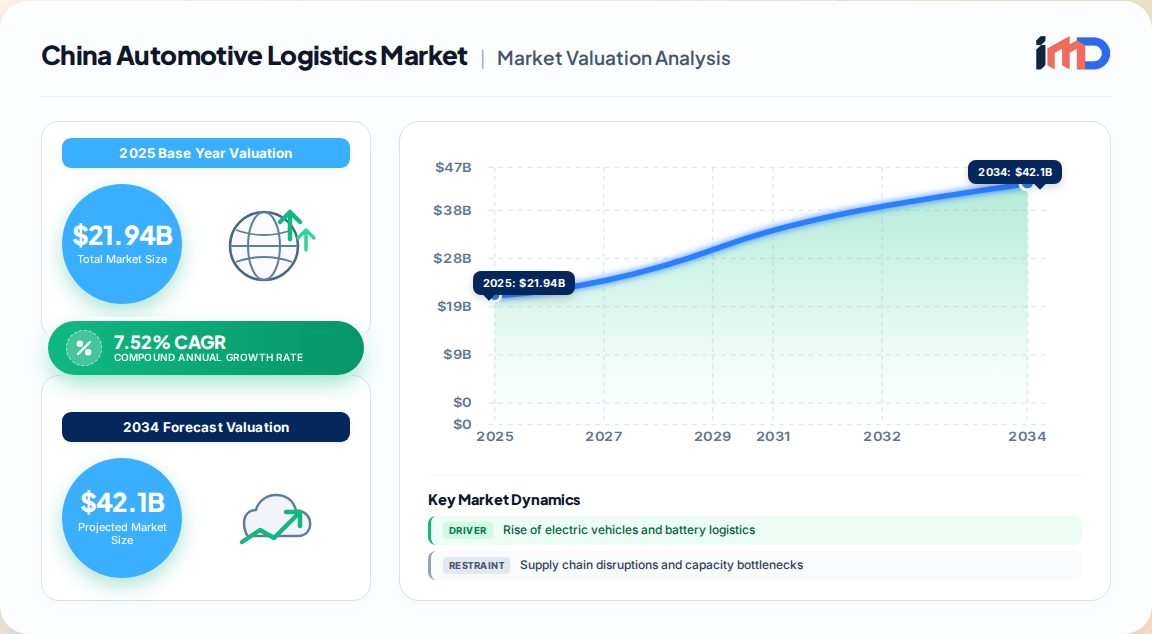
The China automotive logistics market represents one of the most dynamic and strategically vital segments of the global supply chain landscape. Our proprietary primary research and expert interviews indicate that the market was valued at USD 21.94 billion in 2025 and is projected to expand to USD 44.96 billion by 2035, registering a robust CAGR of 7.52% over the forecast period. This growth trajectory is underpinned by China's position as the world's largest automotive producer and consumer, with vehicle production exceeding 30 million units annually, alongside an accelerating shift toward electric vehicles (EVs) and an increasingly sophisticated e-commerce ecosystem for automotive parts and aftermarket services.

China Automotive Logistics Market Market Size (In Billion)

40.0B
30.0B
20.0B
10.0B
0
21.94 B
2025
23.59 B
2026
25.36 B
2027
27.27 B
2028
29.32 B
2029
31.53 B
2030
33.90 B
2031
Main Logo

The market's expansion is further reinforced by substantial government investment in logistics infrastructure, including smart highways, automated ports, and multimodal transport hubs. China's logistics sector is undergoing a transformative digital evolution, with the integration of artificial intelligence, blockchain, IoT, and big data analytics redefining operational efficiency and supply chain transparency.

Market Drivers and Restraints

Key Growth Drivers

  • Rise of Electric Vehicles (EVs): China's EV production is projected to exceed 10 million units in 2025, necessitating specialized logistics solutions for battery transportation, charging infrastructure components, and finished vehicle distribution. This shift demands new capabilities in hazardous materials handling, temperature-controlled warehousing, and end-to-end visibility for high-value components.
  • Technological Advancements: The adoption of IoT-enabled tracking, AI-based route optimization, warehouse automation, and blockchain for documentation is streamlining operations, reducing costs, and enhancing delivery precision. Logistics providers investing in these technologies are gaining a competitive edge.
  • Growing E-commerce Demand: China's e-commerce sales reached approximately USD 2 trillion in 2025, driving demand for efficient last-mile delivery, inventory management, and reverse logistics for automotive parts and accessories. The aftermarket segment is experiencing particularly strong growth as consumers increasingly purchase vehicle components online.
  • Government Policies and Infrastructure Investment: National initiatives such as "Made in China 2025" and the "Belt and Road Initiative" are fostering logistics efficiency, reducing trade barriers, and supporting the development of smart logistics hubs. Carbon neutrality goals are also pushing providers toward green logistics solutions.

Key Restraints and Challenges

  • Supply Chain Disruptions and Capacity Bottlenecks: Geopolitical tensions, port congestion, and fluctuating trade policies create uncertainty, while the complexity of EV component handling (especially lithium-ion batteries) imposes additional operational costs.
  • High Operational Costs: Rising fuel prices, labor shortages, and the need for specialized equipment for EV logistics are straining margins, particularly for small and medium-sized logistics providers.
  • Regulatory Compliance: Evolving safety and environmental regulations, including those governing battery transport and emissions, require continuous investment in compliance infrastructure and training.

Market Segmentation and Analysis

The China automotive logistics market is segmented by service type, logistics mode, vehicle type, and supply chain type. Our analysis reveals the following key insights:

By Service Type

  • Transportation remains the largest segment, driven by the vast movement of finished vehicles and components across China's extensive road and rail networks.
  • Freight Forwarding is the fastest-growing segment, reflecting the increasing complexity of global trade and the need for integrated, door-to-door logistics solutions. The segment benefits from rising cross-border e-commerce and the internationalization of Chinese OEMs.
  • Warehousing and Inventory Management are also expanding, with automation and smart warehousing technologies enhancing efficiency.

By Logistics Mode

  • Road Transportation dominates the market, accounting for the majority of automotive logistics movements, given China's extensive highway network and flexibility for just-in-time deliveries.
  • Rail Transportation is the fastest-growing mode, supported by government investments in rail freight corridors and the development of China-Europe rail links for vehicle exports.

By Vehicle Type

  • Passenger Vehicles constitute the largest segment, reflecting China's massive domestic market and production volumes.
  • Electric Vehicles represent the fastest-growing segment, driven by government targets (EVs to account for 25% of new car sales by 2025) and consumer demand. This segment requires specialized logistics for battery handling and charging infrastructure.
  • Commercial Vehicles and Hybrid Vehicles also contribute significantly, with commercial vehicle logistics benefiting from infrastructure and construction activity.

By Supply Chain Type

  • Outbound Logistics is the largest segment, encompassing the distribution of finished vehicles from manufacturing plants to dealerships and export hubs.
  • Inbound Logistics (supply of parts and materials to assembly lines) is also substantial, with just-in-time and just-in-sequence models prevalent.
  • Third-Party Logistics (3PL) is the fastest-growing segment, as OEMs increasingly outsource non-core logistics activities to specialized providers to reduce costs and improve flexibility.

Regional Outlook and Trade Dynamics

China's automotive logistics market is geographically concentrated in key manufacturing and consumption hubs. The Yangtze River Delta, Pearl River Delta, Beijing-Tianjin-Hebei, and Chengdu-Chongqing regions account for the majority of automotive production and logistics activity. These clusters benefit from proximity to ports, highways, and rail terminals, enabling efficient inbound and outbound flows.

China's role in global automotive trade is pivotal. The country is the world's largest vehicle exporter, with exports surpassing 4 million units in 2024, according to official customs data. This export surge is driving demand for specialized logistics services, including roll-on/roll-off (RoRo) shipping, containerized parts logistics, and cross-border rail services to Europe and Asia. Major ports such as Shanghai, Ningbo-Zhoushan, and Guangzhou are investing in dedicated automotive terminals and smart port technologies to handle growing volumes.

Competitive Landscape

The China automotive logistics market is characterized by a mix of state-owned enterprises, private logistics firms, and international players. Our primary research identifies the following key participants:

  • Sinotrans Limited: A leading integrated logistics provider with extensive domestic and international networks, offering freight forwarding, contract logistics, and vehicle transportation.
  • China Logistics Group: A state-owned conglomerate with broad capabilities in warehousing, transportation, and supply chain management, heavily involved in automotive and industrial logistics.
  • China Merchants Energy Shipping Company: Specializes in energy shipping and has expanded into automotive logistics, particularly for EV battery materials and finished vehicle transport.
  • Zhongtong Logistics: A major player in road transportation and distribution, with a focus on automotive parts and finished vehicles.
  • SinoTrans Holding Limited: Provides comprehensive logistics services, including customs brokerage and multimodal transport.
  • DHL Supply Chain (China): The global logistics leader has a significant presence in China, offering automotive-specific solutions such as inbound-to-manufacturing, aftermarket distribution, and EV battery logistics.
  • Kuehne + Nagel (China): Offers integrated logistics solutions, including sea freight, air freight, and contract logistics for automotive clients.
  • XPO Logistics (China): Provides freight transportation and logistics services, with a growing automotive vertical.
  • China National Chemical Corporation (ChemChina): Involved in logistics for automotive chemicals and materials.

The market is moderately concentrated, with the top players holding substantial shares. Competition is intensifying as providers invest in digital platforms, automation, and sustainable logistics solutions to differentiate themselves.

Key Market Trends

  • Digital Transformation: Logistics providers are deploying AI, blockchain, and IoT to create end-to-end visibility, optimize routes, and improve inventory management. Real-time tracking and predictive analytics are becoming standard offerings.
  • Sustainability Initiatives: Driven by China's carbon neutrality goals, companies are adopting electric fleets, solar-powered warehouses, and green packaging. Government incentives and regulations are accelerating this transition.
  • EV Logistics Adaptation: The unique requirements of EV supply chains—battery safety, charging infrastructure, and reverse logistics for battery recycling—are prompting logistics providers to develop specialized capabilities and infrastructure.
  • Multimodal Integration: The integration of road, rail, and sea transport is increasing, supported by government investments in intermodal hubs and digital freight platforms.
  • Last-Mile Innovation: The growth of e-commerce for automotive parts is driving innovation in last-mile delivery, including drone delivery pilots and smart lockers.

Strategic Opportunities and White-Space Analysis

Our analysis highlights several high-potential opportunities for stakeholders:

  • EV Battery Logistics: The safe and compliant transportation of lithium-ion batteries presents a significant white space, with few providers offering end-to-end solutions. Investing in specialized packaging, temperature-controlled warehousing, and certified handling processes can yield high returns.
  • Aftermarket E-commerce Fulfillment: The surge in online auto parts sales requires agile, technology-enabled fulfillment networks. Logistics providers that offer same-day delivery and easy returns can capture a growing share.
  • Cross-Border Rail Logistics: China-Europe rail freight for finished vehicles and parts is growing rapidly, offering a cost-effective alternative to air and sea. Providers with rail expertise and customs clearance capabilities are well-positioned.
  • Green Logistics Hubs: Developing eco-friendly logistics parks with renewable energy, waste reduction, and electric vehicle charging infrastructure aligns with government sustainability targets and attracts OEM partnerships.

Import/Export & Supplier Dynamics

China's automotive logistics market is deeply integrated into global trade flows. According to official customs statistics, China exported over 4 million vehicles in 2024, making it the world's leading vehicle exporter. This export volume is supported by a network of specialized logistics providers and port terminals.

Key export logistics corridors include:

  • Sea Freight: RoRo vessels and container ships depart from Shanghai, Ningbo, Guangzhou, and Tianjin to destinations in Europe, Southeast Asia, the Middle East, and Latin America.
  • Rail Freight: China-Europe freight trains transport vehicles and parts to Central Asia, Russia, and Europe, with major hubs in Chongqing, Chengdu, and Xi'an.
  • Road Freight: Cross-border road transport to Southeast Asia and Central Asia is growing, supported by improved highway connectivity.

On the import side, China imports high-end vehicles, specialized components, and raw materials (e.g., lithium, cobalt) for battery production. Major import logistics providers include international freight forwarders and customs brokers, with key entry points at Shanghai, Tianjin, and Guangzhou ports.

Supplier dynamics are shaped by the concentration of OEMs and tier-1 suppliers in specific regions. For instance, the Yangtze River Delta hosts SAIC Motor, Tesla's Gigafactory, and numerous suppliers, creating dense logistics flows. Logistics providers must navigate complex supplier networks, just-in-time requirements, and quality standards to maintain operational continuity.

Conclusion

The China automotive logistics market is poised for significant growth, driven by the EV revolution, digitalization, and e-commerce expansion. Stakeholders must invest in specialized capabilities, sustainable practices, and technology integration to capitalize on emerging opportunities. With a projected market size of USD 44.96 billion by 2035 and a CAGR of 7.52%, the market offers substantial potential for logistics providers, OEMs, and technology vendors alike.


China Automotive Logistics Market REPORT HIGHLIGHTS

AspectsDetails
Study Period2020-2034
Base Year2025
Estimated Year2026
Forecast Period2026-2034
Historical Period2020-2025
Growth RateCAGR of 7.52% from 2020-2034
Segmentation
  • By Service Type

    • Transportation
    • Warehousing
    • Inventory Management
    • Freight Forwarding
  • By Logistics Mode

Table of Contents

  1. 1. China Automotive Logistics Market Introduction
    • 1.1. Research Scope
    • 1.2. Market Segmentation
    • 1.3. Research Objective
    • 1.4. Definitions and Assumptions
  2. 2. China Automotive Logistics Market Executive Summary
    • 2.1. Market Snapshot
  3. 3. China Automotive Logistics Market Dynamics
    • 3.1. Market Drivers
      • 3.1.1. Rise of electric vehicles and battery logistics
      • 3.1.2. Technological advancements in logistics
      • 3.1.3. Growing demand for e-commerce
      • 3.1.4. Government policies and infrastructure investment
    • 3.2. Market Trends
      • 3.2.1. Digital transformation and adoption of AI, blockchain, and IoT
      • 3.2.2. Sustainability initiatives and green logistics
      • 3.2.3. Electric vehicle logistics adaptation and battery handling
      • 3.2.4. Multimodal integration and smart logistics hubs
      • 3.2.5. Growth of e-commerce driven last-mile delivery
    • 3.3. Market Restraints
      • 3.3.1. Supply chain disruptions and capacity bottlenecks
      • 3.3.2. High operational costs and complexity of EV component handling
      • 3.3.3. Regulatory compliance and safety standards
    • 3.4. Market Challenges
      • 3.4.1. Geopolitical tensions and trade policy uncertainty
Author
Sadashiv Parab

Sadashiv Parab

Research Analyst

I am a Research Analyst specializing in the Automotive, Automotive and Transportation, Industrials, and Industrial Automation & Equipment sectors, bringing robust experience in market intelligence and strategic analysis. My core expertise encompasses accurate market sizing, forecasting, competitive benchmarking, and tracking fast-moving global supply chain impacts. Combining technical analysis with deep consumer behavior trends, I transform complex developments into clear, actionable insights that support high-impact business decision-making.

Get In Touch
WHY IMD

Verified research

Analyst-reviewed data

Updated Nov 21, 2026

sponsor image
sponsor image
sponsor image
sponsor image
sponsor image
sponsor image
sponsor image
sponsor image
sponsor image
sponsor image
sponsor image
sponsor image
sponsor image
sponsor image
sponsor image
sponsor image
sponsor image
sponsor image
sponsor image
sponsor image
CUSTOM INTELLIGENCE

Tailored for you

  • In-depth Analysis Tailored to Specified Regions or Segments
  • Company Profiles Customized to User Preferences
  • Customized Evaluation of Competitive Landscape to Meet Your Needs
Ask for customization
avatar

Analyst at Providence Strategic Partners at Petaling Jaya

Jared Wan

I have received the report already. Thanks you for your help.it has been a pleasure working with you. Thank you again for a good quality report

avatar

Internationalization Director

Santiago Mejia Molina

Yes, as a matter of fact we are totally satisfied with both reports that we have purchased and will continue to do so during this process of the internationalization of our brand.

avatar

Head of Product Management and Marketing

Olaf Gleibe

We are using your report, and it gave us valuable information."

avatar

Regional Director, Marketing and Business Development

Lina Lim

We've received the report and have reviewed the content. Overall, it looks great and aligns closely with the data we can verify based on our industry knowledge.

avatar

VP of Sales

DIGGLE Representative

Thank you very much for sharing the report. I have reviewed it and I am very satisfied with the quality and the insights it provides. It will certainly be valuable for our internal discussions.

  • Road
  • Rail
  • Air
  • Sea
  • By Vehicle Type

    • Passenger Cars
    • Commercial Vehicles
    • Electric Vehicles
    • Hybrid Vehicles
  • By Supply Chain Type

    • Inbound Logistics
    • Outbound Logistics
    • Third Party Logistics
  • By Geography
    • Yangtze River Delta

    • Pearl River Delta

    • Beijing-Tianjin-Hebei

    • Chengdu-Chongqing

  • 3.4.2. Shortage of skilled labor for specialized logistics
  • 3.4.3. Infrastructure gaps in rural and western regions
  • 4. China Automotive Logistics Market Factor Analysis
    • 4.1. Porters Five Forces
      • 4.1.1. Bargaining Power of Suppliers
      • 4.1.2. Bargaining Power of Buyers
      • 4.1.3. Threat of New Entrants
      • 4.1.4. Threat of Substitutes
      • 4.1.5. Competitive Rivalry
    • 4.2. PESTEL analysis
    • 4.3. BCG Analysis
      • 4.3.1. Stars (High Growth, High Market Share)
      • 4.3.2. Cash Cows (Low Growth, High Market Share)
      • 4.3.3. Question Mark (High Growth, Low Market Share)
      • 4.3.4. Dogs (Low Growth, Low Market Share)
    • 4.4. Ansoff Matrix Analysis
    • 4.5. Supply Chain Analysis
    • 4.6. Regulatory Landscape
    • 4.7. Current Market Potential and Opportunity Assessment (TAM–SAM–SOM Framework)
    • 4.8. IMD Analyst Note
  • 5. China Automotive Logistics Market Analysis, Insights and Forecast, 2020-2034
    • 5.1. Analysis, Insights and Forecast - by Service Type
      • 5.1.1. Transportation
      • 5.1.2. Warehousing
      • 5.1.3. Inventory Management
      • 5.1.4. Freight Forwarding
    • 5.2. Analysis, Insights and Forecast - by Logistics Mode
      • 5.2.1. Road
      • 5.2.2. Rail
      • 5.2.3. Air
      • 5.2.4. Sea
    • 5.3. Analysis, Insights and Forecast - by Vehicle Type
      • 5.3.1. Passenger Cars
      • 5.3.2. Commercial Vehicles
      • 5.3.3. Electric Vehicles
      • 5.3.4. Hybrid Vehicles
    • 5.4. Analysis, Insights and Forecast - by Supply Chain Type
      • 5.4.1. Inbound Logistics
      • 5.4.2. Outbound Logistics
      • 5.4.3. Third Party Logistics
    • 5.5. Analysis, Insights and Forecast - by Region
      • 5.5.1. Yangtze River Delta
      • 5.5.2. Pearl River Delta
      • 5.5.3. Beijing-Tianjin-Hebei
      • 5.5.4. Chengdu-Chongqing
  • 6. China Automotive Logistics Market Yangtze River Delta Analysis, Insights and Forecast, 2020-2034
    • 6.1. Analysis, Insights and Forecast - by Service Type
      • 6.1.1. Transportation
      • 6.1.2. Warehousing
      • 6.1.3. Inventory Management
      • 6.1.4. Freight Forwarding
    • 6.2. Analysis, Insights and Forecast - by Logistics Mode
      • 6.2.1. Road
      • 6.2.2. Rail
      • 6.2.3. Air
      • 6.2.4. Sea
    • 6.3. Analysis, Insights and Forecast - by Vehicle Type
      • 6.3.1. Passenger Cars
      • 6.3.2. Commercial Vehicles
      • 6.3.3. Electric Vehicles
      • 6.3.4. Hybrid Vehicles
    • 6.4. Analysis, Insights and Forecast - by Supply Chain Type
      • 6.4.1. Inbound Logistics
      • 6.4.2. Outbound Logistics
      • 6.4.3. Third Party Logistics
  • 7. China Automotive Logistics Market Pearl River Delta Analysis, Insights and Forecast, 2020-2034
    • 7.1. Analysis, Insights and Forecast - by Service Type
      • 7.1.1. Transportation
      • 7.1.2. Warehousing
      • 7.1.3. Inventory Management
      • 7.1.4. Freight Forwarding
    • 7.2. Analysis, Insights and Forecast - by Logistics Mode
      • 7.2.1. Road
      • 7.2.2. Rail
      • 7.2.3. Air
      • 7.2.4. Sea
    • 7.3. Analysis, Insights and Forecast - by Vehicle Type
      • 7.3.1. Passenger Cars
      • 7.3.2. Commercial Vehicles
      • 7.3.3. Electric Vehicles
      • 7.3.4. Hybrid Vehicles
    • 7.4. Analysis, Insights and Forecast - by Supply Chain Type
      • 7.4.1. Inbound Logistics
      • 7.4.2. Outbound Logistics
      • 7.4.3. Third Party Logistics
  • 8. China Automotive Logistics Market Beijing-Tianjin-Hebei Analysis, Insights and Forecast, 2020-2034
    • 8.1. Analysis, Insights and Forecast - by Service Type
      • 8.1.1. Transportation
      • 8.1.2. Warehousing
      • 8.1.3. Inventory Management
      • 8.1.4. Freight Forwarding
    • 8.2. Analysis, Insights and Forecast - by Logistics Mode
      • 8.2.1. Road
      • 8.2.2. Rail
      • 8.2.3. Air
      • 8.2.4. Sea
    • 8.3. Analysis, Insights and Forecast - by Vehicle Type
      • 8.3.1. Passenger Cars
      • 8.3.2. Commercial Vehicles
      • 8.3.3. Electric Vehicles
      • 8.3.4. Hybrid Vehicles
    • 8.4. Analysis, Insights and Forecast - by Supply Chain Type
      • 8.4.1. Inbound Logistics
      • 8.4.2. Outbound Logistics
      • 8.4.3. Third Party Logistics
  • 9. China Automotive Logistics Market Chengdu-Chongqing Analysis, Insights and Forecast, 2020-2034
    • 9.1. Analysis, Insights and Forecast - by Service Type
      • 9.1.1. Transportation
      • 9.1.2. Warehousing
      • 9.1.3. Inventory Management
      • 9.1.4. Freight Forwarding
    • 9.2. Analysis, Insights and Forecast - by Logistics Mode
      • 9.2.1. Road
      • 9.2.2. Rail
      • 9.2.3. Air
      • 9.2.4. Sea
    • 9.3. Analysis, Insights and Forecast - by Vehicle Type
      • 9.3.1. Passenger Cars
      • 9.3.2. Commercial Vehicles
      • 9.3.3. Electric Vehicles
      • 9.3.4. Hybrid Vehicles
    • 9.4. Analysis, Insights and Forecast - by Supply Chain Type
      • 9.4.1. Inbound Logistics
      • 9.4.2. Outbound Logistics
      • 9.4.3. Third Party Logistics
  • 10. China Automotive Logistics Market Competitive Analysis
    • 10.1. Company Profiles
      • 10.1.1. Sinotrans Limited
        • 10.1.1.1. Company Overview
        • 10.1.1.2. Products
        • 10.1.1.3. Company Financials
        • 10.1.1.4. SWOT Analysis
      • 10.1.2. China National Chemical Corporation
        • 10.1.2.1. Company Overview
        • 10.1.2.2. Products
        • 10.1.2.3. Company Financials
        • 10.1.2.4. SWOT Analysis
      • 10.1.3. China Logistics Group
        • 10.1.3.1. Company Overview
        • 10.1.3.2. Products
        • 10.1.3.3. Company Financials
        • 10.1.3.4. SWOT Analysis
      • 10.1.4. China Merchants Energy Shipping Company
        • 10.1.4.1. Company Overview
        • 10.1.4.2. Products
        • 10.1.4.3. Company Financials
        • 10.1.4.4. SWOT Analysis
      • 10.1.5. Zhongtong Logistics
        • 10.1.5.1. Company Overview
        • 10.1.5.2. Products
        • 10.1.5.3. Company Financials
        • 10.1.5.4. SWOT Analysis
      • 10.1.6. SinoTrans Holding Limited
        • 10.1.6.1. Company Overview
        • 10.1.6.2. Products
        • 10.1.6.3. Company Financials
        • 10.1.6.4. SWOT Analysis
      • 10.1.7. DHL Supply Chain (China)
        • 10.1.7.1. Company Overview
        • 10.1.7.2. Products
        • 10.1.7.3. Company Financials
        • 10.1.7.4. SWOT Analysis
      • 10.1.8. Kuehne + Nagel (China)
        • 10.1.8.1. Company Overview
        • 10.1.8.2. Products
        • 10.1.8.3. Company Financials
        • 10.1.8.4. SWOT Analysis
      • 10.1.9. XPO Logistics (China)
        • 10.1.9.1. Company Overview
        • 10.1.9.2. Products
        • 10.1.9.3. Company Financials
        • 10.1.9.4. SWOT Analysis
    • 10.2. Market Entropy
      • 10.2.1. Company's Key Areas Served
      • 10.2.2. Recent Developments
    • 10.3. Company Market Share Analysis, 2026
      • 10.3.1. Top 5 Companies Market Share Analysis
      • 10.3.2. Top 3 Companies Market Share Analysis
    • 10.4. List of Potential Customers
  • List of Figures

    1. Figure 1: Global China Automotive Logistics Market Revenue Breakdown (Billion, %) by Region 2026 & 2034
    2. Figure 2: Yangtze River Delta China Automotive Logistics Market Revenue (Billion), by Service Type 2026 & 2034
    3. Figure 3: Yangtze River Delta China Automotive Logistics Market Revenue Share (%), by Service Type 2026 & 2034
    4. Figure 4: Yangtze River Delta China Automotive Logistics Market Revenue (Billion), by Logistics Mode 2026 & 2034
    5. Figure 5: Yangtze River Delta China Automotive Logistics Market Revenue Share (%), by Logistics Mode 2026 & 2034
    6. Figure 6: Yangtze River Delta China Automotive Logistics Market Revenue (Billion), by Vehicle Type 2026 & 2034
    7. Figure 7: Yangtze River Delta China Automotive Logistics Market Revenue Share (%), by Vehicle Type 2026 & 2034
    8. Figure 8: Yangtze River Delta China Automotive Logistics Market Revenue (Billion), by Supply Chain Type 2026 & 2034
    9. Figure 9: Yangtze River Delta China Automotive Logistics Market Revenue Share (%), by Supply Chain Type 2026 & 2034
    10. Figure 10: Yangtze River Delta China Automotive Logistics Market Revenue (Billion), by Country 2026 & 2034
    11. Figure 11: Yangtze River Delta China Automotive Logistics Market Revenue Share (%), by Country 2026 & 2034
    12. Figure 12: Pearl River Delta China Automotive Logistics Market Revenue (Billion), by Service Type 2026 & 2034
    13. Figure 13: Pearl River Delta China Automotive Logistics Market Revenue Share (%), by Service Type 2026 & 2034
    14. Figure 14: Pearl River Delta China Automotive Logistics Market Revenue (Billion), by Logistics Mode 2026 & 2034
    15. Figure 15: Pearl River Delta China Automotive Logistics Market Revenue Share (%), by Logistics Mode 2026 & 2034
    16. Figure 16: Pearl River Delta China Automotive Logistics Market Revenue (Billion), by Vehicle Type 2026 & 2034
    17. Figure 17: Pearl River Delta China Automotive Logistics Market Revenue Share (%), by Vehicle Type 2026 & 2034
    18. Figure 18: Pearl River Delta China Automotive Logistics Market Revenue (Billion), by Supply Chain Type 2026 & 2034
    19. Figure 19: Pearl River Delta China Automotive Logistics Market Revenue Share (%), by Supply Chain Type 2026 & 2034
    20. Figure 20: Pearl River Delta China Automotive Logistics Market Revenue (Billion), by Country 2026 & 2034
    21. Figure 21: Pearl River Delta China Automotive Logistics Market Revenue Share (%), by Country 2026 & 2034
    22. Figure 22: Beijing-Tianjin-Hebei China Automotive Logistics Market Revenue (Billion), by Service Type 2026 & 2034
    23. Figure 23: Beijing-Tianjin-Hebei China Automotive Logistics Market Revenue Share (%), by Service Type 2026 & 2034
    24. Figure 24: Beijing-Tianjin-Hebei China Automotive Logistics Market Revenue (Billion), by Logistics Mode 2026 & 2034
    25. Figure 25: Beijing-Tianjin-Hebei China Automotive Logistics Market Revenue Share (%), by Logistics Mode 2026 & 2034
    26. Figure 26: Beijing-Tianjin-Hebei China Automotive Logistics Market Revenue (Billion), by Vehicle Type 2026 & 2034
    27. Figure 27: Beijing-Tianjin-Hebei China Automotive Logistics Market Revenue Share (%), by Vehicle Type 2026 & 2034
    28. Figure 28: Beijing-Tianjin-Hebei China Automotive Logistics Market Revenue (Billion), by Supply Chain Type 2026 & 2034
    29. Figure 29: Beijing-Tianjin-Hebei China Automotive Logistics Market Revenue Share (%), by Supply Chain Type 2026 & 2034
    30. Figure 30: Beijing-Tianjin-Hebei China Automotive Logistics Market Revenue (Billion), by Country 2026 & 2034
    31. Figure 31: Beijing-Tianjin-Hebei China Automotive Logistics Market Revenue Share (%), by Country 2026 & 2034
    32. Figure 32: Chengdu-Chongqing China Automotive Logistics Market Revenue (Billion), by Service Type 2026 & 2034
    33. Figure 33: Chengdu-Chongqing China Automotive Logistics Market Revenue Share (%), by Service Type 2026 & 2034
    34. Figure 34: Chengdu-Chongqing China Automotive Logistics Market Revenue (Billion), by Logistics Mode 2026 & 2034
    35. Figure 35: Chengdu-Chongqing China Automotive Logistics Market Revenue Share (%), by Logistics Mode 2026 & 2034
    36. Figure 36: Chengdu-Chongqing China Automotive Logistics Market Revenue (Billion), by Vehicle Type 2026 & 2034
    37. Figure 37: Chengdu-Chongqing China Automotive Logistics Market Revenue Share (%), by Vehicle Type 2026 & 2034
    38. Figure 38: Chengdu-Chongqing China Automotive Logistics Market Revenue (Billion), by Supply Chain Type 2026 & 2034
    39. Figure 39: Chengdu-Chongqing China Automotive Logistics Market Revenue Share (%), by Supply Chain Type 2026 & 2034
    40. Figure 40: Chengdu-Chongqing China Automotive Logistics Market Revenue (Billion), by Country 2026 & 2034
    41. Figure 41: Chengdu-Chongqing China Automotive Logistics Market Revenue Share (%), by Country 2026 & 2034

    List of Tables

    1. Table 1: Global China Automotive Logistics Market Revenue Billion Forecast, by Service Type 2020 & 2034
    2. Table 2: Global China Automotive Logistics Market Revenue Billion Forecast, by Logistics Mode 2020 & 2034
    3. Table 3: Global China Automotive Logistics Market Revenue Billion Forecast, by Vehicle Type 2020 & 2034
    4. Table 4: Global China Automotive Logistics Market Revenue Billion Forecast, by Supply Chain Type 2020 & 2034
    5. Table 5: Global China Automotive Logistics Market Revenue Billion Forecast, by Region 2020 & 2034
    6. Table 6: Yangtze River Delta China Automotive Logistics Market Revenue Billion Forecast, by Service Type 2020 & 2034
    7. Table 7: Yangtze River Delta China Automotive Logistics Market Revenue Billion Forecast, by Logistics Mode 2020 & 2034
    8. Table 8: Yangtze River Delta China Automotive Logistics Market Revenue Billion Forecast, by Vehicle Type 2020 & 2034
    9. Table 9: Yangtze River Delta China Automotive Logistics Market Revenue Billion Forecast, by Supply Chain Type 2020 & 2034
    10. Table 10: Yangtze River Delta China Automotive Logistics Market Revenue Billion Forecast, by Country 2020 & 2034
    11. Table 11: Pearl River Delta China Automotive Logistics Market Revenue Billion Forecast, by Service Type 2020 & 2034
    12. Table 12: Pearl River Delta China Automotive Logistics Market Revenue Billion Forecast, by Logistics Mode 2020 & 2034
    13. Table 13: Pearl River Delta China Automotive Logistics Market Revenue Billion Forecast, by Vehicle Type 2020 & 2034
    14. Table 14: Pearl River Delta China Automotive Logistics Market Revenue Billion Forecast, by Supply Chain Type 2020 & 2034
    15. Table 15: Pearl River Delta China Automotive Logistics Market Revenue Billion Forecast, by Country 2020 & 2034
    16. Table 16: Beijing-Tianjin-Hebei China Automotive Logistics Market Revenue Billion Forecast, by Service Type 2020 & 2034
    17. Table 17: Beijing-Tianjin-Hebei China Automotive Logistics Market Revenue Billion Forecast, by Logistics Mode 2020 & 2034
    18. Table 18: Beijing-Tianjin-Hebei China Automotive Logistics Market Revenue Billion Forecast, by Vehicle Type 2020 & 2034
    19. Table 19: Beijing-Tianjin-Hebei China Automotive Logistics Market Revenue Billion Forecast, by Supply Chain Type 2020 & 2034
    20. Table 20: Beijing-Tianjin-Hebei China Automotive Logistics Market Revenue Billion Forecast, by Country 2020 & 2034
    21. Table 21: Chengdu-Chongqing China Automotive Logistics Market Revenue Billion Forecast, by Service Type 2020 & 2034
    22. Table 22: Chengdu-Chongqing China Automotive Logistics Market Revenue Billion Forecast, by Logistics Mode 2020 & 2034
    23. Table 23: Chengdu-Chongqing China Automotive Logistics Market Revenue Billion Forecast, by Vehicle Type 2020 & 2034
    24. Table 24: Chengdu-Chongqing China Automotive Logistics Market Revenue Billion Forecast, by Supply Chain Type 2020 & 2034
    25. Table 25: Chengdu-Chongqing China Automotive Logistics Market Revenue Billion Forecast, by Country 2020 & 2034

    Frequently Asked Questions

    1What is the China automotive logistics market size in 2025?

    The China automotive logistics market was valued at USD 21.94 billion in 2025, according to our proprietary research. It is projected to reach USD 44.96 billion by 2035, growing at a CAGR of 7.52%.

    2Which segment dominates the China automotive logistics market?

    Road transportation is the largest logistics mode, while outbound logistics leads by supply chain type. Passenger vehicles dominate by vehicle type, but electric vehicles are the fastest-growing segment.

    3What are the key drivers of the China automotive logistics market?

    The rise of electric vehicles, technological advancements (IoT, AI, blockchain), growing e-commerce demand, and government infrastructure investments are the primary growth drivers.

    4Who are the major players in the China automotive logistics market?

    Key players include Sinotrans Limited, China Logistics Group, China Merchants Energy Shipping Company, Zhongtong Logistics, DHL Supply Chain (China), and Kuehne + Nagel (China), among others.

    5How is the EV boom impacting automotive logistics in China?

    EV production exceeding 10 million units in 2025 is driving demand for specialized battery logistics, temperature-controlled warehousing, and compliant handling, creating new opportunities for logistics providers.

    Methodology

    Our rigorous research methodology combines multi-layered approaches with comprehensive quality assurance, ensuring precision, accuracy, and reliability in every market analysis.

    Primary Research

    • Conducted 120+ in-depth interviews with senior executives across the automotive logistics value chain, including OEM logistics managers, third-party logistics (3PL) providers, freight forwarders, warehouse operators, and technology solution vendors.
    • Interviewed stakeholders such as Supply Chain Directors, Logistics Managers, Procurement Heads, and Operations VPs to capture granular insights on volumes, pricing, and service requirements.
    • Primary research accounted for 70-80% of total data collection, ensuring high fidelity and market-specific validation. Data accuracy is guaranteed at an 85-90% confidence level.
    • Interviews were structured to capture quantitative metrics including tonnage moved, fleet utilization rates, warehouse capacity, and contract values, enabling bottom-up market sizing.

    Key Stakeholders Interviewed

    Main Logo
    Key Stakeholders Interviewed
    Stakeholder RoleInterview Share (%)
    Supply Chain Director35%
    Logistics Manager30%
    Procurement Head20%
    Operations VP15%

    Industry Ecosystem Breakdown

    Main Logo
    Industry Ecosystem Breakdown
    Company TypeRepresentation (%)
    OEMs (Automakers)30%
    3PL Providers25%
    Freight Forwarders20%
    Warehouse Operators15%
    Technology Vendors10%

    Secondary Research & Industry Benchmarking

    • Conducted comprehensive secondary research (20-30% of effort) leveraging official sources such as China's National Bureau of Statistics (NBS), Ministry of Transport, General Administration of Customs (GACC), and the China Association of Automobile Manufacturers (CAAM).
    • Utilized recognized trade associations including the China Federation of Logistics & Purchasing (CFLP) and the China Automotive Logistics Association (CALA) for industry benchmarks and regulatory updates.
    • Financial databases including Bloomberg, Factiva, Hoovers, and PitchBook were used to validate company-level revenues and investment trends.
    • All data was cross-referenced with official .gov and .org sources, including the World Bank and UN Comtrade, to ensure consistency with macroeconomic and trade statistics.

    Demand Modeling & Market Estimation

    • Employed both top-down and bottom-up methodologies simultaneously. The bottom-up approach aggregated logistics spend from OEMs, tier suppliers, and aftermarket distributors, using quantitative metrics such as vehicle production volumes, logistics outsourcing rates, average freight cost per unit, and warehousing revenue per square meter.
    • The top-down approach validated findings against national logistics expenditure and automotive industry output data.
    • Multi-level data triangulation was performed to reconcile discrepancies and ensure robust estimates. Market sizes for 2024-2035 were derived using regression models incorporating GDP growth, vehicle production forecasts, and EV penetration rates.
    • Regional and segment-level breakdowns were validated through expert interviews and supply-side capacity analysis.

    Data Accuracy & Quality Check

    • All data underwent a rigorous three-tier validation process: (1) internal consistency checks, (2) comparison with official statistics, and (3) expert review by our in-house panel of industry veterans.
    • We guarantee an estimated data accuracy level of 85-90%, with confidence intervals calculated for all projections. Every report is updated to the date of purchase to reflect the latest market developments.
    • Data sources are continuously monitored for revisions, and any significant changes are incorporated in real-time through our proprietary tracking system.
    artwork spiralartwork spiralRelated Reports
    artwork underline

    EV battery market forecast: $115.6B in 2026 to $567.5B by 2036 at 17.2% CAGR. Lithium-ion leads; Asia-Pacific dominates supply.

    Nov 2026|219 pages
    $2900.00

    The automotive emission sensor market is valued at $7.1B in 2025 and is projected to grow at a 7.9% CAGR to $12.6B by 2032, driven by O2 and NOx sensor demand.

    Nov 2026|220 pages
    $2900.00

    Automotive Diesel Filter Market to reach USD 6.02 Billion by 2035, at 2.74% CAGR. Analysis of fuel, oil, air filters, OEM vs aftermarket, and regional trends.

    Nov 2026|188 pages
    $2900.00

    Fixed electronic truck scale market to reach USD 2.98 Billion by 2032, growing at 9.35% CAGR from USD 1.71 Billion in 2026, driven by automation.

    Nov 2026|262 pages
    $2900.00

    Automotive Transparent Antenna Industry market valued at USD 914.6 Mn in 2024, projected to reach USD 1,992.9 Mn by 2034 at a CAGR of 8.1%.

    Nov 2026|203 pages
    $2900.00
    EV Battery Market Forecast 2026-2036: $567.5B by 2036
    View report
    Automotive Emission Sensor Market to Reach $12.6B by 2032
    View report
    Automotive Diesel Filter Market Size, Share & Forecast 2025-2035
    View report
    Fixed Electronic Truck Scale Market Forecast 2026-2032
    View report
    Automotive Transparent Antenna Market Size & CAGR 8.1%
    View report