1What is the bicycle bags market size in 2025?
Our primary research values the global bicycle bags market at USD 757.70 million in 2025, with a projected rise to USD 1,162.83 million by 2033 at a 5.5% CAGR.
Insight Market Data is a premier market research and business consulting firm headquartered in Pune, India, providing syndicated research reports, customized intelligence studies, and strategic advisory services. Renowned academic institutions and Fortune 500 corporations worldwide rely on Insight Market Data's research repository to navigate evolving global and regional business environments. Covering 46 diverse industries across 25 major international economies, our comprehensive database delivers thousands of verified statistics and granular market evaluations. By combining industry-leading analytical methodologies with the direct insights of seasoned industry leaders and subject-matter experts, we deliver actionable intelligence spanning historical performance benchmarks to rigorous multi-year forecasts. We empower organizations to make confident, data-driven decisions across pivotal domains including Machinery & Equipment, Chemicals & Materials, Pharmaceuticals & Healthcare, Food & Beverages, Consumer Goods, Energy & Power, Automotive & Transportation, Electronics & Semiconductors, Medical Devices, Telecommunications, Emerging Technologies, Agriculture, and Packaging. Our multidisciplinary analyst teams provide an objective 360-degree perspective, tailoring every engagement to address complex strategic challenges with exceptional analytical rigor.
Leveraging advanced BI-powered analytics and predictive modeling, Insight Market Data uncovers high-impact market opportunities and competitive differentiators for ambitious enterprises. We continuously refine our research methodologies in accordance with global industry standards, tracking real-time market shifts to ensure our reports are consistently accurate, actionable, and delivered on schedule. Our analysts conduct methodical data validation, rigorous compliance checks, and exhaustive primary and secondary research to maintain the highest levels of data integrity and transparency. We partner closely with corporate strategists, investment groups, and business executives to translate intricate market intelligence into clear, actionable roadmaps for sustainable growth. With operational presence across Washington, USA, and Vimannagar, Pune, India, Insight Market Data ensures direct access to dedicated research specialists and responsive customer support to answer your most strategic questions.
 Bicycle Bags Market
 by Product Type (Cycle Carrier Bags/Panniers, Backpacks/Bag-Packs, Handlebar Bags, Saddle Bags, Trunk Bags, Frame Bags), by Material (Nylon, Polyester, Canvas, Leather, Polyurethane), by Capacity (Small, Medium, Large), by End Use (Commuting, Recreational Cycling, Professional Cycling), by Distribution Channel (Offline/Specialty Bicycle Retailer, Full-Line Sporting Goods, Departmental Stores, Online Retail), by Europe (Germany, UK, France, Netherlands, Italy, Spain), by North America (US, Canada, Mexico), by Asia-Pacific (China, Japan, India, South Korea, Australia), by South America (Brazil, Argentina, Chile), by Middle East & Africa (Saudi Arabia, UAE, South Africa) Forecast 2026-2034

Research Analyst


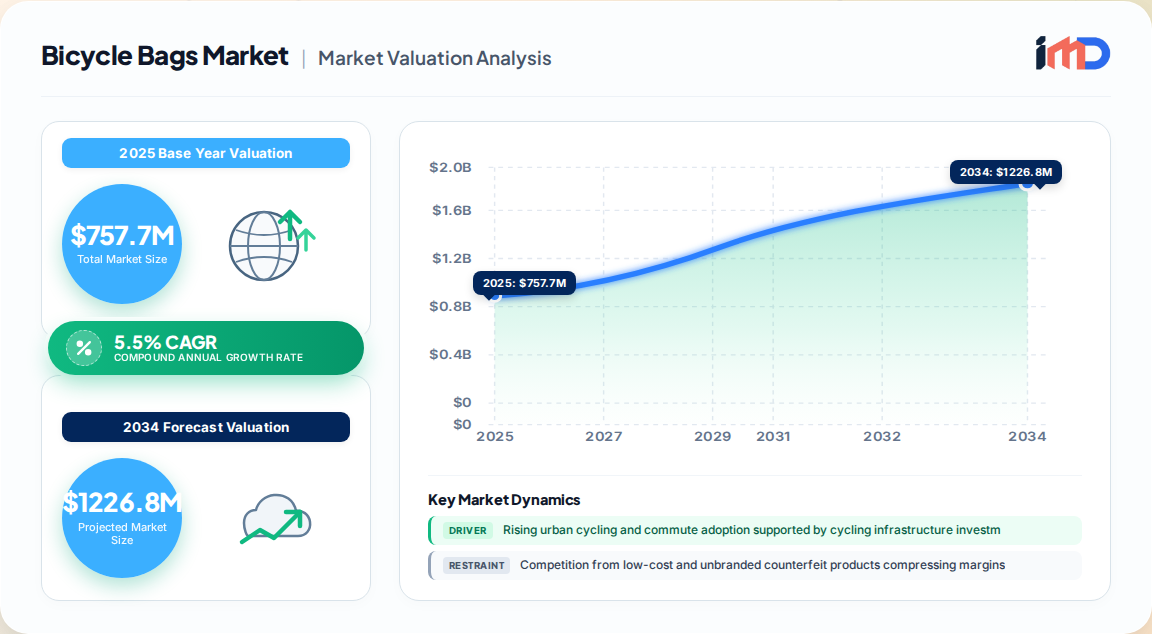
Our proprietary primary research places the global bicycle bags market at USD 757.70 million in 2025, with a clear trajectory to USD 1,162.83 million by 2033 — a 5.5% CAGR sustained by structural shifts toward utility cycling and adventure travel. The category has moved decisively from a fragmented accessory niche toward a structured, tiered market defined by waterproofing standards, modular mounting systems, and e-bike compatibility.
Two forces anchor baseline demand. First, urban cycling has become routine transport rather than recreation in major economies; national travel data from England show per-person cycling averaged 53 miles in 2024, up 12% year on year. Second, government cycling-to-work frameworks demonstrably change behavior — participation in the U.K.'s Cycle to Work Scheme lifted the share of participants cycling to work from roughly 38% to 74%.
Demand rests on durable, non-discretionary use cases. Commuters need secure laptop and document storage; touring and bikepacking riders require weather-sealed, load-distributing systems; delivery riders need high-capacity insulated carriers. Commercial deployment of insulated delivery carriers has improved last-mile efficiency by 27% versus traditional motorized alternatives, creating a genuine operational return on bag investment.
| Driver | Quantified Impact |
|---|---|
| Rising disposable incomes | Enables premium, durable adventure-gear purchases |
| Cycling infrastructure investment | Broadens daily-commuter addressable base |
| Seam-welded waterproof construction | 40% improvement in moisture-resistance reliability |
| Modular quick-release systems | Higher repeat purchase among daily commuters |
Restraints are equally concrete. Counterfeit and unbranded products compress margins and divert capital from R&D into authentication and brand protection. Seasonal demand — spring and summer peaks — creates inventory risk for distributors who over-order into colder months. Procurement of specialized synthetic fabrics remains a bottleneck, though supply-chain optimization for raw-material stability cuts production delays by 15%.
The market segments by product, material, capacity, end use, and distribution channel. Panniers and cycle carrier bags form the revenue core; handlebar, saddle, frame, and trunk bags serve specialized touring and commuting roles. Backpack-style bag-packs remain a strong secondary category for multi-modal commuters.
| Segment Dimension | Leading Category | Share / Insight |
|---|---|---|
| Product type | Cycle carrier bags (panniers) | 59.1% of 2025 revenue |
| Product type (alt. definition) | Cycle carrier bags / backpacks | 42.0% in 2026 |
| Material | Nylon | ~48% of revenue |
| Material (secondary) | Polyester, canvas, leather, polyurethane | Growing premium and eco tiers |
| Distribution | Offline / specialty retail | USD 89.02 million in 2024 |
| End use | Commuting, recreational, professional | Commuting anchors volume |
Offline specialty retail remains structurally important: tactile evaluation of waterproof panniers and in-store fitting of quick-release hardware has reduced post-purchase return rates by 18% across specialty outlets. Online channels are nonetheless the fastest-growing route to market, expanding access in under-penetrated regions.
Europe's 38.5% share reflects a mature replacement and premiumization cycle. Government-subsidized commuting programs have accelerated deployment of waterproof bikepacking frame storage, and localized sourcing has cut European distributor logistics costs by 12%.
North America follows with a 48.6% contribution to incremental growth in some forecast horizons, supported by extensive cycling networks and a 34% higher adoption rate of advanced gear than South America. APAC emphasizes high-volume delivery applications, generating a 28% increase in demand for expandable trunk storage. Manufacturers must therefore tailor inventory: rigid internal stabilizers for European touring, heavy-duty designs for Asian commercial logistics.
The bicycle bags value chain spans synthetic textile mills, hardware and buckle component suppliers, seam-welding contract manufacturers, and brand assemblers. Trade flows concentrate in three corridors: Chinese and Taiwanese fabric and hardware exports; Vietnamese and Cambodian cut-and-sew assembly; and European and North American brand-led distribution.
The competitive field is bifurcated between premium technical brands (Ortlieb, Thule, Deuter Sport, TOPEAK, Blackburn, Osprey) and bicycle OEM house brands (Trek Bicycle Corporation, Giant Bicycles, MERIDA BIKES, SHIMANO). Specialty bicycle retailers lead distribution at roughly 36% share, while direct-to-consumer digital channels gain ground.
Recent and notable developments include:
Value concentrates at two points: material engineering (waterproof fabrics, welded seams) and mounting-system IP (quick-release, rack compatibility). White-space opportunities include:
Ansoff analysis suggests the strongest risk-adjusted returns sit in market development (APAC delivery fleets) and product development (smart and sustainable tiers), while diversification into general-purpose backpacks should be avoided given the exclusion of non-bicycle-specific products from the addressable market.
| Aspects | Details |
|---|---|
| Study Period | 2020-2034 |
| Base Year | 2025 |
| Estimated Year | 2026 |
| Forecast Period | 2026-2034 |
| Historical Period | 2020-2025 |
| Growth Rate | CAGR of 5.5% from 2020-2034 |
| Segmentation |
|
By Material
By Capacity
By End Use
By Distribution Channel
| By Geography |
|
Our primary research values the global bicycle bags market at USD 757.70 million in 2025, with a projected rise to USD 1,162.83 million by 2033 at a 5.5% CAGR.
Europe leads with a 38.5% revenue share in 2025, driven by strong cycling culture and infrastructure in Germany, the Netherlands, and France, while Asia-Pacific is the fastest-growing region.
Cycle carrier bags (panniers) dominate with a 59.1% market share in 2025, favored for load stability, rack compatibility, and use in commuting and last-mile delivery.
Rising urban cycling, government bike-to-work schemes (which lifted cycling-to-work participation from 38% to 74% in the U.K.), and bikepacking tourism are the principal growth drivers.
Nylon accounts for nearly 48% of market revenue due to its durability, light weight, and water resistance, followed by polyester and canvas.
Leading participants include Ortlieb, Thule, Deuter Sport GmbH, TOPEAK, Blackburn, Osprey, Trek Bicycle Corporation, Giant Bicycles, MERIDA BIKES, and SHIMANO.
Our rigorous research methodology combines multi-layered approaches with comprehensive quality assurance, ensuring precision, accuracy, and reliability in every market analysis.
| Stakeholder Role | Interview Share (%) |
|---|---|
| Procurement Director | 30% |
| Product Development Lead | 25% |
| Category Manager (Specialty Retail) | 25% |
| Supply Chain Manager | 20% |
| Company Type | Representation (%) |
|---|---|
| Synthetic textile & coated-fabric mills | 30% |
| Hardware & mounting-system suppliers | 20% |
| Seam-welding & assembly manufacturers | 25% |
| Bicycle bag brand owners | 15% |
| Specialty cycling retailers | 10% |
 Related Reports


Analyst at Providence Strategic Partners at Petaling Jaya
I have received the report already. Thanks you for your help.it has been a pleasure working with you. Thank you again for a good quality report

Internationalization Director
Yes, as a matter of fact we are totally satisfied with both reports that we have purchased and will continue to do so during this process of the internationalization of our brand.

Head of Product Management and Marketing
We are using your report, and it gave us valuable information."

Regional Director, Marketing and Business Development
We've received the report and have reviewed the content. Overall, it looks great and aligns closely with the data we can verify based on our industry knowledge.

VP of Sales
Thank you very much for sharing the report. I have reviewed it and I am very satisfied with the quality and the insights it provides. It will certainly be valuable for our internal discussions.