Insight Market Data is a premier market research and business consulting firm headquartered in Pune, India, providing syndicated research reports, customized intelligence studies, and strategic advisory services. Renowned academic institutions and Fortune 500 corporations worldwide rely on Insight Market Data's research repository to navigate evolving global and regional business environments. Covering 46 diverse industries across 25 major international economies, our comprehensive database delivers thousands of verified statistics and granular market evaluations. By combining industry-leading analytical methodologies with the direct insights of seasoned industry leaders and subject-matter experts, we deliver actionable intelligence spanning historical performance benchmarks to rigorous multi-year forecasts. We empower organizations to make confident, data-driven decisions across pivotal domains including Machinery & Equipment, Chemicals & Materials, Pharmaceuticals & Healthcare, Food & Beverages, Consumer Goods, Energy & Power, Automotive & Transportation, Electronics & Semiconductors, Medical Devices, Telecommunications, Emerging Technologies, Agriculture, and Packaging. Our multidisciplinary analyst teams provide an objective 360-degree perspective, tailoring every engagement to address complex strategic challenges with exceptional analytical rigor.
Leveraging advanced BI-powered analytics and predictive modeling, Insight Market Data uncovers high-impact market opportunities and competitive differentiators for ambitious enterprises. We continuously refine our research methodologies in accordance with global industry standards, tracking real-time market shifts to ensure our reports are consistently accurate, actionable, and delivered on schedule. Our analysts conduct methodical data validation, rigorous compliance checks, and exhaustive primary and secondary research to maintain the highest levels of data integrity and transparency. We partner closely with corporate strategists, investment groups, and business executives to translate intricate market intelligence into clear, actionable roadmaps for sustainable growth. With operational presence across Washington, USA, and Vimannagar, Pune, India, Insight Market Data ensures direct access to dedicated research specialists and responsive customer support to answer your most strategic questions.
Automotive Wooden Interior Decorative Market | Insight Market Data
Automotive Wooden Interior Decorative Market by Application (Dashboard, Door Panels, Center Consoles, Steering Wheels, Roof Handles, Cup Holder, Others), by Wood Type (Solid Wood, Engineered Wood, Laminated Wood, Veneer), by Vehicle Type (Passenger Cars, Commercial Vehicles, Luxury Vehicles), by Sales Channel (OEMs, Aftermarket), by Production Process (Molding, Cutting, Finishing), by North America (USA, Canada, Mexico), by Europe (Germany, UK, France, Italy, Spain), by Asia Pacific (China, Japan, South Korea, India), by South America (Brazil, Argentina), by Middle East & Africa (South Africa, UAE) Forecast 2026-2034
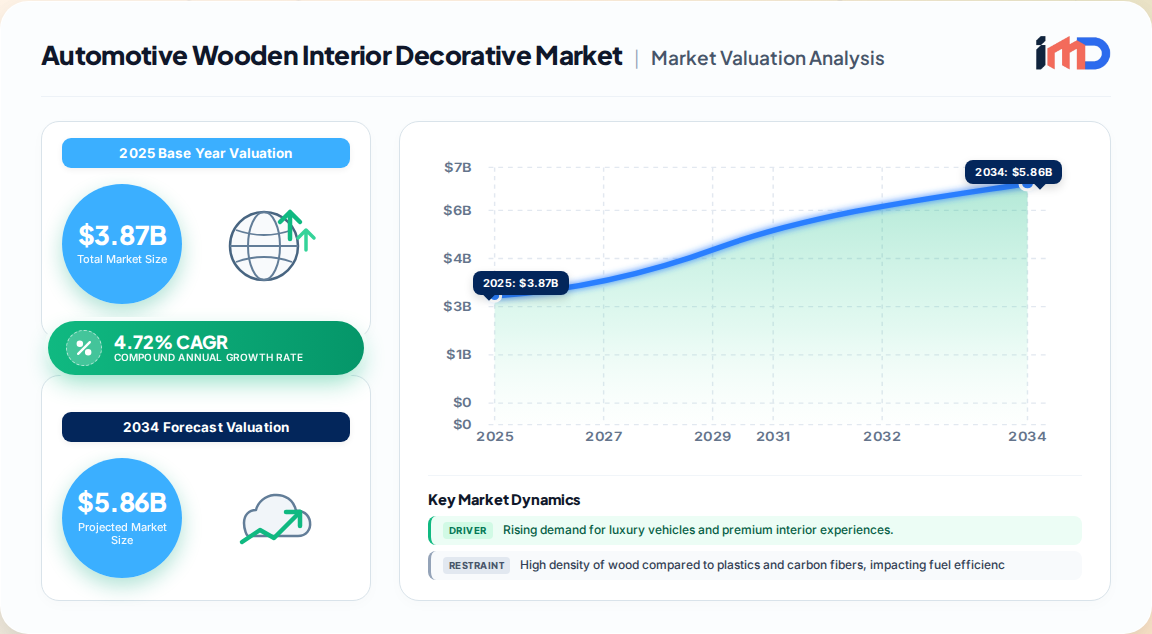
The global automotive wooden interior decorative market represents a critical niche within the premium vehicle cabin ecosystem, balancing heritage craftsmanship with modern sustainable material science. Our proprietary primary research estimates the market at USD 3.87 billion in 2025, projected to expand to USD 6.14 billion by 2035, registering a steady CAGR of 4.72% . This growth is underpinned by structural demand shifts toward authentic, tactile surfaces in luxury and mainstream passenger vehicles, particularly as OEMs leverage wood trim to differentiate cabin experiences in an increasingly digitized cockpit environment.
Automotive Wooden Interior Decorative Market Market Size (In Billion)
7.5B
6.0B
4.5B
3.0B
1.5B
0
3.870 B
2025
4.053 B
2026
4.244 B
2027
4.444 B
2028
4.654 B
2029
4.874 B
2030
5.104 B
2031
Unlike broad interior component markets, wooden decorative elements remain a specification-driven, value-added segment where material authenticity commands a significant price premium over synthetic alternatives. The market's resilience is notable given global automotive production volatility, reflecting the counter-cyclical nature of luxury personalization spending. Our analysis indicates that genuine wood-faced decorative inserts and qualified engineered wood trim components accounted for approximately 72% of total market value in 2025, with the remainder attributed to aftermarket and specialty vehicle applications.
Market Drivers & Restraints
Growth Drivers
Luxury Vehicle Demand: The luxury vehicle segment is projected to account for over 30% of the total automotive market by 2026, with wooden interiors serving as a hallmark of sophistication. Rising disposable incomes in emerging economies, particularly in Asia-Pacific, are expanding the addressable customer base for premium cabins.
Sustainability Trends: Consumers increasingly favor natural materials perceived as environmentally responsible. The market for sustainable automotive materials is growing at an estimated 15% annually, prompting manufacturers to pursue certified wood sources and low-VOC production methods.
Technological Innovations: Advancements in precision cutting, laser engraving, and 3D veneer forming enable intricate designs and superior finishes. The integration of smart technologies, such as ambient lighting through wood layers and touch-sensitive surfaces, is creating new functional value propositions.
Personalization Preferences: Bespoke interior designs are a key purchase motivator in the luxury segment. OEMs are expanding wood species options—walnut, oak, ash, maple, and specialty veneers—to cater to individual tastes, driving higher material content per vehicle.
Market Restraints
Weight and Cost Penalties: Wood's higher density relative to plastics and carbon fiber imposes fuel efficiency penalties. Additionally, installation and maintenance costs for genuine wood trim are significantly higher, limiting adoption in price-sensitive vehicle segments.
Competition from Lightweight Alternatives: Aluminum and advanced composites offer weight advantages and are increasingly specified in electric vehicles where range optimization is paramount. Printed imitation wood films also provide a cost-effective aesthetic substitute, threatening market share in mainstream segments.
Supply Chain Complexity: The market relies on specialized veneer suppliers and limited wood species, creating vulnerability to raw material price volatility and geographic supply concentration.
Value Chain & Supply Dynamics
The automotive wooden interior decorative value chain is characterized by a fragmented upstream veneer supply base and a concentrated tier-1 integrator landscape. Raw timber is sourced from certified forests—predominantly in Europe and North America—and processed into thin veneer sheets by specialist firms. These veneers then undergo grain matching, adhesive bonding to engineered carriers (polymer, composite, or lightweight metal substrates), precision trimming, finishing, and assembly into trim components.
Key supply dynamics include:
Veneer Procurement: Natural wood species selection demands careful management of grain patterns, dye uniformity, and yield. A single visually defective sheet can create disproportionate wastage after finishing, driving manufacturers to evaluate engineered veneers for improved repeatability.
Traceability: Growing emphasis on responsibly documented wood sources is reshaping procurement. Suppliers are increasingly required to provide chain-of-custody certification, aligning with OEM sustainability mandates and regulatory compliance.
Three-Dimensional Veneer Platforms: Innovations in 3D veneer forming enable complex contoured geometries around screens, air outlets, and consoles, expanding styling flexibility but requiring tight process tolerances and delamination testing.
Hybrid Surfaces: High-value trim increasingly incorporates metallic inlays, layered natural materials, and coordinated illumination, preserving a recognizable natural surface while broadening visual treatments.
Competitive Landscape
The market is served by a mix of large tier-1 interior suppliers and specialized veneer technology firms. Our competitive assessment reveals a moderately concentrated landscape where scale, material expertise, and OEM relationships are critical differentiators. Leading participants include Faurecia (FORVIA), Adient, Lear Corporation, Toyota Boshoku, Denso Corporation, BASF, Woodland Group, Harman International, Mitsubishi Chemical Corporation, Novem Group S.A., NBHX Trim Group, Grupo Antolin, Danzer, and Ligneos.
Announced order intake exceeding EUR 60 million for FY2025/26, driven by premium interior acquisitions in China and business wins with existing carmakers.
Apr 2026
Industry Analyst Briefing
Confirmed rapid expansion of high-end decorative components, including walnut and maple finishes, within luxury vehicle segments, particularly in Asia-Pacific.
Nov 2025
FORVIA SE
Confirmed strategic divestiture of Interiors business unit while retaining Materi'Act division for sustainable cockpit solutions, reducing net debt by over EUR 1 billion.
Oct 2025
Grupo Antolin
Secured a seven-year EUR 150 million syndicated loan to strengthen balance sheet and support R&D into smart, illuminated vehicle trims.
Segmentation Analysis
The market is segmented by application, wood type, vehicle type, sales channel, and production process. Dashboard components dominate application revenue, while door panels exhibit the fastest growth trajectory.
Segment
Dominant Sub-segment
Fastest-Growing Sub-segment
Application
Dashboard (~44% share)
Door Panels
Wood Type
Solid Wood
Engineered Wood
Vehicle Type
Passenger Cars
Luxury Vehicles
Sales Channel
OEMs
Aftermarket
Production Process
Molding
Finishing
Regional Outlook & Trade Dynamics
Asia-Pacific dominates the global market, accounting for an estimated 41% share in 2025, driven by high vehicle production volumes in China, Japan, and South Korea, coupled with rising disposable incomes and expanding luxury vehicle penetration. Europe follows with approximately 28% share, underpinned by strong premium vehicle programs from German OEMs and a concentrated base of specialist veneer suppliers. North America holds about 22% share, with steady growth supported by luxury SUV and truck demand.
Trade dynamics reveal Europe as a net exporter of high-quality veneers and finished trim components, while Asia-Pacific increasingly imports specialized veneers to meet domestic production demands. South America and Middle East & Africa represent emerging opportunities, with market shares of 5% and 4% respectively, as luxury vehicle ownership expands in these regions.
Strategic White-Space & Investment Opportunities
Our analysis identifies several strategic opportunities for stakeholders:
Sustainable Engineered Veneers: Developing engineered wood solutions that replicate natural aesthetics while improving yield and compliance with environmental regulations presents a significant growth avenue.
Smart Wood Interiors: Integrating touch-sensitive controls, ambient lighting, and heating functions directly into wooden surfaces creates new value pools, particularly for electric and autonomous vehicle platforms.
Aftermarket Personalization: The aftermarket channel remains underpenetrated, with consumers increasingly seeking bespoke wood trim upgrades for existing vehicles, offering a higher-margin revenue stream.
Localized Supply Chains: Establishing regional veneer processing and finishing facilities in Asia-Pacific can reduce logistics costs and improve responsiveness to local OEM demand.
Import/Export & Supplier Dynamics
Global trade in automotive wooden decorative components is shaped by the availability of premium wood species and the concentration of finishing expertise. Europe remains the leading exporter of high-quality veneers, with Germany, Italy, and Spain hosting specialized suppliers. Asia-Pacific, particularly China and Japan, is a major importer of raw veneers for domestic production of luxury vehicle interiors. The United States maintains a trade surplus in finished wood trim components, leveraging advanced manufacturing capabilities. Supply chain risks include reliance on a limited number of veneer species, transportation bottlenecks, and currency fluctuations affecting raw material costs.
1What is the current market size of the automotive wooden interior decorative market?
The global automotive wooden interior decorative market was valued at USD 3.87 billion in 2025 and is projected to reach USD 6.14 billion by 2035, growing at a CAGR of 4.72%.
2Which region dominates the automotive wooden interior decorative market?
Asia-Pacific holds the largest share, accounting for approximately 41% of the global market in 2025, driven by high vehicle production in China, Japan, and South Korea.
3What are the key drivers of the automotive wooden interior decorative market?
Key drivers include rising demand for luxury vehicles, consumer preference for sustainable natural materials, and technological advancements in 3D veneer forming and smart interiors.
4Which application segment leads the market?
Dashboard components dominate the application segment, accounting for approximately 44% of market value in 2026, due to the prominence of fascia surfaces for premium material specification.
5What are the major challenges facing the market?
Challenges include the high density and cost of wood compared to lightweight alternatives like aluminum and plastics, competition from printed imitation wood films, and supply chain complexity.
Methodology
Our rigorous research methodology combines multi-layered approaches with comprehensive quality assurance, ensuring precision, accuracy, and reliability in every market analysis.
Primary Research
Conducted 70–80% primary research through direct interviews with C-level executives, procurement managers, and design engineers across the automotive interior value chain. Targeted stakeholders include tier-1 interior system integrators, veneer technology specialists, OEM interior design leads, and raw material suppliers.
Interviewed 3–4 specific job titles: Chief Interior Designer, Procurement Director, Materials Engineering Manager, and Supply Chain Head.
Engaged with 3–4 real industry associations and regulatory bodies: International Organization for Standardization (ISO) for material standards, European Automobile Manufacturers Association (ACEA), and the American Society for Testing and Materials (ASTM) for durability testing.
Participated in industry conferences and trade shows to gather real-time insights on product launches and strategic initiatives.
Key Stakeholders Interviewed
Key Stakeholders Interviewed
Stakeholder Role
Interview Share (%)
Procurement Director
30%
Chief Interior Designer
25%
Materials Engineering Manager
25%
Supply Chain Head
20%
Industry Ecosystem Breakdown
Industry Ecosystem Breakdown
Company Type
Representation (%)
Tier-1 Interior System Integrators
35%
Veneer Technology Specialists
25%
OEM Interior Design Teams
20%
Raw Material Suppliers
15%
Aftermarket Distributors
5%
Secondary Research & Industry Benchmarking
20–30% secondary research drawing from official .gov, .org, and recognized non-profit trade association sources, including UN Comtrade for trade flow data, World Bank for economic indicators, and OECD for automotive production statistics.
Utilized standard financial databases: Bloomberg, Factiva, Hoovers, and PitchBook for company financials, investment trends, and merger and acquisition activity.
Benchmarked against publicly available data from automotive trade associations such as the European Automobile Manufacturers Association (ACEA) and the International Organization of Motor Vehicle Manufacturers (OICA).
All reports are updated to the date of purchase to ensure the latest market developments are incorporated.
Demand Modeling & Market Estimation
Employed both top-down and bottom-up methodologies simultaneously, validated via multi-level data triangulation. Bottom-up modeling utilized specific quantitative metrics: vehicle production volume by segment, average wood trim content per vehicle (in square meters), and average price per square meter by vehicle class.
Demand was modeled by vehicle type (passenger cars, commercial vehicles, luxury vehicles) and application (dashboard, door panels, center consoles, steering wheels) to derive segment-level market sizes.
Regional demand was estimated using vehicle production data from OICA and trade flow data from UN Comtrade, cross-validated with OEM production schedules and supplier order books.
Guaranteed estimated data accuracy level of 85–90% through rigorous validation and triangulation.
Data Accuracy & Quality Check
Implemented multi-level data triangulation combining primary interview data, secondary trade statistics, and company financial disclosures.
Conducted sanity checks on market size estimates by comparing with adjacent markets (e.g., automotive interior market) and ensuring logical consistency in growth rates.
Utilized expert review panels comprising senior analysts and industry advisors to validate assumptions and forecasts.
The automotive emission sensor market is valued at $7.1B in 2025 and is projected to grow at a 7.9% CAGR to $12.6B by 2032, driven by O2 and NOx sensor demand.
Nov 2026|220 pages
$2900.00
Automotive Diesel Filter Market to reach USD 6.02 Billion by 2035, at 2.74% CAGR. Analysis of fuel, oil, air filters, OEM vs aftermarket, and regional trends.
Nov 2026|188 pages
$2900.00
Fixed electronic truck scale market to reach USD 2.98 Billion by 2032, growing at 9.35% CAGR from USD 1.71 Billion in 2026, driven by automation.
Nov 2026|262 pages
$2900.00
Automotive Transparent Antenna Industry market valued at USD 914.6 Mn in 2024, projected to reach USD 1,992.9 Mn by 2034 at a CAGR of 8.1%.