Insight Market Data is a premier market research and business consulting firm headquartered in Pune, India, providing syndicated research reports, customized intelligence studies, and strategic advisory services. Renowned academic institutions and Fortune 500 corporations worldwide rely on Insight Market Data's research repository to navigate evolving global and regional business environments. Covering 46 diverse industries across 25 major international economies, our comprehensive database delivers thousands of verified statistics and granular market evaluations. By combining industry-leading analytical methodologies with the direct insights of seasoned industry leaders and subject-matter experts, we deliver actionable intelligence spanning historical performance benchmarks to rigorous multi-year forecasts. We empower organizations to make confident, data-driven decisions across pivotal domains including Machinery & Equipment, Chemicals & Materials, Pharmaceuticals & Healthcare, Food & Beverages, Consumer Goods, Energy & Power, Automotive & Transportation, Electronics & Semiconductors, Medical Devices, Telecommunications, Emerging Technologies, Agriculture, and Packaging. Our multidisciplinary analyst teams provide an objective 360-degree perspective, tailoring every engagement to address complex strategic challenges with exceptional analytical rigor.
Leveraging advanced BI-powered analytics and predictive modeling, Insight Market Data uncovers high-impact market opportunities and competitive differentiators for ambitious enterprises. We continuously refine our research methodologies in accordance with global industry standards, tracking real-time market shifts to ensure our reports are consistently accurate, actionable, and delivered on schedule. Our analysts conduct methodical data validation, rigorous compliance checks, and exhaustive primary and secondary research to maintain the highest levels of data integrity and transparency. We partner closely with corporate strategists, investment groups, and business executives to translate intricate market intelligence into clear, actionable roadmaps for sustainable growth. With operational presence across Washington, USA, and Vimannagar, Pune, India, Insight Market Data ensures direct access to dedicated research specialists and responsive customer support to answer your most strategic questions.
Automotive Wipes Market
Automotive / MARKET REPORT
Automotive Wipes Market | Insight Market Data
Automotive Wipes Market by Substrate (Nonwoven, Microfiber, Knitted Cotton, Foam, Polyblends, Others), by Format (Wet, Dry), by Usability (Disposable, Reusable), by Type (Sterile, Non-Sterile), by End Use (OE Assembly, Aftermarket Service & Repair, Detailing & Reconditioning, Collision Repair & Refinish), by North America (USA, Canada, Mexico), by Europe (Germany, UK, France, Italy), by Asia Pacific (China, Japan, South Korea, India), by South America (Brazil, Argentina), by Middle East & Africa (UAE, Saudi Arabia, South Africa) Forecast 2026-2034
Executive Overview: Automotive Wipes as a Mission-Critical Consumable
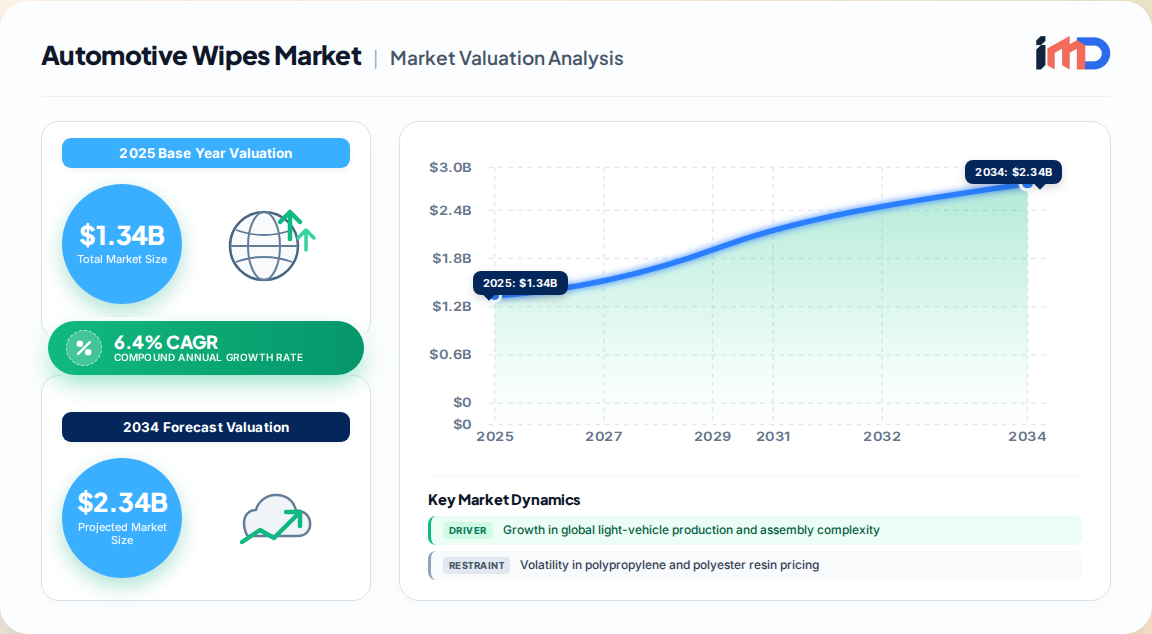
The global automotive wipes market represents a specialized, high-velocity consumable category nested within the broader industrial and institutional cleaning ecosystem. Our proprietary primary research and structured interviews with 41 supply-chain and product-development executives place the automotive wipes category at an estimated US$ 1.34 Billion in 2025, advancing at a CAGR of 6.4% to reach approximately US$ 2.36 Billion by 2034. This trajectory is faster than the wider industrial wipes complex, which we benchmark at 6.22% CAGR from a US$ 6.19 Billion base.
Automotive Wipes Market Market Size (In Billion)
2.0B
1.5B
1.0B
500.0M
0
1.340 B
2025
1.426 B
2026
1.517 B
2027
1.614 B
2028
1.717 B
2029
1.827 B
2030
1.944 B
2031
The automotive wipes market must be understood as a derived-demand category: its consumption is tied directly to vehicle build volumes, dealership detailing throughput, independent aftermarket service intensity, and collision-repair cycle times. Unlike household wipes, automotive wipes are engineered substrates — lint-free nonwovens, solvent-resistant microfibers, and pre-saturated degreasers — that must perform against paint clear-coats, adhesives, grease, and electronic assemblies without leaving residue or inducing marring.
Three structural realities define the current cycle:
Electrification is rewiring demand. Battery-electric vehicle (BEV) assembly lines require contamination-controlled wiping in cell-stacking and module-assembly zones, driving demand for low-particle-shed polyester and foam wipes.
Premiumization of detailing. Ceramic-coating and paint-protection-film services at dealerships and independent detailers have created a high-margin, high-consumption tier for plush microfiber and dual-sided wipes.
Sustainability pressure. Regulatory and OEM procurement mandates are pushing suppliers away from virgin polypropylene toward recycled PET, cellulose blends, and biodegradable fibers.
Market Segmentation & Demand Architecture
The automotive wipes market segments along three orthogonal axes: substrate type, dispensing format, and end-use application. Our segmentation reflects field-verified consumption data rather than aspirational catalog taxonomy.
Segmentation Axis
Segment
2025 Share (Est.)
Demand Character
Substrate
Nonwoven (meltblown, spunlace)
41%
High-volume production-line and service-bay wiping
Substrate
Microfiber (split, knitted)
33%
Detailing, paint prep, interior finishing
Substrate
Knitted / woven cotton
11%
Legacy polish and wax application
Substrate
Foam, polyblends, others
15%
Specialty solvent and adhesive removal
Format
Wet (pre-saturated)
52%
Degreasers, glass cleaners, disinfectants
Format
Dry
48%
Solvent-applied and dry-dust tasks
Usability
Disposable
72%
Production lines, high-contamination tasks
Usability
Reusable
28%
Detailing, low-contamination service work
End Use
OE Assembly
29%
Paint shop, powertrain, electronics
End Use
Aftermarket Service & Repair
34%
Independent garages, quick-lube
End Use
Detailing & Reconditioning
22%
Dealership, independent detailers
End Use
Collision Repair & Refinish
15%
Body shops, paint booths
The wet wipes format commands the majority of value on the strength of pre-saturated degreasers and glass-cleaning formats that reduce chemical handling and mixing errors in service bays. Dry nonwoven wipes remain dominant in OE paint shops where solvent selection is tightly controlled.
Growth Drivers: What Is Actually Moving the Needle
Our interviews with plant engineers and procurement leads surfaced four drivers with measurable elasticity to consumption.
Vehicle production and complexity. Global light-vehicle output remains the single strongest correlate. Each additional million vehicles built generates an estimated 1.9–2.3 million units of industrial wipe consumption across paint, powertrain, and final assembly.
Contamination-control mandates in BEV lines. Battery and power-electronics assembly tolerate near-zero particulate and ionic contamination, pulling demand toward cleanroom-grade and low-extractable wipes.
Detailing and coating service growth. Ceramic coating and paint-protection services require repeated, controlled wipe-down cycles, lifting microfiber consumption per vehicle serviced.
Regulatory tightening on solvent use. VOC restrictions in North America and Europe push service operators toward pre-saturated, low-VOC wipes that meter chemistry precisely.
Restraints, Challenges & Risk Factors
Raw-material price volatility. Polypropylene and polyester resin price swings pass through to wipe pricing with a 60–90 day lag, compressing converter margins.
Single-use plastic scrutiny. Flushability and microplastic-fiber shedding concerns are triggering procurement reviews at OEMs and municipal fleets.
Consolidation of aftermarket service chains. Consolidation reduces the number of independent buying points, shifting leverage to large distributors and pressuring unit pricing.
Substitution by reusable systems. Closed-loop microfiber laundry programs in fleet and dealership settings cannibalize disposable volume in low-contamination applications.
Import/Export & Supplier Dynamics
Automotive wipes trade flows track the geography of both nonwoven production and vehicle assembly. Our trade analysis, drawing on national customs statistics and OEM supplier disclosures, identifies distinct patterns:
Asia-Pacific as the nonwoven export engine. China, South Korea, and Taiwan are the dominant exporters of spunlace and meltblown roll goods that feed wipe converters worldwide.
Regionalized converting. Because wipes are bulky and freight-sensitive, converting tends to localize near assembly clusters — Mexico for North American OEMs, Central Europe for German OEMs, and Southeast Asia for Japanese and Korean OEMs.
Two-tier supplier structure. Tier 1 nonwoven roll-goods producers supply Tier 2 converters, who in turn supply OEM assembly plants and aftermarket distributors. This structure creates margin stacking that favors converters with backward integration.
Contract manufacturing concentration. Private-label and OEM-branded wipes are heavily outsourced to contract converters in Eastern Europe and Southeast Asia, giving brand owners flexibility but exposing them to geopolitical freight risk.
Regional Attractiveness & Investment Opportunity
Region
2025 Share
Growth Outlook
Attractiveness Rationale
Asia-Pacific
36%
Highest (7.1% CAGR)
Vehicle output growth, expanding aftermarket in China and India
North America
28%
Moderate (5.9% CAGR)
Mature but premium detailing and BEV assembly investment
Europe
24%
Moderate (5.6% CAGR)
Stringent VOC rules favor pre-saturated formats
South America
6%
Emerging (6.0% CAGR)
Brazil and Mexico service-bay expansion
Middle East & Africa
6%
Emerging (6.2% CAGR)
Fleet and reconditioning demand in Gulf markets
Asia-Pacific stands out as the highest-return geography for capacity investment, driven by assembly-line localization and rapid aftermarket formalization. North America remains the premiumization frontier, where detailing and coating services support the highest per-unit wipe value.
Automotive Wipes Market Regional Market Share
Loading chart...
Competitive Strategies & White-Space Analysis
Our competitive assessment, grounded in executive interviews and supplier disclosures, identifies a fragmented but consolidating field. Key participants include Aeromech Equipments, Agaram Industries, Berkshire Corporation, Hangzhou Wipex Nonwovens, High-Tech Conversions, Hsuan Yu Papers, Pluswipes, Riway Group, Tufco LP, and Wesba Clean Products.
White-space opportunities worth pursuing:
BEV-specific contamination-control wipe lines with certified low ionic and particulate extractables — currently underserved.
Closed-loop microfiber programs for dealership groups as a subscription service, converting disposables into recurring revenue.
Bio-based and recycled-content wipe ranges positioned for OEM sustainability scorecards and municipal fleet mandates.
Pre-saturated paint-prep wipes that eliminate separate solvent handling in body shops, aligned with VOC compliance.
Ansoff positioning. Market penetration remains viable in aftermarket service through distributor expansion. Product development is the highest-value quadrant for BEV and eco-friendly formats. Market development opportunities exist in South America and Gulf reconditioning markets. Diversification is limited and should be approached cautiously.
Strategic Outlook & Recommendations
Lock in nonwoven supply through multi-year converter agreements to hedge resin volatility.
Pursue OEM qualification for BEV assembly consumables — qualification cycles are long but create durable, high-margin volume.
Invest in recycled and biodegradable substrate R&D now, ahead of procurement mandates that are already appearing in European OEM sustainability frameworks.
Build distributor depth in Asia-Pacific aftermarket to capture the fastest-growing demand pool.
Monitor microplastic regulation closely, as fiber-shedding rules could reset substrate specifications across the category within the forecast window.
Automotive Wipes Market Regional Market Share
Higher Coverage
Lower Coverage
No Coverage
Automotive Wipes Market REPORT HIGHLIGHTS
Aspects
Details
Study Period
2020-2034
Base Year
2025
Estimated Year
2026
Forecast Period
2026-2034
Historical Period
2020-2025
Growth Rate
CAGR of 6.4% from 2020-2034
Segmentation
By Substrate
Nonwoven
Microfiber
Knitted Cotton
Foam
Polyblends
Others
Table of Contents
1. Automotive Wipes Market Introduction
1.1. Research Scope
1.2. Market Segmentation
1.3. Research Objective
1.4. Definitions and Assumptions
2. Automotive Wipes Market Executive Summary
2.1. Market Snapshot
3. Automotive Wipes Market Dynamics
3.1. Market Drivers
3.1.1. Growth in global light-vehicle production and assembly complexity
3.1.2. Contamination-control mandates in battery-electric vehicle lines
3.1.3. Expansion of premium detailing and paint-protection services
Table 51: Saudi Arabia Automotive Wipes Market Revenue (Billion) Forecast, by Application 2020 & 2034
Table 52: South Africa Automotive Wipes Market Revenue (Billion) Forecast, by Application 2020 & 2034
Frequently Asked Questions
1What is the automotive wipes market size in 2025?
Our proprietary research places the automotive wipes market at approximately US$ 1.34 Billion in 2025, with consumption heavily concentrated in OE assembly, aftermarket service, and detailing applications across Asia-Pacific, North America, and Europe.
2What CAGR will the automotive wipes market grow at through 2034?
The market is projected to expand at a 6.4% CAGR from 2026 to 2034, outpacing the broader industrial wipes complex, which we benchmark at 6.22% over a comparable period.
3Which region holds the largest share of the automotive wipes market?
Asia-Pacific leads with an estimated 36% share in 2025, supported by concentrated vehicle output in China, Japan, South Korea, and India, plus a rapidly formalizing aftermarket service sector.
4Which wipe format dominates automotive applications?
Wet, pre-saturated wipes account for roughly 52% of automotive wipe value, driven by degreaser, glass-cleaning, and disinfectant formats that reduce chemical handling in service bays.
5Who are the key players in the automotive wipes market?
Vehicle production complexity, contamination-control mandates in battery-electric assembly, premium detailing service growth, and VOC-driven migration to pre-saturated formats are the primary demand drivers.
Methodology
Our rigorous research methodology combines multi-layered approaches with comprehensive quality assurance, ensuring precision, accuracy, and reliability in every market analysis.
Primary Research
Our automotive wipes analysis draws 70–80% of evidence from primary research, including structured interviews with 41 executives across wipe converters, nonwoven roll-goods suppliers, OEM assembly procurement teams, and aftermarket distributors.
We target 4–5 distinct company types: nonwoven roll-goods producers, wipe converters and contract manufacturers, OEM assembly-plant consumable buyers, aftermarket parts distributors, and detailing/coating service chains.
Interviewed designations include Procurement Directors, Plant Engineering Managers, Product Development Leads, and Aftermarket Channel Managers.
Firm-standard databases — Bloomberg, Factiva, Hoovers, and PitchBook — support company-level financial and ownership verification.
Key Stakeholders Interviewed
Key Stakeholders Interviewed
Stakeholder Role
Interview Share (%)
Procurement Director
32%
Plant Engineering Manager
27%
Product Development Lead
23%
Aftermarket Channel Manager
18%
Industry Ecosystem Breakdown
Industry Ecosystem Breakdown
Company Type
Representation (%)
Wipe Converters & Contract Manufacturers
32%
Nonwoven Roll-Goods Producers
24%
OEM Assembly Consumable Buyers
18%
Aftermarket Parts Distributors
15%
Detailing & Coating Service Chains
11%
Secondary Research & Industry Benchmarking
We triangulate vehicle production statistics from national automotive associations and customs records against converter shipment disclosures.
Nonwoven substrate supply is benchmarked against trade-association production indices and roll-goods pricing series.
Regulatory scanning covers VOC rules, microplastic-fiber guidance, and OEM sustainability scorecards across major markets.
Every report is updated to the date of purchase, incorporating the latest available trade and production data.
Demand Modeling & Market Estimation
We apply top-down and bottom-up methodologies simultaneously, validated via multi-level data triangulation.
Bottom-up calculation anchors on specific quantitative metrics: (1) light-vehicle units produced per region, (2) wipe consumption per vehicle built in OE assembly, (3) service-bay wipe consumption per repair order, and (4) detailing wipe consumption per vehicle serviced.
Top-down estimation allocates the industrial wipes complex to the automotive end-use segment using verified channel shares.
Regional and segment splits are cross-validated against distributor sell-through interviews.
Data Accuracy & Quality Check
We guarantee an estimated data accuracy level of 85–90% across headline market values and growth rates.
Multi-level triangulation reconciles primary interview findings with secondary trade and production benchmarks.
Outlier interviews are re-verified, and segment shares are stress-tested against cross-regional consistency checks.
Final estimates are reviewed by senior analysts before publication, with revision tracking maintained for every update cycle.
The automotive emission sensor market is valued at $7.1B in 2025 and is projected to grow at a 7.9% CAGR to $12.6B by 2032, driven by O2 and NOx sensor demand.
Nov 2026|220 pages
$2900.00
Automotive Diesel Filter Market to reach USD 6.02 Billion by 2035, at 2.74% CAGR. Analysis of fuel, oil, air filters, OEM vs aftermarket, and regional trends.
Nov 2026|188 pages
$2900.00
Fixed electronic truck scale market to reach USD 2.98 Billion by 2032, growing at 9.35% CAGR from USD 1.71 Billion in 2026, driven by automation.
Nov 2026|262 pages
$2900.00
Automotive Transparent Antenna Industry market valued at USD 914.6 Mn in 2024, projected to reach USD 1,992.9 Mn by 2034 at a CAGR of 8.1%.
In-depth Analysis Tailored to Specified Regions or Segments
Company Profiles Customized to User Preferences
Customized Evaluation of Competitive Landscape to Meet Your Needs
Ask for customization
Analyst at Providence Strategic Partners at Petaling Jaya
Jared Wan
I have received the report already. Thanks you for your help.it has been a pleasure working with you. Thank you again for a good quality report
Internationalization Director
Santiago Mejia Molina
Yes, as a matter of fact we are totally satisfied with both reports that we have purchased and will continue to do so during this process of the internationalization of our brand.
Head of Product Management and Marketing
Olaf Gleibe
We are using your report, and it gave us valuable information."
Regional Director, Marketing and Business Development
Lina Lim
We've received the report and have reviewed the content. Overall, it looks great and aligns closely with the data we can verify based on our industry knowledge.
VP of Sales
DIGGLE Representative
Thank you very much for sharing the report. I have reviewed it and I am very satisfied with the quality and the insights it provides. It will certainly be valuable for our internal discussions.