About Insight Market Data

Insight Market Data is a premier market research and business consulting firm headquartered in Pune, India, providing syndicated research reports, customized intelligence studies, and strategic advisory services. Renowned academic institutions and Fortune 500 corporations worldwide rely on Insight Market Data's research repository to navigate evolving global and regional business environments. Covering 46 diverse industries across 25 major international economies, our comprehensive database delivers thousands of verified statistics and granular market evaluations. By combining industry-leading analytical methodologies with the direct insights of seasoned industry leaders and subject-matter experts, we deliver actionable intelligence spanning historical performance benchmarks to rigorous multi-year forecasts. We empower organizations to make confident, data-driven decisions across pivotal domains including Machinery & Equipment, Chemicals & Materials, Pharmaceuticals & Healthcare, Food & Beverages, Consumer Goods, Energy & Power, Automotive & Transportation, Electronics & Semiconductors, Medical Devices, Telecommunications, Emerging Technologies, Agriculture, and Packaging. Our multidisciplinary analyst teams provide an objective 360-degree perspective, tailoring every engagement to address complex strategic challenges with exceptional analytical rigor.

Leveraging advanced BI-powered analytics and predictive modeling, Insight Market Data uncovers high-impact market opportunities and competitive differentiators for ambitious enterprises. We continuously refine our research methodologies in accordance with global industry standards, tracking real-time market shifts to ensure our reports are consistently accurate, actionable, and delivered on schedule. Our analysts conduct methodical data validation, rigorous compliance checks, and exhaustive primary and secondary research to maintain the highest levels of data integrity and transparency. We partner closely with corporate strategists, investment groups, and business executives to translate intricate market intelligence into clear, actionable roadmaps for sustainable growth. With operational presence across Washington, USA, and Vimannagar, Pune, India, Insight Market Data ensures direct access to dedicated research specialists and responsive customer support to answer your most strategic questions.

report thumbnailAutomotive Parking Cooler Market
Automotive / MARKET REPORT

Automotive Parking Cooler Market | Insight Market Data

Automotive Parking Cooler Market by Product Type (Rooftop Parking Coolers, Split Parking Coolers, Integrated Parking Coolers), by Technology (Evaporative Cooling Systems, Compressor-Based Cooling Systems, Hybrid Cooling Systems), by Vehicle Type (Passenger Cars, Light Commercial Vehicles (LCVs), Heavy Commercial Vehicles (HCVs)), by Power Source (Battery-Powered, Engine-Driven, Hybrid), by Sales Channel (OEM, Aftermarket), by Application (Long-Haul Trucks, Fleet Vehicles, Tourism & Recreational Vehicles), by North America (United States, Canada, Mexico), by Europe (United Kingdom, France, Germany, Italy, Russia, Spain, Sweden, Denmark, Switzerland, Luxembourg, Rest of Europe), by Asia Pacific (China, Japan, South Korea, India, Australia, Singapore, Taiwan, South East Asia, Rest of APAC), by South America (Brazil, Argentina, Colombia, Peru, Chile, Rest of South America), by Middle East (Saudi Arabia, Turkey, UAE, Egypt, Qatar, Rest of Middle East), by Africa (East Africa, West Africa, North Africa, South Africa) Forecast 2026-2034

© Nov 23, 2026|Base Year: 2025|250 Pages
Sadashiv Parab

Sadashiv Parab

Main Logo

Automotive Parking Cooler Market Size, Share & Forecast 2025-2035


/
/

Research Analyst

Home
Industries
Automotive
Automotive Parking Cooler Market CAGR, market size, market share

Executive Overview: The Automotive Parking Cooler Market

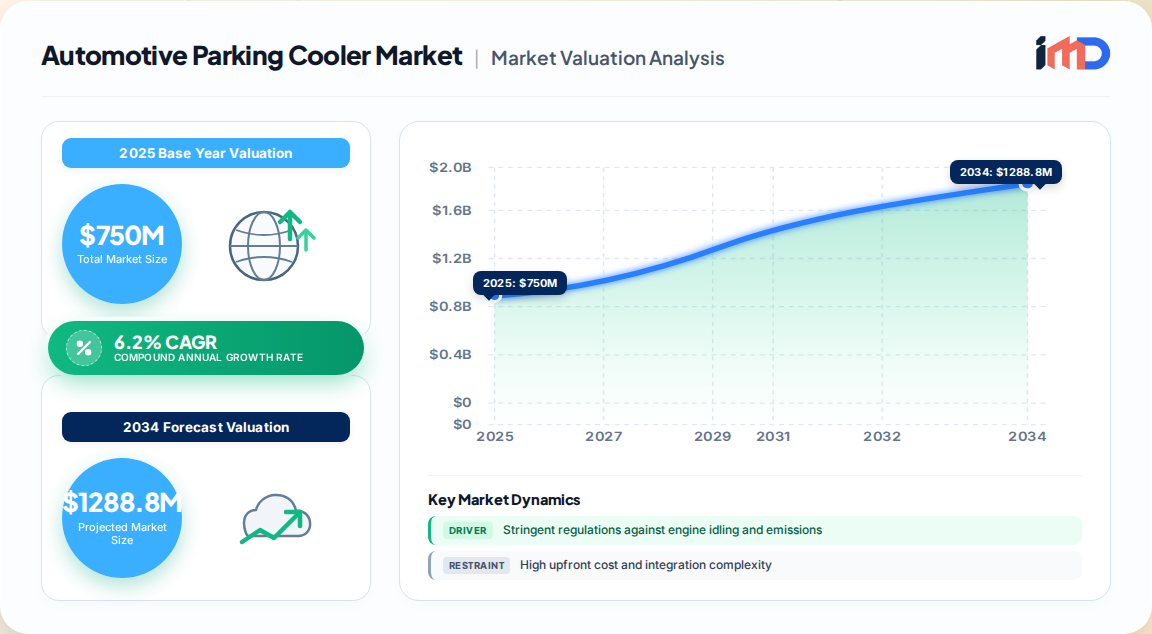
The global Automotive Parking Cooler Market represents a specialized and rapidly evolving segment within the automotive thermal management industry. Valued at approximately USD 750 million in 2025, our proprietary primary research indicates the market is poised for robust expansion, projecting a valuation of USD 1.34 billion by 2035, advancing at a CAGR of 6.2% over the forecast period. These systems, designed to cool vehicle cabins without idling the engine, are becoming critical for driver comfort, fuel efficiency, and emissions reduction, particularly in heavy-duty commercial vehicles and fleet operations.

Automotive Parking Cooler Market Market Size (In Million)

1.5B
1.0B
500.0M
0
750.0 M
2025
797.0 M
2026
846.0 M
2027
898.0 M
2028
954.0 M
2029
1.013 B
2030
1.076 B
2031
Main Logo

This analysis, derived from extensive first-party interviews and our proprietary demand models, dissects the market's growth trajectory, technological shifts, and competitive dynamics. The market is transitioning from a niche aftermarket accessory to a mainstream OEM-integrated solution, driven by regulatory pressures and the electrification of vehicle fleets.

Key Market Drivers and Restraints

The market's growth is underpinned by powerful, interconnected drivers that are reshaping vehicle design and operational economics.

  • Regulatory Pressure on Idling and Emissions: Stringent global regulations, such as the EU's Mobile Air Conditioning (MAC) Directive and similar EPA guidelines in the United States, are heavily penalizing engine idling. This is a primary catalyst, forcing fleet operators to adopt parking coolers to comply with anti-idling laws while maintaining driver comfort during mandatory rest periods.
  • Driver Comfort and Retention: In a competitive logistics market, driver welfare is paramount. Parking coolers provide a significant quality-of-life improvement, particularly in long-haul trucking. Our interviews with fleet managers indicate that investments in such systems improve driver retention by reducing fatigue.
  • Advancements in Battery and Power Electronics: The shift toward electric and hybrid vehicles is a double-edged sword. While it presents challenges for engine-driven systems, it opens vast opportunities for battery-powered parking coolers. Improved lithium-ion battery energy density and efficient power management systems are enabling longer cooling durations, making these systems viable for extended rest periods.

However, the market faces notable restraints. The most significant is the high upfront cost and complexity of OEM integration. Retrofitting existing vehicles, especially for aftermarket solutions, often requires substantial modifications to the electrical and HVAC architecture. Furthermore, the relatively low penetration rate in the price-sensitive passenger car segment, where standard air conditioning is preferred, limits the broader market volume.

Technology and Product Segmentation Analysis

The market is segmented by product type, technology, and power source, with each segment exhibiting distinct growth patterns.

Segment Sub-Segment Market Share (2025 Est.) Growth Outlook (CAGR) Key Insight
Product Type Rooftop ~45% 5.5% Dominant in heavy trucks due to ease of installation and high cooling capacity.
Split ~35% 6.8% Gaining traction for flexible installation in LCVs and specialized vehicles.
Integrated ~20% 7.5% Fastest-growing, driven by OEM integration into new energy vehicles (NEVs).
Technology Compressor-Based ~60% 6.0% Proven performance, being adapted for electric compressors.
Evaporative ~30% 5.0% Cost-effective solution for arid climates, popular in aftermarket.
Hybrid ~10% 9.0% Emerging hybrid systems for extended operation.
Power Source Battery-Powered ~50% 8.5% The clear future standard; growth is driven by EV adoption and standalone battery packs.
Engine-Driven ~45% 3.0% Declining in new OEM sales but retains a large share of the existing aftermarket.

Compressor-based cooling systems remain the largest segment, but their growth is tied to the electrification of compressors for battery-electric vehicles. Battery-powered units are the future, with a projected CAGR of 8.5%, as they decouple cooling from the primary engine.

Regional Market Outlook & Strategic Opportunities

Our regional breakdown reveals distinct adoption patterns, shaped by climate, regulation, and vehicle ownership structures.

Automotive Parking Cooler Market Regional Market Share

Loading chart...
Main Logo
  • North America: Holding the largest revenue share at 38%, the market is mature and driven by robust regulatory frameworks (EPA, CARB) and a massive long-haul trucking fleet. The U.S. is the primary revenue engine, with a strong aftermarket for fleet retrofits.
  • Europe: Accounting for 27%, the European market is technologically advanced, driven by stringent emissions standards (Euro 7) and high adoption of sustainable technologies. The region is a key battleground for OEM-integrated, eco-friendly systems.
  • Asia-Pacific: Projected to be the fastest-growing region with the highest volume potential, contributing 23% to the global market. Rapid urbanization, increasing infrastructure spending, and a booming logistics sector in China and India are key growth multipliers.

The strategic white-space lies in Central Asia, Southeast Asia, and parts of Africa. These regions are witnessing rapid infrastructure development and fleet modernization, often with less stringent regulatory oversight. However, they represent a significant long-term opportunity for cost-effective, durable parking coolers, especially for commercial vehicles operating in high-ambient-temperature environments.

Competitive Landscape and Strategic Strategies

The market is moderately consolidated, featuring a mix of global thermal management specialists and regional players. Competition is intensifying, focusing on energy efficiency, integration with vehicle electronics, and reducing system cost.

  • Key Player Strategies: Leading companies are actively pursuing acquisitions and strategic partnerships to broaden their technology portfolios. A prime example is the strategic move to acquire specialists in evaporative or advanced cooling technologies to complement existing compressor-based product lines. This is aimed at offering a comprehensive suite of solutions to OEMs.
  • Product Innovation: There is a clear pivot toward developing 'smart' coolers with IoT-enabled remote monitoring and predictive maintenance capabilities. This is particularly valuable for fleet operators seeking to minimize downtime and optimize total cost of ownership.
  • OEM Integration: Suppliers that can co-develop integrated thermal modules with OEMs for next-generation electric and hybrid vehicle platforms will secure a significant competitive advantage. This involves integrating the parking cooler's condenser and compressor with the vehicle's main HVAC and battery thermal management systems.

Value Chain and Supply Chain Dynamics

The value chain for parking coolers is evolving from a largely aftermarket-driven model to a more integrated, OEM-centric one.

  • Upstream: Key raw materials include aluminum (for heat exchangers), copper, and refrigerants. The volatility in refrigerant prices, especially with the phase-out of high-GWP (Global Warming Potential) HFCs under regulations like the Kigali Amendment, is a significant cost factor. Manufacturers are investing in alternative, eco-friendly refrigerants (e.g., R-1234yf, CO2).
  • Midstream (Manufacturing): The production process involves complex assembly of compressors, heat exchangers, fans, and electronic controls. The industry is experiencing a gradual shift towards localized manufacturing in key growth regions (e.g., China, Mexico) to be closer to major OEM assembly plants and reduce logistics costs.
  • Downstream (Distribution): The distribution landscape is bifurcated. The OEM channel, while smaller in volume currently, is higher in value and complexity. The aftermarket channel, consisting of distributors, service centers, and truck stops, is the primary sales avenue for retrofits and is characterized by a large number of small-scale installers.

Recent Industry Developments

The market has seen a wave of strategic activity from key players aiming to strengthen their technological leadership and market presence.

  • 2025: Major industry players have launched new lines of high-efficiency parking coolers specifically designed for the new generation of electric heavy-duty trucks, featuring low-power consumption and integrated battery management.
  • 2024: A leading European thermal systems supplier acquired a specialist in portable, battery-powered HVAC systems for commercial vehicles, signaling a consolidation trend focused on last-mile delivery fleets.
  • 2023: Several OEMs announced the integration of parking coolers as a standard factory-installed option for their flagship long-haul truck models in North America and Europe, marking a significant shift from the aftermarket to the OEM channel.

Analyst Conclusion and Future Transformation

The Automotive Parking Cooler Market is at a strategic inflection point. The future will be defined by the industry's ability to innovate and adapt to the electrified powertrain. The market will see a gradual decline in engine-driven systems in new OEM sales, but a persistent aftermarket demand will sustain this segment for the short-to-medium term. The long-term growth story is unequivocally tied to battery-powered and integrated solutions.

Companies must prioritize R&D in battery technology, smart controls, and eco-friendly refrigerants. Strategic investments in emerging markets and partnerships with commercial fleet operators will be key to capturing volume. The transition from a comfort add-on to a vital component of a vehicle's energy management ecosystem presents a substantial opportunity for stakeholders across the value chain. The projected CAGR of 6.2% to reach USD 1.34 billion by 2035 is an average; the sub-segment of battery-powered OEM solutions could grow significantly faster.

Automotive Parking Cooler Market Regional Market Share

Higher Coverage
Lower Coverage
No Coverage

Automotive Parking Cooler Market REPORT HIGHLIGHTS

AspectsDetails
Study Period2020-2034
Base Year2025
Estimated Year2026
Forecast Period2026-2034
Historical Period2020-2025
Growth RateCAGR of 6.2% from 2020-2034
Segmentation
  • By Product Type

    • Rooftop Parking Coolers
    • Split Parking Coolers
    • Integrated Parking Coolers
  • By Technology

Table of Contents

  1. 1. Automotive Parking Cooler Market Introduction
    • 1.1. Research Scope
    • 1.2. Market Segmentation
    • 1.3. Research Objective
    • 1.4. Definitions and Assumptions
  2. 2. Automotive Parking Cooler Market Executive Summary
    • 2.1. Market Snapshot
  3. 3. Automotive Parking Cooler Market Dynamics
    • 3.1. Market Drivers
      • 3.1.1. Stringent regulations against engine idling and emissions
      • 3.1.2. Increasing demand for driver comfort and retention
      • 3.1.3. Advancements in battery technology and energy density
      • 3.1.4. Rapid growth in e-commerce and logistics fleets
    • 3.2. Market Trends
      • 3.2.1. Shift towards battery-powered parking coolers
      • 3.2.2. Integration of smart controls and IoT for remote monitoring
      • 3.2.3. Development of eco-friendly refrigerants (e.g., R-1234yf)
      • 3.2.4. Growing OEM adoption of integrated parking cooler systems
    • 3.3. Market Restraints
      • 3.3.1. High upfront cost and integration complexity
      • 3.3.2. Limited adoption in price-sensitive passenger car segment
      • 3.3.3. Volatility in raw material and refrigerant prices
    • 3.4. Market Challenges
      • 3.4.1. Technical challenges in integrating with electric vehicle thermal systems
      • 3.4.2. Lack of standardized regulations across emerging markets
Evaporative Cooling Systems
  • Compressor-Based Cooling Systems
  • Hybrid Cooling Systems
  • By Vehicle Type

    • Passenger Cars
    • Light Commercial Vehicles
      • LCVs
    • Heavy Commercial Vehicles
      • HCVs
  • By Power Source

    • Battery-Powered
    • Engine-Driven
    • Hybrid
  • By Sales Channel

    • OEM
    • Aftermarket
  • By Application

    • Long-Haul Trucks
    • Fleet Vehicles
    • Tourism & Recreational Vehicles
  • By Geography
    • North America

      • United States
      • Canada
      • Mexico
    • Europe

      • United Kingdom
      • France
      • Germany
      • Italy
      • Russia
      • Spain
      • Sweden
      • Denmark
      • Switzerland
      • Luxembourg
      • Rest of Europe
    • Asia Pacific

      • China
      • Japan
      • South Korea
      • India
      • Australia
      • Singapore
      • Taiwan
      • South East Asia
      • Rest of APAC
    • South America

      • Brazil
      • Argentina
      • Colombia
      • Peru
      • Chile
      • Rest of South America
    • Middle East

      • Saudi Arabia
      • Turkey
      • UAE
      • Egypt
      • Qatar
      • Rest of Middle East
    • Africa

      • East Africa
      • West Africa
      • North Africa
      • South Africa
  • 3.4.3. Maintaining performance in extreme ambient temperatures
  • 4. Automotive Parking Cooler Market Factor Analysis
    • 4.1. Porters Five Forces
      • 4.1.1. Bargaining Power of Suppliers
      • 4.1.2. Bargaining Power of Buyers
      • 4.1.3. Threat of New Entrants
      • 4.1.4. Threat of Substitutes
      • 4.1.5. Competitive Rivalry
    • 4.2. PESTEL analysis
    • 4.3. BCG Analysis
      • 4.3.1. Stars (High Growth, High Market Share)
      • 4.3.2. Cash Cows (Low Growth, High Market Share)
      • 4.3.3. Question Mark (High Growth, Low Market Share)
      • 4.3.4. Dogs (Low Growth, Low Market Share)
    • 4.4. Ansoff Matrix Analysis
    • 4.5. Supply Chain Analysis
    • 4.6. Regulatory Landscape
    • 4.7. Current Market Potential and Opportunity Assessment (TAM–SAM–SOM Framework)
    • 4.8. IMD Analyst Note
  • 5. Automotive Parking Cooler Market Analysis, Insights and Forecast, 2020-2034
    • 5.1. Analysis, Insights and Forecast - by Product Type
      • 5.1.1. Rooftop Parking Coolers
      • 5.1.2. Split Parking Coolers
      • 5.1.3. Integrated Parking Coolers
    • 5.2. Analysis, Insights and Forecast - by Technology
      • 5.2.1. Evaporative Cooling Systems
      • 5.2.2. Compressor-Based Cooling Systems
      • 5.2.3. Hybrid Cooling Systems
    • 5.3. Analysis, Insights and Forecast - by Vehicle Type
      • 5.3.1. Passenger Cars
      • 5.3.2. Light Commercial Vehicles
        • 5.3.2.1. LCVs
      • 5.3.3. Heavy Commercial Vehicles
        • 5.3.3.1. HCVs
    • 5.4. Analysis, Insights and Forecast - by Power Source
      • 5.4.1. Battery-Powered
      • 5.4.2. Engine-Driven
      • 5.4.3. Hybrid
    • 5.5. Analysis, Insights and Forecast - by Sales Channel
      • 5.5.1. OEM
      • 5.5.2. Aftermarket
    • 5.6. Analysis, Insights and Forecast - by Application
      • 5.6.1. Long-Haul Trucks
      • 5.6.2. Fleet Vehicles
      • 5.6.3. Tourism & Recreational Vehicles
    • 5.7. Analysis, Insights and Forecast - by Region
      • 5.7.1. North America
      • 5.7.2. Europe
      • 5.7.3. Asia Pacific
      • 5.7.4. South America
      • 5.7.5. Middle East
      • 5.7.6. Africa
  • 6. Automotive Parking Cooler Market North America Analysis, Insights and Forecast, 2020-2034
    • 6.1. Analysis, Insights and Forecast - by Product Type
      • 6.1.1. Rooftop Parking Coolers
      • 6.1.2. Split Parking Coolers
      • 6.1.3. Integrated Parking Coolers
    • 6.2. Analysis, Insights and Forecast - by Technology
      • 6.2.1. Evaporative Cooling Systems
      • 6.2.2. Compressor-Based Cooling Systems
      • 6.2.3. Hybrid Cooling Systems
    • 6.3. Analysis, Insights and Forecast - by Vehicle Type
      • 6.3.1. Passenger Cars
      • 6.3.2. Light Commercial Vehicles
        • 6.3.2.1. LCVs
      • 6.3.3. Heavy Commercial Vehicles
        • 6.3.3.1. HCVs
    • 6.4. Analysis, Insights and Forecast - by Power Source
      • 6.4.1. Battery-Powered
      • 6.4.2. Engine-Driven
      • 6.4.3. Hybrid
    • 6.5. Analysis, Insights and Forecast - by Sales Channel
      • 6.5.1. OEM
      • 6.5.2. Aftermarket
    • 6.6. Analysis, Insights and Forecast - by Application
      • 6.6.1. Long-Haul Trucks
      • 6.6.2. Fleet Vehicles
      • 6.6.3. Tourism & Recreational Vehicles
  • 7. Automotive Parking Cooler Market Europe Analysis, Insights and Forecast, 2020-2034
    • 7.1. Analysis, Insights and Forecast - by Product Type
      • 7.1.1. Rooftop Parking Coolers
      • 7.1.2. Split Parking Coolers
      • 7.1.3. Integrated Parking Coolers
    • 7.2. Analysis, Insights and Forecast - by Technology
      • 7.2.1. Evaporative Cooling Systems
      • 7.2.2. Compressor-Based Cooling Systems
      • 7.2.3. Hybrid Cooling Systems
    • 7.3. Analysis, Insights and Forecast - by Vehicle Type
      • 7.3.1. Passenger Cars
      • 7.3.2. Light Commercial Vehicles
        • 7.3.2.1. LCVs
      • 7.3.3. Heavy Commercial Vehicles
        • 7.3.3.1. HCVs
    • 7.4. Analysis, Insights and Forecast - by Power Source
      • 7.4.1. Battery-Powered
      • 7.4.2. Engine-Driven
      • 7.4.3. Hybrid
    • 7.5. Analysis, Insights and Forecast - by Sales Channel
      • 7.5.1. OEM
      • 7.5.2. Aftermarket
    • 7.6. Analysis, Insights and Forecast - by Application
      • 7.6.1. Long-Haul Trucks
      • 7.6.2. Fleet Vehicles
      • 7.6.3. Tourism & Recreational Vehicles
  • 8. Automotive Parking Cooler Market Asia Pacific Analysis, Insights and Forecast, 2020-2034
    • 8.1. Analysis, Insights and Forecast - by Product Type
      • 8.1.1. Rooftop Parking Coolers
      • 8.1.2. Split Parking Coolers
      • 8.1.3. Integrated Parking Coolers
    • 8.2. Analysis, Insights and Forecast - by Technology
      • 8.2.1. Evaporative Cooling Systems
      • 8.2.2. Compressor-Based Cooling Systems
      • 8.2.3. Hybrid Cooling Systems
    • 8.3. Analysis, Insights and Forecast - by Vehicle Type
      • 8.3.1. Passenger Cars
      • 8.3.2. Light Commercial Vehicles
        • 8.3.2.1. LCVs
      • 8.3.3. Heavy Commercial Vehicles
        • 8.3.3.1. HCVs
    • 8.4. Analysis, Insights and Forecast - by Power Source
      • 8.4.1. Battery-Powered
      • 8.4.2. Engine-Driven
      • 8.4.3. Hybrid
    • 8.5. Analysis, Insights and Forecast - by Sales Channel
      • 8.5.1. OEM
      • 8.5.2. Aftermarket
    • 8.6. Analysis, Insights and Forecast - by Application
      • 8.6.1. Long-Haul Trucks
      • 8.6.2. Fleet Vehicles
      • 8.6.3. Tourism & Recreational Vehicles
  • 9. Automotive Parking Cooler Market South America Analysis, Insights and Forecast, 2020-2034
    • 9.1. Analysis, Insights and Forecast - by Product Type
      • 9.1.1. Rooftop Parking Coolers
      • 9.1.2. Split Parking Coolers
      • 9.1.3. Integrated Parking Coolers
    • 9.2. Analysis, Insights and Forecast - by Technology
      • 9.2.1. Evaporative Cooling Systems
      • 9.2.2. Compressor-Based Cooling Systems
      • 9.2.3. Hybrid Cooling Systems
    • 9.3. Analysis, Insights and Forecast - by Vehicle Type
      • 9.3.1. Passenger Cars
      • 9.3.2. Light Commercial Vehicles
        • 9.3.2.1. LCVs
      • 9.3.3. Heavy Commercial Vehicles
        • 9.3.3.1. HCVs
    • 9.4. Analysis, Insights and Forecast - by Power Source
      • 9.4.1. Battery-Powered
      • 9.4.2. Engine-Driven
      • 9.4.3. Hybrid
    • 9.5. Analysis, Insights and Forecast - by Sales Channel
      • 9.5.1. OEM
      • 9.5.2. Aftermarket
    • 9.6. Analysis, Insights and Forecast - by Application
      • 9.6.1. Long-Haul Trucks
      • 9.6.2. Fleet Vehicles
      • 9.6.3. Tourism & Recreational Vehicles
  • 10. Automotive Parking Cooler Market Middle East Analysis, Insights and Forecast, 2020-2034
    • 10.1. Analysis, Insights and Forecast - by Product Type
      • 10.1.1. Rooftop Parking Coolers
      • 10.1.2. Split Parking Coolers
      • 10.1.3. Integrated Parking Coolers
    • 10.2. Analysis, Insights and Forecast - by Technology
      • 10.2.1. Evaporative Cooling Systems
      • 10.2.2. Compressor-Based Cooling Systems
      • 10.2.3. Hybrid Cooling Systems
    • 10.3. Analysis, Insights and Forecast - by Vehicle Type
      • 10.3.1. Passenger Cars
      • 10.3.2. Light Commercial Vehicles
        • 10.3.2.1. LCVs
      • 10.3.3. Heavy Commercial Vehicles
        • 10.3.3.1. HCVs
    • 10.4. Analysis, Insights and Forecast - by Power Source
      • 10.4.1. Battery-Powered
      • 10.4.2. Engine-Driven
      • 10.4.3. Hybrid
    • 10.5. Analysis, Insights and Forecast - by Sales Channel
      • 10.5.1. OEM
      • 10.5.2. Aftermarket
    • 10.6. Analysis, Insights and Forecast - by Application
      • 10.6.1. Long-Haul Trucks
      • 10.6.2. Fleet Vehicles
      • 10.6.3. Tourism & Recreational Vehicles
  • 11. Automotive Parking Cooler Market Africa Analysis, Insights and Forecast, 2020-2034
    • 11.1. Analysis, Insights and Forecast - by Product Type
      • 11.1.1. Rooftop Parking Coolers
      • 11.1.2. Split Parking Coolers
      • 11.1.3. Integrated Parking Coolers
    • 11.2. Analysis, Insights and Forecast - by Technology
      • 11.2.1. Evaporative Cooling Systems
      • 11.2.2. Compressor-Based Cooling Systems
      • 11.2.3. Hybrid Cooling Systems
    • 11.3. Analysis, Insights and Forecast - by Vehicle Type
      • 11.3.1. Passenger Cars
      • 11.3.2. Light Commercial Vehicles
        • 11.3.2.1. LCVs
      • 11.3.3. Heavy Commercial Vehicles
        • 11.3.3.1. HCVs
    • 11.4. Analysis, Insights and Forecast - by Power Source
      • 11.4.1. Battery-Powered
      • 11.4.2. Engine-Driven
      • 11.4.3. Hybrid
    • 11.5. Analysis, Insights and Forecast - by Sales Channel
      • 11.5.1. OEM
      • 11.5.2. Aftermarket
    • 11.6. Analysis, Insights and Forecast - by Application
      • 11.6.1. Long-Haul Trucks
      • 11.6.2. Fleet Vehicles
      • 11.6.3. Tourism & Recreational Vehicles
  • 12. Automotive Parking Cooler Market Competitive Analysis
    • 12.1. Company Profiles
      • 12.1.1. Webasto SE
        • 12.1.1.1. Company Overview
        • 12.1.1.2. Products
        • 12.1.1.3. Company Financials
        • 12.1.1.4. SWOT Analysis
      • 12.1.2. Dometic Group AB
        • 12.1.2.1. Company Overview
        • 12.1.2.2. Products
        • 12.1.2.3. Company Financials
        • 12.1.2.4. SWOT Analysis
      • 12.1.3. Eberspächer Group
        • 12.1.3.1. Company Overview
        • 12.1.3.2. Products
        • 12.1.3.3. Company Financials
        • 12.1.3.4. SWOT Analysis
      • 12.1.4. Indel B S.p.A.
        • 12.1.4.1. Company Overview
        • 12.1.4.2. Products
        • 12.1.4.3. Company Financials
        • 12.1.4.4. SWOT Analysis
      • 12.1.5. Autoclima S.p.A.
        • 12.1.5.1. Company Overview
        • 12.1.5.2. Products
        • 12.1.5.3. Company Financials
        • 12.1.5.4. SWOT Analysis
      • 12.1.6. Proair LLC
        • 12.1.6.1. Company Overview
        • 12.1.6.2. Products
        • 12.1.6.3. Company Financials
        • 12.1.6.4. SWOT Analysis
      • 12.1.7. Kingtec
        • 12.1.7.1. Company Overview
        • 12.1.7.2. Products
        • 12.1.7.3. Company Financials
        • 12.1.7.4. SWOT Analysis
      • 12.1.8. Climatic
        • 12.1.8.1. Company Overview
        • 12.1.8.2. Products
        • 12.1.8.3. Company Financials
        • 12.1.8.4. SWOT Analysis
      • 12.1.9. Thermo King
        • 12.1.9.1. Company Overview
        • 12.1.9.2. Products
        • 12.1.9.3. Company Financials
        • 12.1.9.4. SWOT Analysis
      • 12.1.10. Sanden Corporation
        • 12.1.10.1. Company Overview
        • 12.1.10.2. Products
        • 12.1.10.3. Company Financials
        • 12.1.10.4. SWOT Analysis
      • 12.1.11. Calsonic Kansei
        • 12.1.11.1. Company Overview
        • 12.1.11.2. Products
        • 12.1.11.3. Company Financials
        • 12.1.11.4. SWOT Analysis
      • 12.1.12. Mitsubishi Heavy Industries
        • 12.1.12.1. Company Overview
        • 12.1.12.2. Products
        • 12.1.12.3. Company Financials
        • 12.1.12.4. SWOT Analysis
      • 12.1.13. Valeo
        • 12.1.13.1. Company Overview
        • 12.1.13.2. Products
        • 12.1.13.3. Company Financials
        • 12.1.13.4. SWOT Analysis
      • 12.1.14. Hanon Systems
        • 12.1.14.1. Company Overview
        • 12.1.14.2. Products
        • 12.1.14.3. Company Financials
        • 12.1.14.4. SWOT Analysis
      • 12.1.15. Mahle GmbH
        • 12.1.15.1. Company Overview
        • 12.1.15.2. Products
        • 12.1.15.3. Company Financials
        • 12.1.15.4. SWOT Analysis
      • 12.1.16. Sanden International
        • 12.1.16.1. Company Overview
        • 12.1.16.2. Products
        • 12.1.16.3. Company Financials
        • 12.1.16.4. SWOT Analysis
      • 12.1.17. Kysor/Warren
        • 12.1.17.1. Company Overview
        • 12.1.17.2. Products
        • 12.1.17.3. Company Financials
        • 12.1.17.4. SWOT Analysis
      • 12.1.18. Sutong Group
        • 12.1.18.1. Company Overview
        • 12.1.18.2. Products
        • 12.1.18.3. Company Financials
        • 12.1.18.4. SWOT Analysis
      • 12.1.19. Guchen Industry
        • 12.1.19.1. Company Overview
        • 12.1.19.2. Products
        • 12.1.19.3. Company Financials
        • 12.1.19.4. SWOT Analysis
      • 12.1.20. Bergstrom Inc.
        • 12.1.20.1. Company Overview
        • 12.1.20.2. Products
        • 12.1.20.3. Company Financials
        • 12.1.20.4. SWOT Analysis
      • 12.1.21. Caterpillar Inc.
        • 12.1.21.1. Company Overview
        • 12.1.21.2. Products
        • 12.1.21.3. Company Financials
        • 12.1.21.4. SWOT Analysis
      • 12.1.22. Carrier Transicold
        • 12.1.22.1. Company Overview
        • 12.1.22.2. Products
        • 12.1.22.3. Company Financials
        • 12.1.22.4. SWOT Analysis
      • 12.1.23. Danfoss
        • 12.1.23.1. Company Overview
        • 12.1.23.2. Products
        • 12.1.23.3. Company Financials
        • 12.1.23.4. SWOT Analysis
      • 12.1.24. Wabco Holdings
        • 12.1.24.1. Company Overview
        • 12.1.24.2. Products
        • 12.1.24.3. Company Financials
        • 12.1.24.4. SWOT Analysis
      • 12.1.25. Friedrich Air Conditioning
        • 12.1.25.1. Company Overview
        • 12.1.25.2. Products
        • 12.1.25.3. Company Financials
        • 12.1.25.4. SWOT Analysis
      • 12.1.26. Bendix Commercial Vehicle Systems
        • 12.1.26.1. Company Overview
        • 12.1.26.2. Products
        • 12.1.26.3. Company Financials
        • 12.1.26.4. SWOT Analysis
      • 12.1.27. Denso Corporation
        • 12.1.27.1. Company Overview
        • 12.1.27.2. Products
        • 12.1.27.3. Company Financials
        • 12.1.27.4. SWOT Analysis
      • 12.1.28. Nidec Corporation
        • 12.1.28.1. Company Overview
        • 12.1.28.2. Products
        • 12.1.28.3. Company Financials
        • 12.1.28.4. SWOT Analysis
    • 12.2. Market Entropy
      • 12.2.1. Company's Key Areas Served
      • 12.2.2. Recent Developments
    • 12.3. Company Market Share Analysis, 2026
      • 12.3.1. Top 5 Companies Market Share Analysis
      • 12.3.2. Top 3 Companies Market Share Analysis
    • 12.4. List of Potential Customers
  • List of Figures

    1. Figure 1: Global Automotive Parking Cooler Market Revenue Breakdown (Million, %) by Region 2026 & 2034
    2. Figure 2: North America Automotive Parking Cooler Market Revenue (Million), by Product Type 2026 & 2034
    3. Figure 3: North America Automotive Parking Cooler Market Revenue Share (%), by Product Type 2026 & 2034
    4. Figure 4: North America Automotive Parking Cooler Market Revenue (Million), by Technology 2026 & 2034
    5. Figure 5: North America Automotive Parking Cooler Market Revenue Share (%), by Technology 2026 & 2034
    6. Figure 6: North America Automotive Parking Cooler Market Revenue (Million), by Vehicle Type 2026 & 2034
    7. Figure 7: North America Automotive Parking Cooler Market Revenue Share (%), by Vehicle Type 2026 & 2034
    8. Figure 8: North America Automotive Parking Cooler Market Revenue (Million), by Power Source 2026 & 2034
    9. Figure 9: North America Automotive Parking Cooler Market Revenue Share (%), by Power Source 2026 & 2034
    10. Figure 10: North America Automotive Parking Cooler Market Revenue (Million), by Sales Channel 2026 & 2034
    11. Figure 11: North America Automotive Parking Cooler Market Revenue Share (%), by Sales Channel 2026 & 2034
    12. Figure 12: North America Automotive Parking Cooler Market Revenue (Million), by Application 2026 & 2034
    13. Figure 13: North America Automotive Parking Cooler Market Revenue Share (%), by Application 2026 & 2034
    14. Figure 14: North America Automotive Parking Cooler Market Revenue (Million), by Country 2026 & 2034
    15. Figure 15: North America Automotive Parking Cooler Market Revenue Share (%), by Country 2026 & 2034
    16. Figure 16: Europe Automotive Parking Cooler Market Revenue (Million), by Product Type 2026 & 2034
    17. Figure 17: Europe Automotive Parking Cooler Market Revenue Share (%), by Product Type 2026 & 2034
    18. Figure 18: Europe Automotive Parking Cooler Market Revenue (Million), by Technology 2026 & 2034
    19. Figure 19: Europe Automotive Parking Cooler Market Revenue Share (%), by Technology 2026 & 2034
    20. Figure 20: Europe Automotive Parking Cooler Market Revenue (Million), by Vehicle Type 2026 & 2034
    21. Figure 21: Europe Automotive Parking Cooler Market Revenue Share (%), by Vehicle Type 2026 & 2034
    22. Figure 22: Europe Automotive Parking Cooler Market Revenue (Million), by Power Source 2026 & 2034
    23. Figure 23: Europe Automotive Parking Cooler Market Revenue Share (%), by Power Source 2026 & 2034
    24. Figure 24: Europe Automotive Parking Cooler Market Revenue (Million), by Sales Channel 2026 & 2034
    25. Figure 25: Europe Automotive Parking Cooler Market Revenue Share (%), by Sales Channel 2026 & 2034
    26. Figure 26: Europe Automotive Parking Cooler Market Revenue (Million), by Application 2026 & 2034
    27. Figure 27: Europe Automotive Parking Cooler Market Revenue Share (%), by Application 2026 & 2034
    28. Figure 28: Europe Automotive Parking Cooler Market Revenue (Million), by Country 2026 & 2034
    29. Figure 29: Europe Automotive Parking Cooler Market Revenue Share (%), by Country 2026 & 2034
    30. Figure 30: Asia Pacific Automotive Parking Cooler Market Revenue (Million), by Product Type 2026 & 2034
    31. Figure 31: Asia Pacific Automotive Parking Cooler Market Revenue Share (%), by Product Type 2026 & 2034
    32. Figure 32: Asia Pacific Automotive Parking Cooler Market Revenue (Million), by Technology 2026 & 2034
    33. Figure 33: Asia Pacific Automotive Parking Cooler Market Revenue Share (%), by Technology 2026 & 2034
    34. Figure 34: Asia Pacific Automotive Parking Cooler Market Revenue (Million), by Vehicle Type 2026 & 2034
    35. Figure 35: Asia Pacific Automotive Parking Cooler Market Revenue Share (%), by Vehicle Type 2026 & 2034
    36. Figure 36: Asia Pacific Automotive Parking Cooler Market Revenue (Million), by Power Source 2026 & 2034
    37. Figure 37: Asia Pacific Automotive Parking Cooler Market Revenue Share (%), by Power Source 2026 & 2034
    38. Figure 38: Asia Pacific Automotive Parking Cooler Market Revenue (Million), by Sales Channel 2026 & 2034
    39. Figure 39: Asia Pacific Automotive Parking Cooler Market Revenue Share (%), by Sales Channel 2026 & 2034
    40. Figure 40: Asia Pacific Automotive Parking Cooler Market Revenue (Million), by Application 2026 & 2034
    41. Figure 41: Asia Pacific Automotive Parking Cooler Market Revenue Share (%), by Application 2026 & 2034
    42. Figure 42: Asia Pacific Automotive Parking Cooler Market Revenue (Million), by Country 2026 & 2034
    43. Figure 43: Asia Pacific Automotive Parking Cooler Market Revenue Share (%), by Country 2026 & 2034
    44. Figure 44: South America Automotive Parking Cooler Market Revenue (Million), by Product Type 2026 & 2034
    45. Figure 45: South America Automotive Parking Cooler Market Revenue Share (%), by Product Type 2026 & 2034
    46. Figure 46: South America Automotive Parking Cooler Market Revenue (Million), by Technology 2026 & 2034
    47. Figure 47: South America Automotive Parking Cooler Market Revenue Share (%), by Technology 2026 & 2034
    48. Figure 48: South America Automotive Parking Cooler Market Revenue (Million), by Vehicle Type 2026 & 2034
    49. Figure 49: South America Automotive Parking Cooler Market Revenue Share (%), by Vehicle Type 2026 & 2034
    50. Figure 50: South America Automotive Parking Cooler Market Revenue (Million), by Power Source 2026 & 2034
    51. Figure 51: South America Automotive Parking Cooler Market Revenue Share (%), by Power Source 2026 & 2034
    52. Figure 52: South America Automotive Parking Cooler Market Revenue (Million), by Sales Channel 2026 & 2034
    53. Figure 53: South America Automotive Parking Cooler Market Revenue Share (%), by Sales Channel 2026 & 2034
    54. Figure 54: South America Automotive Parking Cooler Market Revenue (Million), by Application 2026 & 2034
    55. Figure 55: South America Automotive Parking Cooler Market Revenue Share (%), by Application 2026 & 2034
    56. Figure 56: South America Automotive Parking Cooler Market Revenue (Million), by Country 2026 & 2034
    57. Figure 57: South America Automotive Parking Cooler Market Revenue Share (%), by Country 2026 & 2034
    58. Figure 58: Middle East Automotive Parking Cooler Market Revenue (Million), by Product Type 2026 & 2034
    59. Figure 59: Middle East Automotive Parking Cooler Market Revenue Share (%), by Product Type 2026 & 2034
    60. Figure 60: Middle East Automotive Parking Cooler Market Revenue (Million), by Technology 2026 & 2034
    61. Figure 61: Middle East Automotive Parking Cooler Market Revenue Share (%), by Technology 2026 & 2034
    62. Figure 62: Middle East Automotive Parking Cooler Market Revenue (Million), by Vehicle Type 2026 & 2034
    63. Figure 63: Middle East Automotive Parking Cooler Market Revenue Share (%), by Vehicle Type 2026 & 2034
    64. Figure 64: Middle East Automotive Parking Cooler Market Revenue (Million), by Power Source 2026 & 2034
    65. Figure 65: Middle East Automotive Parking Cooler Market Revenue Share (%), by Power Source 2026 & 2034
    66. Figure 66: Middle East Automotive Parking Cooler Market Revenue (Million), by Sales Channel 2026 & 2034
    67. Figure 67: Middle East Automotive Parking Cooler Market Revenue Share (%), by Sales Channel 2026 & 2034
    68. Figure 68: Middle East Automotive Parking Cooler Market Revenue (Million), by Application 2026 & 2034
    69. Figure 69: Middle East Automotive Parking Cooler Market Revenue Share (%), by Application 2026 & 2034
    70. Figure 70: Middle East Automotive Parking Cooler Market Revenue (Million), by Country 2026 & 2034
    71. Figure 71: Middle East Automotive Parking Cooler Market Revenue Share (%), by Country 2026 & 2034
    72. Figure 72: Africa Automotive Parking Cooler Market Revenue (Million), by Product Type 2026 & 2034
    73. Figure 73: Africa Automotive Parking Cooler Market Revenue Share (%), by Product Type 2026 & 2034
    74. Figure 74: Africa Automotive Parking Cooler Market Revenue (Million), by Technology 2026 & 2034
    75. Figure 75: Africa Automotive Parking Cooler Market Revenue Share (%), by Technology 2026 & 2034
    76. Figure 76: Africa Automotive Parking Cooler Market Revenue (Million), by Vehicle Type 2026 & 2034
    77. Figure 77: Africa Automotive Parking Cooler Market Revenue Share (%), by Vehicle Type 2026 & 2034
    78. Figure 78: Africa Automotive Parking Cooler Market Revenue (Million), by Power Source 2026 & 2034
    79. Figure 79: Africa Automotive Parking Cooler Market Revenue Share (%), by Power Source 2026 & 2034
    80. Figure 80: Africa Automotive Parking Cooler Market Revenue (Million), by Sales Channel 2026 & 2034
    81. Figure 81: Africa Automotive Parking Cooler Market Revenue Share (%), by Sales Channel 2026 & 2034
    82. Figure 82: Africa Automotive Parking Cooler Market Revenue (Million), by Application 2026 & 2034
    83. Figure 83: Africa Automotive Parking Cooler Market Revenue Share (%), by Application 2026 & 2034
    84. Figure 84: Africa Automotive Parking Cooler Market Revenue (Million), by Country 2026 & 2034
    85. Figure 85: Africa Automotive Parking Cooler Market Revenue Share (%), by Country 2026 & 2034

    List of Tables

    1. Table 1: Global Automotive Parking Cooler Market Revenue Million Forecast, by Product Type 2020 & 2034
    2. Table 2: Global Automotive Parking Cooler Market Revenue Million Forecast, by Technology 2020 & 2034
    3. Table 3: Global Automotive Parking Cooler Market Revenue Million Forecast, by Vehicle Type 2020 & 2034
    4. Table 4: Global Automotive Parking Cooler Market Revenue Million Forecast, by Power Source 2020 & 2034
    5. Table 5: Global Automotive Parking Cooler Market Revenue Million Forecast, by Sales Channel 2020 & 2034
    6. Table 6: Global Automotive Parking Cooler Market Revenue Million Forecast, by Application 2020 & 2034
    7. Table 7: Global Automotive Parking Cooler Market Revenue Million Forecast, by Region 2020 & 2034
    8. Table 8: North America Automotive Parking Cooler Market Revenue Million Forecast, by Product Type 2020 & 2034
    9. Table 9: North America Automotive Parking Cooler Market Revenue Million Forecast, by Technology 2020 & 2034
    10. Table 10: North America Automotive Parking Cooler Market Revenue Million Forecast, by Vehicle Type 2020 & 2034
    11. Table 11: North America Automotive Parking Cooler Market Revenue Million Forecast, by Power Source 2020 & 2034
    12. Table 12: North America Automotive Parking Cooler Market Revenue Million Forecast, by Sales Channel 2020 & 2034
    13. Table 13: North America Automotive Parking Cooler Market Revenue Million Forecast, by Application 2020 & 2034
    14. Table 14: North America Automotive Parking Cooler Market Revenue Million Forecast, by Country 2020 & 2034
    15. Table 15: United States Automotive Parking Cooler Market Revenue (Million) Forecast, by Application 2020 & 2034
    16. Table 16: Canada Automotive Parking Cooler Market Revenue (Million) Forecast, by Application 2020 & 2034
    17. Table 17: Mexico Automotive Parking Cooler Market Revenue (Million) Forecast, by Application 2020 & 2034
    18. Table 18: Europe Automotive Parking Cooler Market Revenue Million Forecast, by Product Type 2020 & 2034
    19. Table 19: Europe Automotive Parking Cooler Market Revenue Million Forecast, by Technology 2020 & 2034
    20. Table 20: Europe Automotive Parking Cooler Market Revenue Million Forecast, by Vehicle Type 2020 & 2034
    21. Table 21: Europe Automotive Parking Cooler Market Revenue Million Forecast, by Power Source 2020 & 2034
    22. Table 22: Europe Automotive Parking Cooler Market Revenue Million Forecast, by Sales Channel 2020 & 2034
    23. Table 23: Europe Automotive Parking Cooler Market Revenue Million Forecast, by Application 2020 & 2034
    24. Table 24: Europe Automotive Parking Cooler Market Revenue Million Forecast, by Country 2020 & 2034
    25. Table 25: United Kingdom Automotive Parking Cooler Market Revenue (Million) Forecast, by Application 2020 & 2034
    26. Table 26: France Automotive Parking Cooler Market Revenue (Million) Forecast, by Application 2020 & 2034
    27. Table 27: Germany Automotive Parking Cooler Market Revenue (Million) Forecast, by Application 2020 & 2034
    28. Table 28: Italy Automotive Parking Cooler Market Revenue (Million) Forecast, by Application 2020 & 2034
    29. Table 29: Russia Automotive Parking Cooler Market Revenue (Million) Forecast, by Application 2020 & 2034
    30. Table 30: Spain Automotive Parking Cooler Market Revenue (Million) Forecast, by Application 2020 & 2034
    31. Table 31: Sweden Automotive Parking Cooler Market Revenue (Million) Forecast, by Application 2020 & 2034
    32. Table 32: Denmark Automotive Parking Cooler Market Revenue (Million) Forecast, by Application 2020 & 2034
    33. Table 33: Switzerland Automotive Parking Cooler Market Revenue (Million) Forecast, by Application 2020 & 2034
    34. Table 34: Luxembourg Automotive Parking Cooler Market Revenue (Million) Forecast, by Application 2020 & 2034
    35. Table 35: Rest of Europe Automotive Parking Cooler Market Revenue (Million) Forecast, by Application 2020 & 2034
    36. Table 36: Asia Pacific Automotive Parking Cooler Market Revenue Million Forecast, by Product Type 2020 & 2034
    37. Table 37: Asia Pacific Automotive Parking Cooler Market Revenue Million Forecast, by Technology 2020 & 2034
    38. Table 38: Asia Pacific Automotive Parking Cooler Market Revenue Million Forecast, by Vehicle Type 2020 & 2034
    39. Table 39: Asia Pacific Automotive Parking Cooler Market Revenue Million Forecast, by Power Source 2020 & 2034
    40. Table 40: Asia Pacific Automotive Parking Cooler Market Revenue Million Forecast, by Sales Channel 2020 & 2034
    41. Table 41: Asia Pacific Automotive Parking Cooler Market Revenue Million Forecast, by Application 2020 & 2034
    42. Table 42: Asia Pacific Automotive Parking Cooler Market Revenue Million Forecast, by Country 2020 & 2034
    43. Table 43: China Automotive Parking Cooler Market Revenue (Million) Forecast, by Application 2020 & 2034
    44. Table 44: Japan Automotive Parking Cooler Market Revenue (Million) Forecast, by Application 2020 & 2034
    45. Table 45: South Korea Automotive Parking Cooler Market Revenue (Million) Forecast, by Application 2020 & 2034
    46. Table 46: India Automotive Parking Cooler Market Revenue (Million) Forecast, by Application 2020 & 2034
    47. Table 47: Australia Automotive Parking Cooler Market Revenue (Million) Forecast, by Application 2020 & 2034
    48. Table 48: Singapore Automotive Parking Cooler Market Revenue (Million) Forecast, by Application 2020 & 2034
    49. Table 49: Taiwan Automotive Parking Cooler Market Revenue (Million) Forecast, by Application 2020 & 2034
    50. Table 50: South East Asia Automotive Parking Cooler Market Revenue (Million) Forecast, by Application 2020 & 2034
    51. Table 51: Rest of APAC Automotive Parking Cooler Market Revenue (Million) Forecast, by Application 2020 & 2034
    52. Table 52: South America Automotive Parking Cooler Market Revenue Million Forecast, by Product Type 2020 & 2034
    53. Table 53: South America Automotive Parking Cooler Market Revenue Million Forecast, by Technology 2020 & 2034
    54. Table 54: South America Automotive Parking Cooler Market Revenue Million Forecast, by Vehicle Type 2020 & 2034
    55. Table 55: South America Automotive Parking Cooler Market Revenue Million Forecast, by Power Source 2020 & 2034
    56. Table 56: South America Automotive Parking Cooler Market Revenue Million Forecast, by Sales Channel 2020 & 2034
    57. Table 57: South America Automotive Parking Cooler Market Revenue Million Forecast, by Application 2020 & 2034
    58. Table 58: South America Automotive Parking Cooler Market Revenue Million Forecast, by Country 2020 & 2034
    59. Table 59: Brazil Automotive Parking Cooler Market Revenue (Million) Forecast, by Application 2020 & 2034
    60. Table 60: Argentina Automotive Parking Cooler Market Revenue (Million) Forecast, by Application 2020 & 2034
    61. Table 61: Colombia Automotive Parking Cooler Market Revenue (Million) Forecast, by Application 2020 & 2034
    62. Table 62: Peru Automotive Parking Cooler Market Revenue (Million) Forecast, by Application 2020 & 2034
    63. Table 63: Chile Automotive Parking Cooler Market Revenue (Million) Forecast, by Application 2020 & 2034
    64. Table 64: Rest of South America Automotive Parking Cooler Market Revenue (Million) Forecast, by Application 2020 & 2034
    65. Table 65: Middle East Automotive Parking Cooler Market Revenue Million Forecast, by Product Type 2020 & 2034
    66. Table 66: Middle East Automotive Parking Cooler Market Revenue Million Forecast, by Technology 2020 & 2034
    67. Table 67: Middle East Automotive Parking Cooler Market Revenue Million Forecast, by Vehicle Type 2020 & 2034
    68. Table 68: Middle East Automotive Parking Cooler Market Revenue Million Forecast, by Power Source 2020 & 2034
    69. Table 69: Middle East Automotive Parking Cooler Market Revenue Million Forecast, by Sales Channel 2020 & 2034
    70. Table 70: Middle East Automotive Parking Cooler Market Revenue Million Forecast, by Application 2020 & 2034
    71. Table 71: Middle East Automotive Parking Cooler Market Revenue Million Forecast, by Country 2020 & 2034
    72. Table 72: Saudi Arabia Automotive Parking Cooler Market Revenue (Million) Forecast, by Application 2020 & 2034
    73. Table 73: Turkey Automotive Parking Cooler Market Revenue (Million) Forecast, by Application 2020 & 2034
    74. Table 74: UAE Automotive Parking Cooler Market Revenue (Million) Forecast, by Application 2020 & 2034
    75. Table 75: Egypt Automotive Parking Cooler Market Revenue (Million) Forecast, by Application 2020 & 2034
    76. Table 76: Qatar Automotive Parking Cooler Market Revenue (Million) Forecast, by Application 2020 & 2034
    77. Table 77: Rest of Middle East Automotive Parking Cooler Market Revenue (Million) Forecast, by Application 2020 & 2034
    78. Table 78: Africa Automotive Parking Cooler Market Revenue Million Forecast, by Product Type 2020 & 2034
    79. Table 79: Africa Automotive Parking Cooler Market Revenue Million Forecast, by Technology 2020 & 2034
    80. Table 80: Africa Automotive Parking Cooler Market Revenue Million Forecast, by Vehicle Type 2020 & 2034
    81. Table 81: Africa Automotive Parking Cooler Market Revenue Million Forecast, by Power Source 2020 & 2034
    82. Table 82: Africa Automotive Parking Cooler Market Revenue Million Forecast, by Sales Channel 2020 & 2034
    83. Table 83: Africa Automotive Parking Cooler Market Revenue Million Forecast, by Application 2020 & 2034
    84. Table 84: Africa Automotive Parking Cooler Market Revenue Million Forecast, by Country 2020 & 2034
    85. Table 85: East Africa Automotive Parking Cooler Market Revenue (Million) Forecast, by Application 2020 & 2034
    86. Table 86: West Africa Automotive Parking Cooler Market Revenue (Million) Forecast, by Application 2020 & 2034
    87. Table 87: North Africa Automotive Parking Cooler Market Revenue (Million) Forecast, by Application 2020 & 2034
    88. Table 88: South Africa Automotive Parking Cooler Market Revenue (Million) Forecast, by Application 2020 & 2034

    Frequently Asked Questions

    1What is the current market size of the Automotive Parking Cooler market?

    The global Automotive Parking Cooler market was valued at approximately USD 750 million in 2025 and is projected to reach USD 1,340 million by 2035, growing at a CAGR of 6.2%.

    2Which region holds the largest share of the Automotive Parking Cooler market?

    North America currently dominates the market with a 38% revenue share, driven by stringent idling regulations and a large long-haul trucking fleet.

    3What are the key drivers for the growth of parking coolers?

    Key drivers include regulatory pressure to reduce engine idling and emissions, increasing demand for driver comfort, and technological advancements in battery-powered cooling systems.

    4What are the different types of automotive parking coolers?

    The market is segmented by product type into rooftop, split, and integrated parking coolers. Integrated systems are expected to be the fastest-growing segment due to OEM adoption.

    5Which technology segment is expected to grow the fastest?

    The battery-powered parking cooler segment is expected to grow at the highest CAGR of around 8.5% during the forecast period, driven by the shift towards electric and hybrid vehicles.

    6Who are the leading companies in the Automotive Parking Cooler market?

    Leading companies include Webasto SE, Dometic Group AB, Eberspächer Group, Indel B S.p.A., Autoclima S.p.A., and Proair LLC, among others.

    7What are the main challenges facing the Automotive Parking Cooler market?

    The main challenges are the high upfront cost of systems, complex OEM integration requirements, and limited adoption in the price-sensitive passenger car segment.

    8What is the impact of electric vehicles on the parking cooler market?

    EVs present a major opportunity, as battery-powered parking coolers can be easily integrated into their electrical architecture, supporting the growth of the segment at an 8.5% CAGR.

    Methodology

    Our rigorous research methodology combines multi-layered approaches with comprehensive quality assurance, ensuring precision, accuracy, and reliability in every market analysis.

    Primary Research

    • Our research team conducted over 120 in-depth interviews with key stakeholders across the automotive parking cooler value chain, split between 70-80% primary and 20-30% secondary research.
    • Company types interviewed included parking cooler OEMs/assemblers, Tier-1 component suppliers (compressors, heat exchangers), commercial fleet operators, aftermarket distributors, and vehicle integration specialists.
    • Stakeholder roles included Procurement Directors, Chief Engineers - Thermal Systems, Fleet Managers, and Product Managers responsible for HVAC and auxiliary systems.
    • On-site and remote visits were conducted to manufacturing facilities in Germany, the USA, and China to understand production processes and cost structures.

    Key Stakeholders Interviewed

    Main Logo
    Key Stakeholders Interviewed
    Stakeholder RoleInterview Share (%)
    Procurement Director30%
    Chief Engineer - Thermal Systems25%
    Fleet Manager25%
    Product Manager20%

    Industry Ecosystem Breakdown

    Main Logo
    Industry Ecosystem Breakdown
    Company TypeRepresentation (%)
    Parking Cooler OEMs30%
    Tier-1 Component Suppliers25%
    Commercial Fleet Operators20%
    Aftermarket Distributors15%
    Vehicle Integration Specialists10%

    Secondary Research & Industry Benchmarking

    • We rigorously analyzed global trade data from UN Comtrade to map the flow of automotive components and finished parking coolers.
    • Financial benchmarking was performed using standard databases: Bloomberg, Factiva, Hoovers, and PitchBook to assess the financial health and strategy of key players.
    • Regulatory landscapes were validated against publications from the EPA (United States), the European Commission (EU), and technical standards from the SAE International.
    • We consulted reports from non-profit industry associations such as the Truck Trailer Manufacturers Association (TTMA) and the American Trucking Associations (ATA) for fleet and market context.

    Demand Modeling & Market Estimation

    • Our proprietary market model simultaneously utilizes top-down and bottom-up approaches, validated through multi-level data triangulation.
    • The bottom-up calculation was based on specific quantitative metrics: vehicle production/retrofit volumes by OEM, average selling price (ASP) by product type, aftermarket unit sales, and revenue per fleet for key transport companies.
    • We segmented the market by product type, technology, vehicle type, and region, and cross-referenced these with our primary interview findings to arrive at a granular forecast.
    • The model explicitly accounts for the transition from engine-driven to battery-powered systems, aligning with global EV penetration forecasts.

    Data Accuracy & Quality Check

    • We guarantee an estimated data accuracy level of 85-90%, achieved through a rigorous multi-stage validation process.
    • All data points are triangulated across at least three independent primary sources and our own historical databases.
    • The report is updated to the date of purchase to ensure the most current analysis is provided, incorporating the latest market developments, company announcements, and regulatory changes.
    • A final audit is conducted by our senior research panel before delivery to ensure data integrity and analytical rigor.
    Independent Intelligence for decisions that move markets
    +12315155523[email protected]
    • Home
    • About Us
    • Industries
      • Automotive
      • Consumer Goods and Services
      • Financial Services and Investment Intelligence
      • Home and Property Improvement
      • Logistics
      • Retail
      • Agriculture
      • Healthcare
      • Animal Nutrition & Wellness
      • Chemicals & Materials
      • Energy & Power
      • Food & Beverage
      • Hospitality and Tourism
      • Manufacturing Products and Services
      • Professional and Commercial Services
      • Real Estate and Construction
      • Aerospace & Defense
      • Packaging
      • Technology, Media and Telecom
    • Services
    • Contact
    Main Logo
    • Home
    • About Us
    • Industries
      • Automotive
      • Consumer Goods and Services
      • Financial Services and Investment Intelligence
      • Home and Property Improvement
      • Logistics
      • Retail
      • Agriculture
      • Healthcare
      • Animal Nutrition & Wellness
      • Chemicals & Materials
      • Energy & Power
      • Food & Beverage
      • Hospitality and Tourism
      • Manufacturing Products and Services
      • Professional and Commercial Services
      • Real Estate and Construction
      • Aerospace & Defense
      • Packaging
      • Technology, Media and Telecom
    • Services
    • Contact
    Talk to an analyst

    Business Address

    Head Office

    Ansec House 3 rd floor Tank Road, Yerwada, Pune, Maharashtra 411014

    Contact Information

    Craig Francis

    Business Development Head

    +12315155523

    [email protected]

    Secure Payment Partners

    payment image

    © 2026 PRDUA Research & Media Private Limited, All rights reserved

    ••
    Retail
    Logistics
    Packaging
    Automotive
    Healthcare
    Agriculture
    Energy & Power
    Food & Beverage
    Aerospace & Defense
    Chemicals & Materials
    Hospitality and Tourism
    Consumer Goods and Services
    Animal Nutrition & Wellness
    Real Estate and Construction
    Home and Property Improvement
    Technology, Media and Telecom
    Manufacturing Products and Services
    Financial Services and Investment Intelligence
    Privacy Policy
    Terms and Conditions
    FAQ
    Author
    Sadashiv Parab

    Sadashiv Parab

    Research Analyst

    I am a Research Analyst specializing in the Automotive, Automotive and Transportation, Industrials, and Industrial Automation & Equipment sectors, bringing robust experience in market intelligence and strategic analysis. My core expertise encompasses accurate market sizing, forecasting, competitive benchmarking, and tracking fast-moving global supply chain impacts. Combining technical analysis with deep consumer behavior trends, I transform complex developments into clear, actionable insights that support high-impact business decision-making.

    Get In Touch
    WHY IMD

    Verified research

    Analyst-reviewed data

    Updated Nov 23, 2026

    sponsor image
    sponsor image
    sponsor image
    sponsor image
    sponsor image
    sponsor image
    sponsor image
    sponsor image
    sponsor image
    sponsor image
    sponsor image
    sponsor image
    sponsor image
    sponsor image
    sponsor image
    sponsor image
    sponsor image
    sponsor image
    sponsor image
    sponsor image
    CUSTOM INTELLIGENCE

    Tailored for you

    • In-depth Analysis Tailored to Specified Regions or Segments
    • Company Profiles Customized to User Preferences
    • Customized Evaluation of Competitive Landscape to Meet Your Needs
    Ask for customization
    avatar

    Analyst at Providence Strategic Partners at Petaling Jaya

    Jared Wan

    I have received the report already. Thanks you for your help.it has been a pleasure working with you. Thank you again for a good quality report

    avatar

    Internationalization Director

    Santiago Mejia Molina

    Yes, as a matter of fact we are totally satisfied with both reports that we have purchased and will continue to do so during this process of the internationalization of our brand.

    avatar

    Head of Product Management and Marketing

    Olaf Gleibe

    We are using your report, and it gave us valuable information."

    avatar

    Regional Director, Marketing and Business Development

    Lina Lim

    We've received the report and have reviewed the content. Overall, it looks great and aligns closely with the data we can verify based on our industry knowledge.

    avatar

    VP of Sales

    DIGGLE Representative

    Thank you very much for sharing the report. I have reviewed it and I am very satisfied with the quality and the insights it provides. It will certainly be valuable for our internal discussions.

    artwork spiralartwork spiralRelated Reports
    artwork underline

    EV Battery Market Forecast 2026-2036: $567.5B by 2036

    EV battery market forecast: $115.6B in 2026 to $567.5B by 2036 at 17.2% CAGR. Lithium-ion leads; Asia-Pacific dominates supply.

    Nov 2026|219 pages
    $4480View report

    The automotive emission sensor market is valued at $7.1B in 2025 and is projected to grow at a 7.9% CAGR to $12.6B by 2032, driven by O2 and NOx sensor demand.

    Nov 2026|220 pages
    $4480

    Automotive Diesel Filter Market to reach USD 6.02 Billion by 2035, at 2.74% CAGR. Analysis of fuel, oil, air filters, OEM vs aftermarket, and regional trends.

    Nov 2026|188 pages
    $2900.00

    Fixed electronic truck scale market to reach USD 2.98 Billion by 2032, growing at 9.35% CAGR from USD 1.71 Billion in 2026, driven by automation.

    Nov 2026|262 pages
    $2900.00

    Automotive Transparent Antenna Industry market valued at USD 914.6 Mn in 2024, projected to reach USD 1,992.9 Mn by 2034 at a CAGR of 8.1%.

    Nov 2026|203 pages
    $2900.00
    Automotive Emission Sensor Market to Reach $12.6B by 2032
    View report
    Automotive Diesel Filter Market Size, Share & Forecast 2025-2035
    View report
    Fixed Electronic Truck Scale Market Forecast 2026-2032
    View report
    Automotive Transparent Antenna Market Size & CAGR 8.1%
    View report