1What is the automotive display cover glass market size?
The global automotive display cover glass market was valued at USD 4.8 billion in 2025 and is projected to reach USD 11.2 billion by 2034, growing at a 9.8% CAGR.
Insight Market Data is a premier market research and business consulting firm headquartered in Pune, India, providing syndicated research reports, customized intelligence studies, and strategic advisory services. Renowned academic institutions and Fortune 500 corporations worldwide rely on Insight Market Data's research repository to navigate evolving global and regional business environments. Covering 46 diverse industries across 25 major international economies, our comprehensive database delivers thousands of verified statistics and granular market evaluations. By combining industry-leading analytical methodologies with the direct insights of seasoned industry leaders and subject-matter experts, we deliver actionable intelligence spanning historical performance benchmarks to rigorous multi-year forecasts. We empower organizations to make confident, data-driven decisions across pivotal domains including Machinery & Equipment, Chemicals & Materials, Pharmaceuticals & Healthcare, Food & Beverages, Consumer Goods, Energy & Power, Automotive & Transportation, Electronics & Semiconductors, Medical Devices, Telecommunications, Emerging Technologies, Agriculture, and Packaging. Our multidisciplinary analyst teams provide an objective 360-degree perspective, tailoring every engagement to address complex strategic challenges with exceptional analytical rigor.
Leveraging advanced BI-powered analytics and predictive modeling, Insight Market Data uncovers high-impact market opportunities and competitive differentiators for ambitious enterprises. We continuously refine our research methodologies in accordance with global industry standards, tracking real-time market shifts to ensure our reports are consistently accurate, actionable, and delivered on schedule. Our analysts conduct methodical data validation, rigorous compliance checks, and exhaustive primary and secondary research to maintain the highest levels of data integrity and transparency. We partner closely with corporate strategists, investment groups, and business executives to translate intricate market intelligence into clear, actionable roadmaps for sustainable growth. With operational presence across Washington, USA, and Vimannagar, Pune, India, Insight Market Data ensures direct access to dedicated research specialists and responsive customer support to answer your most strategic questions.
 Automotive Display Cover Glass Market
 by Product Type (Tempered Glass, Laminated Glass, Gorilla Glass, Dragontrail Glass, Others), by Application (Infotainment Systems, Instrument Cluster, Head-Up Displays, Others), by Vehicle Type (Passenger Vehicles, Commercial Vehicles, Electric Vehicles), by Distribution Channel (OEMs, Aftermarket), by Asia Pacific (China, Japan, South Korea, India, Taiwan), by North America (USA, Canada, Mexico), by Europe (Germany, UK, France, Italy, Spain), by South America (Brazil, Argentina), by Middle East & Africa (UAE, Saudi Arabia, South Africa) Forecast 2026-2034

Research Analyst


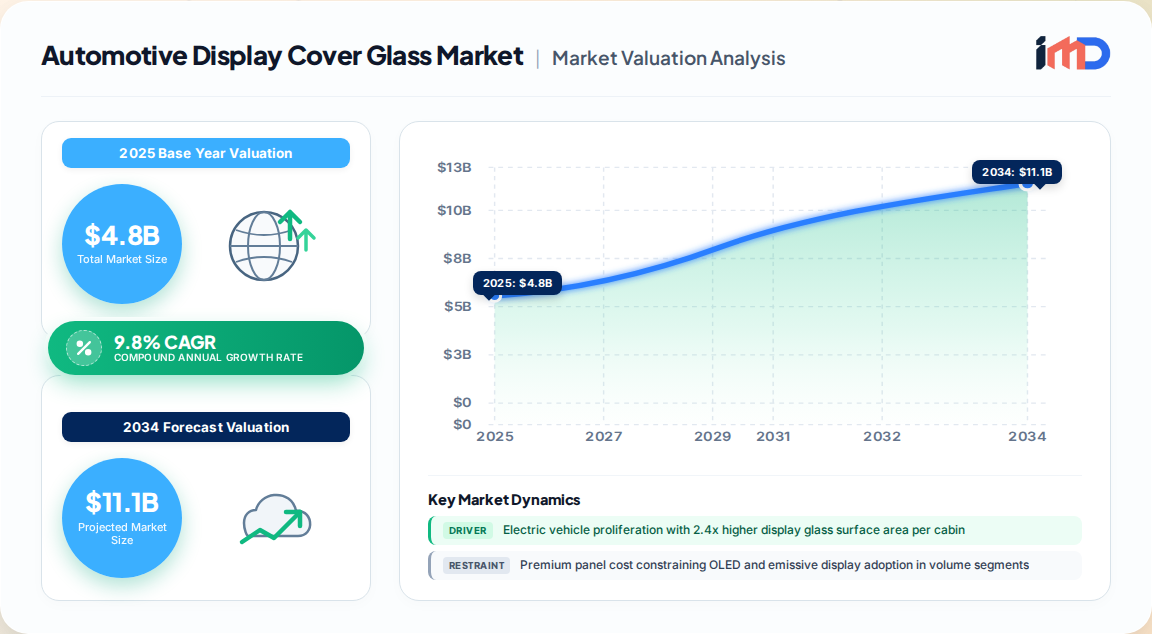
The global automotive display cover glass market reached USD 4.8 billion in 2025 and is projected to expand to USD 11.2 billion by 2034, representing a 9.8% CAGR across the 2026–2034 forecast horizon. This growth is not merely a function of rising vehicle production; it reflects a structural transformation in vehicle interior architecture where cover glass has migrated from a passive protective layer to a strategic, value-accretive human-machine interface (HMI) component.
Our proprietary primary research, drawing on interviews with Tier-1 integrators, OEM interior engineering teams, and specialty glass manufacturers, indicates that the average display glass surface area per battery electric vehicle (BEV) cabin surpassed 1,200 square centimeters in 2025, approximately 2.4 times that of a conventional internal combustion engine sedan. This content-per-vehicle dynamic is the single most important revenue driver through the forecast period.
The market's expansion is anchored by several compounding demand vectors that are relatively insulated from short-term vehicle production cycles.
Electric Vehicle Proliferation and Cockpit Digitization BEV and plug-in hybrid platforms integrate significantly higher display node counts and display surface area than internal combustion equivalents. Global electric car sales surpassed 17 million units in 2024, according to International Energy Agency data, and each of these vehicles carries a materially higher cover glass bill of materials. The average BEV cockpit in 2025 featured between 2.8 and 3.4 display nodes, compared with 1.6 to 2.1 in comparable ICE vehicles.
Head-Up Display (HUD) Adoption and ADAS Integration The expansion of advanced driver assistance systems (ADAS) and augmented reality HUDs is creating demand for optically precise, anti-reflective cover glass with stringent wavefront distortion tolerances. Regulatory safety mandates, including EU General Safety Regulation (EU) 2019/2144, require real-time visual interfaces for intelligent speed assistance, lane-keeping, and driver-drowsiness detection, establishing a floor-level display specification across mass-market nameplates.
Durability and Optical Quality Standards Automotive-grade cover glass must withstand thermal cycling from minus 40 degrees Celsius to above 85 degrees Celsius, UV exposure, chemical attack, and vibration. The shift from soda-lime float glass to ion-exchange-strengthened aluminosilicate formulations has delivered scratch resistance improvements of four-to-seven times and drop performance improvements of two-to-three times, enabling wall thicknesses as low as 0.55 millimeters.
The competitive frontier in automotive display cover glass is defined by three material science transitions.
| Innovation Vector | Technical Attribute | Commercial Impact |
|---|---|---|
| Glass-ceramic hybrids | Drop survival on rough surfaces beyond conventional aluminosilicate | Premium tier differentiation; 15–25% price premium |
| 3D cold-bending and hot-forming | Curved geometries with optical-grade surface quality | 35–50% price premium over flat panels |
| Functional coatings | Anti-reflective, anti-fingerprint, anti-glare, embedded antenna layers | Converts glass from commodity substrate to value-added electronic component |
Our interviews with OEM platform engineers confirm that glass-ceramic compounds and nano-coated surfaces are progressively replacing conventional aluminosilicate formulations in flagship programmes. In March 2026, Corning launched Gorilla Glass Ceramic 3 for the Motorola razr fold device, designed to survive at least 20 repeated one-meter drops onto asphalt-simulating surfaces. In January 2025, Samsung's Galaxy S25 Ultra debuted Gorilla Armor 2, the first scratch-resistant and anti-reflective glass ceramic for mobile devices, signaling the technology migration path toward automotive applications.
Asia-Pacific commanded the largest share of the global automotive display cover glass market at USD 2.03 billion in 2025, representing 42.3% of total revenues. The region's dominance is underpinned by its position as the world's largest automotive production hub and the home base of leading glass manufacturers and panel makers.
In Europe, the End-of-Life Vehicles Regulation is reshaping procurement criteria. The regulation, which covers the entire vehicle lifecycle from design to end-of-life treatment, introduces circularity passports, recycled content mandates, and extended producer responsibility. OEMs including Apple and Samsung have committed to increasing recycled content across supply chains, creating downstream demand for cover glass suppliers to certify and report recycling input levels at commercial scale.
The competitive structure of the automotive display cover glass market is characterized by medium concentration, with specialty glass manufacturers and their Tier-1 integrator partners occupying distinct strategic positions.
Corning Incorporated maintains a leadership position through its Gorilla Glass Automotive platform, which has demonstrated deep OEM qualification integration. AGC Inc., through its Dragontrail Pro line, and SCHOTT AG, with its Xensation portfolio, represent the primary competitors in the ion-exchange-strengthened aluminosilicate segment. Nippon Electric Glass and Schott also supply specialty ultrathin flexible glass for foldable and rollable inner displays.
On the display panel side, Continental AG led the broader automotive display market with over 14% market share in 2025, according to our analysis. The top five players, including Continental AG, Visteon Corporation, Nippon Seiki, Panasonic Automotive, and Robert Bosch GmbH, collectively held 44.5% of the automotive display market.
Strategic differentiation is increasingly shifting toward:
The automotive display cover glass value chain comprises five principal stages, each with distinct economics and qualification barriers.
Procurement strategy is increasingly characterized by longer-term supply agreements between glass manufacturers and automakers, providing revenue visibility and encouraging R&D investment. Our interviews confirm that OEM procurement teams are consolidating supplier bases toward partners capable of delivering automotive-grade systems rather than panels alone, with optical bonding, thermal management, and integration complexity becoming decisive qualification criteria.
The automotive display cover glass market presents several high-value white-space opportunities through 2034.
Our demand modeling indicates that the shift toward software-defined vehicle architectures, where display screens serve as the primary HMI for virtually every vehicle function, elevates cover glass from a tier-2 component to a strategic platform decision. This dynamic is expected to sustain above-average pricing power for qualified suppliers through the forecast period.
| Aspects | Details |
|---|---|
| Study Period | 2020-2034 |
| Base Year | 2025 |
| Estimated Year | 2026 |
| Forecast Period | 2026-2034 |
| Historical Period | 2020-2025 |
| Growth Rate | CAGR of 9.8% from 2020-2034 |
| Segmentation |
|
By Vehicle Type
By Distribution Channel
| By Geography |
|
The global automotive display cover glass market was valued at USD 4.8 billion in 2025 and is projected to reach USD 11.2 billion by 2034, growing at a 9.8% CAGR.
Asia-Pacific commanded the largest share at 42.3% of total revenues in 2025, equivalent to USD 2.03 billion, underpinned by the region's position as the world's largest automotive production hub.
Electric vehicle proliferation, cockpit digitization, head-up display adoption, and regulatory safety mandates requiring real-time visual interfaces are the primary demand drivers. The average display glass surface area per BEV cabin surpassed 1,200 square centimeters in 2025.
Tempered Glass held the largest product type share at 38.4% in 2025, followed by laminated glass and specialty chemically strengthened variants such as Gorilla Glass and Dragontrail.
Corning Incorporated leads through its Gorilla Glass Automotive platform, alongside AGC Inc., SCHOTT AG, and Nippon Electric Glass. On the display integration side, Continental AG held over 14% market share in 2025.
The market is expanding at a 9.8% CAGR over the 2026–2034 forecast period, driven by large-format touch displays, curved instrument clusters, and head-up display systems.
Our rigorous research methodology combines multi-layered approaches with comprehensive quality assurance, ensuring precision, accuracy, and reliability in every market analysis.
| Stakeholder Role | Interview Share (%) |
|---|---|
| Procurement and Sourcing Director | 30% |
| Display Systems Engineering Director | 28% |
| Chief Interior Architect | 22% |
| Advanced Materials R&D Lead | 20% |
| Company Type | Representation (%) |
|---|---|
| Cover Glass and Specialty Glass Manufacturers | 35% |
| Tier-1 Display Module Integrators | 25% |
| OEM Interior and Cockpit Engineering Teams | 20% |
| Coating and Materials Suppliers | 10% |
| Aftermarket and Distribution Channel Partners | 10% |
 Related Reports
