1What is the current market size of the automotive air lumbar support market?
The global automotive air lumbar support market was valued at approximately $2.2 Billion in 2024 and is projected to reach $4.2 Billion by 2034, growing at a CAGR of 6.6%.
Insight Market Data is a premier market research and business consulting firm headquartered in Pune, India, providing syndicated research reports, customized intelligence studies, and strategic advisory services. Renowned academic institutions and Fortune 500 corporations worldwide rely on Insight Market Data's research repository to navigate evolving global and regional business environments. Covering 46 diverse industries across 25 major international economies, our comprehensive database delivers thousands of verified statistics and granular market evaluations. By combining industry-leading analytical methodologies with the direct insights of seasoned industry leaders and subject-matter experts, we deliver actionable intelligence spanning historical performance benchmarks to rigorous multi-year forecasts. We empower organizations to make confident, data-driven decisions across pivotal domains including Machinery & Equipment, Chemicals & Materials, Pharmaceuticals & Healthcare, Food & Beverages, Consumer Goods, Energy & Power, Automotive & Transportation, Electronics & Semiconductors, Medical Devices, Telecommunications, Emerging Technologies, Agriculture, and Packaging. Our multidisciplinary analyst teams provide an objective 360-degree perspective, tailoring every engagement to address complex strategic challenges with exceptional analytical rigor.
Leveraging advanced BI-powered analytics and predictive modeling, Insight Market Data uncovers high-impact market opportunities and competitive differentiators for ambitious enterprises. We continuously refine our research methodologies in accordance with global industry standards, tracking real-time market shifts to ensure our reports are consistently accurate, actionable, and delivered on schedule. Our analysts conduct methodical data validation, rigorous compliance checks, and exhaustive primary and secondary research to maintain the highest levels of data integrity and transparency. We partner closely with corporate strategists, investment groups, and business executives to translate intricate market intelligence into clear, actionable roadmaps for sustainable growth. With operational presence across Washington, USA, and Vimannagar, Pune, India, Insight Market Data ensures direct access to dedicated research specialists and responsive customer support to answer your most strategic questions.
 Automotive Air Lumbar Support Drivers of Growth: Opportunities to Market
 by Type (Electric Waist Support, Manual Waist Support, Pneumatic Lumbar Support), by Application (Passenger Vehicle, Commercial Vehicle), by Vehicle Type (Sedans, SUVs, Trucks, Buses), by Technology (Manual, Electric, Pneumatic), by Material (Polyurethane Foam, Memory Foam), by Asia-Pacific (China, Japan, South Korea, India, Southeast Asia, Australia), by North America (United States, Canada, Mexico), by Europe (Germany, France, UK, Italy, Spain, Russia), by South America (Brazil, Argentina, Rest of South America), by Middle East & Africa (GCC Countries, South Africa, Turkey, Rest of MEA) Forecast 2026-2034

Research Analyst


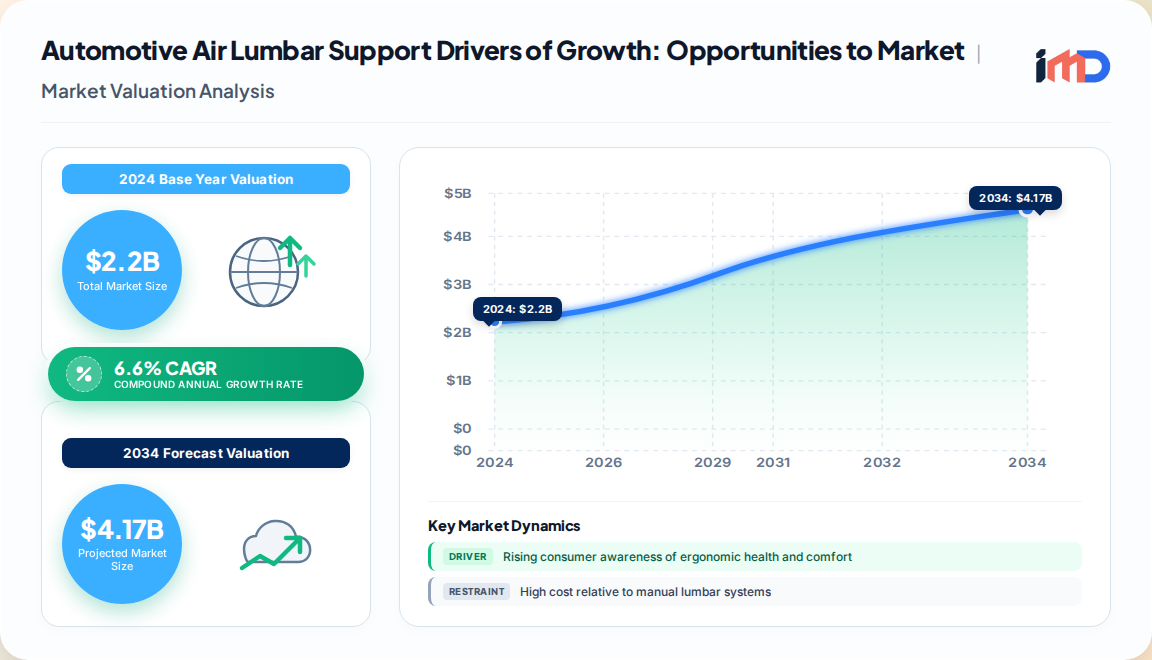
The global automotive air lumbar support market is undergoing a structural transformation, driven by a confluence of ergonomic science, regulatory pressure, and shifting consumer expectations around in-cabin wellness. Our proprietary primary research estimates the market will expand at a CAGR of 6.6% from 2026 to 2034, reaching a valuation of $4.2 Billion by 2034 from a 2024 base of $2.2 Billion.
This growth is not merely a function of vehicle production volume; it reflects a fundamental re-rating of the seat as a health and wellness interface. Air lumbar support systems—particularly electric and pneumatic variants—are transitioning from luxury options to mainstream ergonomic necessities. The integration of these systems is being accelerated by the rise of electrified and autonomous vehicle architectures, where the seat serves as a primary point of user interaction and comfort differentiation.
The air lumbar support market is being propelled by five principal demand-side and supply-side drivers. Our analysis quantifies their relative impact and identifies the specific opportunities they unlock for component manufacturers, Tier-1 integrators, and OEMs.
Prolonged driving is clinically linked to lower back pain, and consumers increasingly recognize lumbar support as a health-preserving feature. This awareness is shifting purchasing behavior, particularly in the passenger vehicle segment where daily commute times exceed 60 minutes in major urban centers.
Regulatory bodies in Europe and North America are tightening ergonomic design standards, compelling OEMs to embed adjustable lumbar support as standard equipment in mid- and high-trim vehicles. This regulatory floor raises the baseline volume addressable by air-based systems.
Electric vehicle platforms are redefining seat architecture, with flat floors and flexible cabin layouts. Air lumbar systems are particularly suited to these architectures due to their low profile, modularity, and ability to integrate with seat heating and ventilation matrices.
Consumers increasingly expect vehicle interiors to mirror the personalization of consumer electronics. Air lumbar support offers multi-zone adjustability and memory presets, aligning with the broader trend toward configurable cabin environments.
Trade policy shifts, including USMCA regional value content rules and EU local-content incentives, are driving localization of seating component production. Air lumbar systems, with their relatively compact supply chains, are well-positioned for regional assembly.
The market faces several headwinds that could temper growth if not strategically managed.
The value chain for automotive air lumbar support systems spans raw materials to vehicle assembly, with distinct value pools at each stage.
| Value Chain Stage | Key Activities | Value Pool Characteristics |
|---|---|---|
| Raw Materials & Components | Polymer foams, elastomers, micro-compressors, solenoid valves, sensors | Moderate margins; scale-driven; concentrated in specialized suppliers |
| Sub-Assembly | Valve blocks, pump units, lumbar bladders, controllers | Higher margins; technology-intensive |
| System Integration | Complete lumbar modules integrated with seat frames | High margins; Tier-1 controlled |
| Seat Assembly | Full seat systems delivered to OEMs | Moderate margins; volume-driven |
| Vehicle Assembly | OEM integration into final vehicle | Low margins; brand-controlled |
The most attractive value pools reside in sub-assembly and system integration, where intellectual property and design knowledge create defensible margins. Tier-1 suppliers such as Adient, Lear, and Faurecia control significant share through vertical integration and OEM design partnerships.
Our regional analysis identifies distinct investment theses across key geographies.
| Region | Market Share (2026 est.) | Growth Outlook | Key Attractiveness Factors |
|---|---|---|---|
| Asia-Pacific | 38% | High (7.2% CAGR) | Production scale, domestic OEM growth, cost-competitive manufacturing |
| Europe | 27% | Moderate (5.8% CAGR) | Regulatory stringency, premium vehicle mix, ergonomic standards |
| North America | 26% | High (6.9% CAGR) | SUV/truck dominance, consumer willingness to pay for comfort |
| South America | 4% | Moderate (5.5% CAGR) | Emerging middle class, localized production incentives |
| Middle East & Africa | 5% | Moderate (5.2% CAGR) | Vehicle import dependence, premium vehicle demand in GCC |
Investment priority: Asia-Pacific offers the highest volume opportunity, particularly for cost-competitive pneumatic systems. Europe presents the most stable regulatory-driven demand. North America offers the highest per-unit value capture due to consumer preference for premium features.
Several under-served segments present white-space opportunities for market entrants and incumbents alike.
The competitive landscape is characterized by consolidation among Tier-1 suppliers and strategic partnerships with technology providers.
Notable strategic developments (2023–2025):
Global trade in automotive air lumbar components is characterized by intra-regional flows, with components often crossing borders multiple times before final assembly.
Supply chain risks:
Supplier strategy recommendations:
The automotive air lumbar support market is poised for sustained growth, with the following strategic imperatives for stakeholders:
The convergence of health awareness, regulatory pressure, and technological innovation will continue to elevate the strategic importance of air lumbar support systems in the global automotive interior landscape.
| Aspects | Details |
|---|---|
| Study Period | 2020-2034 |
| Base Year | 2024 |
| Estimated Year | 2026 |
| Forecast Period | 2026-2034 |
| Historical Period | 2020-2025 |
| Growth Rate | CAGR of 6.6% from 2020-2034 |
| Segmentation |
|
By Vehicle Type
By Technology
By Material
| By Geography |
|
The global automotive air lumbar support market was valued at approximately $2.2 Billion in 2024 and is projected to reach $4.2 Billion by 2034, growing at a CAGR of 6.6%.
Asia-Pacific holds the largest share at around 38% in 2026, driven by high vehicle production volumes in China, Japan, and South Korea, followed by Europe and North America.
Key drivers include rising consumer awareness of ergonomic health, regulatory mandates for occupant comfort and safety, the shift to electric vehicles with customizable interiors, and increasing demand for personalized comfort features.
The passenger vehicle segment, particularly SUVs and premium sedans, is expected to lead demand due to higher consumer willingness to pay for comfort and advanced seating features.
Generative AI enables real-time, personalized lumbar adjustments by analyzing biometric and posture data, leading to adaptive support systems that enhance comfort and reduce fatigue during driving.
Our rigorous research methodology combines multi-layered approaches with comprehensive quality assurance, ensuring precision, accuracy, and reliability in every market analysis.
| Stakeholder Role | Interview Share (%) |
|---|---|
| Procurement Director | 30% |
| Chief Seat Engineer | 25% |
| Product Manager – Comfort Systems | 25% |
| Supply Chain Strategist | 20% |
| Company Type | Representation (%) |
|---|---|
| Tier-1 Seating System Integrators | 30% |
| Pneumatic Valve & Micro-Compressor OEMs | 25% |
| Automotive OEM Interior Engineers | 20% |
| Aftermarket Retrofit Distributors | 15% |
| Testing & Certification Laboratories | 10% |
 Related Reports
