1What is the size of the Argentina beauty and personal care products market?
The market is estimated at USD 6.55 billion in 2026 and is projected to reach USD 10.53 billion by 2031, growing at a CAGR of 9.98%.
Insight Market Data is a premier market research and business consulting firm headquartered in Pune, India, providing syndicated research reports, customized intelligence studies, and strategic advisory services. Renowned academic institutions and Fortune 500 corporations worldwide rely on Insight Market Data's research repository to navigate evolving global and regional business environments. Covering 46 diverse industries across 25 major international economies, our comprehensive database delivers thousands of verified statistics and granular market evaluations. By combining industry-leading analytical methodologies with the direct insights of seasoned industry leaders and subject-matter experts, we deliver actionable intelligence spanning historical performance benchmarks to rigorous multi-year forecasts. We empower organizations to make confident, data-driven decisions across pivotal domains including Machinery & Equipment, Chemicals & Materials, Pharmaceuticals & Healthcare, Food & Beverages, Consumer Goods, Energy & Power, Automotive & Transportation, Electronics & Semiconductors, Medical Devices, Telecommunications, Emerging Technologies, Agriculture, and Packaging. Our multidisciplinary analyst teams provide an objective 360-degree perspective, tailoring every engagement to address complex strategic challenges with exceptional analytical rigor.
Leveraging advanced BI-powered analytics and predictive modeling, Insight Market Data uncovers high-impact market opportunities and competitive differentiators for ambitious enterprises. We continuously refine our research methodologies in accordance with global industry standards, tracking real-time market shifts to ensure our reports are consistently accurate, actionable, and delivered on schedule. Our analysts conduct methodical data validation, rigorous compliance checks, and exhaustive primary and secondary research to maintain the highest levels of data integrity and transparency. We partner closely with corporate strategists, investment groups, and business executives to translate intricate market intelligence into clear, actionable roadmaps for sustainable growth. With operational presence across Washington, USA, and Vimannagar, Pune, India, Insight Market Data ensures direct access to dedicated research specialists and responsive customer support to answer your most strategic questions.
 Argentina Beauty and Personal Care Products Market
 by Product Type (Personal Care Products(Hair Care, Skin Care(Facial Care, Body Care, Lip Care), Bath and Shower, Oral Care, Men's Grooming, Deodorants and Antiperspirants), Cosmetics/Make-up(Facial Cosmetics, Eye Cosmetics, Lip and Nail Makeup)), by Category (Mass, Premium), by Ingredient Type (Natural and Organic, Conventional/Synthetic), by Distribution Channel (Supermarkets/Hypermarkets, Specialty Stores, Online Retail, Other Channels), by Buenos Aires Region, by Litoral Region, by Cordoba Region, by Northern Region, by Cuyo Region, by Patagonia Region Forecast 2026-2034

Research Analyst


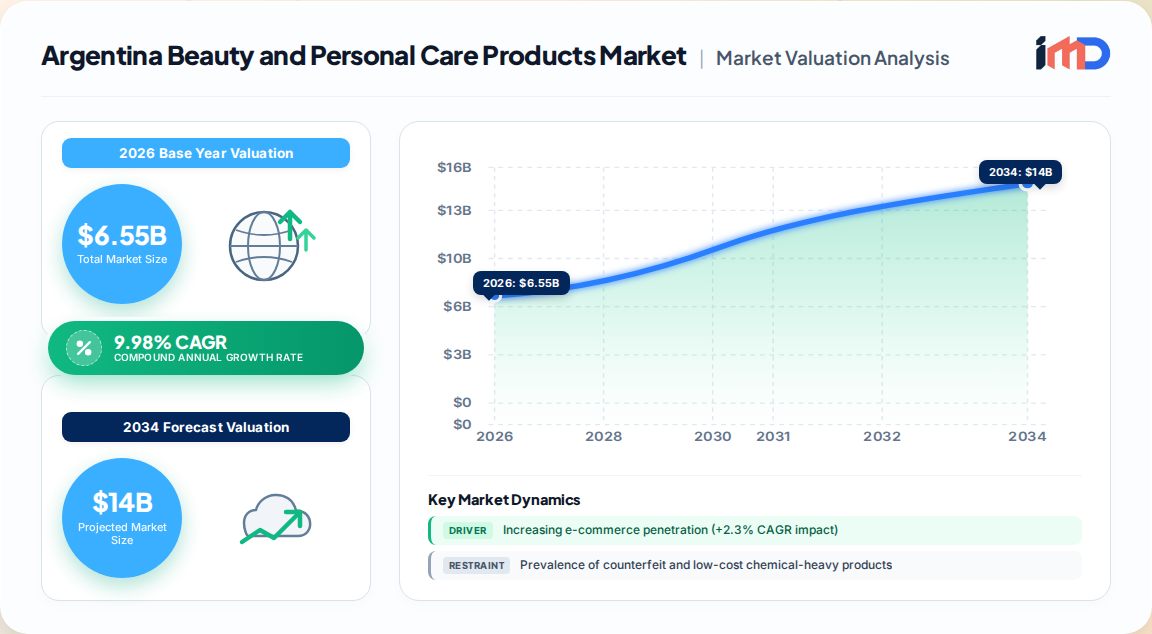
The Argentina beauty and personal care products market is undergoing a profound structural transformation, propelled by shifting consumer values, rapid digital adoption, and a resilient domestic manufacturing base. Our proprietary primary research estimates the market at USD 6.55 billion in 2026, up from USD 5.96 billion in 2025, and projects it to reach USD 10.53 billion by 2031, representing a robust CAGR of 9.98% over the forecast period. This growth significantly outpaces historical trajectories and reflects a market that is not merely recovering but actively re-rating toward higher-value, more sophisticated consumption patterns.
Argentina's beauty and personal care landscape is uniquely characterized by a deeply ingrained grooming culture, a strong preference for accessible mass-market formats, and an accelerating premiumization narrative. The market's medium concentration—with a balanced mix of multinational conglomerates and agile local brands—fosters intense competition and rapid innovation cycles. Critically, the market is bifurcating along two simultaneously expanding axes: value-driven mass consumption (which held 83.63% of 2025 revenue) and aspirational premiumization (growing at 11.58% CAGR). This dual-track dynamic creates a complex but highly rewarding operating environment for stakeholders across the value chain.
The Argentine market's growth engine is powered by several mutually reinforcing forces. Our primary interviews and demand modeling reveal the following impact hierarchy:
| Driver | Estimated CAGR Impact | Geographic Relevance | Impact Timeline |
|---|---|---|---|
| Increasing e-commerce penetration | +2.3% | National, urban concentration | Short term (≤2 years) |
| Rising demand for personal care in grooming routines | +2.1% | National, middle-class | Short term (≤2 years) |
| Natural and organic skincare demand | +1.8% | Buenos Aires, urban centers | Medium term (2-4 years) |
| Male grooming product adoption | +1.4% | Metropolitan areas | Medium term (2-4 years) |
| Paraben-free and vegan product demand | +1.2% | Educated consumers | Long term (≥4 years) |
| Influence of beauty and fashion events | +0.9% | Buenos Aires and major cities | Short term (≤2 years) |
Key Restraints: The market faces notable headwinds from the prevalence of counterfeit and low-cost products with high chemical concentrations, which erode consumer trust and brand equity. Additionally, macroeconomic volatility and inflationary pressures periodically compress discretionary spending, particularly in the premium tier. Regulatory complexity, including updated sanitary rules requiring extensive documentation and formulation records, raises compliance costs for local producers and importers alike.
By Product Type: Personal care products dominate with a 90.88% revenue share in 2025, projected to grow at 11.09% CAGR through 2031. Within this, skincare is the standout performer, driven by multifunctional formats that combine UV protection, anti-aging, and moisturizing benefits. The cosmetics segment, while smaller, is growing rapidly, with facial cosmetics accounting for a strong majority of cosmetic sales.
By Category: Mass products held 83.63% of 2025 share, but premium products are recording the fastest growth at 11.58% CAGR. This premiumization is fueled by a growing aspirational middle class and the proliferation of accessible premium lines that bridge the gap between mass and prestige.
By Ingredient Type: Conventional formulations captured 73.92% of 2025 sales, yet natural and organic lines are advancing at a 12.05% CAGR. The lack of a uniform third-party certification system creates commercial space for new entrants but also raises credibility pressure as consumers become more fluent in claim language.
By Distribution Channel: Specialty stores retained a 31.98% share in 2025, underscoring their role in product discovery and brand storytelling. However, online retail is the fastest-growing channel at 12.97% CAGR, driven by near-universal internet penetration (88.4% in 2024) and widespread social media adoption (68.2% of the population).
| Segment | 2025 Share | Fastest-Growing Sub-Segment | CAGR (2026-2031) |
|---|---|---|---|
| Personal Care Products | 90.88% | Skincare (multifunctional) | 11.09% |
| Mass Category | 83.63% | Premium category | 11.58% |
| Conventional Ingredients | 73.92% | Natural & organic | 12.05% |
| Specialty Stores | 31.98% | Online retail | 12.97% |
Argentina's beauty and personal care market exhibits pronounced regional disparities, shaped by demographic density, income levels, and retail infrastructure. Our bottom-up regional modeling identifies the following distribution of market value:
| Region | Estimated Share | Key Characteristics |
|---|---|---|
| Buenos Aires Region (AMBA) | 38% | Highest disposable income, trend-setting consumption, premium retail concentration |
| Litoral Region | 18% | Strong mid-tier consumption, growing e-commerce adoption |
| Cordoba Region | 14% | Emerging premium demand, university-driven youth consumption |
| Northern Region | 12% | Price-sensitive, traditional retail dominance |
| Cuyo Region | 10% | Steady mass-market growth, agricultural-cyclical demand |
| Patagonia Region | 8% | Niche premium skincare demand, low population density |
The Buenos Aires Region represents the primary growth engine and test market for new product launches, accounting for over one-third of national value. Investment in omnichannel retail infrastructure and last-mile delivery in secondary cities is expected to unlock significant white space, particularly in the Litoral and Cordoba regions.
The Argentine competitive arena is characterized by a mix of global scale players and nimble domestic challengers. Key multinationals—including Unilever PLC, L'Oréal SA, The Procter & Gamble Company, Beiersdorf AG, and Natura & Co Holding SA—leverage extensive portfolios and marketing budgets. Meanwhile, local brands compete through botanical storytelling, direct selling models, and aggressive pricing.
Strategic White-Space Opportunities:
Recent Industry Developments:
Argentina's beauty and personal care trade flows reveal a market increasingly integrated into global supply chains while retaining a strong domestic manufacturing base. According to official trade data, imports of skin care and make-up preparations surged from USD 113.01 million in 2021 to USD 147.77 million in 2023, reflecting growing consumer demand for international formats and ingredients. This upward trajectory is expected to continue, albeit tempered by periodic currency controls and import licensing requirements.
Key Supply Chain Considerations:
The Argentine beauty and personal care value chain is characterized by several distinct stages, each with unique dynamics:
The Argentina beauty and personal care products market is poised for a decade of significant expansion. The 9.98% CAGR forecast to 2031 is underpinned by structural shifts that favor brands capable of balancing affordability with innovation. Stakeholders should prioritize:
The path to 2031 will reward those who can navigate Argentina's unique macroeconomic context while delivering products that resonate with a consumer base that is increasingly sophisticated, value-conscious, and digitally empowered.
| Aspects | Details |
|---|---|
| Study Period | 2020-2034 |
| Base Year | 2026 |
| Estimated Year | 2026 |
| Forecast Period | 2026-2034 |
| Historical Period | 2020-2025 |
| Growth Rate | CAGR of 9.98% from 2020-2034 |
| Segmentation |
|
By Category
By Ingredient Type
By Distribution Channel
| By Geography |
|
The market is estimated at USD 6.55 billion in 2026 and is projected to reach USD 10.53 billion by 2031, growing at a CAGR of 9.98%.
Online retail is the fastest-growing channel at a 12.97% CAGR, driven by 88.4% internet penetration and 68.2% social media adoption in Argentina.
Key drivers include increasing e-commerce penetration (+2.3% CAGR impact), rising demand for personal grooming (+2.1%), demand for natural and organic products (+1.8%), and growing male grooming adoption (+1.4%).
Major companies include Unilever PLC, L'Oréal SA, The Procter & Gamble Company, Beiersdorf AG, and Natura & Co Holding SA, among others.
Personal care products led with a 90.88% revenue share in 2025 and are forecast to expand at an 11.09% CAGR through 2031, with skincare being a standout performer.
While conventional formulations captured 73.92% of 2025 sales, natural and organic lines are advancing at a 12.05% CAGR, reflecting strong consumer preference for clean-label products.
Our rigorous research methodology combines multi-layered approaches with comprehensive quality assurance, ensuring precision, accuracy, and reliability in every market analysis.
| Stakeholder Role | Interview Share (%) |
|---|---|
| Procurement Director | 30% |
| R&D and Formulation Head | 25% |
| Brand Manager | 25% |
| Supply Chain Manager | 20% |
| Company Type | Representation (%) |
|---|---|
| Mass-Market Brand Owners | 30% |
| Premium & Niche Beauty Brands | 20% |
| Contract Manufacturers & Formulators | 20% |
| Raw Material & Ingredient Suppliers | 15% |
| Omnichannel Retailers & Distributors | 15% |
 Related Reports
