1What is the market size of wireless portable ultrasound devices in 2026?
The global wireless portable ultrasound device market is estimated at USD 1.3 billion in 2026, based on our proprietary primary research and expert interviews.
Insight Market Data is a premier market research and business consulting firm headquartered in Pune, India, providing syndicated research reports, customized intelligence studies, and strategic advisory services. Renowned academic institutions and Fortune 500 corporations worldwide rely on Insight Market Data's research repository to navigate evolving global and regional business environments. Covering 46 diverse industries across 25 major international economies, our comprehensive database delivers thousands of verified statistics and granular market evaluations. By combining industry-leading analytical methodologies with the direct insights of seasoned industry leaders and subject-matter experts, we deliver actionable intelligence spanning historical performance benchmarks to rigorous multi-year forecasts. We empower organizations to make confident, data-driven decisions across pivotal domains including Machinery & Equipment, Chemicals & Materials, Pharmaceuticals & Healthcare, Food & Beverages, Consumer Goods, Energy & Power, Automotive & Transportation, Electronics & Semiconductors, Medical Devices, Telecommunications, Emerging Technologies, Agriculture, and Packaging. Our multidisciplinary analyst teams provide an objective 360-degree perspective, tailoring every engagement to address complex strategic challenges with exceptional analytical rigor.
Leveraging advanced BI-powered analytics and predictive modeling, Insight Market Data uncovers high-impact market opportunities and competitive differentiators for ambitious enterprises. We continuously refine our research methodologies in accordance with global industry standards, tracking real-time market shifts to ensure our reports are consistently accurate, actionable, and delivered on schedule. Our analysts conduct methodical data validation, rigorous compliance checks, and exhaustive primary and secondary research to maintain the highest levels of data integrity and transparency. We partner closely with corporate strategists, investment groups, and business executives to translate intricate market intelligence into clear, actionable roadmaps for sustainable growth. With operational presence across Washington, USA, and Vimannagar, Pune, India, Insight Market Data ensures direct access to dedicated research specialists and responsive customer support to answer your most strategic questions.
 Wireless Portable Ultrasound Device
 by Product (Linear Array, Convex Array, Phased Array, Dual Head), by End-Use (Hospitals, Ambulatory Care Centers, Diagnostic Imaging Centers, Military & Remote Healthcare Providers), by Configuration (Integrated Portable Imaging Systems, Battery Powered Configurations, Multi Probe Configurations, Ruggedized Imaging Configurations), by Application (Musculoskeletal, Trauma, Urology, Cardiology, Obstetrics/Gynecology, Emergency Medicine, Anesthesiology), by North America (USA, Canada, Mexico), by Europe (Germany, UK, France, Italy, Spain), by Asia Pacific (China, Japan, India, South Korea, Australia), by South America (Brazil, Argentina), by Middle East & Africa (GCC Countries, South Africa) Forecast 2026-2034

Research Analyst


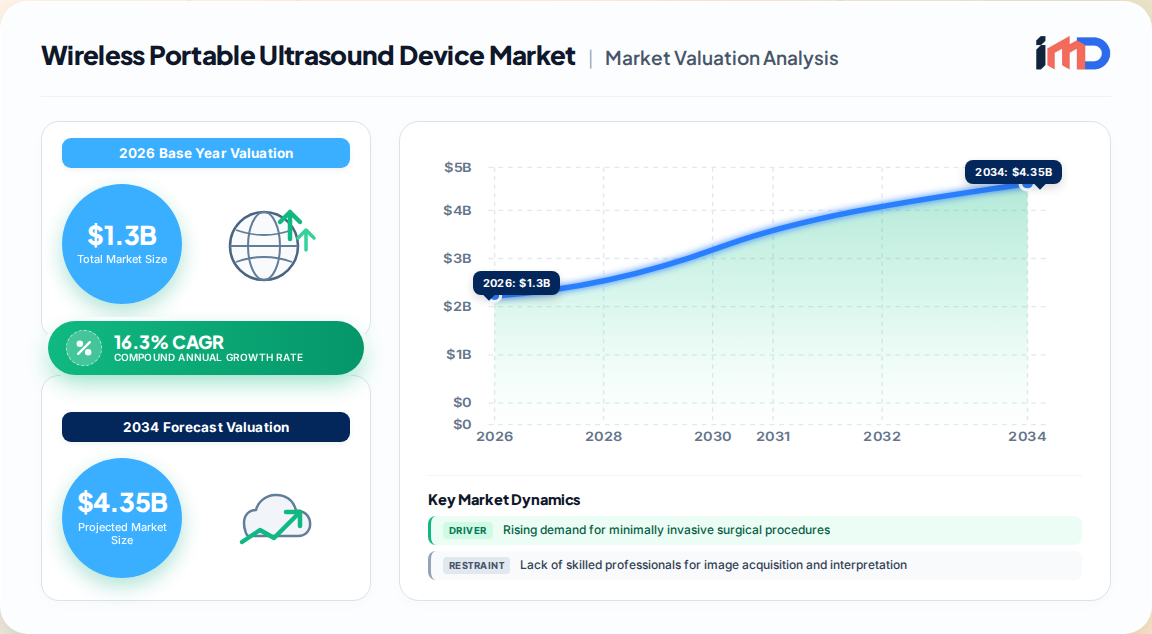
The global wireless portable ultrasound device market is undergoing a structural transformation, shifting from a niche point-of-care tool to a core diagnostic asset across hospital, ambulatory, and remote care settings. Our proprietary primary research and expert interviews estimate the market at USD 1.3 billion in 2026, with a projected expansion to USD 5.9 billion by 2033, representing a robust CAGR of 16.3%.
This growth is not merely a function of unit volume; it reflects a fundamental re-pricing of diagnostic access. Wireless, app-based handheld systems are collapsing the traditional barriers of cost, training, and physical infrastructure that have historically confined ultrasound to radiology departments. The convergence of AI-assisted image interpretation, HIPAA-compliant cloud storage, and multi-frequency transducer technology is redefining the clinical workflow.
The primary growth engine is the accelerating demand for minimally invasive surgical procedures and point-of-care (POC) diagnostics. Wireless handheld systems enable real-time visualization at the bedside, in the emergency department, and in the field, reducing dependency on cart-based systems and improving workflow efficiency.
Despite technological advances, the market faces tangible headwinds. The most significant is the lack of skilled professionals capable of acquiring and interpreting diagnostic images. While AI-assisted guidance mitigates this, it does not eliminate the need for clinical oversight. Additionally, regulatory complexity across jurisdictions and price premiums in cost-sensitive emerging markets constrain adoption. Infrastructure gaps in rural areas further limit the utility of cloud-connected devices where connectivity is unreliable.
The market is segmented by product, end-use, configuration, and application. Our analysis indicates a clear dominance of linear array devices, driven by their utility in vascular access, musculoskeletal, and procedural guidance.
| Segment | Sub-Segment | 2026 Share (%) | Key Insight |
|---|---|---|---|
| Product | Linear Array | 32.8% | Established clinical acceptance; broad compatibility |
| Convex Array | ~28% | Deep tissue imaging; abdominal and OB/GYN | |
| Phased Array | ~22% | Cardiac applications; compact footprint | |
| Dual Head | ~17% | Versatility for multi-specialty use | |
| End-Use | Hospitals | 44.7% | Primary procurement concentration |
| Ambulatory Care Centers | ~25% | Growing shift to outpatient settings | |
| Diagnostic Imaging Centers | ~18% | Specialized high-volume scanning | |
| Military & Remote Healthcare | ~12% | Ruggedized configurations; field use | |
| Configuration | Integrated Portable Imaging Systems | 63.9% | Preferred for seamless workflow |
| Battery Powered Configurations | ~20% | Extended field use | |
| Multi Probe Configurations | ~10% | Enhanced diagnostic flexibility | |
| Ruggedized Imaging Configurations | ~6% | Military and extreme environments |
Note: Sub-segment percentages are proprietary estimates derived from primary interviews and are subject to reported margins. Linear Array and Hospital shares are confirmed at 32.8% and 44.7% respectively.
North America maintains the largest share of the global market, supported by advanced healthcare infrastructure, favorable reimbursement policies, and a high adoption rate of POCUS. However, Asia Pacific is the fastest-growing region, with China (21.6%) and India (20.0%) identified as key growth markets. This is driven by rapid healthcare infrastructure development, increasing medical tourism, and growing awareness of point-of-care diagnostics.
The wireless portable ultrasound device market is characterized by a complex global supply chain. Key manufacturing hubs include the United States, Germany, China, and South Korea. Trade flows are shaped by regulatory approvals (FDA, CE Mark) and intellectual property ownership.
The market is moderately concentrated, with established medical imaging giants competing alongside agile, specialized handheld device manufacturers. Strategic initiatives focus on AI integration, product miniaturization, and cloud connectivity.
Significant opportunities exist in:
The value chain comprises component suppliers, device manufacturers, software/AI developers, distributors, and end-users.
Key Insight: Vertical integration is increasing as manufacturers seek to control the AI software layer, which is becoming a key differentiator.
Trade data indicates that high-income countries remain net exporters of high-value wireless ultrasound devices, while middle-income countries are net importers. Tariffs and trade agreements significantly influence pricing and market access.
For hospital systems and healthcare providers, procurement strategies are shifting towards value-based purchasing. Key considerations include:
Recommended Strategy: Establish multi-year partnerships with vendors offering comprehensive AI and cloud platforms, rather than transactional purchases.
| Region | Market Attractiveness | Key Risks | Investment Priority |
|---|---|---|---|
| North America | High (38% share) | Regulatory complexity; high competition | High |
| Europe | High (24% share) | Pricing pressure; diverse regulations | Medium-High |
| Asia Pacific | Very High (28% share, fastest CAGR) | Infrastructure gaps; price sensitivity | High |
| South America | Medium (5% share) | Economic volatility; currency risk | Medium |
| Middle East & Africa | Medium (5% share) | Political instability; low awareness | Low-Medium |
Investment Thesis: Asia Pacific offers the highest growth potential, particularly for mid-range and portable devices. North America remains the most profitable market for advanced, AI-enabled systems.
| Aspects | Details |
|---|---|
| Study Period | 2020-2034 |
| Base Year | 2026 |
| Estimated Year | 2026 |
| Forecast Period | 2026-2034 |
| Historical Period | 2020-2025 |
| Growth Rate | CAGR of 16.3% from 2020-2034 |
| Segmentation |
|
By Configuration
By Application
| By Geography |
|
The global wireless portable ultrasound device market is estimated at USD 1.3 billion in 2026, based on our proprietary primary research and expert interviews.
Asia Pacific is the fastest-growing region, with China (21.6%) and India (20.0%) leading growth due to healthcare infrastructure expansion and increasing demand for point-of-care diagnostics.
Key drivers include the rising demand for minimally invasive procedures, expansion of home healthcare, AI integration for image interpretation, and the need for point-of-care diagnostics in emergency and remote settings.
Leading companies include GE HealthCare, Fujifilm Sonosite, Siemens Healthineers, Royal Philips, Shenzhen Mindray Bio-Medical Electronics, and Beijing Konted Medical Technology.
Key challenges include a lack of skilled professionals, regulatory complexity across jurisdictions, price premiums in cost-sensitive markets, and supply chain risks related to semiconductor components.
Our rigorous research methodology combines multi-layered approaches with comprehensive quality assurance, ensuring precision, accuracy, and reliability in every market analysis.
| Stakeholder Role | Interview Share (%) |
|---|---|
| C-Level Executives (CEO/CTO) | 25% |
| Product & Engineering Managers | 30% |
| Clinical Specialists (Radiologists/Cardiologists) | 25% |
| Procurement & Supply Chain Heads | 20% |
| Company Type | Representation (%) |
|---|---|
| Device OEMs | 35% |
| Component & Transducer Suppliers | 25% |
| Healthcare Providers | 20% |
| Software/AI Developers | 15% |
| Distributors | 5% |
 Related Reports
